Flint is the first model from Recursive, the London-incorporated lab led by Richard Socher, and the company says its own automated research system helped design nearly every part of it. It is a free, open-weight coding model under Apache 2.0 that runs offline on a laptop with 48 GB of memory, at well over 100 tokens per second. On Recursive’s own numbers it is the best small mixture-of-experts model for agentic coding, but a larger dense Qwen model still beats it. The more interesting story is how it was made, and what that says about who can build models next.
What Flint is
Recursive released Flint on 21 October 2026 as a model for coding agents: reading a codebase, fixing bugs, implementing features and writing tests, with reasoning and multi-turn tool use. The weights are on Hugging Face under Apache 2.0, so companies can download, modify and use them commercially without asking anyone.
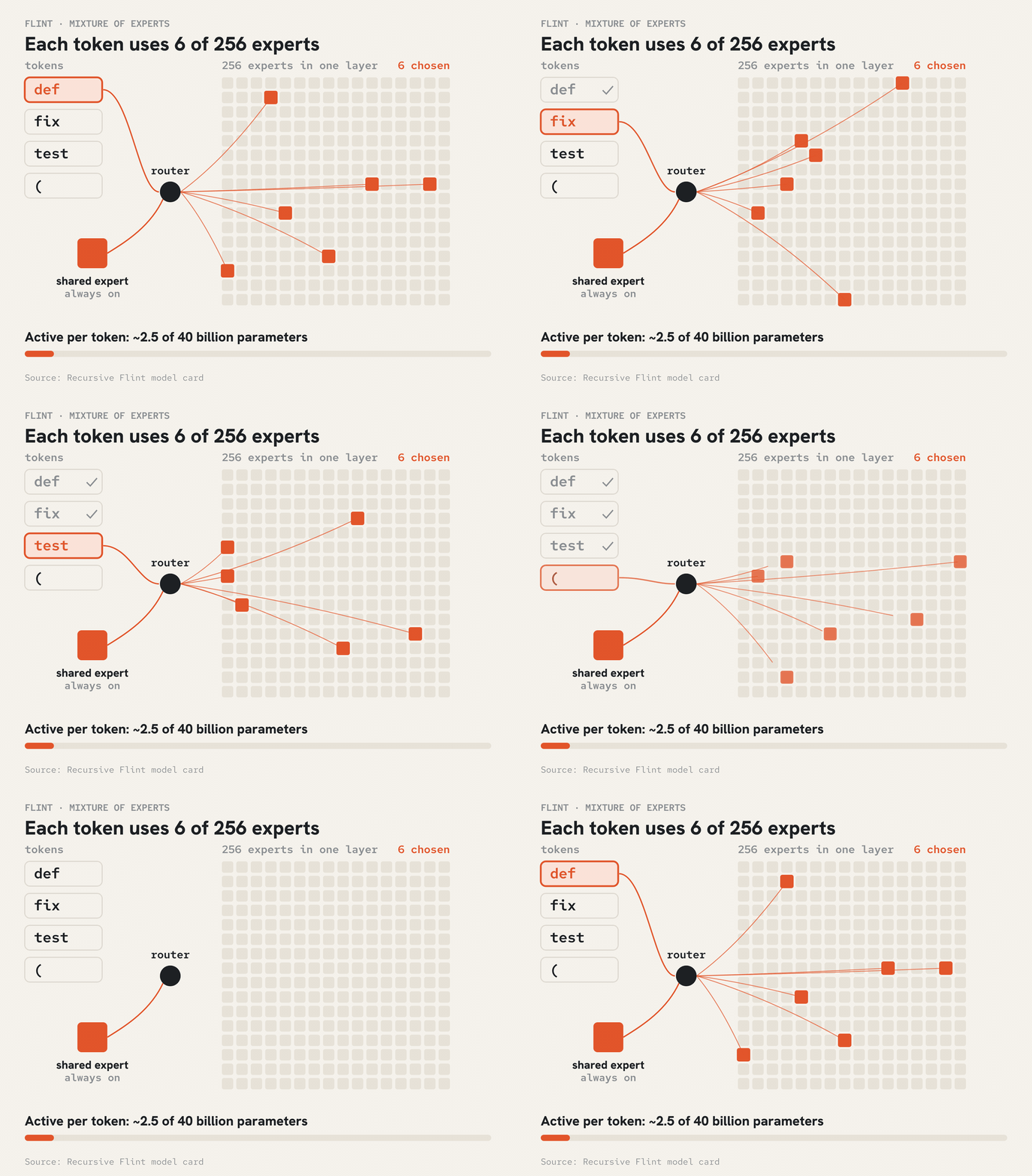
According to the model card, Flint has 39.8 billion parameters, of which about 2.5 billion work on each token. Every mixture-of-experts layer holds 256 experts. A router picks 6 of them per token, and one shared expert always joins in. That is how the model carries the knowledge of a 40B model while computing like a much smaller one.
The context window is 262,144 tokens, with Recursive advising users to stay within 256K. The model is text only and its knowledge stops in June 2026.
What the Eureka Machine did
Recursive exists to build AI that improves AI. Its automated research system, the Eureka Machine, generates ideas, runs experiments and uses the results to decide what to try next. Recursive says it contributed to data, optimisers, training recipes, infrastructure and inference, and that a small team of people and agents built Flint from scratch in under four months. The launch post names four concrete findings.
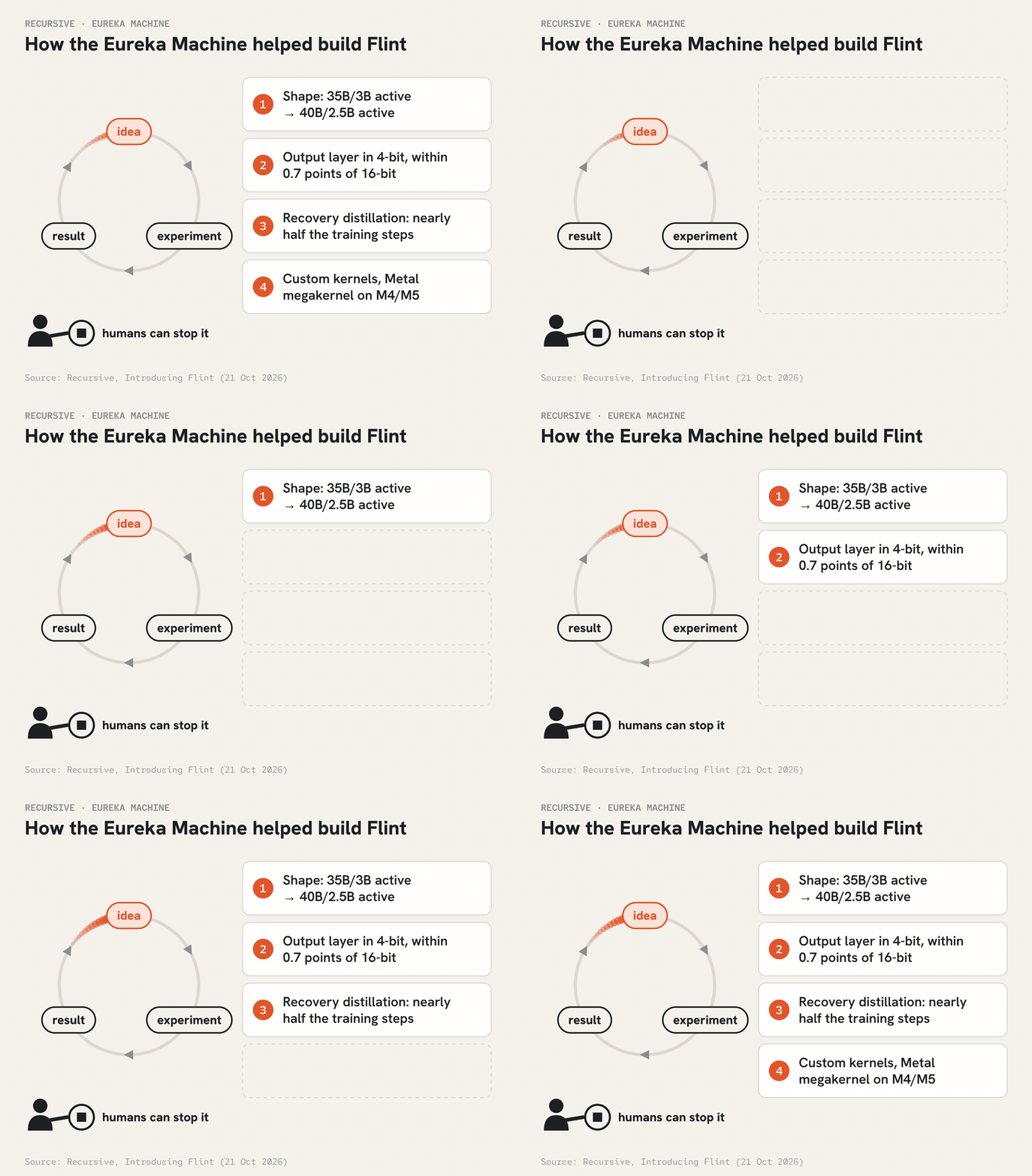
- The shape of the model. Starting from a baseline with 35 billion parameters and 3 billion active, the system explored expert configurations and widths. It settled on 40 billion with 2.5 billion active, projected as the best mix of speed and coding quality among the options tested.
- A 4-bit output layer. Most model makers keep the final layer at higher precision. The Eureka Machine quantised it to 4 bits anyway, and the NVFP4 model scores within 0.7 points of the 16-bit version across Recursive’s benchmarks.
- Recovery distillation. The compressed model learns from the full model on its own pre-sampled answers. That nearly halved the training steps compared with the usual quantisation-aware training.
- Custom kernels. Specialised routines for low-bit maths, expert routing, attention and prompt processing. On Apple M4 and M5 chips, a single Metal megakernel runs the whole decoding step.
None of these is a breakthrough on its own. What matters is that a machine searched for them, tested them and kept the ones that worked, which is the kind of tedious engineering that normally eats months of researcher time.
What it did not do
This is not a model that trained itself while nobody watched. The Eureka Machine is a research assistant overseen by people, and Socher told Wired that humans supervise the process and can stop it, as TechCrunch reports. Recursive also has not said how much researcher time the system saved, or what Flint cost to build. Without those two numbers, “built largely by AI” is a description of the workflow, not yet proof that it is cheaper.
How good it really is
The model card reports 54.9% on Terminal-Bench 2.1, 89.7% on SWE-bench Pro v2 and 74.2% on SWE-bench Verified, averaged over at least five attempts. All of these are Recursive’s own numbers. The comparison chart from the launch, written out by MarkTechPost, shows where Flint wins and where it does not.
| Model | Type | Terminal-Bench 2.1 | SWE-bench Pro v2 | SWE-bench Verified |
|---|---|---|---|---|
| Flint | MoE, 2.5B active | 54.9 | 89.7 | 74.2 |
| Qwen 3.6 | MoE, 3B active | 44.9 | 73.8 | 73.4 |
| Laguna XS 2.1 | MoE, 3B active | 24.7 | 38.6 | 70.9 |
| Qwen 3.8 | dense | 73.0 | 94.9 | 75.6 |
| Muse Glimmer | dense | 51.7 | 86.0 | 76.0 |
| Gemma 4 | dense | 43.4 | 61.7 | 66.6 |
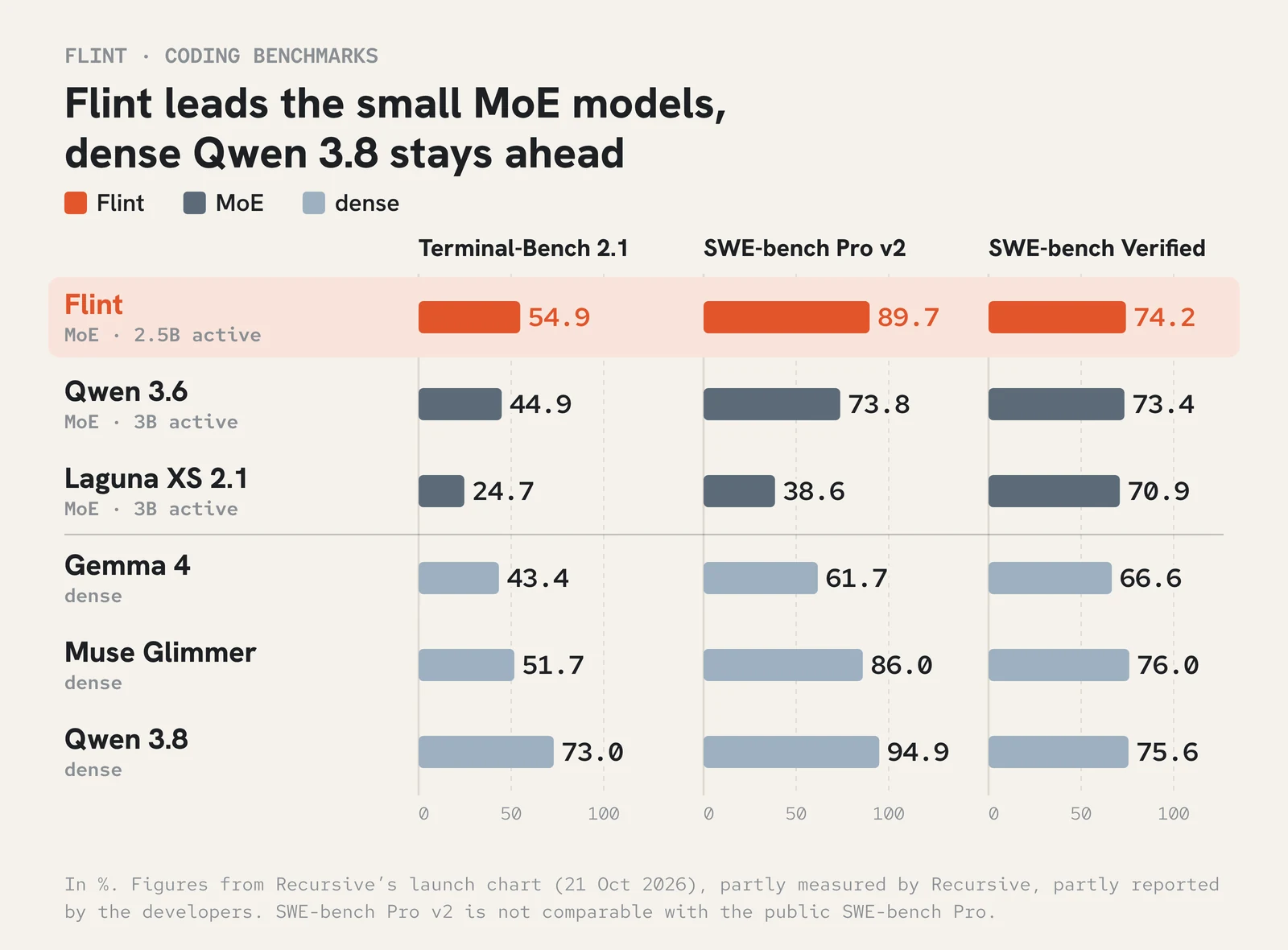
Three caveats are worth keeping in mind. SWE-bench Pro v2 is Recursive’s own measurement and cannot be compared with the public SWE-bench Pro leaderboard, where Qwen 3.6 and Poolside’s Laguna XS 2.1 report scores just under 50%. Some competitor figures come from different benchmark versions. And Terminal-Bench, where the model works in a real terminal, is Flint’s weakest result.
Speed is the real differentiator. Recursive’s own measurements, published by TechCrunch, put Flint at about 131 tokens per second on a MacBook Pro with an M4 Pro, against 58 to 69 for Gemma 4 and Nemotron 3.5 Lightning on the same machine. Recursive claims Flint matches dense 25B to 40B coding models while running more than five times faster. For an agent that takes dozens of steps, that is the difference between waiting one minute and waiting five.
Why a fast local model matters for European teams
A model that runs on the developer’s own machine changes three things that cloud assistants cannot.
- The code stays on the device. No source code, credentials or customer data leave the laptop, which removes a whole class of questions about data transfers and processor agreements.
- There is no metered bill. Inference costs hardware and electricity, not tokens, so an agent can retry and explore without anyone watching an API budget.
- The licence is clean. Apache 2.0 has no user caps or acceptable-use clauses tied to company size, unlike several other open-weight licences.
That last point is part of a wider pattern. Large open models such as Meta’s Muse Spark Open need a terabyte of memory and come with licence conditions. Flint goes the other way: small enough for one machine, with no strings. For teams that want to keep their options open as models change every few weeks, it is one more reason to treat models as rented and context as owned.
There is one trap. Flint is also available for free on OpenRouter, where tools such as Kilo Code, Cline and OpenClaw already use it heavily. That endpoint has a single provider, Recursive, and the page does not say whether prompts are logged or used for training. The free online version is convenient for a test, but it is not the private local model, so check the terms before sending real company code through it.
What it takes to run
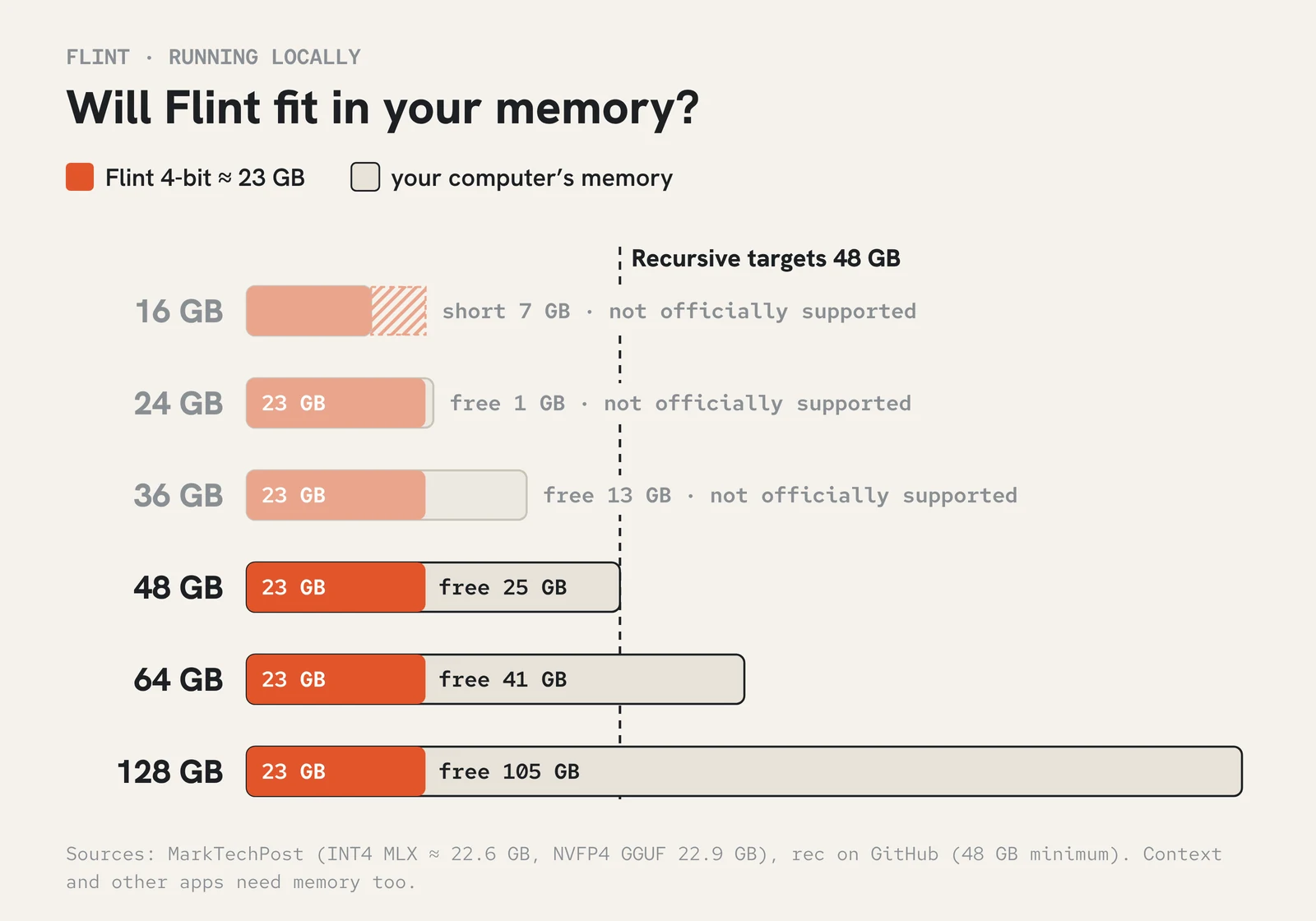
Flint fits on one machine, but not on most laptops. The 4-bit builds are about 23 GB, and context, the operating system and the developer’s other tools need room too. Recursive therefore targets 48 GB of memory.
- Mac: Recursive’s own inference engine, rec, supports the M4 Pro, M5 Pro and M5 Max with at least 48 GB of unified memory and about 30 GB of free disk space. Recursive reports more than 125 tokens per second at short contexts, and 1.4 to 2.6 times the throughput of llama.cpp on an M4 Pro.
- Nvidia: a 64 GB RTX Spark reaches more than 150 tokens per second at short contexts, and more than 100 at a 120,000-token context according to OpenHands, which supported Flint from day one.
- Server: the full BF16 checkpoint is about 80 GB and runs on one Nvidia B300 or H200 per replica with the SGLang kit from the model card.
Ollama, LM Studio, llama.cpp, Unsloth, vLLM and SGLang all work, and each offers an OpenAI-compatible endpoint that coding tools can point at. Recursive’s advice is to split big tasks into smaller steps with explicit instructions, because Flint “may need more guidance than the larger closed-source coding models”. Teams already running terminal agents such as Omp can treat it as a fast local engine for the routine work.
The economics behind the experiment
Recursive emerged from stealth in May 2026 with more than $650 million at a $4.65 billion valuation, led by GV and Greycroft with Nvidia and AMD participating. It is incorporated in London, has offices in London and San Francisco, and is run by Socher, formerly chief scientist at Salesforce, and Tim Rocktäschel, a UCL professor and former Google DeepMind researcher. At the time it had fewer than 30 staff.
In July 2026 it signed a $410 million multi-year compute deal with AWS, roughly two thirds of what it had raised. Socher summed up the bet as “less about headcount and more about agent count”. Flint is the first public result of that bet: a small team, a lot of compute and an automated researcher, producing a competitive model in four months. Whether that adds up to cheaper model development is the open question, because the compute bill for all those experiments is exactly the number Recursive has not shared.
Frequently asked questions
Is Flint free to use commercially?
Yes. The weights are released under Apache 2.0, which allows commercial use and modification. Hosted API terms, such as the OpenRouter endpoint, are separate from the weight licence.
Does Flint run on a 16 GB or 32 GB laptop?
Not officially. The 4-bit model alone is about 23 GB, and Recursive’s rec engine requires at least 48 GB of memory. Smaller machines can use the free online endpoint instead, with the privacy trade-off that brings.
Can Flint replace Claude or Codex?
Not for large, complex tasks. Recursive itself says Flint needs more guidance than the big closed models. It is best used as a fast, private model for everyday coding steps.
Was Flint really built by AI?
Partly. The Eureka Machine proposed and tested many of the design choices, from the model’s shape to its quantisation and kernels, but people oversaw the work and could stop it. Recursive has not disclosed how much time or money the approach saved.
The real product is the method
Flint is a good small coding model, but it will not be the best one for long. Rival labs ship new small models every few months. What Recursive is really showing is a production line: if an automated researcher can take a model from blank page to competitive release in four months, the next one will come faster, and the gap between a lab of 25 people and one with thousands gets smaller. For European companies the practical lesson is simpler. Capable coding models that never send code off the laptop are now real, so the question is less whether to try one and more which work stays local and which goes to the cloud.