Claude Duet is Anthropic’s new proactive agent: an app that watches your email, calendar and invoices, sends you a morning brief, does work in the background on its own cloud computer and asks before it sends, pays, signs or deletes anything. The research preview opened on 21 October 2026 for US subscribers on Claude Pro and Max, through a waitlist. The features are familiar by now. What makes or breaks an agent like this is a judgement call it has to make again at every check: does this deserve your attention, and is this a moment to act or a moment to ask? Anthropic says openly that Duet has not mastered that yet.
What Claude Duet is
Anthropic describes it as “a new app where Claude works as a proactive agent”. It is a separate app for iOS and Android, also reachable at claude.ai on a computer, and it runs on Claude Opus 5.5. Duet works on its own virtual machine with its own browser, so the task continues when your laptop is closed. It inherits the memory, skills and connected apps of your Claude account, and you talk to it in one ongoing thread, by text or by voice.
Two tabs organise the work. Tasks shows what Duet is doing and what needs your input. Make collects finished output as editable files: research briefs, financial models, slide decks, dashboards. Duet can suggest that a task is done, but only you can mark it complete.
The target user is explicit: professionals and small business owners. The examples Anthropic and early coverage give are back-office work, such as chasing unpaid Stripe invoices, preparing payroll for approval, scheduling meetings and drafting job posts.
Proactive means three decisions, not one feature
A chat assistant has an easy life. You ask, it answers, and the timing is yours. An always-on agent has to decide three things you used to decide yourself:
- What to watch. Which inboxes, calendars, channels and ledgers it reads, and how often.
- When to speak. Which of the hundred things it notices are worth a message to you, and which can wait for tomorrow’s brief.
- When to stop. Where preparing work ends and acting on your behalf begins.
Get the first wrong and the agent misses what matters. Get the second wrong and you mute it within a week. Get the third wrong and it does something you cannot undo. Duet’s design is best read as Anthropic’s answer to each of the three.
How often it looks, and what that costs you
Duet sends a short brief every morning and then checks your connected accounts every few hours. Anthropic gives the reason plainly: “checking nonstop would use up your plan’s limits much faster”. Every check is model usage, and during the preview Duet shares the five-hour and weekly limits of your plan with the rest of Claude.
That trade-off is visible in the product. An email that lands just after a check waits until the next one. The help centre says it directly: something urgent can arrive between checks. For a freelancer that is usually fine. For a support queue or a time-critical sale it is not.
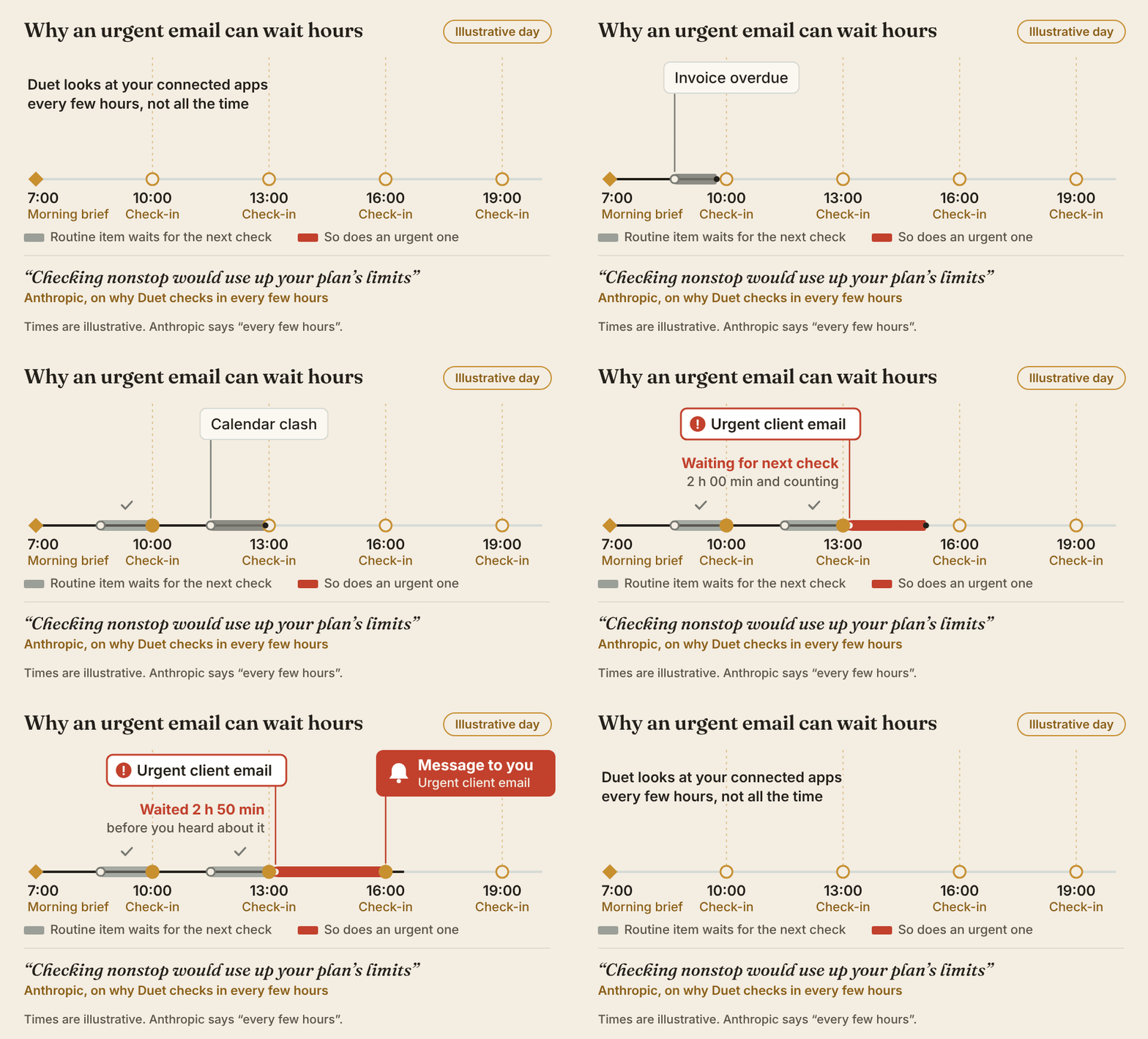
There is a pricing logic underneath. Duet costs nothing extra during the preview and is included in Pro, $20 a month or $17 a month billed annually, and Max, from $100 a month. Background checks and large jobs such as a financial model eat into the same allowance as your chats, so Pro users will hit limits sooner. On admission, Anthropic resets both limits once.
The permission map, written down
Where Duet stops is the most concrete part of the launch. Anthropic’s own descriptions sort actions into three bands.
| Duet does it on its own | Duet asks you first | Duet never does it, even if you say yes |
|---|---|---|
| Read connected apps, research, draft replies and documents, prepare payroll, build files in Make | Send a message, make a payment, sign a document, delete anything | Among other things: trade securities, move money between accounts, access someone else’s account |
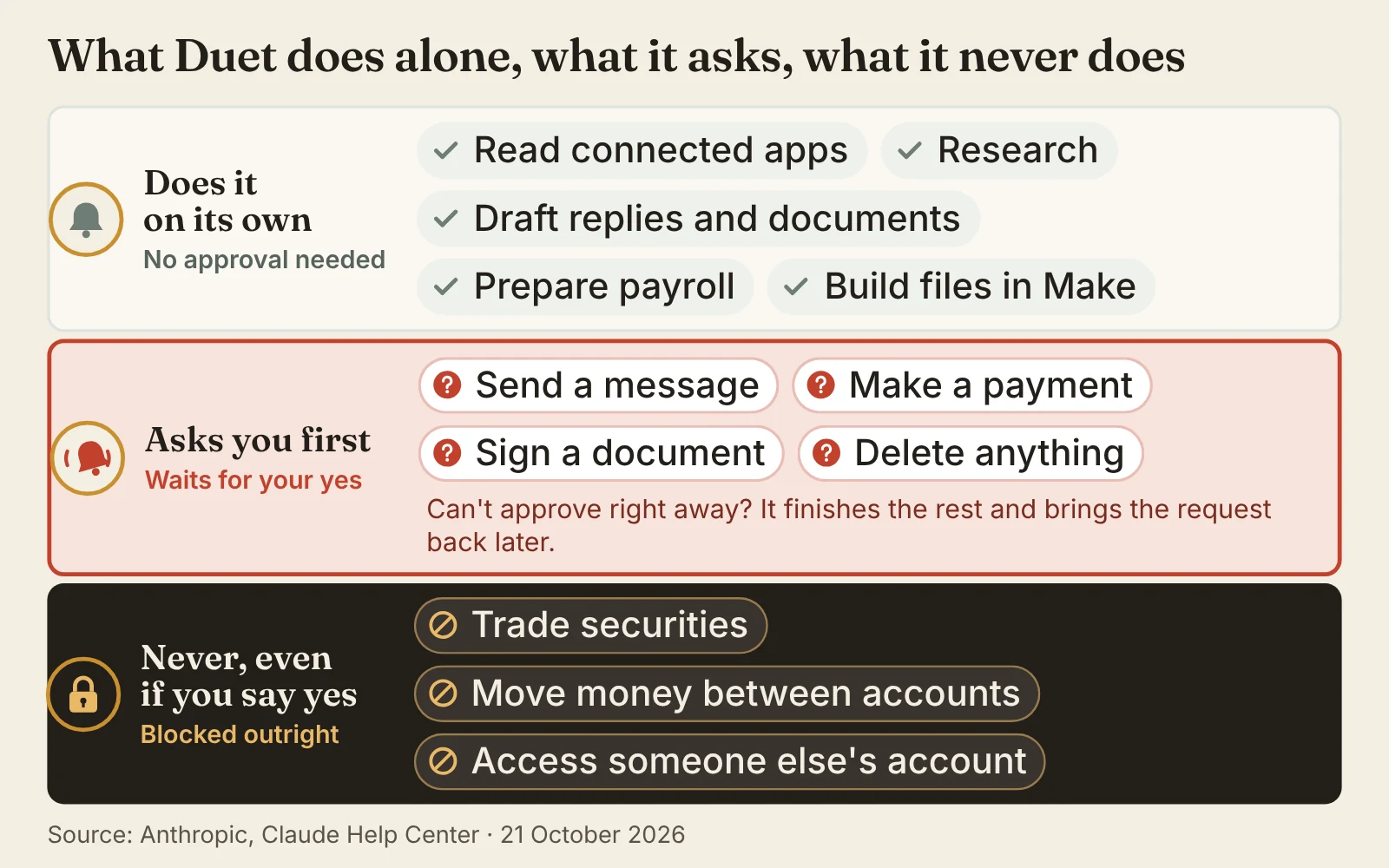
Around that map sit the safeguards you would expect from an agent with access to your accounts. Purchases go through Link, Stripe’s wallet, with a one-time virtual card, or through Shop Pay, so your real card number is never shared. Passwords are typed into a separate form that stays out of the chat. Content from emails and web pages is treated as information, not instructions, to blunt prompt injection. A dedicated classifier is designed to block requests to share credit card numbers and government IDs, and health or personal finance details are only sent when you explicitly instruct it to. If you cannot approve a step straight away, Duet finishes the rest of the task and brings the request back later.
The design choice is worth copying even if you never use Duet. Most organisations that pilot agents argue about which tools to connect. The harder and more useful conversation is about this table: which actions in your business can an agent take alone, which need a human click, and which are off limits whatever anyone says. We made a similar case in how to collaborate with AI without losing control of your work.
When to speak is the unsolved part
Anthropic’s own list of limitations reads like a description of the second decision. Duet “might misread a thread or miscalibrate what’s urgent”, and the company is still tuning when the app sends you a message, based on tester feedback. You also cannot watch or take over its cloud browser, so you judge its work by results rather than by seeing the steps.
The tester stories Anthropic chose show what good calibration looks like. A real-estate broker had a showing flagged that was booked on the wrong day, without asking. A brand strategist got a warning that a client call sat right before her flight. Neither is a hard task. Both depend on connecting two facts and deciding that the combination matters to this person today.
On Hacker News, launch-day comments split along the same line. Sceptics worry about broad access, about handing an LLM a password manager once the announced 1Password sign-in arrives, and about agents that surface insights nobody needs. People already using OpenAI’s dots report the opposite experience for one job: an agent watching the inbox brings up messages they would have missed.
A crowded field, and Europe outside it
Duet joins a fast-growing field of background agents. xAI has had Grok Bot in beta since August, Meta launched Muse on 8 September and OpenAI released dots on 29 September. All run on their own cloud computers. Duet positions itself on business work, while Muse leans towards consumers, with travel and shopping.
For European readers the common thread is availability. Duet requires a US Claude account. OpenAI said dots “will not reach Pro users in the European Economic Area, Switzerland or the UK for now”, and Muse is limited to the US and Canada according to Notebookcheck. None of the companies has given a reason. Commentators point to GDPR and the AI Act’s transparency rules, since these agents read mail and calendars continuously, but that is their reading, not a stated policy.
Two practical gaps matter for European firms when Duet does arrive. Microsoft 365 is not supported yet, which matters for the many European SMEs that run on Outlook and Teams, and Team and Enterprise plans are not included. In the meantime, the memory, skills and connectors you build up in Claude carry over, which is one more argument for treating your context as an asset you own.
Frequently asked questions about Claude Duet
Is Claude Duet available in Europe?
Not yet. The research preview is open to US Claude accounts on Pro or Max through a waitlist. Anthropic has not given a date for Europe or for Team and Enterprise plans.
Does Claude Duet cost extra?
Not during the preview. It is included in Pro and Max and shares their usage limits, including the morning brief and background checks.
How often does Claude Duet check my apps?
Every few hours, plus a morning brief. Anthropic chose intervals to save usage, so urgent items can arrive late.
What will Claude Duet never do?
Among other things, trade securities, move money between accounts or access someone else’s account, even with your approval. Sending, paying, signing and deleting always need your approval.
Which apps does Claude Duet work with?
Connectors from your Claude account, including Gmail, Google Calendar, Google Drive, Slack with some limits, QuickBooks, HubSpot, Docusign and Calendly, plus Stripe, Link and Shop Pay. Microsoft 365 is not available yet.
The interruption is the product
Connectors, cloud computers and approval buttons are becoming standard across every agent on the market. The scarce skill is restraint: speaking up rarely enough that you keep listening, and often enough that nothing important slips through. That is also the part no benchmark measures, which is why the real test of Duet will come from users muting it or not in the weeks after their invite arrives.