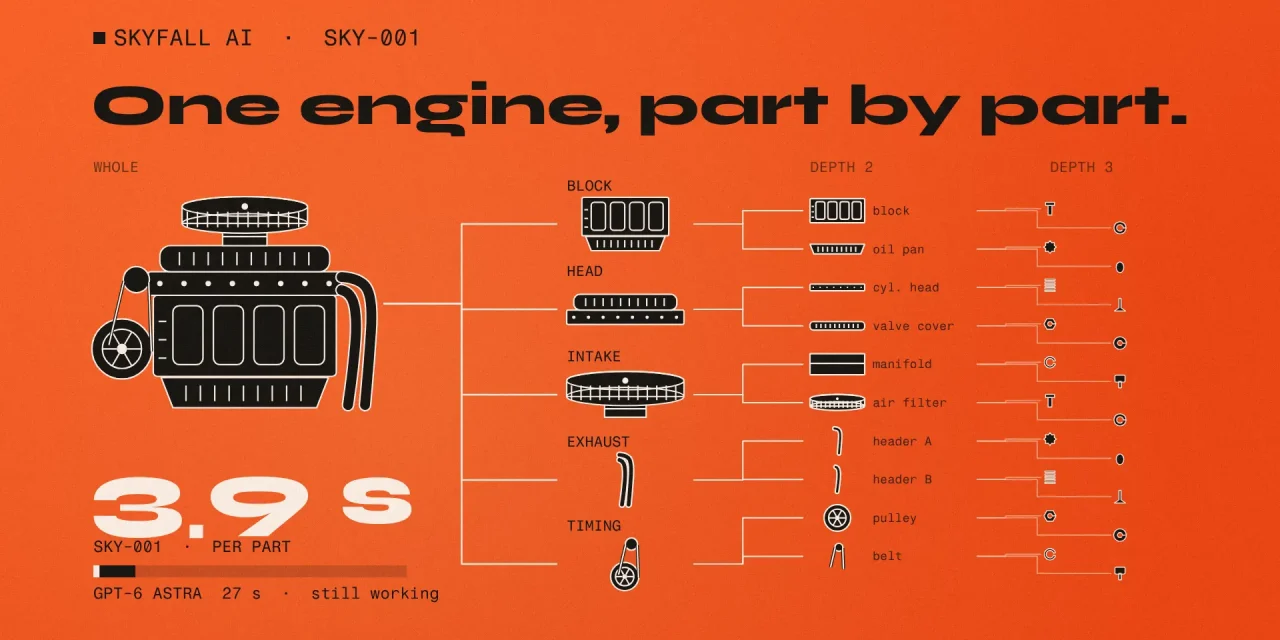
SKY-001, launched by Skyfall AI on 19 October 2026, is the first AI model built to plan physical products the way engineering teams do: it breaks a design into a tree of assemblies and parts, then plans the sketches and operations that build each part in CAD, or the drawing steps of a floor plan in BIM. On Skyfall’s own benchmark it matches GPT-6 Astra on quality while working about 50 times faster and 150 times cheaper per part. For CAD and BIM teams, the speed matters more than the score, because it changes what design exploration costs. The output is not yet a model your engineers can edit, though, and nobody outside Skyfall has tested it.
This article looks at SKY-001 from the side of the people who would use it: manufacturers, product developers, architects and construction firms. What does it produce, how far can you trust the numbers, where does it fit in an engineering workflow, and what can you prepare now?
What Skyfall launched
Skyfall AI is a start-up based in Toronto and San Francisco, founded by the team behind Maluuba, the deep learning lab Microsoft bought in 2017. Sam Pasupalak is CEO, alongside co-founders Sumit Pasupalak and Kaheer Suleman. Backers include Fidelity, Touring Capital, M13 and iNovia Capital, according to citybiz.
SKY-001 is a research preview. There is a waitlist, but no API, no pricing, no licence terms and no downloadable weights. Skyfall targets full commercial deployment in early 2027 and names sports cars, drones, satellites and medical facilities as examples of what it should design.
Why engineering is hard for language models
Today’s frontier models can already produce 3D objects, but they do it indirectly. GPT-6 Astra or Claude writes a script for Blender or a CAD tool, and the script draws, extrudes and cuts shapes one line at a time. The model reasons in text about something that exists in space. Every bolt has to fit the housing it sits in, and an error in step 12 can break step 400.
Skyfall’s argument, set out in its launch post, is that a design that reads well in text is not necessarily geometrically accurate, physically feasible or manufacturable, and that language is an inefficient medium for keeping spatial constraints consistent across thousands of components. Its answer is a world model: a model that plans in images and 3D states rather than words. Until now, world models such as those from General Intuition, Google and Nvidia have mostly generated game worlds, video or robot training scenes. SKY-001 generates a design plus the sequence of steps that builds it.
How SKY-001 plans a design
The model follows the order in which engineers work: the whole product first, then assemblies, then individual parts. It has two components.
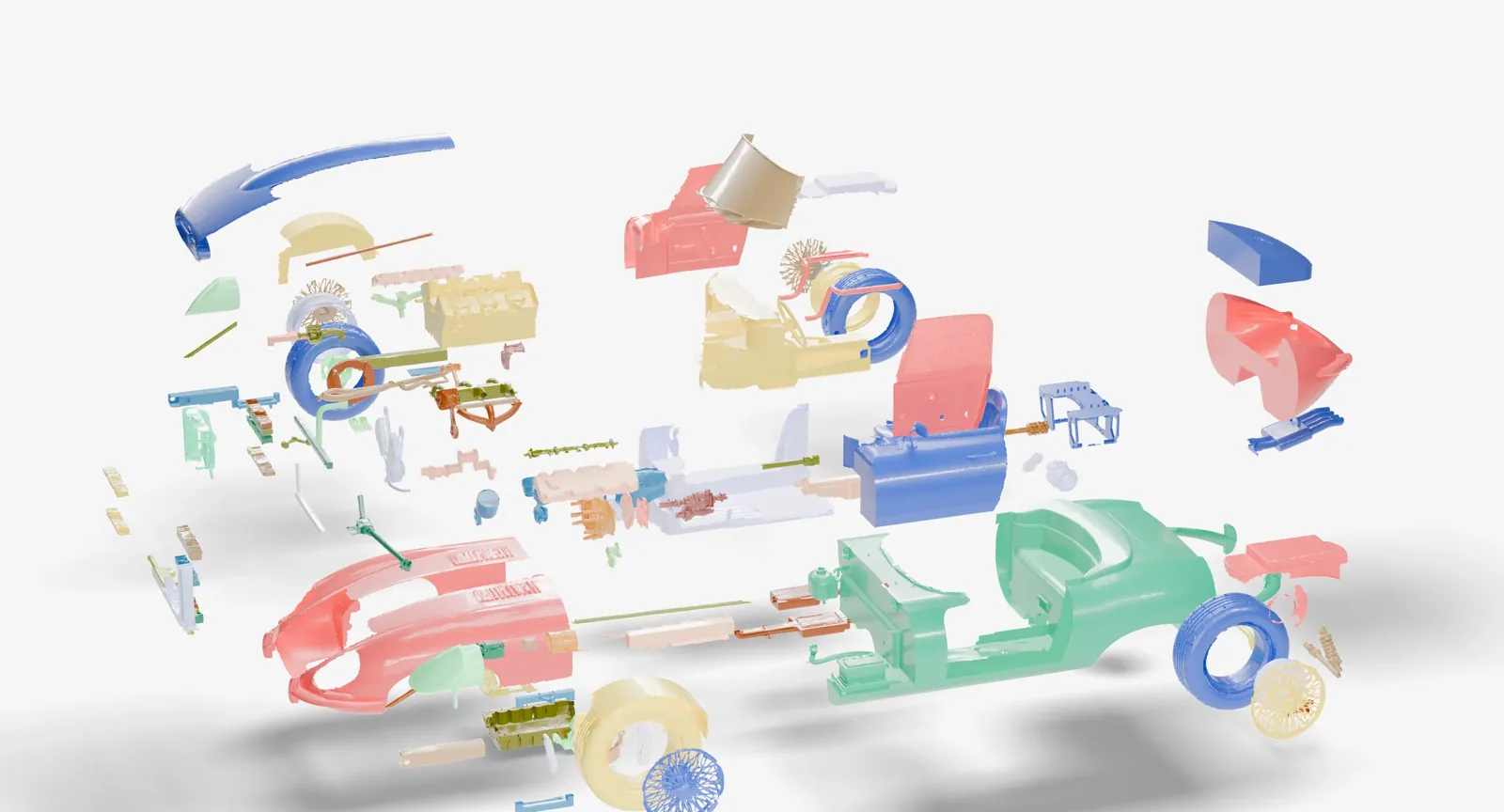
- The Hierarchical Composer takes an image, a text prompt or a brief and generates a rough 3D shape of the whole object. It then splits that shape level by level until every piece is a single part. For the VMS-85 engine in Skyfall’s demo, one photo becomes a five-level tree, from engine block and cylinder heads down to gear stacks, shafts, hoses and sleeves. A refiner then completes each part, including geometry that was hidden inside the rough shape.
- The Construction World Model plans how each part is built. In CAD, it predicts the intermediate 3D states of a part and draws the 2D sketch between each pair of states. In BIM, it draws a floor plan the way an architect would: exterior walls, then walls between apartments and the shared corridors, then each unit room by room.
The hierarchy is what makes it fast. Parts on the same level can be worked out in parallel once their parent is fixed, so the number of sequential steps grows with the depth of a design rather than with its number of parts. Drawing happens with diffusion in two passes: a coarse rollout in a compressed latent space, then a refiner that restores sharp lines and exact corners.
The training data is a large part of the story. The composer learned from more than 200,000 parts and the construction model from over 600,000 construction examples, taken from public datasets of real product assemblies and cleaned up to follow standard engineering hierarchies. Where build histories were missing, Skyfall reconstructed them with engineering tools and LLM-based workflows. Its objects have a median of 288 parts, against 6 in PartVerse, a widely used dataset for part decomposition. For BIM, it used about 35,000 real and synthetic floor plans.
The numbers, and how far to trust them
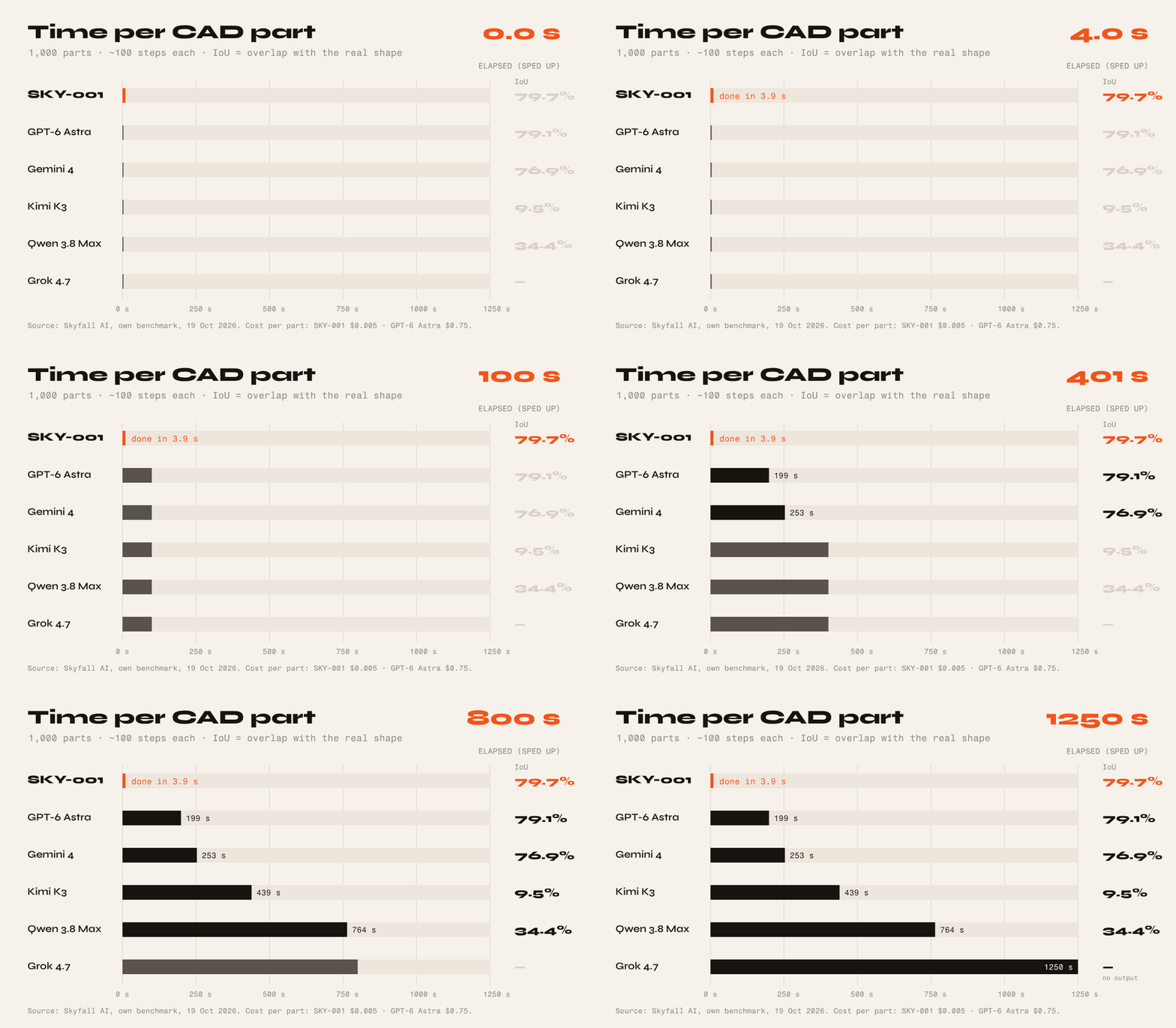
Skyfall compared SKY-001 with frontier models on two construction benchmarks: 1,000 CAD components from objects such as a Jaguar E-Type, a FANUC welding robot, a compact tractor and a Bell 222 helicopter, each about 100 drawing steps, and 1,000 floor plans of about 70 steps on average. Quality is measured as IoU, the overlap between the generated shape and the reference.
| Benchmark | Model | IoU | Time per case | Cost per case |
|---|---|---|---|---|
| CAD | SKY-001 | 79.7% | 3.9 s | $0.005 |
| CAD | GPT-6 Astra | 79.1% | 199 s | $0.75 |
| CAD | Gemini 4 | 76.9% | 253 s | $0.25 |
| BIM | SKY-001 | 43.6% | 1.22 s | $0.0024 |
| BIM | Gemini 3.8 Flash | 42.3% | 346.2 s | $0.218 |
| BIM | GPT-6 Astra | 40.6% | 144.6 s | $0.446 |
Read those numbers with four caveats.
- The quality lead is marginal. In CAD, SKY-001 beats GPT-6 Astra by 0.6 IoU points, which a different scoring convention could erase. Skyfall itself says the model “matches” Astra. The real claim is speed and cost: about 51 times faster and 150 times cheaper than Astra, and about 50 times cheaper than Gemini 4.
- BIM is far from solved. The best model reconstructs less than half of a floor plan. SKY-001 does it in 1.2 seconds instead of almost two and a half minutes, but at 43.6% IoU it is a sketch generator, not a drafting tool.
- The headline multipliers vary. The research post says about 50x faster in CAD and 120x in BIM. The CEO’s launch post on X says 51 to 125 times faster and 150 to 210 times cheaper. The press release says 100 times faster. Use the tables, not the headlines.
- It is Skyfall’s own test. Skyfall picked the test set and the competitors, drove the rival models itself and has not published prompts, scripts or how cost per case was calculated. Independent replication is the next thing to watch.
The gap between a visual plan and a model you can edit
For an engineering organisation, the key question is what SKY-001 actually hands over. Today it is a visual design plan: a part tree with, per part, a sequence of sketches and 3D states that you can view in a standard 3D viewer or in Autodesk Fusion. Skyfall notes that the transitions in its figures are illustrative and that the saved sketch and 3D geometry can disagree.
That is not what a design team works with. Engineers need parametric models with an editable feature history, dimensions, constraints and tolerances, and they need assemblies that carry material and manufacturing data into simulation, PLM and the shop floor. Architects need walls, doors and rooms as objects in a BIM model, not as drawing states.
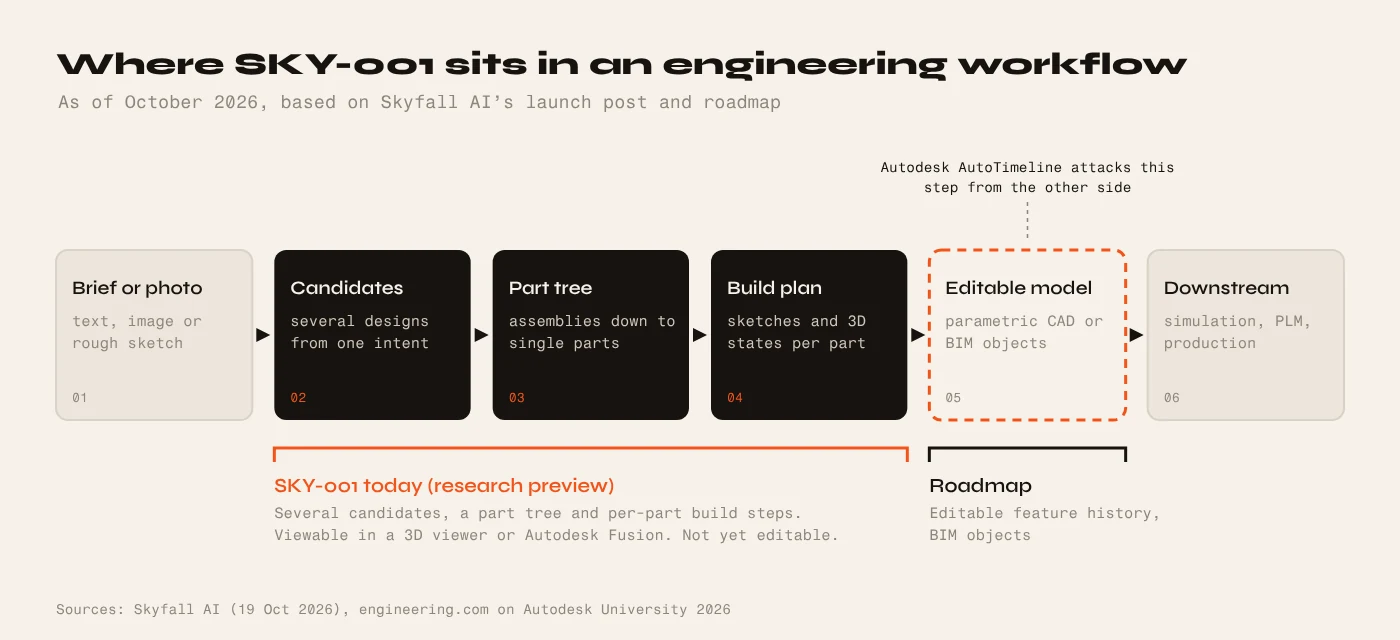
Skyfall lists exactly these as next steps: turning sketch rollouts into executable operations with an editable feature history, letting designers ask for changes in text (“widen this bracket”) with neighbouring parts updating automatically, and turning floor plans into BIM objects. PCB design and other hardware come after that.
The incumbents are closing the same gap from the other side. At Autodesk University in September, Autodesk showed AutoTimeline, which turns an imported solid into a parametric part with a feature timeline, and AutoAssemble, which constrains imported parts into an assembly, reports engineering.com. Start-ups such as Arda, which is building an IDE for manufacturing engineering, attack the step after design. The likely end state is a chain: a world model proposes and plans, CAD software makes the result editable, and simulation checks it.
What cheap design exploration changes
A design is rarely made once. Teams try dozens of variants of a bracket, an engine mount or a floor layout and throw most of them away. When one attempt costs half a cent and four seconds instead of 75 cents and three minutes, the economics of that search change. Skyfall says SKY-001 can generate several candidate designs from the same intent, so a designer can compare them before the model unfolds one into parts and a build plan.
For manufacturers, that points to faster concept phases and more variants per engineer. For real estate developers and architects, a model that turns a building envelope and a brief into a first apartment layout in about a second could speed up feasibility studies, as long as nobody mistakes a 43.6% plan for a finished one. In both cases the gain sits at the front of the process, where today most variants are never drawn at all because they take too long.
What engineering and construction teams can do now
SKY-001 is not something you can buy yet, but the direction is clear enough to prepare for.
- Get on the waitlist if you design complex assemblies, and ask for a test on your own parts rather than the demo objects.
- Bring your own benchmark. Pick 20 to 50 real components or floor plans with known reference models and measure any vendor, Skyfall included, against them.
- Ask what you get out. A mesh, a sketch sequence, a STEP file or a parametric model with a feature tree are very different deliverables.
- Clean up your own design history. Skyfall’s main advantage is data: assemblies with consistent hierarchies and recorded build steps. Your CAD archive, with its feature trees and revisions, is the same kind of asset.
- Check where your data goes. Proprietary designs are core intellectual property. Ask about hosting, training on customer data and export control before uploading anything.
The build history is the real asset
The most telling detail in Skyfall’s launch is not the speed. It is the effort that went into data: hundreds of thousands of parts rebuilt into clean hierarchies, and construction histories reconstructed where they were missing. That is the material that lets a model learn how things are built rather than what they look like. Companies already sit on decades of it in their PDM and BIM archives. As with language models, the model will be rented, but the context you own decides how useful it is for you. For engineering firms, that context is the design history: who built what, in which order, and why.
The wider bet on spatial AI is getting expensive. AMD agreed in September to buy Fei-Fei Li’s World Labs for about $8.2 billion in stock. SKY-001 shows what that bet looks like when it is aimed at the factory and the building site instead of the game world.
FAQ
Is SKY-001 a large language model?
No. It is a world model that plans in images and 3D states using diffusion transformers. The language models in Skyfall’s comparison write scripts that build the geometry instead.
Can companies use SKY-001 today?
Only by joining the waitlist. There is no API, price list or self-hosting option. Skyfall targets commercial deployment in early 2027.
Does SKY-001 produce editable CAD models?
Not yet. It produces a part tree and a visual build sequence. Editable feature histories and editable BIM models are on Skyfall’s roadmap.
What does IoU measure?
Intersection over Union: the overlap between the generated shape and the reference shape, divided by their combined volume or area. It measures shape similarity, not whether dimensions, tolerances or manufacturability are right.
Who is behind Skyfall AI?
Sam Pasupalak, Sumit Pasupalak and Kaheer Suleman, who previously built Maluuba, acquired by Microsoft in 2017. The company is based in Toronto and San Francisco.