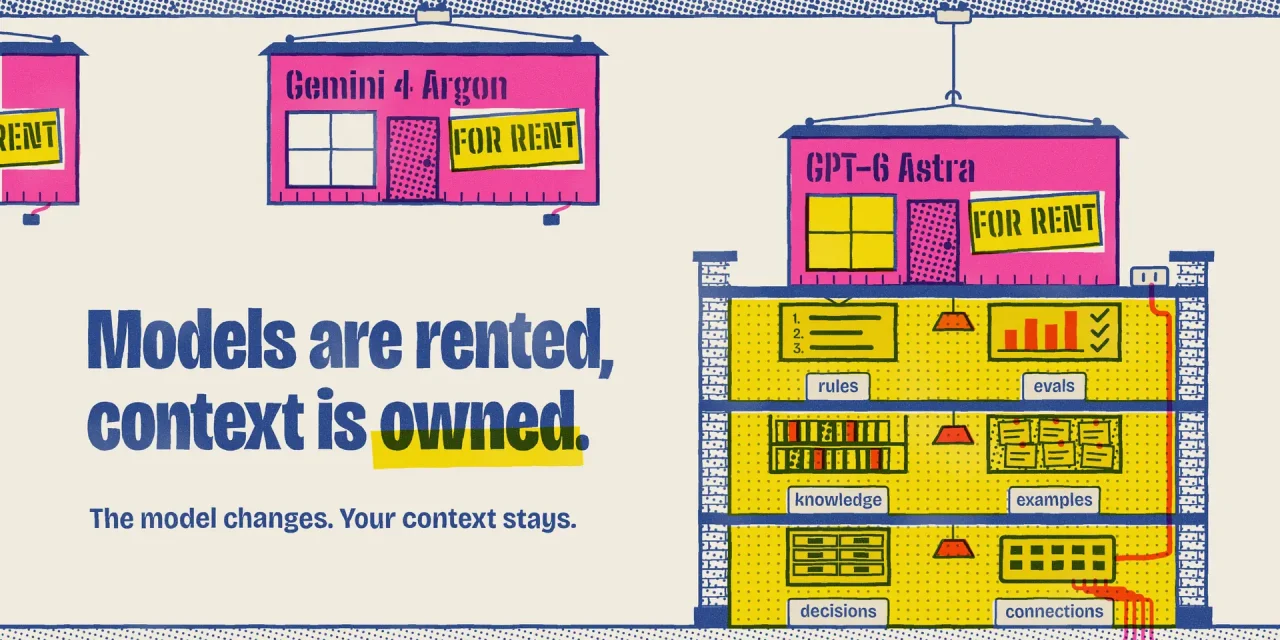
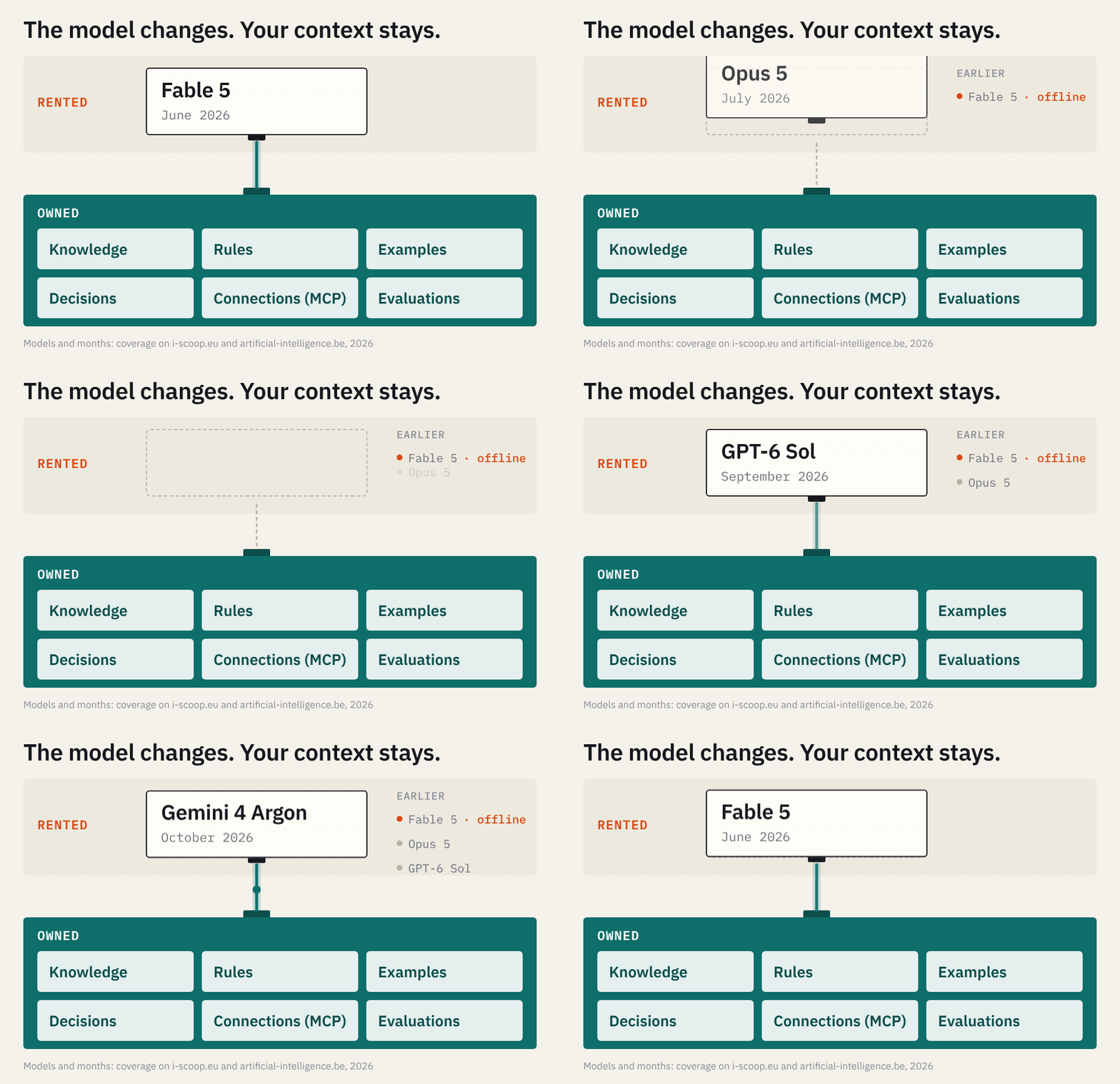
The AI model your organisation relies on today will be replaced within months by one that is better and cheaper. What does not move with it automatically is everything the model needs to know about your business: your knowledge, rules, examples, decisions and connections to your own data. That is your context. Models are rented. Context should be owned, kept in a form that any future model can read, under your control.
For European organisations this is more than a technical preference. Model access can be cut by a foreign government, prices and terms change with every release, and EU rules on data portability only help if your context is something you can actually export. This article explains why the model has become a rental, where companies unknowingly rent their context as well, and what a context strategy looks like in practice.
Why the model has become a rental
A model is a service you pay for per token, which your provider can replace, reprice or withdraw at any time. Three developments made that very visible in 2026.
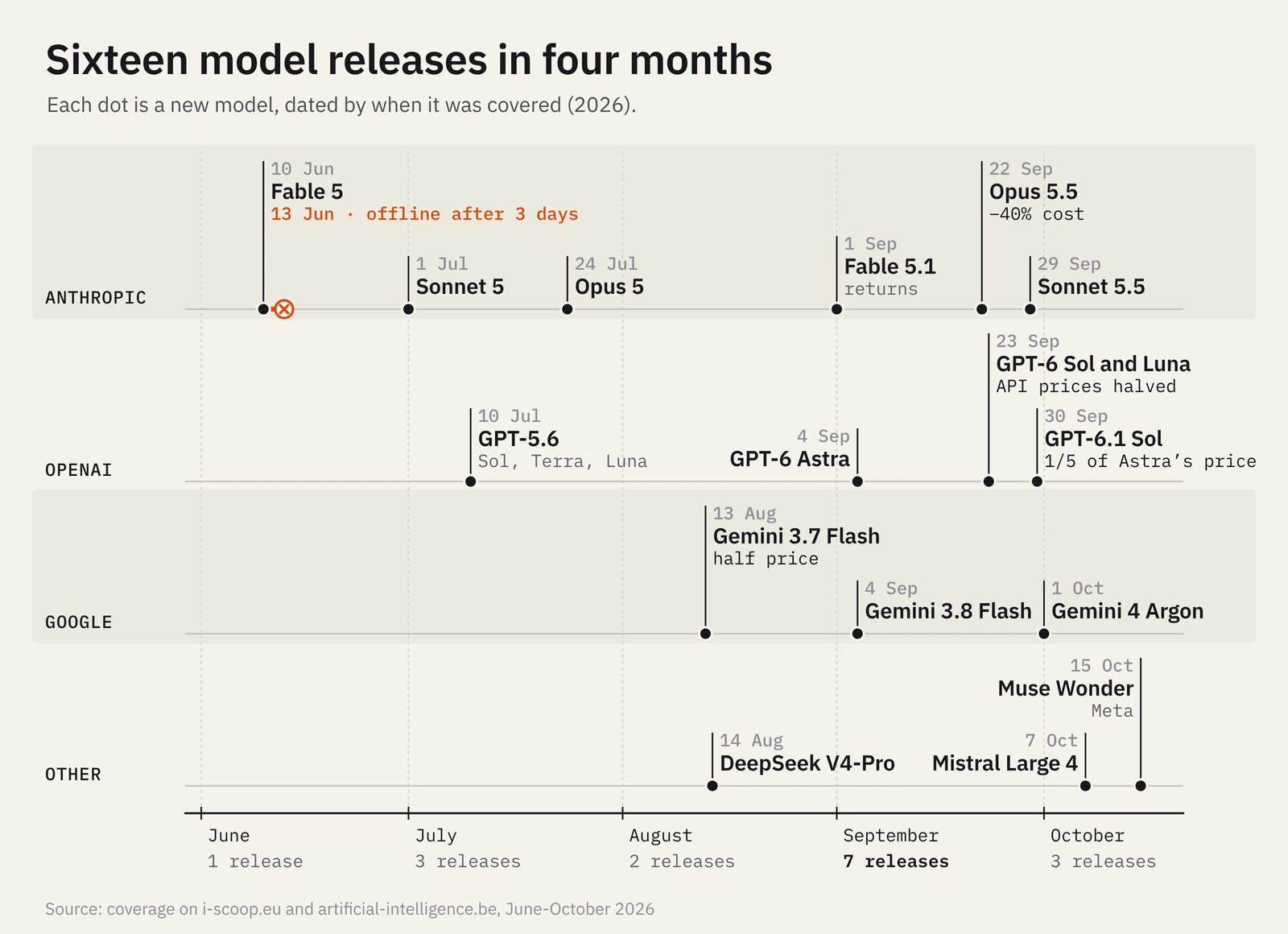
Release speed. Between June and mid-October 2026, the major labs shipped at least sixteen new frontier and workhorse models, from Claude Opus 5 and GPT-6 Astra to Gemini 4 Argon and Mistral Large 4. Whoever picked the best model in June is running something two generations old by October.
Falling prices. Each generation undercuts the last. Claude Opus 5.5 cut costs by 40% in September, and GPT-6 Sol and Luna halved API prices a day later. Research group Epoch AI found that the price of reaching a given level of performance falls by a factor of 9 to 900 per year, depending on the task. Any advantage you buy simply by paying for a premium model is quickly available to everyone.
The lease can be terminated. Three days after Claude Fable 5 launched in June, a US export control directive barred access for anyone who is not a US national. Unable to verify nationality per user, Anthropic switched the model off worldwide. Companies that had built workflows around it had to fall back to other models overnight. Fable returned as version 5.1 in September, but the lesson for non-US users stands: access to a frontier model is a geopolitical variable.
Enterprises already behave accordingly. In a16z’s survey of 100 enterprise CIOs, 37% used five or more models, up from 29% a year earlier. Menlo Ventures found that 66% of teams upgraded to a newer model from the same provider within a year and 11% switched provider. Both figures date from mid-2025; the pace of releases has only increased since.
What context actually is
A model knows a lot about the world and nothing about your organisation. It does not know your customers, your pricing logic, your compliance constraints or why you stopped working with a certain supplier. Anthropic describes context engineering as curating the smallest set of high-signal information a model needs to do a task well. In a business setting, that information has six layers:
- Knowledge: product information, procedures, customer history, internal documents.
- Rules: policies, brand and tone of voice, regulatory boundaries, approval limits.
- Examples: good and bad outputs that define what “good” means for you.
- Decisions: why things are done a certain way, and what has already been tried.
- Connections: access to email, CRM, ERP, document stores and databases.
- Evaluations: a fixed set of real tasks to measure whether a model performs for you.
Each layer takes time to build and grows more valuable the longer it is maintained. A new model is one API key away. A well-kept organisational memory is not. That is where durable advantage sits, not in the choice between Claude, GPT, Gemini or Mistral. It is the same logic behind context-driven software factories, where standards live in plain files so that every run improves the next.
Where companies rent their context without noticing
Many organisations assume their context is theirs because they created it. The real questions are who holds it, and in what form.
Memory inside an assistant. Consumer and workplace assistants now build memory automatically from conversations. Useful, but that memory lives with the vendor. How sticky it is became clear when Anthropic released a memory import tool in March 2026, aimed at people moving from ChatGPT, Gemini or Copilot. A product built to rescue context from another vendor says a lot about where context ends up by default.
Prompts tuned to one model family. Models respond differently to the same instruction. One CIO told a16z that “all the prompts have been tuned for OpenAI”, and that agentic prompts running to many pages turn a model change into a significant engineering task.
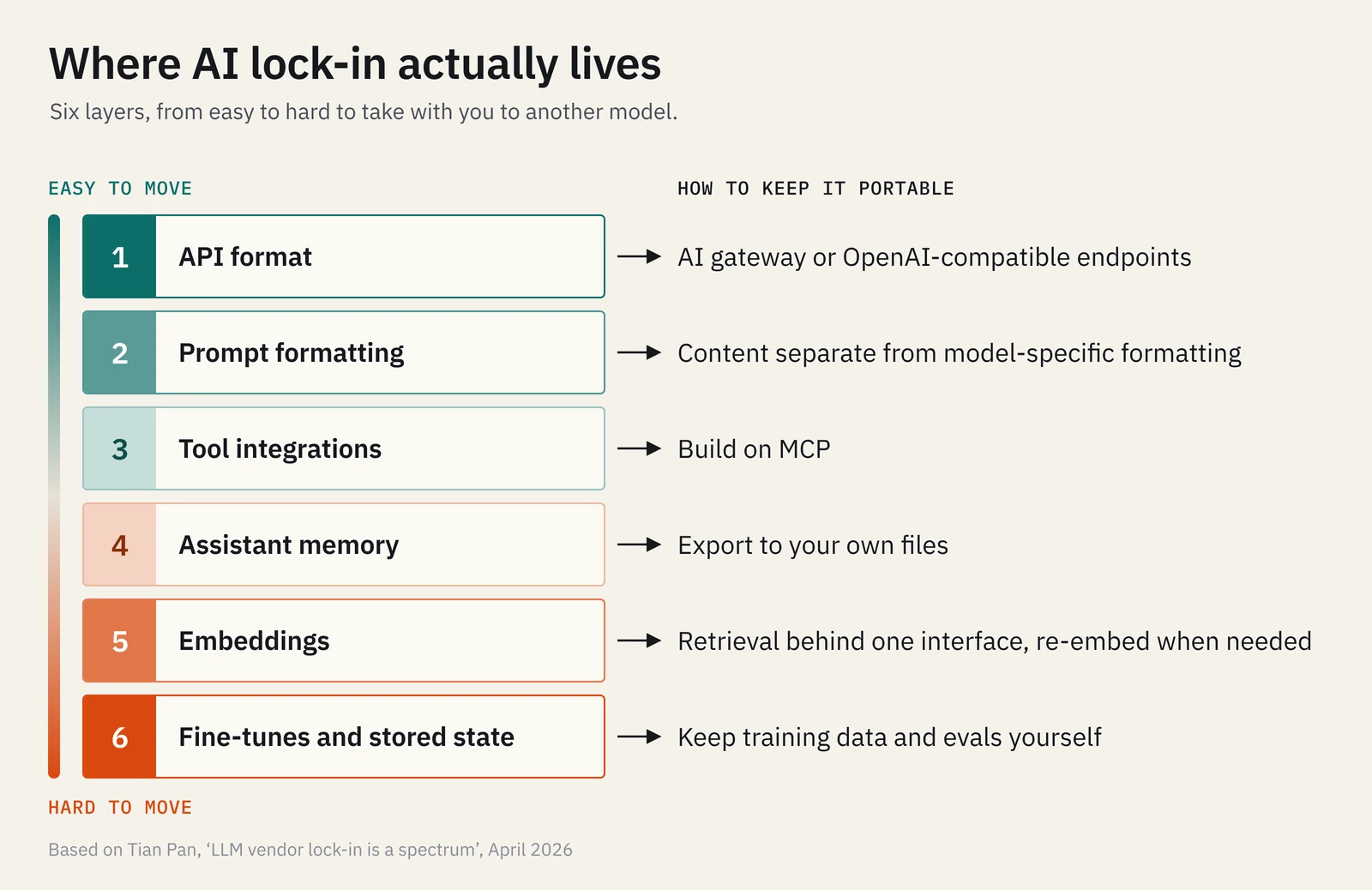
Embeddings, fine-tunes and stored state. Embeddings from one provider do not work in another’s vector space, and fine-tunes on closed models usually cannot be exported. Engineer Tian Pan places these layers on a spectrum from easy to hard to move: switching the API format takes an afternoon, while stored state and fine-tunes are the hardest to escape.
What EU rules do and do not solve
Europe gives organisations some leverage. The switching provisions of the EU Data Act have applied since 12 September 2025 and cover data processing services broadly, including SaaS. Providers must support porting of data and digital assets, and all switching charges are banned from 12 January 2027.
That helps you get your data out. It does not make a prompt library tuned for one model behave the same on another, and it does not turn a vendor’s opaque memory into a document your team can read. Portability rights are worth most to organisations that already keep their context in open, structured formats. In other words, regulation lowers the cost of leaving, but only context you own is worth taking with you.
The same applies to sovereignty strategies. Running open-weight models such as Mistral’s on European infrastructure protects you against losing access. It does not by itself make those models useful for your business. Sovereign compute without owned context is an empty building.
A context strategy in six moves
- Write context down in plain files. Markdown or text in a repository your organisation controls: policies, procedures, examples, decision logs. Conventions such as AGENTS.md and skill files are plain text any model can read.
- Connect through an open standard. The Model Context Protocol (MCP) links models to tools and data and is supported by ChatGPT, Gemini, Microsoft Copilot, Claude, Cursor and VS Code. Anthropic donated MCP to the Linux Foundation’s Agentic AI Foundation in December 2025, when it already counted more than 97 million monthly SDK downloads. An integration built once works across models.
- Separate content from model-specific formatting. Keep what you want apart from how you phrase it for a particular model, so a switch only touches the formatting layer.
- Own your evaluations. Twenty to fifty real tasks with reference answers let you judge a new model on your work within hours, not on a public benchmark. They also turn model choice into a measurable decision, the logic behind tracking return on tokens.
- Keep memory exportable. Where teams rely on assistant memory, export what matters to your own store regularly. Agents you build should write their notes to storage you control, as Anthropic recommends for long-running agents.
- Put it in procurement. Ask every AI vendor which context is exportable, in which format, and how fast. Make that part of the contract, alongside the Data Act’s porting provisions.
For practical guidance on keeping context compact and effective, see our piece on context engineering for Claude 5.
How Zaela puts this into practice
Zaela, the platform from Belgian company Edge that was called Edge OS until recently, is built around exactly this idea. It is not a model of its own and not another chatbot. Zaela gives the AI an organisation already uses, such as Claude or ChatGPT, the company’s knowledge, methods and tools through a single connection based on MCP. Any assistant that supports MCP can plug in. When the model changes, the context stays in the organisation’s own Zaela workspace rather than in one vendor’s chat memory.
Zaela is organised in four building blocks that map closely onto the layers described above:
- Memory: shared knowledge per brand or topic, such as brand rules, tone of voice, guidelines and earlier work, with version history so nothing disappears quietly.
- Agents: roles such as a content writer, a report builder or an SEO specialist, which know which knowledge and tools they need and hand work to each other.
- Skills: methods written down once and then used by everyone, with whichever model is connected.
- Tools: connections to data and platforms, such as Google Analytics, Search Console or a CRM, through one gateway.
Everything the AI uses can be viewed, adjusted and extended by the team in the Zaela web app. Each organisation gets its own workspace, strictly separated from others. The AI sees only what the user is allowed to see, keys stay encrypted and every action is logged. That matters for governance: context you own is context you should be able to audit.
This article is an example in itself. It was produced by an agent in Zaela that pulled the site’s style rules, previous covers and working method from shared memory. You can read how it works and leave your details at zaela.com. Disclosure: Zaela is built by Edge, the company that produced this article.
Frequently asked questions
Does “context is owned” mean we should avoid vendor memory features?
No. They are convenient for everyday use. Just make sure anything that matters to the business also exists in your own files, so a switch does not erase it.
Does the EU Data Act cover AI model providers?
The switching rules apply to data processing services, defined broadly enough to include most cloud and SaaS offerings. Whether a specific AI service falls in scope depends on how it is delivered and contracted, so check with legal counsel. Either way, the rules cover data and digital assets, not how a model behaves.
Are open-weight models the answer to lock-in?
They protect against losing access, because you can run them yourself. They do not replace context. An open model without your knowledge, rules and evaluations is just as generic as a closed one.
Who should own the context layer internally?
Treat it like any other business asset: a named owner, usually where knowledge management, data and AI teams meet, with contributions from the business units whose expertise it captures.
Choose models by the quarter, context for years
Which model is best gets a different answer every quarter, and that is fine as long as switching is cheap. The question that lasts is another one: if you had to change provider tomorrow, what would you take with you? If the answer is a handful of chat histories, you are renting more than you think. If it is a maintained body of knowledge, rules, examples and tests, every new model simply makes your organisation stronger.