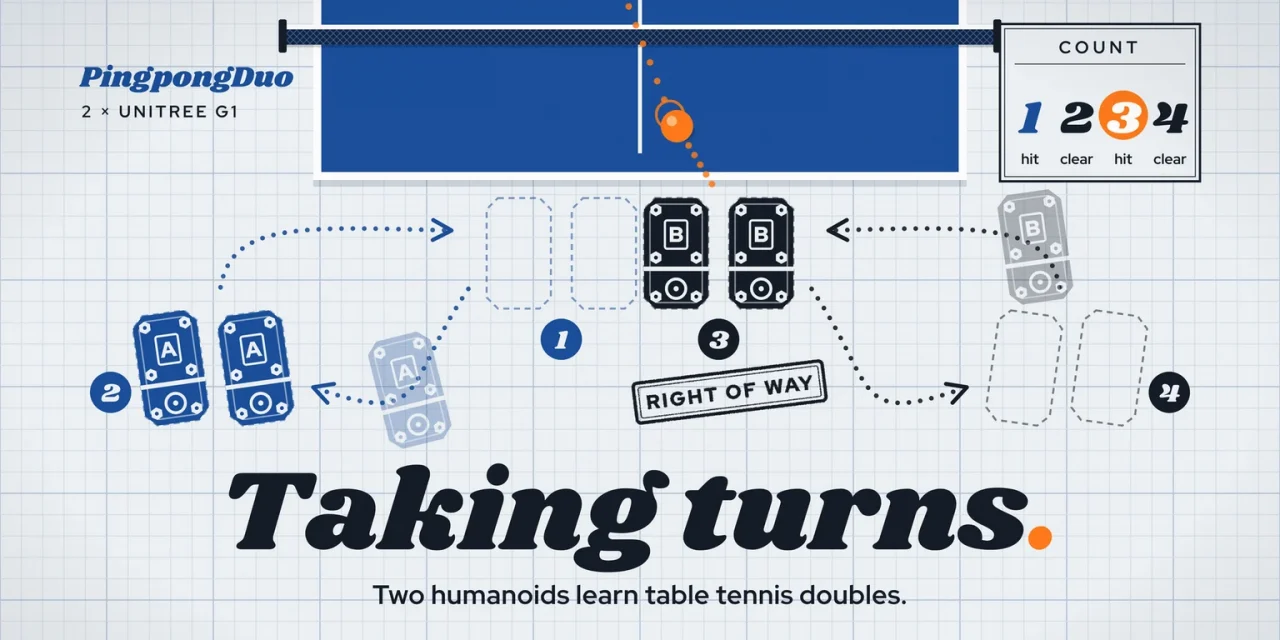
Two Unitree G1 humanoid robots stand on the same side of a table tennis table and return the ball in turn, more than ten times in a row. The system is called PingpongDuo and comes from researchers at the University of Hong Kong, the Shanghai Innovation Institute, Archon Robotics and NVIDIA. The hard part is not hitting the ball. It is taking turns: deciding who stands where, who clears out and who gets right of way, in a space only a few metres wide.
What PingpongDuo does
PingpongDuo is the first system that lets humanoid robots play table tennis doubles. In doubles, teammates must strike in strict alternation, so the player who just hit has to make room at once for the partner to step in. Interesting Engineering reported the work on 16 October 2026. The details are in the paper on arXiv (2610.20579) and on Archon Robotics’ project page, which has videos and an interactive 3D simulation.
The team used two Unitree G1 robots with 29 degrees of freedom. The G1 is a small humanoid, 1.32 metres tall and about 35 kilograms; the base version starts at 13,500 dollars according to Unitree, the Chinese robot maker that went public in Shanghai this year.
On real hardware the two robots sustained more than ten consecutive alternating strikes. The longest rally in the video on the project page counts 18 returns. One robot covered 2.15 metres to clear the way and come back in 2.4 seconds, with a peak speed of 2.23 metres per second.
Why doubles is harder than singles
A robot playing alone has one thing to track: the ball. In doubles two robots share the same cramped strip behind the table, with less than two seconds between strikes. That creates two problems that pull against each other. If the striker clears out fast, its shot gets less accurate. If it lingers, its partner walks into it. Hands, feet and bodies can collide, and a fall of a 35-kilogram robot is not a detail.
That makes the ten-shot rally less impressive than it sounds, and more interesting. Singles systems already sustain far longer exchanges: HITTER, a humanoid system from UC Berkeley researchers, reached 106 consecutive shots against a human in 2025. What PingpongDuo adds is coordination between two machines that can get in each other’s way.
How it works, in three layers
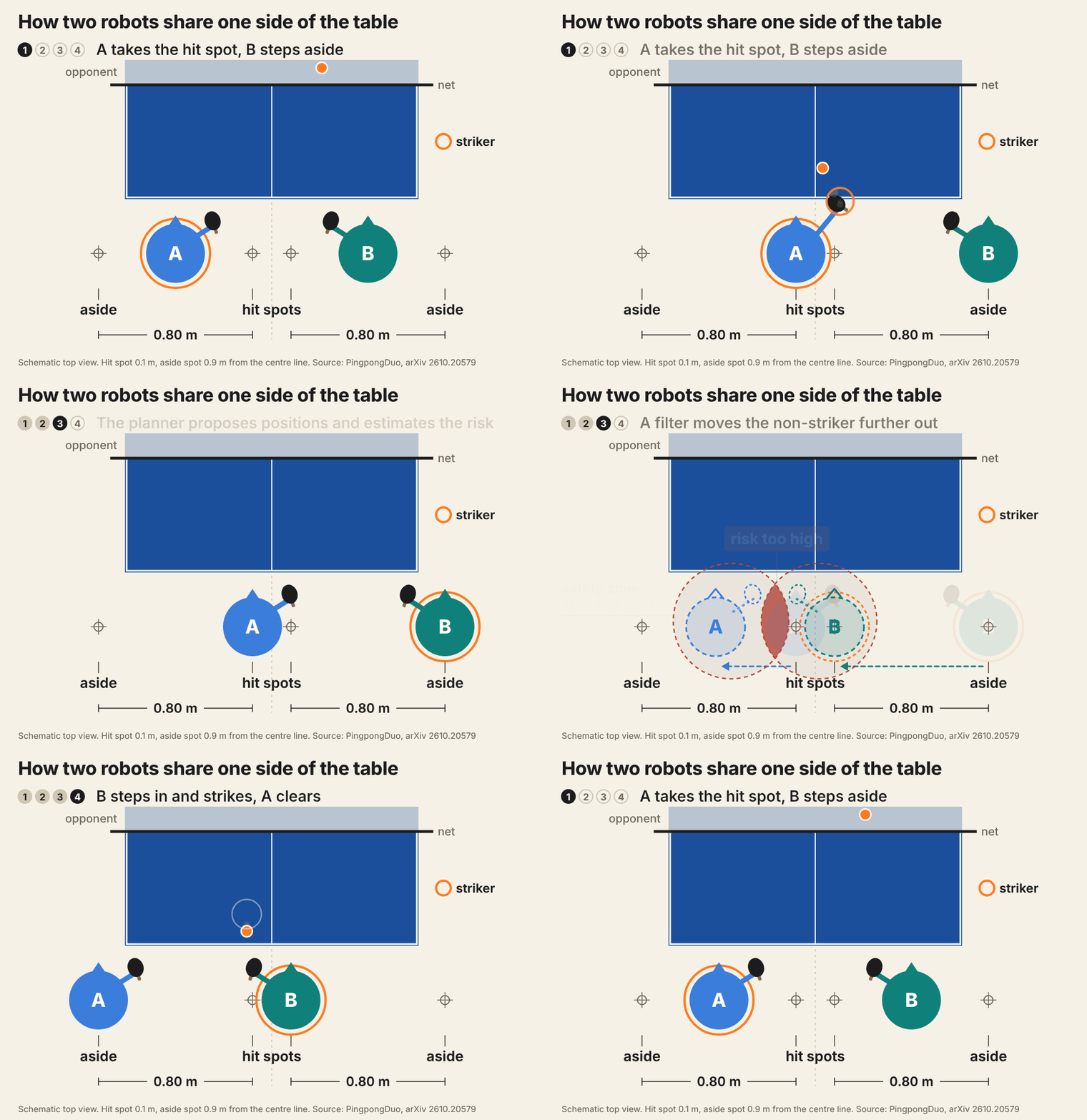
The team planner picks a position for both robots at once for every incoming ball. It is trained with reinforcement learning. A learned risk estimator predicts whether hands, feet or bodies will come too close. If the risk is too high, a safety filter searches for the nearest safe alternative and moves the robot that is not striking the most. The striker keeps priority. If no safe pair exists, both robots return to default positions and the handoff waits.
Footwork and striking are separate skills. The footwork comes from recordings of humans playing doubles: the researchers cut about 200 short movements from them and retargeted them to the G1’s body. Each skill trains from the poses the other one produces, so a robot can strike straight after a fast side step without first returning to a neutral stance.
Arm refinement corrects the stroke after a quick move. A small extra policy adjusts the seven arm joints based on the robot’s state and the estimated position and speed of the ball. It was trained in a simulator, NVIDIA’s Isaac Lab, which the team calibrated with real measurements of ball flight, table bounces and racket contact. That teaches the system which arm motion gets the ball over the net and onto the opponent’s half. Running such policies on board, rather than on external computers, is where compute modules like NVIDIA’s Jetson Thor T3000 come in.
What the numbers do and do not say
The most quoted claim is a 13.2 percent improvement in ball returns over the best existing approach. It is 13.2 percentage points, in simulation: 55.6 percent of balls legally returned versus 42.4 percent for HITTER. Without arm refinement PingpongDuo drops to 44.2 percent, so that last layer does most of the work.
At team level, the average number of returns per rally rises from 3.60 with a simple rule-based planner to 4.87 with the trained planner and learned risk. Notably, learned risk on top of a rule-based planner adds exactly as much as a classic safety filter (3.79). Only the combination with the learned planner makes the difference.
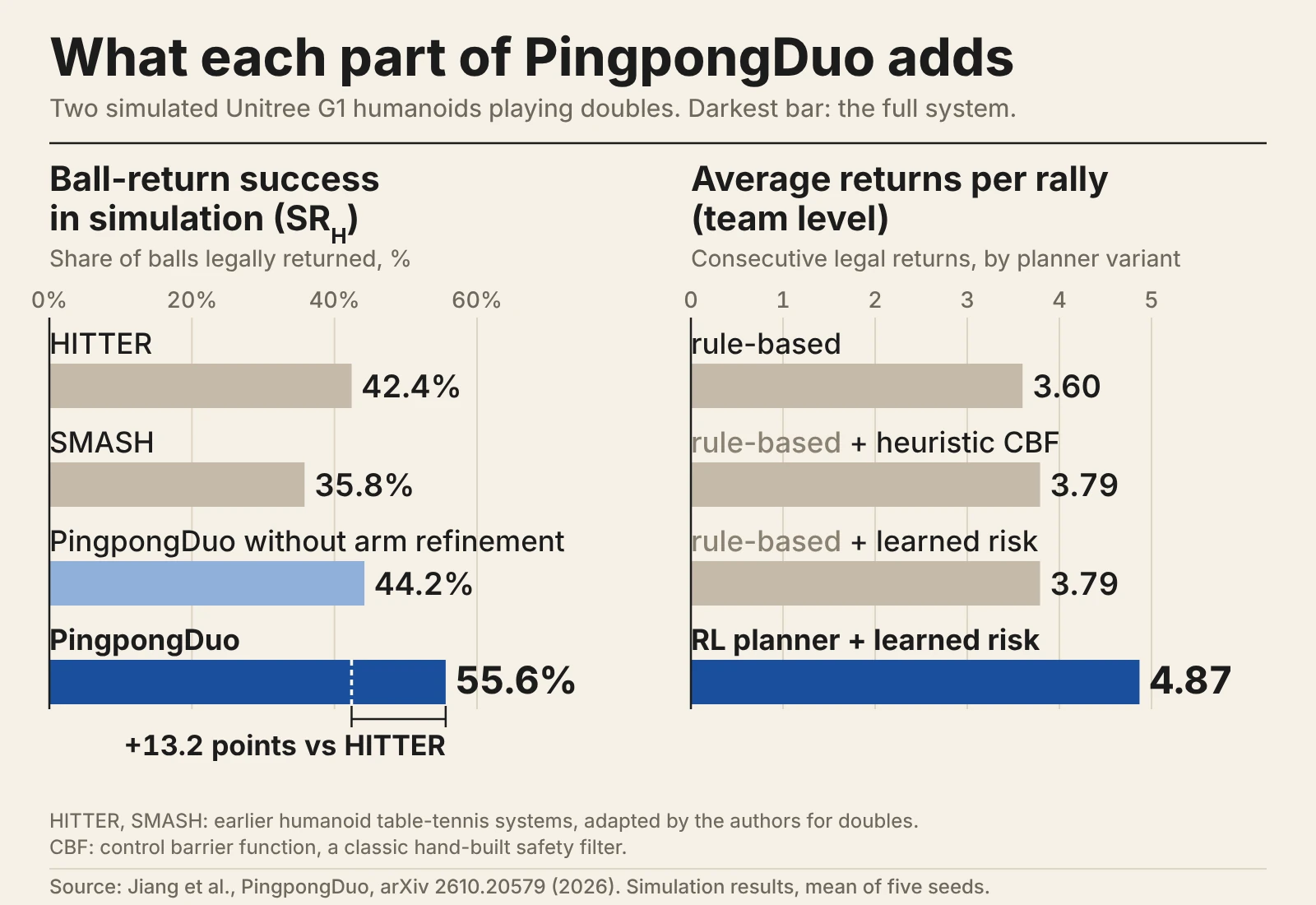
Most of the numbers come from simulation. For the real robots the paper reports the 2.15-metre clearance, the run of more than ten strikes and a rally of four alternating returns against a human. It does not say how often things went wrong on hardware or how often the robots touched.
Where humanoid table tennis stands in 2026
Table tennis has become a favourite test bed: the ball is fast, the space is small and every mistake is visible. The main milestones so far:
| System | When | Robot | What it does |
|---|---|---|---|
| Google DeepMind | August 2024 | robot arm | won 13 of 29 games against humans, none against advanced players |
| HITTER (UC Berkeley) | August 2025 | humanoid | 106 consecutive shots against a human, with external cameras |
| SMASH (HKU and others) | April 2026 | humanoid | strikes using its own cameras, no external sensors |
| Ace (Sony AI) | April 2026 | robot arm | won 3 of 5 matches against elite players, lost to professionals |
| PingpongDuo | October 2026 | 2 humanoids | doubles, more than 10 alternating strikes |
The team behind SMASH largely overlaps with the PingpongDuo authors. With SMASH, an HKU team took silver at the World Humanoid Robot Games in Beijing in September. Sony AI’s robot arm Ace sits at the top: it beat elite players in a study published in Nature. A fixed arm has a much easier job than a robot that has to move on two legs, though.
The limits of this research
- External cameras. The positions of robots and ball come from a motion-capture system around the table, not from the robots themselves. Outside a lab, it does not work like this.
- No spin. The system neither measures nor predicts spin. Against a player who uses it, the robots would struggle quickly.
- No tactics. The robots do not yet choose attacking or defensive shots. They return the ball.
The researchers name exactly these three points as next steps: onboard perception, spin estimation and choosing a strategy based on the opponent. With SMASH the same group has already solved the first one for singles, so combining the two is the obvious move.
What a ping-pong table teaches about robots at work
Nobody needs a robot doubles team to play ping-pong. The question PingpongDuo answers matters far beyond sport, though: how do you let two fast-moving humanoids work in the same tight space without collisions, and who yields when it gets crowded? That is the question warehouses and assembly lines face as soon as more than one humanoid walks around. The new safety standard ISO 25785-1 mainly deals with safety between robots and people. A learned risk estimate with a clear right-of-way rule is a building block for the next level: safety between robots. Archon Robotics, the Shanghai company behind the work and one of the many young players in China’s embodied AI scene alongside the country’s leading AI labs, raised hundreds of millions of yuan in June to build exactly this kind of whole-body robot model.
Frequently asked questions
Do the robots play fully autonomously?
Yes, nobody steers them during play. They do get the position of the ball and of themselves from an external motion-capture system around the table.
Which robots does PingpongDuo use?
Two Unitree G1 humanoids with 29 degrees of freedom. The G1 is 1.32 metres tall and weighs about 35 kilograms.
Can the robots beat human players yet?
Not really. The paper shows a rally of four alternating returns against a human. Without reading spin and without tactics, a practised player would outplay them.
What does the 13.2 percent improvement mean?
It means 13.2 percentage points more balls legally returned in simulation: 55.6 percent for PingpongDuo versus 42.4 percent for the earlier HITTER system.