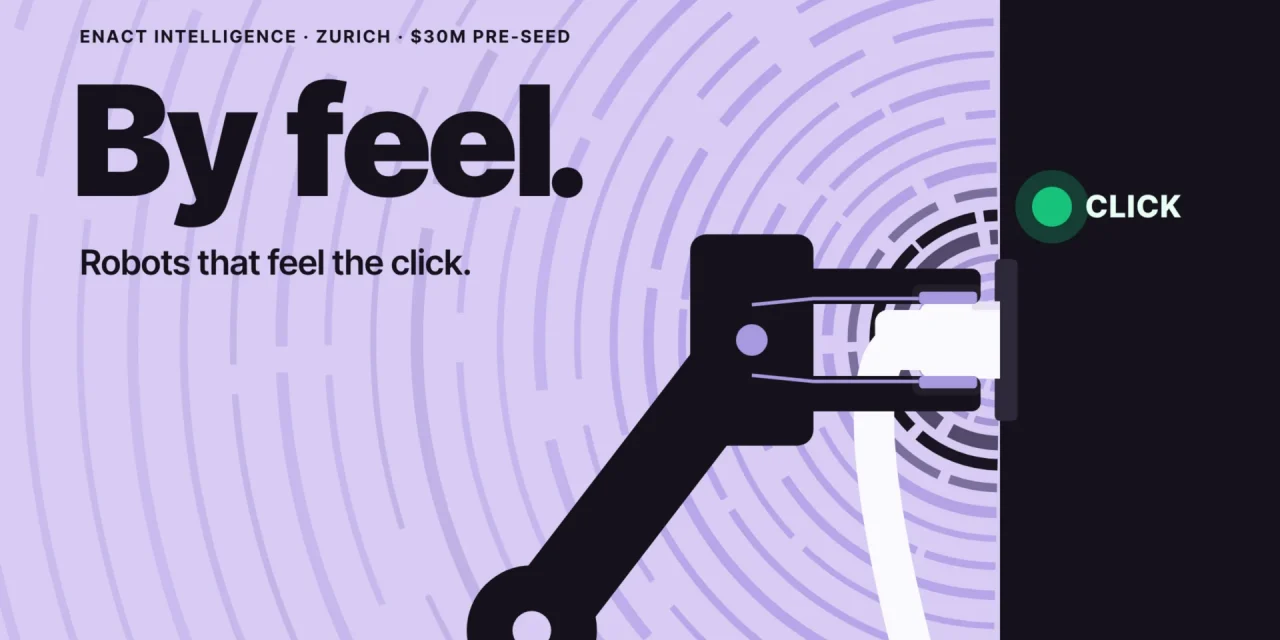
Enact Intelligence, a Zurich robotics start-up, has raised $30 million to give robots a sense of touch. It builds its own sensors, actuators and AI models for factory work that is still done almost entirely by hand: plugging in cables, fitting seals, starting screws. Yann LeCun and Mistral founder Arthur Mensch are among the backers. What Enact has not shown yet is any performance data.
What Enact Intelligence announced on 22 October
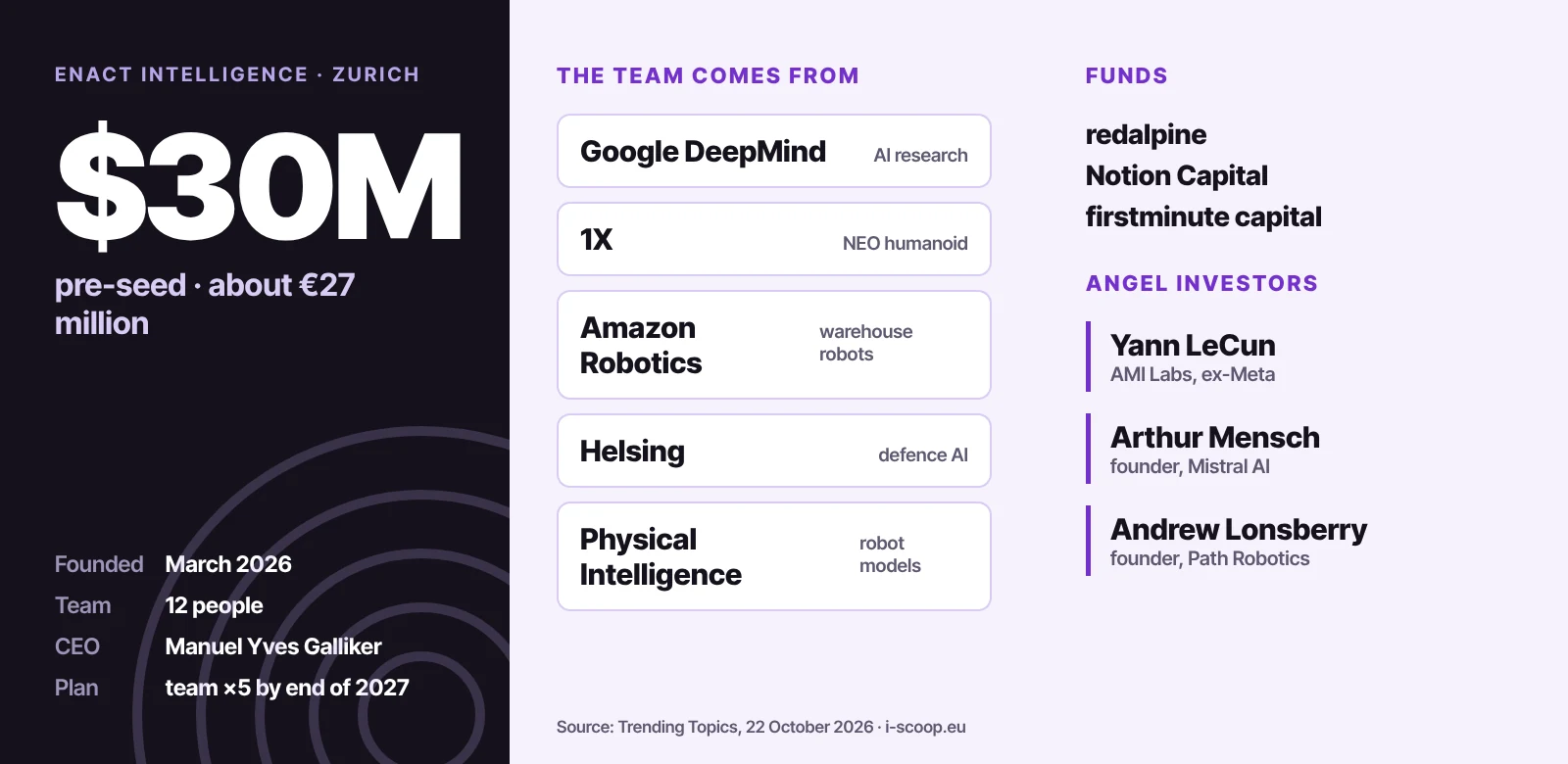
Enact came out of stealth on 22 October 2026 with a $30 million pre-seed round, about €27 million. The round comes from redalpine, Notion Capital and firstminute capital. Three well-known names joined as angel investors: Yann LeCun, Arthur Mensch and Andrew Lonsberry, founder of the welding robot maker Path Robotics.
That is a lot of money for a company founded in March 2026 with twelve people. Sifted called it one of the largest pre-seed rounds in Swiss history. Enact did not disclose a valuation.
Why robots that only look get stuck
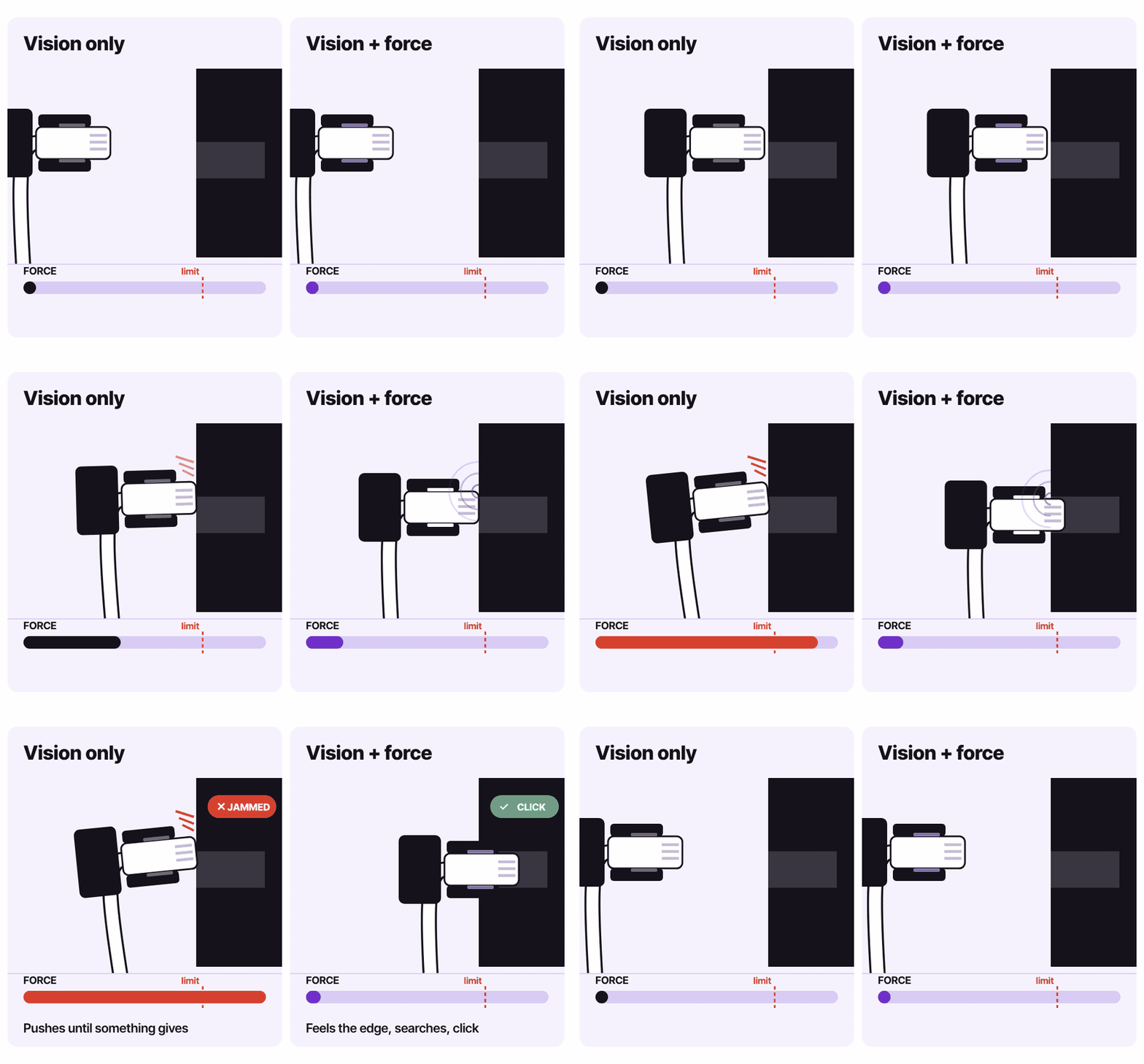
Most robot models today steer by vision and position. The camera sees where the plug and the socket are, and the model works out where the hand should go. That works for picking and placing. It fails at inserting, clicking and tightening, because the last millimetre is a matter of force, not sight.
Roboticists William Xie and Nikolaus Correll spell out the problem in a 2025 literature survey. With a stiff contact, a small error in position becomes a large error in force. The plug sits a fraction off, the robot pushes harder, and a pin bends or a clip snaps. A person feels that resistance in a split second and corrects. In their survey, a policy conditioned on force inserted a peg into a hole with less than half a millimetre of clearance in under two seconds, with more than 90% success. Position-only policies took at least twice as long.
So why is this not standard already? Robots with force sensors exist, but according to Enact they are often too expensive and too fragile for the factory floor. There is a data problem as well. Xie and Correll found that 76% of the force-sensing studies they reviewed train on fewer than 200 demonstrations. For a model meant to learn thousands of tasks, that is nothing.
A nervous system and a cortex, Enact’s approach
Enact describes its approach with two images from biology. The nervous system is a network of sensors that measures force across the robot’s whole body, down to the fingertips. The cortex is the AI model that reads those signals and controls the movement. The goal fits on one line of Enact’s website: solving dexterity through force and touch.
What stands out is that Enact wants to build the whole stack itself: model architecture, data pipeline, actuators and sensors. Investor f4 fund describes a “proprioceptive nerve system” that gives the robot whole-body force awareness. The technology is meant to work on any form factor, from a simple robot arm to a humanoid.
For the cortex, Enact does not start from scratch. It builds on existing AI models, such as video models, and adapts them to output robot movements. A research job posting speaks of “force-aware robotic foundation models” and lists architectures such as JEPA, the kind of world model LeCun has argued for over years and now pursues at AMI Labs.
The robots learn by being shown, not by being programmed. Enact is hiring robot operators in Zurich who pilot robots remotely with motion capture. They sort, use tools, open doors, assemble parts and handle cables, over and over. Those demonstrations become the training data, and in the words of the posting, the operator teaches the AI “what good looks like”. It is the same demonstration-first logic behind Walden Robotics and its large behaviour models, with force added as a first-class signal.
Who is behind Enact
Founder and CEO Manuel Yves Galliker studied mechanical engineering at ETH Zurich and did research in Marco Hutter’s lab and at Caltech’s AMBER lab. His master’s work on bipedal walking with model predictive control was published on arXiv and was a best paper finalist at IEEE Humanoids 2022. At the Norwegian company 1X he then led the controls and embedded team for the NEO humanoid, the team that taught NEO to walk. After that he worked at Physical Intelligence, the US maker of robot foundation models.
The twelve-person team comes from Google DeepMind, 1X, Amazon Robotics, Helsing and Physical Intelligence. Philip Kneis, previously a deep tech investor at redalpine, moved over to lead growth.
The angels say something too. LeCun’s AMI Labs raised $1 billion in March to build world models that understand the physical world. Lonsberry’s Path Robotics builds welding robots that learn from data. Both know how wide the gap is between a model that reasons and a machine that reliably assembles something.
Variety, not volume
Enact is not aiming at the car plant assembly line, where the same motion repeats thousands of times a day and classic robots have been at home for decades. It is aiming at final assembly in small batches with many variants. Programming a robot for every variant does not pay off there, so people do the work.
Enact cites a German figure to show the gap: 4.6% of small and midsize companies use robots, against 24% of large companies. We could not trace a primary source for those exact numbers, but the pattern is well known: the smaller the batch, the less automation. For Europe’s manufacturing base, with its long tail of specialised suppliers, that is exactly the market.
Galliker sums up the strategy in one line: “China wins on volume; we win on variety.” It is more than positioning. According to MIT Technology Review, nearly 90% of the roughly 15,000 humanoid robots shipped in 2025 came from Chinese companies. On price and unit numbers, Asia sets the bar.
With the money, Enact plans to grow its team fivefold by the end of 2027, speed up hardware development and deploy its first robots with industrial partners. It is in talks with European companies in manufacturing, infrastructure, retail and food processing. Zurich was chosen for its proximity to ETH, the local robotics cluster and industrial customers.
What Enact still has to prove
- Performance. Enact has published no success rates, cycle times or demo videos. For a seven-month-old company that is normal, but it means the approach cannot be judged yet.
- Customers. There are talks, no named customers.
- Hardware. Building your own sensors and actuators is slow and expensive. They have to end up cheaper and tougher than what exists, or the core argument falls away.
- Reliability. A factory needs near-flawless work. Robotics pioneer Marc Raibert points out in MIT Technology Review that going from 50% to 70% success is still a failure in practice.
- Competition. Physical Intelligence, NEURA Robotics, RobCo, Agile Robots and Gravis Robotics work on related problems, often with far more capital. NEURA recently added touch, hearing and memory to its Neuron AI model.
The difference Enact claims is the ambition to design sensors, hardware and model as one system, rather than bolting touch onto a vision model, and to make that run in a factory. Genesis AI made a similar bet on hand-level manipulation with GENE 26.5.
Frequently asked questions
What does Enact Intelligence do?
Enact builds robots that sense force and touch, with its own sensors, actuators and AI models. It targets manual work in final assembly, such as plugging in cables, fitting seals and starting screws.
How much did Enact raise and from whom?
$30 million (about €27 million) in a pre-seed round from redalpine, Notion Capital and firstminute capital, with Yann LeCun, Arthur Mensch and Andrew Lonsberry as angel investors.
Is Enact building a humanoid robot?
Not necessarily. The technology is meant to work on any form factor, from a simple robot arm to a humanoid. Which robot Enact will deploy first has not been disclosed.
Who founded Enact?
Manuel Yves Galliker, an ETH Zurich engineer who led the controls team for the NEO humanoid at 1X and then worked at Physical Intelligence.
The test that matters is a cable the model has never seen
If you want to track Enact, do not watch the next round or the next video. The real yardstick is simpler: how often does an Enact robot insert a connector it has never seen, without breaking anything, and how fast. If the company produces numbers that convince a plant manager, Europe has an answer to Chinese scale. If not, it remains a strong team with a good story.