ElevenLabs launched Eleven Realtime on 20 October 2026: two voice-agent models that start speaking in about 0.6 seconds. The speed is what made the headlines. For companies that buy voice agents, the more consequential detail is that the new Realtime API speaks the same protocol as OpenAI’s. Moving an existing agent comes down to a new endpoint and a new model name, which makes voice vendors easier to swap. The models themselves are fast and strong at spoken reasoning, but in independent tests they finish fewer tasks than Grok Voice 3.0 and Gemini 3.8 Live. By our own estimate, a conversation costs between 8 and 10 US cents a minute.
What ElevenLabs launched
Eleven Realtime comes in two versions. Eleven Realtime v1 Mini is the default, built for natural conversation at low cost: assistants, tutors and interactive characters. ElevenLabs says it covers most use cases. Eleven Realtime v1 Max reasons before it answers and is meant for customer support, lead qualification and workflows where the agent follows a process and calls several tools. Both speak more than 90 languages and can use any of the 17,000-plus voices in the ElevenLabs library, according to the launch announcement.
There are two ways in. ElevenAgents, the company’s hosted agent platform, lets you pick a Realtime model from a dropdown and deploy it to phone lines, a web widget, WhatsApp and contact-centre platforms such as Zendesk and Genesys, with a knowledge base, guardrails, scripted tests and monitoring. The Realtime API is the second route, for teams that run their own client and backend. Access is rolling out gradually.
The launch lands while ElevenLabs is scaling fast. Annual recurring revenue passed $500 million in the first quarter of 2026, and a $300 million employee share sale in September valued the company at $22 billion, double its February valuation. Large organisations now make up 55% of revenue, Journal du Net reports.
The protocol is the bigger story
The Realtime API uses the same client and server events and the same WebSocket transport as OpenAI’s Realtime API. The migration guide shows OpenAI’s own SDK, @openai/agents-realtime, pointed at wss://api.elevenlabs.io/v1/convai/realtime with the model name eleven_realtime_v1_mini. Your backend mints a short-lived client secret, so the API key never reaches the browser.
When a challenger adopts the market leader’s wire format, that format starts to behave like a standard. For buyers this changes the negotiation. If your voice front end talks one protocol to several vendors, you can compare them on the same calls and move when prices or quality shift. That is the logic we described in Models are rented, context is owned: keep the parts you own portable and treat the model as a rental.
The compatibility has limits. The API supports WebSocket only, so apps built on WebRTC have to change transport. The OpenAI SDK only wires audio automatically over WebRTC, which means you capture and play 24 kHz PCM16 audio yourself. And the bare API is separate from ElevenAgents: phone and WhatsApp channels, the knowledge base and monitoring are not included. ElevenLabs itself advises starting on ElevenAgents, so teams on the bare API may end up rebuilding those features.
A managed cascade, not one model
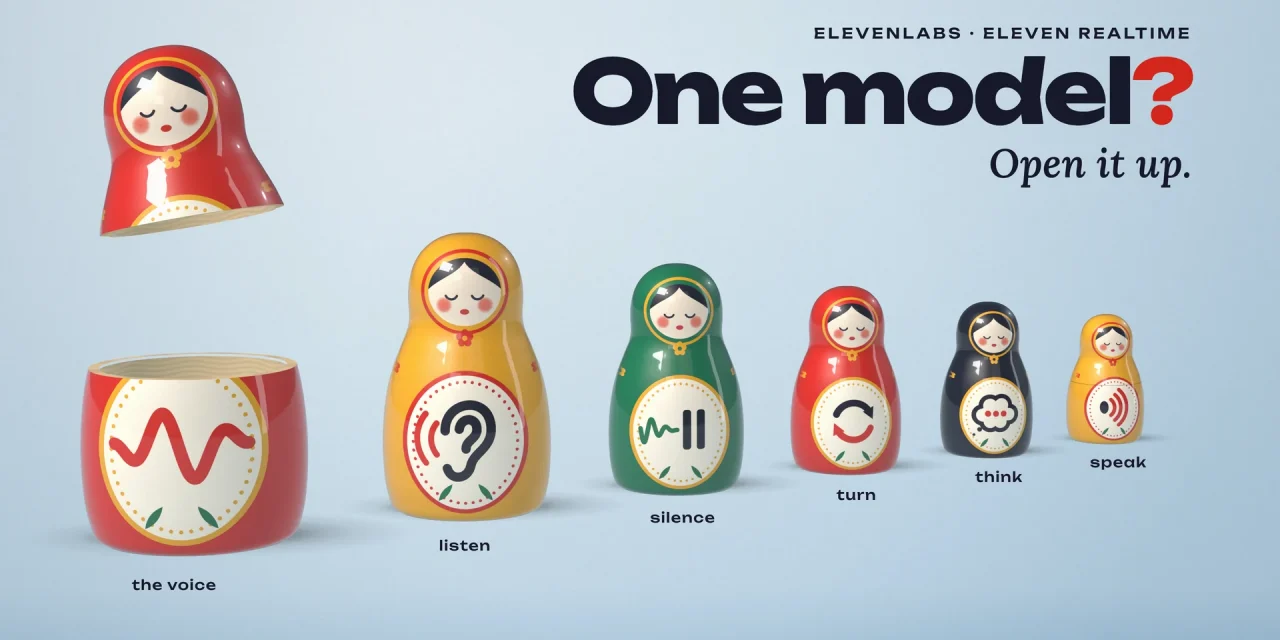
ElevenLabs markets Eleven Realtime as “a new class of Speech to Speech models” that handles recognition, turn-taking, reasoning and voice in one system. Its documentation is more precise. Mini and Max use a cascaded architecture in which each component is a distinct model, explicitly not a fused speech-to-speech model, and the underlying models are not disclosed.
That fits the company’s own position. In March 2026 ElevenLabs argued that cascades suit businesses and governments better than fused models, because the text between stages lets you enforce guardrails, trace failures and swap in a newer language model. It conceded that fused models preserve rhythm and emotion better. Eleven Realtime is that cascade, tuned and locked by ElevenLabs.
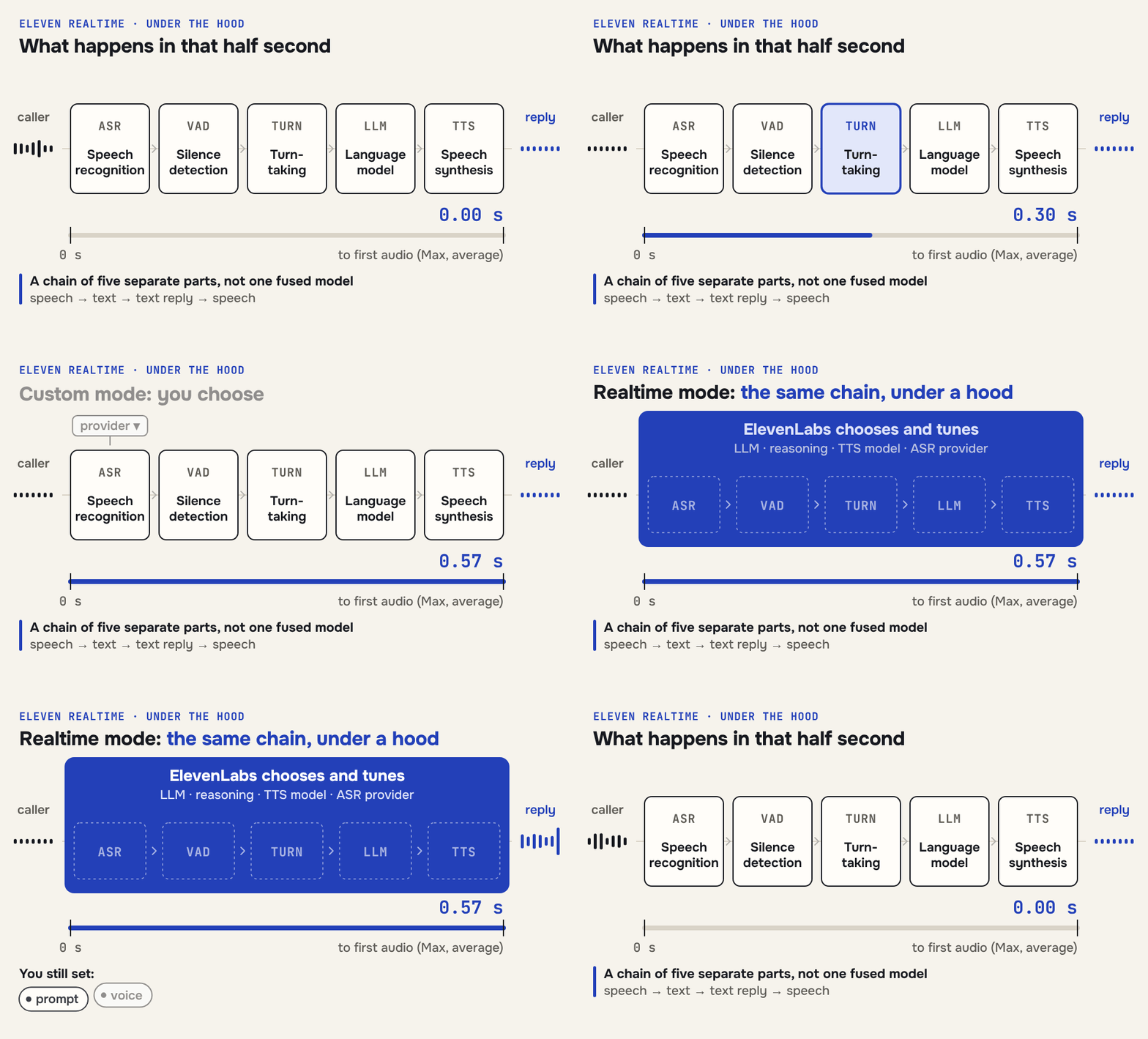
The Realtime models documentation lists what ElevenLabs takes over: the language model, reasoning effort, thinking budget, parallel tool calls, the speech model, expressive mode and the speech recogniser. You keep the system prompt, first message, voice, languages, temperature through the API, tools, knowledge base and turn-taking settings such as eagerness, timeouts and interruptions. Custom LLMs and Amazon Bedrock are not supported in Realtime mode. For a contact centre that has standardised on one language model for compliance reasons, that is a real constraint.
The New Stack described the launch as ElevenLabs effectively taking over the voice-agent harness: turn detection, interruption handling and orchestration. That layer matters, as Google’s Harness² showed for text agents. Handing it to the vendor saves engineering time, but it also hands over the layer where many quality gains are made.
How Eleven Realtime scores against Grok, Gemini and OpenAI
The benchmark figures ElevenLabs quotes come from Artificial Analysis, an independent test lab. As of 21 October 2026:
| Model | Time to first audio | Spoken reasoning | Task success | Turn-taking | Blind preference, Elo |
|---|---|---|---|---|---|
| Eleven Realtime v1 Max | 0.57 s | 98.8% | 87.1% | 94.1% | 997 |
| Eleven Realtime v1 Mini | 0.62 s | 75.9% | 60.3% | 95.8% | 988 |
| Grok Voice 3.0 | 0.81 s | 98.5% | 94.8% | 97.0% | 1064 |
| Gemini 3.8 Live | 1.18 s | 92% | 93.2% | 96.1% | 1078 |
| GPT-Live-1, Sol low | 1.24 s | 89% | 90.9% | 97.3% | 1047 |
Spoken reasoning is Big Bench Audio, 1,000 spoken questions. Turn-taking is Full-Duplex-Bench, which tests pauses, interruptions and backchannels such as “mm-hmm”. Blind preference comes from the Speech Agent Arena, where people rate conversations without knowing which model they heard.
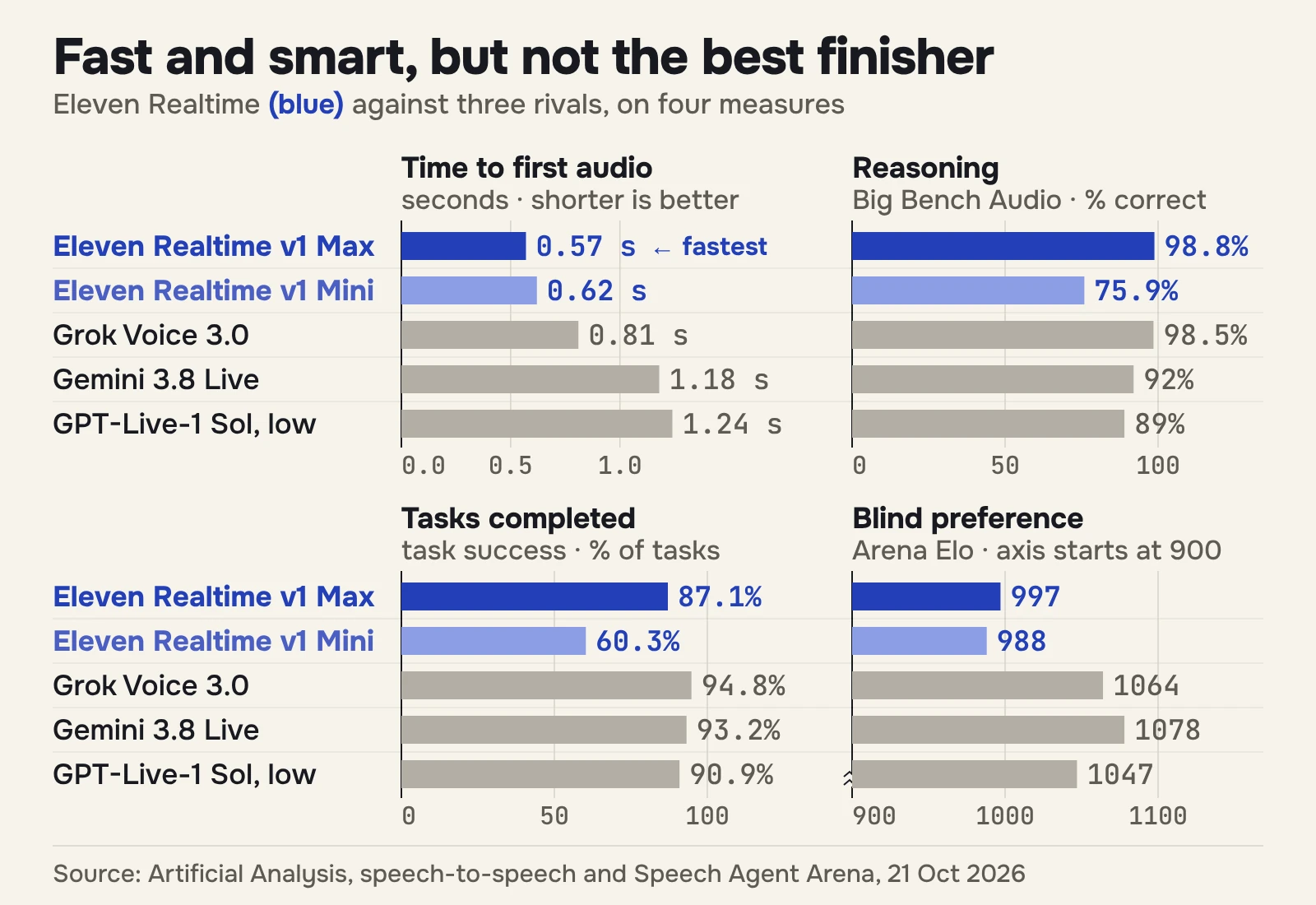
ElevenLabs’ claim that no model is both faster and more accurate holds for reasoning: the only faster model, Deepslate Opal at 0.44 seconds, scores 85%. Task success tells a different story. Max completes 87.1% of tasks against 94.8% for Grok Voice 3.0, and Mini manages 60.3%, which rules it out for tool-heavy work. In the blind arena Max ranks ninth, three points above the older default cascade of ElevenLabs Agents. Neither model has an overall Speech-to-Speech Index score yet, because the τ-Voice agent test has not been run. Grok Voice 3.0 leads that index at 86.9.
What Eleven Realtime costs
Several launch reports said pricing was unknown. The ElevenLabs API pricing page does list it, as of 21 October 2026:
| Realtime v1 Mini | Realtime v1 Max | |
|---|---|---|
| Connected audio | $0.08 per minute | $0.08 per minute |
| Input tokens | $0.20 per million | $1.80 per million |
| Output tokens | $6.00 per million | $9.00 per million |
| Burst above your concurrency limit | $0.16 per minute | $0.16 per minute |
| Indicative cost per minute, our estimate | about $0.084 | about $0.102 |
ElevenLabs does not say how many tokens a minute of conversation uses, so the last row is our own calculation. On the tier that matches the $99-a-month Pro plan for regular agents, ElevenLabs estimates about 1,179 minutes of Mini or 971 minutes of Max at typical usage. Dividing gives 8.4 and 10.2 cents a minute, which makes Max roughly 21% more expensive. Fewer retries on complex calls could close that gap. In Artificial Analysis’s benchmark runs, an hour of input audio cost $4.80 on Eleven Realtime, the same as Grok Voice 3.0, while Gemini 3.8 Live did it for $0.84.
Compliance and data residency for European buyers
Both models run in ElevenLabs’ EU data residency environment. The difference sits in the stricter settings: Zero Retention Mode and HIPAA configurations exist only for Max, in the US and EU. Mini is available in India and Singapore, Max is not. ElevenLabs lists SOC 2 Type II, ISO 27001, ISO 42001 and PCI DSS Level 1 among its certifications. Those are vendor claims, so check the scope of each certificate against your own use case.
Two platform rules matter for larger deployments. Realtime agents can only transfer calls to other Realtime agents, though Mini and Max can hand over to each other. And Max requires a token limit of at least 1,024, or none at all.
European deployments also carry a disclosure duty. Article 50(1) of the EU AI Act has applied since 2 August 2026: people must be told they are interacting with an AI system unless that is obvious. The July 2026 digital omnibus moved the high-risk deadlines but left this obligation in place. The simplest fix is a first message that says it.
How to run a fair pilot
The benchmarks say nothing about production load, compressed phone audio or your languages beyond a count of 90. A pilot should measure what you will pay for:
- Cost per completed call, not cost per minute. A cheap minute that ends in a handover is expensive.
- Transfer rate to human agents on your real top intents.
- Your markets’ languages and accents, recorded from your own customers. ElevenLabs publishes no per-language accuracy.
- Real phone lines, where compression and network delay add to the 0.57 seconds.
- Failure diagnostics: when a call goes wrong, can your team see why?
- Your exit path: run the same client against a second backend over the shared protocol before you sign.
FAQ about Eleven Realtime
Is Eleven Realtime a true speech-to-speech model?
From the outside, yes: audio goes in and audio comes out. Inside, ElevenLabs’ documentation describes a cascade of separate models that ElevenLabs selects and tunes.
Can I move my OpenAI Realtime agent to Eleven Realtime?
Mostly. You keep OpenAI’s SDK and change the endpoint and model name. WebRTC is not supported, so you switch to WebSocket and handle 24 kHz PCM16 audio yourself.
Should I choose Mini or Max?
Mini for simple, conversational agents. Max for multi-step tool use, long instructions, or when you need Zero Retention Mode or HIPAA.
Can I try it for free?
The smallest pricing tier, which matches the free plan, includes an estimated 14 minutes of Mini or 12 minutes of Max, but access is rolling out gradually, so not every workspace has it yet.
The exit door is now part of the product
ElevenLabs adopted OpenAI’s protocol to make switching to ElevenLabs painless. The same door opens the other way. A team that wires its agents to the shared protocol can put two vendors on the same traffic and let completed calls decide. On today’s numbers, Max would win the speed test and lose the completion test. That is exactly the kind of result a buyer can now check in weeks instead of months.