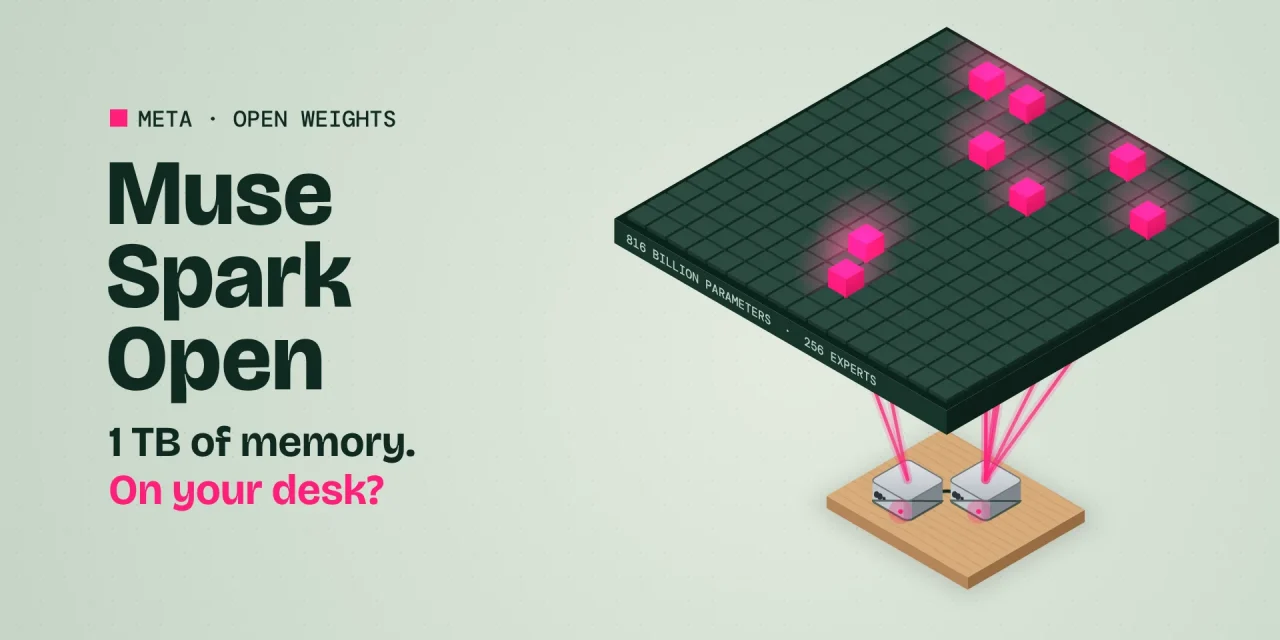
Muse Spark Open is Meta’s new open-weight model: 816 billion parameters, a one million token context window and a design aimed at coding agents and long, multi-step work. You can download the weights for free, fine-tune them and use them commercially. For European companies that want a strong model under their own roof, it is the first US-built option close to the top of the open-weight rankings in a long time. The catch: self-hosting it takes about a terabyte of memory, the licence comes with conditions, and on pure coding it still trails the leading Chinese models.
What Meta released
Meta published Muse Spark Open on 15 October 2026, three days after its closed flagship Muse Wonder. It is the largest Muse model with public weights and Meta’s first major open release since Llama 4 in April 2025. In its announcement Meta calls it “the most capable US open-weight model to date”.
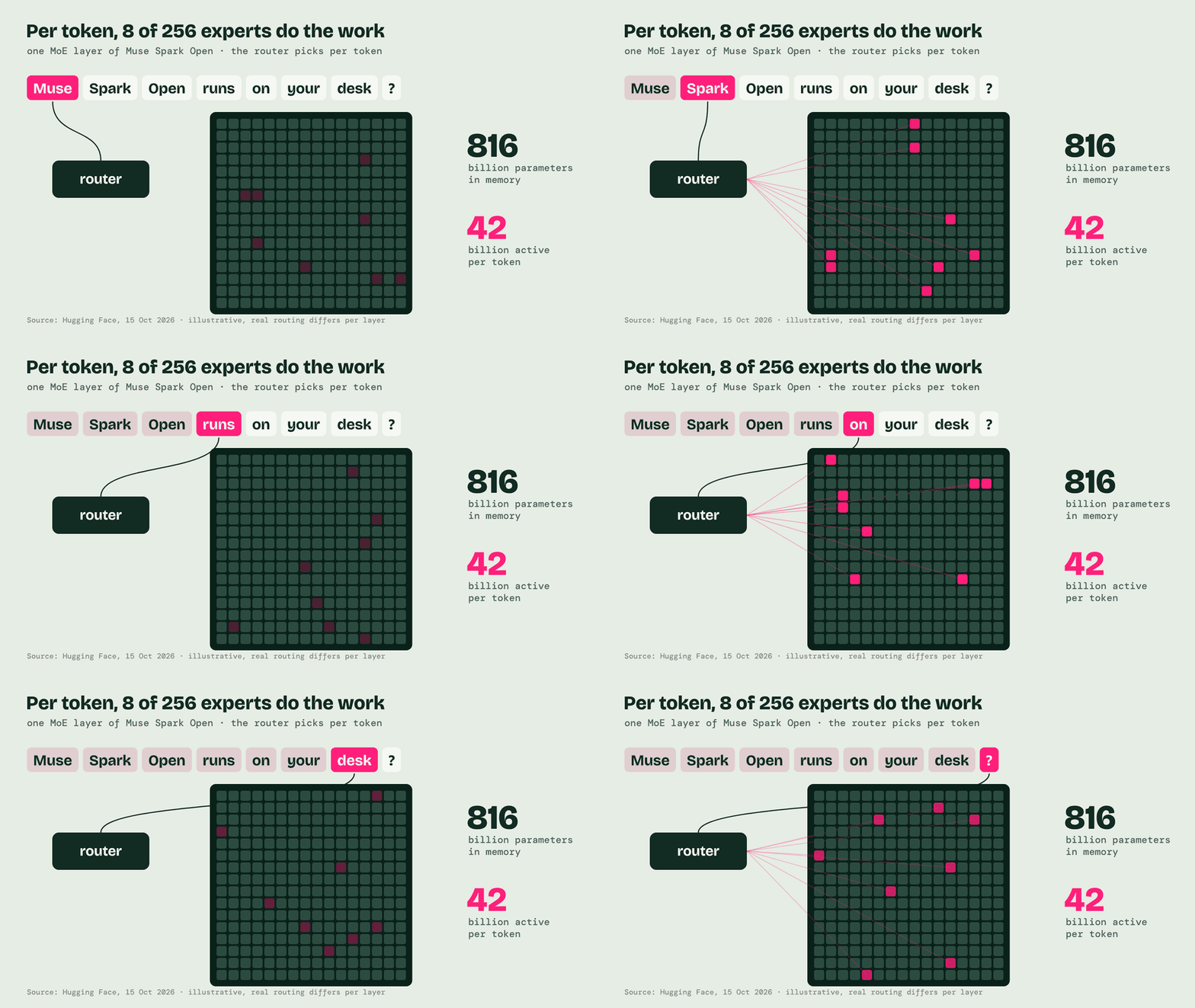
- 816 billion parameters, 42 billion active per token. It is a mixture-of-experts model with 256 experts per layer, of which a router picks 8 for each token.
- Context of up to 1,048,576 tokens, shared across text, images, audio and video.
- Multimodal input (text, images, audio, video) with text output.
- Reasoning is always on, with four effort levels from low to xhigh.
- Trained on more than 100 languages, although the model card does not say which ones are strongly supported. If you work in Dutch, French or German, test that first.
Where it leads and where it trails
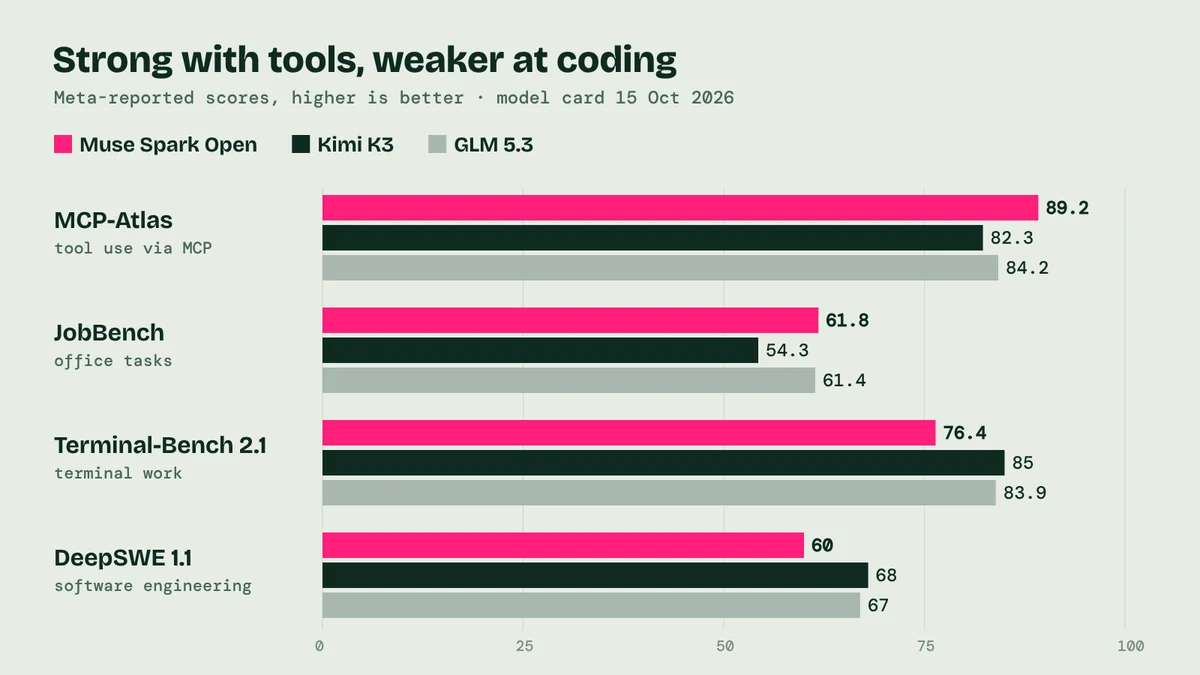
Meta’s own benchmark table on Hugging Face shows a clear profile. Muse Spark Open is strongest at agentic work with tools and weaker at software engineering.
| Benchmark | Muse Spark Open | Kimi K3 | GLM 5.3 |
|---|---|---|---|
| MCP-Atlas (tool use via MCP) | 89.2 | 82.3 | 84.2 |
| JobBench (office tasks) | 61.8 | 54.3 | 61.4 |
| Terminal-Bench 2.1 | 76.4 | 85.0 | 83.9 |
| DeepSWE 1.1 | 60 | 68 | 67 |
| Artificial Analysis Intelligence Index | 39 | 44 | 45 |
Against other US open models the jump is large: Thinking Machines’ Inkling scores 26 on the Intelligence Index and Nvidia’s Nemotron 3 Ultra 23. Against the Chinese leaders it is a different story. Kimi K3, GLM 5.3 and Xiaomi MiMo-V2.6-Pro (46) all rank higher, and The New Stack notes that Meta already acknowledged the coding gap when it launched the closed Muse Spark in April.
Two results matter for companies that will be accountable for what a self-hosted model says. On StrongREJECT v2, which measures how often a model goes along with jailbreak attempts, Muse Spark Open scores 0.5 against 63 to 86 for the other open models in the table (lower is better). On AA Omniscience, which penalises confident guessing, it posts 25, the best score in the comparison. All figures are Meta’s own, measured at the highest effort level.
What self-hosting really takes
The full BF16 weights are around 1.5 TB. A 4-bit NVFP4 version for Nvidia Blackwell GPUs exists, but the model card still lists at least 700 GB of GPU memory for it. That leaves three realistic routes.
- Two Mac Studios as one machine. Meta worked with Apple so the model runs on two M5 Ultra Mac Studios with 512 GB of unified memory each, linked through MLX. Meta used that setup to have Muse Code ship fixes and features for the open-source Mastodon app Ice Cubes, and to review and crop footage in DaVinci Resolve, all on-device. According to MacRumors the 512 GB Mac Studio ships later in October; Apple has not announced a price, but the 256 GB model already costs more than $10,000.
- One Mac with an aggressive quantisation. On a single M3 Ultra with 512 GB, Hugging Face ran a 2-bit version at 18 tokens per second and a 3-bit MLX version at 21 tokens per second, using roughly 304 GB and 344 GB (Hugging Face blog). Fine for experiments, but the quality loss at that compression has not been measured.
- A GPU server. One B200 node or four GB300 GPUs for NVFP4, or four nodes of eight H200s for full precision. vLLM, SGLang, TensorRT-LLM, Transformers, llama.cpp, MLX and Unsloth are all supported, with optimisations for AMD, Apple, Intel and Nvidia hardware.
Long contexts add to the bill: a full million-token KV cache takes about 266 GB in BF16. For sovereign or on-prem deployments, compare this with lighter options such as Aikido Altar, which compresses a frontier security model to 328 GB.
Start with an API, not with hardware
Muse Spark Open is available from Baseten, Fireworks AI, Groq, Modal, Nebius, OpenRouter and Together AI. Artificial Analysis lists $1.25 per million input tokens and $4.25 per million output tokens, with about 131 tokens per second and a first token after 0.73 seconds. Weights are also on Amazon SageMaker AI, Google Cloud Model Garden and Microsoft Foundry, which helps if your organisation already buys AI through one of those clouds.
A practical pilot: give it a small, real issue from your own codebase or workflow that has a clear test, and compare the result, cost and waiting time with the model you use today. Only when it wins on your own tasks is a hardware investment worth discussing.
The licence in plain terms
The weights come under the Muse Model License, Meta’s own licence rather than Apache 2.0 or MIT.
- You may use, modify, fine-tune, distil and sell the model as part of your own products. Meta claims no rights to outputs.
- Every product built on it, or on a derivative, must prominently show “Built with Muse Spark Open” in the interface, documentation or settings.
- If you offer the model to third parties as a service and you and your affiliates exceed $20 million in gross revenue over twelve months, you must notify Meta and sign a separate agreement first. Internal use, research and embedding it in your own product are excluded.
- The usage policy rules out military use, operating critical infrastructure, malware and use by anyone under 18.
Two points for European buyers. The licence contains no geographic restriction, so companies in the EU can download and deploy it. But downloading from Hugging Face requires your legal name, date of birth and full company name, processed under Meta’s privacy policy. And Chinese competitors such as Qwen and GLM mostly ship under Apache 2.0 or MIT, without revenue thresholds or attribution rules. Whether a licence with commercial conditions still qualifies for the open-source provisions of the EU AI Act is a question for Meta as provider, not for you as a user, but your legal team will want to know which licence it is signing.
Who should look at it now
- Teams building tool-heavy agents that need to stay on their own infrastructure. The MCP-Atlas and JobBench results are where the model stands out.
- Organisations with a policy against Chinese-built models. Until now the strongest open weights came almost entirely from China; this is the first US alternative in the same range. Compare it with Europe’s own Mistral Large 4, which scores 38 on the same index.
- Not yet: teams that mainly want a coding agent. Kimi K3 and GLM 5.3 do better today.
Frequently asked questions
Is Muse Spark Open open source?
Not in the strict sense. The weights are free to download and use commercially, but the licence adds conditions such as mandatory attribution and a revenue threshold for model-as-a-service providers. Meta calls it open weights.
How does it relate to Muse Spark 1.3 and Muse Wonder?
Muse Spark 1.3 and Muse Wonder are Meta models without public weights, reachable through the Meta Model API and Muse Code. Muse Spark Open scores lower than Wonder, but you get the weights and can run it yourself.
Can it run on a normal workstation?
No. Even the most compressed version needs more than 256 GB of memory. For ordinary hardware Meta offers the much smaller 30-billion-parameter Muse Glimmer.
A second supplier for open weights
Muse Spark Open is not the best open model, and its licence is less free than Apache. What it changes is the shortlist. A company that wants a capable model fully under its own control now has a credible US-built candidate next to the Chinese leaders and Mistral, and that is a stronger negotiating position than it had a week ago.