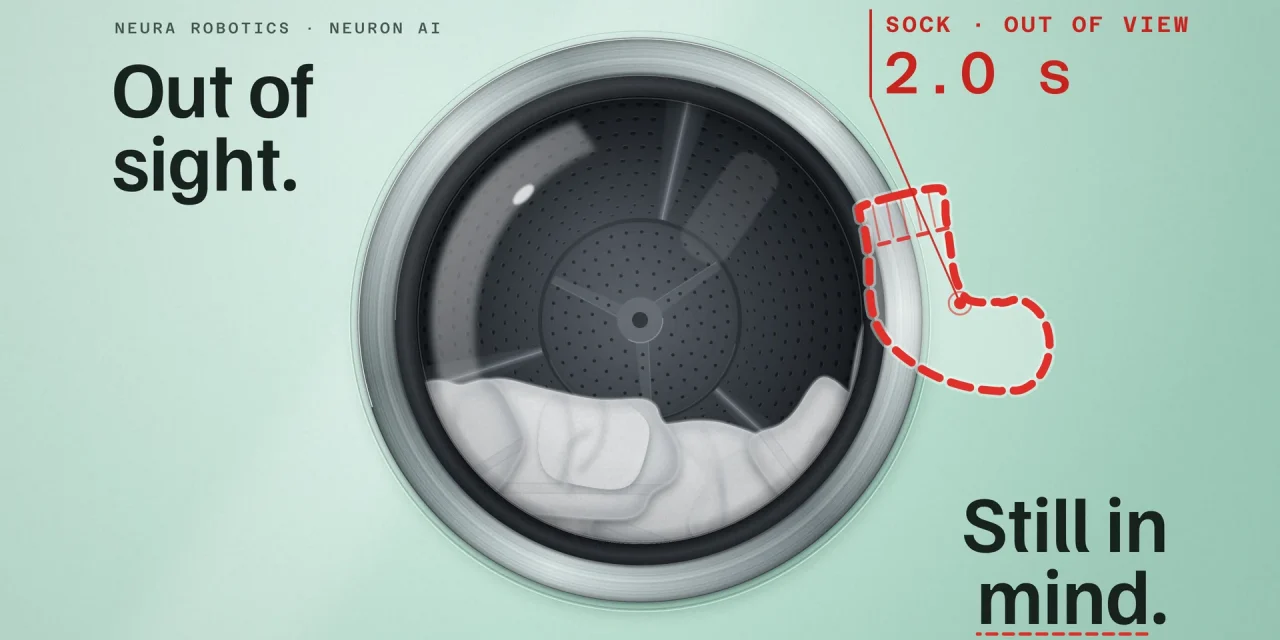
A camera cannot tell whether a lock has really opened. A person hears the click and feels the resistance give way. With Neuron AI, Germany’s NEURA Robotics wants its robots to do the same. The new foundation model combines 3D vision with touch, force, sound, the robot’s own state and language, and it remembers what has happened. This week it faces its first public test: a humanoid robot that handles laundry on its own for eleven minutes at NVIDIA GTC Berlin. Here is what Neuron AI does differently, what it was trained on and what NEURA has not shown yet.
What NEURA Robotics announced
NEURA Robotics, based in Metzingen near Stuttgart, presented Neuron AI on 14 October 2026. The company calls it a Perception-Language-Action model, or PLA. It reads all of the robot’s senses at once, aligns them on a single timeline and returns one stream of actions: an arm that moves, a hand that squeezes, a step to the side.
NEURA built and trained the model in-house in Germany. It runs on five of the company’s own robots, each with different grippers and hands. Founder and CEO David Reger put the goal this way: “An intelligent robot needs a brain that brings its senses together and remembers what happened.”
Why touch, sound and memory are the bet
Most well-known robot foundation models are vision-language-action models. They learn mainly from images and language. That works well for recognising an object and locating it. It falls short when the important part happens where the camera cannot look: inside a hand that closes around an object, behind a door or in a sound.
NEURA gives three examples of its own. Sound and touch confirm that a lock is really open. Touch lets a robot grasp an object it cannot see. In welding, sound says something about the quality of the seam. Memory adds a fourth ability. The robot keeps track of where an object is after it leaves the camera’s view, and it knows how its earlier actions changed its surroundings.
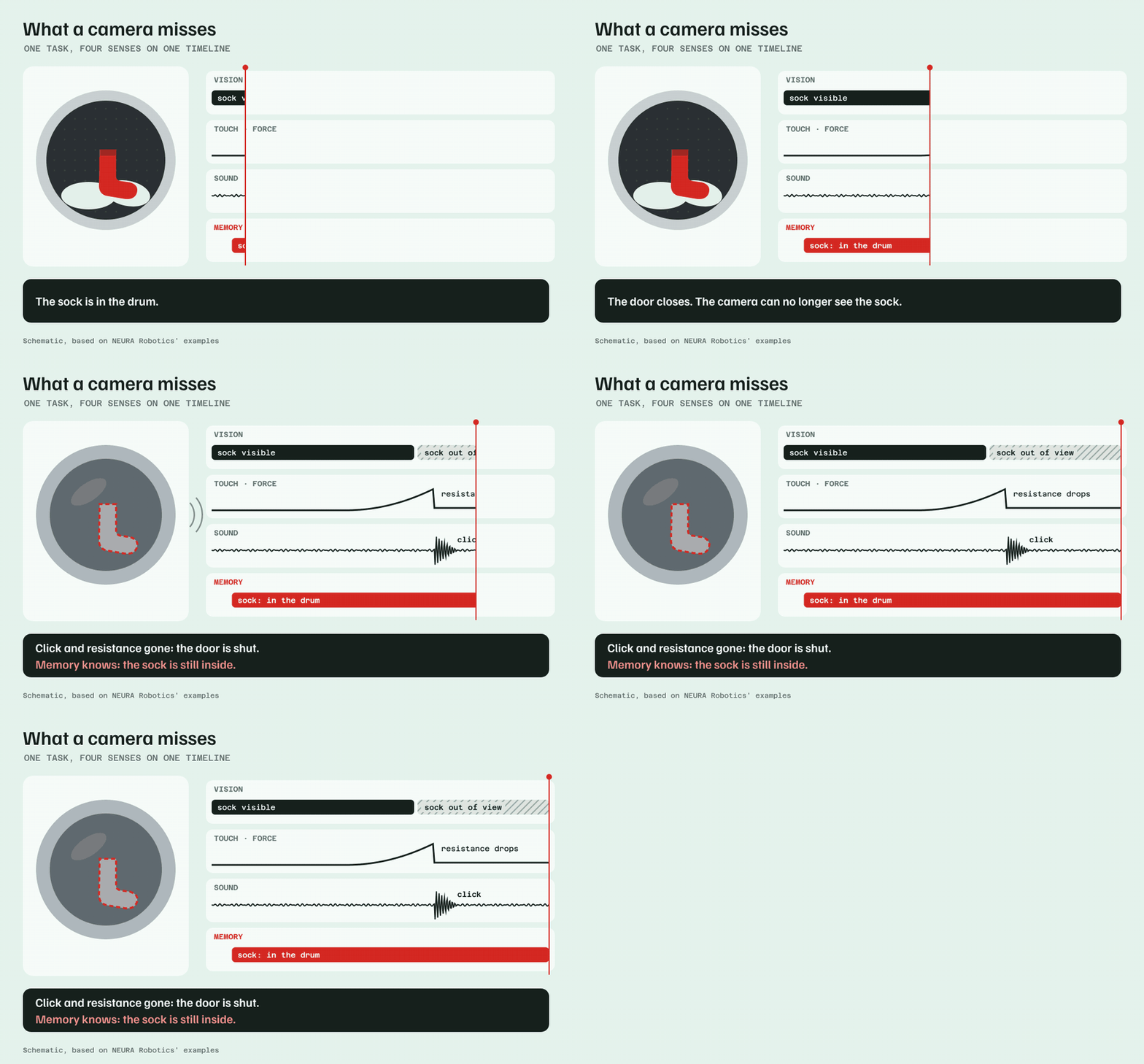
With laundry, that is not a detail. Whoever loads a machine, shuts the door and opens it again later has to know what is inside and whether the door really closed. That is why NEURA picked laundry for its first public demo.
The data behind Neuron AI
According to NEURA, the training data comes from three sources:
- Real robot data from the NEURA Gyms, training halls where robots perform tasks while vision, touch, force, sound and movement are recorded in sync.
- Simulation data, expanded with the company’s Data Amplifier, which generates variations of tasks and environments.
- Human demonstrations, captured with sensor-equipped suits that people wear while going through everyday movements.
Industrial partners Schaeffler and Bosch contribute data as well. That is also where the biggest question sits. Rueben Scriven of research firm Interact Analysis told TechTarget that there is already a shortage of well-annotated video data, “let alone multi-modal input data”. The real question, he said, is whether the data collected across NEURA’s gyms will be enough to train the models. A review paper on arXiv published the same week makes a similar point. Tactile data is scarce because it can only be collected through physical contact, and it is closely tied to the specific sensor that measured it.
One model, five robots and skills that stay private
Neuron AI is a single shared model for five platforms: the 4NE1 Gen 3 and Gen 4 humanoids, a wheeled 4NE1 and two bimanual platforms, Interesting Engineering reports. NEURA’s product information says inference runs locally on the robot, without a cloud connection. For factories with strict data rules, and for the compute budget on board, that matters. Our look at the Jetson Thor T3000 shows how much on-board AI compute humanoids now carry.
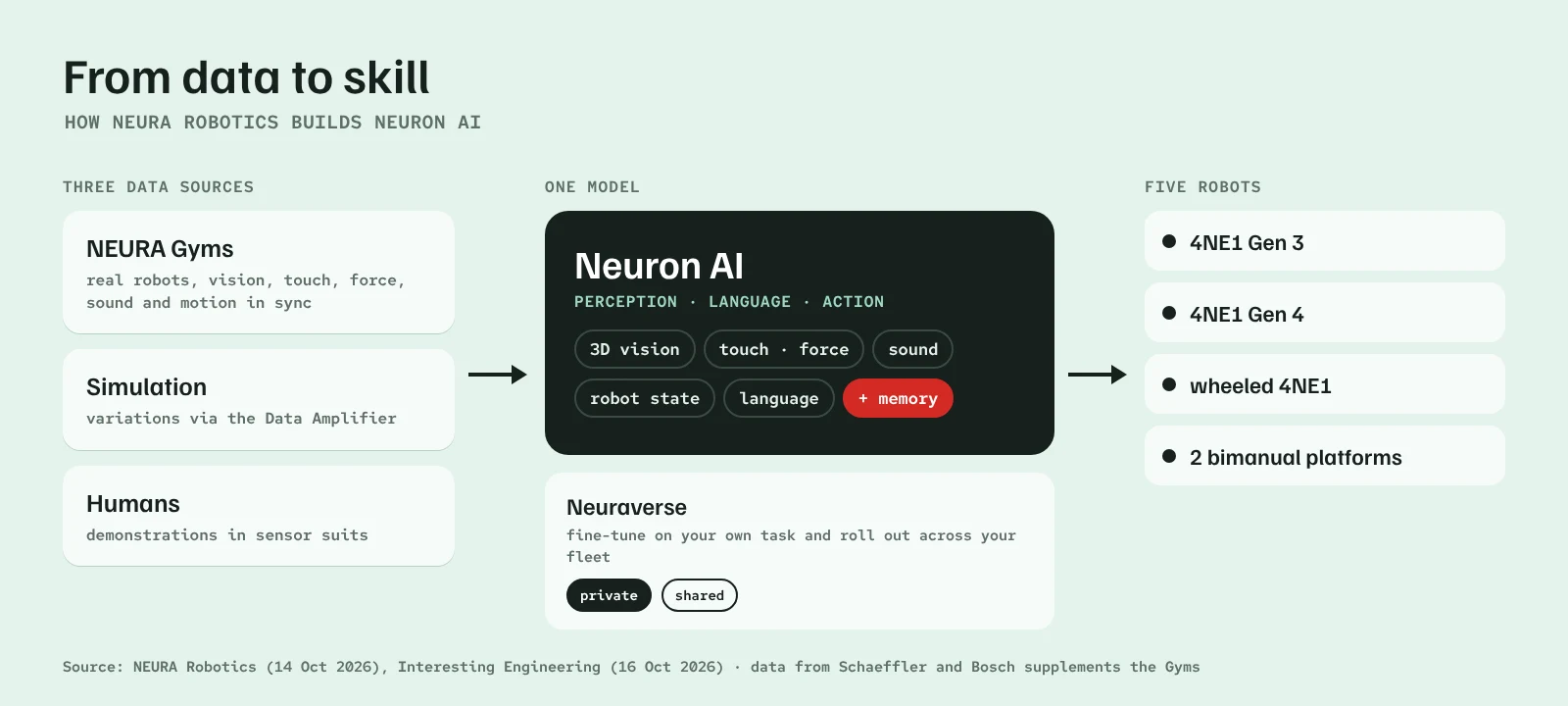
Companies fine-tune the model for their own tasks through Neuraverse, NEURA’s platform, and roll the resulting skills out across their fleet. They can keep a learned skill private or share it with other users. For a manufacturer that does not want to hand its process know-how to a vendor or a competitor, that is a serious selling point.
NEURA tracks progress with one metric: Time-to-Skill, the time it takes a robot to learn a new task and perform it reliably. It is the right measure for a company that wants to deploy robots. NEURA has not published a single Time-to-Skill figure yet.
Memory gets help from Linz
On 20 October NEURA announced a partnership with NXAI, the Austrian company founded by AI pioneer Sepp Hochreiter. Together they are building a memory component for robots based on xLSTM, Hochreiter’s architecture that maintains state efficiently over long sequences. NXAI also plans to offer its own xLSTM-based model on Neuraverse, next to Neuron AI, with no date given. “A robot that genuinely helps in everyday life and industry must be able to remember,” Reger said.
That NEURA brings in outside help for memory a week after launch says something about how hard that part is. A robot that misremembers acts with the same confidence as one that remembers correctly, and a stale memory near people is a safety question, not just a performance one. The new ISO 25785-1 standard for humanoid robot safety is where that question will eventually land.
What NEURA has not shown yet
The ambition is large and the evidence is thin. NEURA has published no benchmarks, no technical report, no model card and no weights. Parameter count, latency, pricing and customers are not disclosed. How much touch, sound and memory add compared with a vision-only model, the company has not measured, or at least not shared.
The GTC Berlin demo runs from 20 to 22 October. A successful eleven-minute run is a good start, but it says little about how often things go wrong and how the robot recovers. NEURA knows how wide the gap between stage and shop floor can be. In June at Computex in Taipei, a 4NE1 running Qualcomm hardware collapsed on stage during a keynote. Qualcomm blamed a communication glitch that triggered a controlled safety shutdown.
NEURA is also not the only company adding touch. Figure AI’s Figure 03 robot has tactile sensors and palm cameras feeding its Helix 02 model. The difference lies in the approach: NEURA puts touch, sound and memory at the core of the model instead of treating them as extras on top of vision. Whether that works better still has to be proven. Other teams take yet another route, such as the large behaviour models trained by demonstration at Walden Robotics.
Europe’s biggest bet on a robot brain
NEURA is Europe’s largest wager on humanoid robots. In June the company raised up to $1.4 billion in a Series C led by Tether, with the full amount tied to milestones. Nvidia, Amazon, Qualcomm, Bosch, Schaeffler, the European Investment Bank and imec.xpand, the venture fund linked to Belgium’s imec, also joined. Bloomberg put the valuation at around $7 billion, a figure NEURA did not confirm. The company has more than 1,000 employees and says its order book and deployment pipeline exceed $1 billion.
A home-grown model makes NEURA less dependent on American and Chinese foundation models for its robots, and it gives European manufacturers a supplier that keeps training and data in Europe. At the same time, Nvidia is both an investor and the host of the demo stage, and Qualcomm supplies the compute platform for NEURA’s humanoids. Sovereignty in robotics stops at the silicon for now. For a sense of the competition, see our overview of the 40 most innovative AI labs in China, several of which build models for robots.
Questions to ask before a pilot
For companies considering NEURA robots, the announcement suggests a short list of questions:
- What is the measured Time-to-Skill for a task like yours, and over how many runs?
- What is the success rate, and what does the robot do when it fails?
- Which data leaves your site during fine-tuning, and who owns the resulting skill?
- How do learned behaviours interact with the certified safety controller around people?
Frequently asked questions about Neuron AI
What does PLA mean in Neuron AI?
PLA stands for Perception-Language-Action. Where a typical vision-language-action model relies mainly on images and language, Neuron AI also processes touch, force, sound and the robot’s state, combined with memory.
Can I use Neuron AI myself?
Not as a standalone model. Neuron AI runs on NEURA robots and is fine-tuned through the Neuraverse platform. NEURA has not released weights or pricing.
Which robots run Neuron AI?
Five NEURA platforms: the 4NE1 Gen 3 and Gen 4 humanoids, a wheeled 4NE1 and two bimanual platforms.
When is Neuron AI available?
NEURA describes the model as launched but has given no date for general availability. The demo at NVIDIA GTC Berlin from 20 to 22 October 2026 is its first public test.
The laundry basket is only the first exam
Eleven minutes of laundry without help is a strong demo. The real exam starts when a customer runs the robot a thousand times, with different fabrics, a different machine and a door that sometimes sticks. Only then will it show whether touch and memory prevent mistakes or just make a better story. So the question to put to NEURA is not how smart Neuron AI is, but how long it takes before your task runs reliably. On that question, Time-to-Skill, the company now has to come back with numbers.