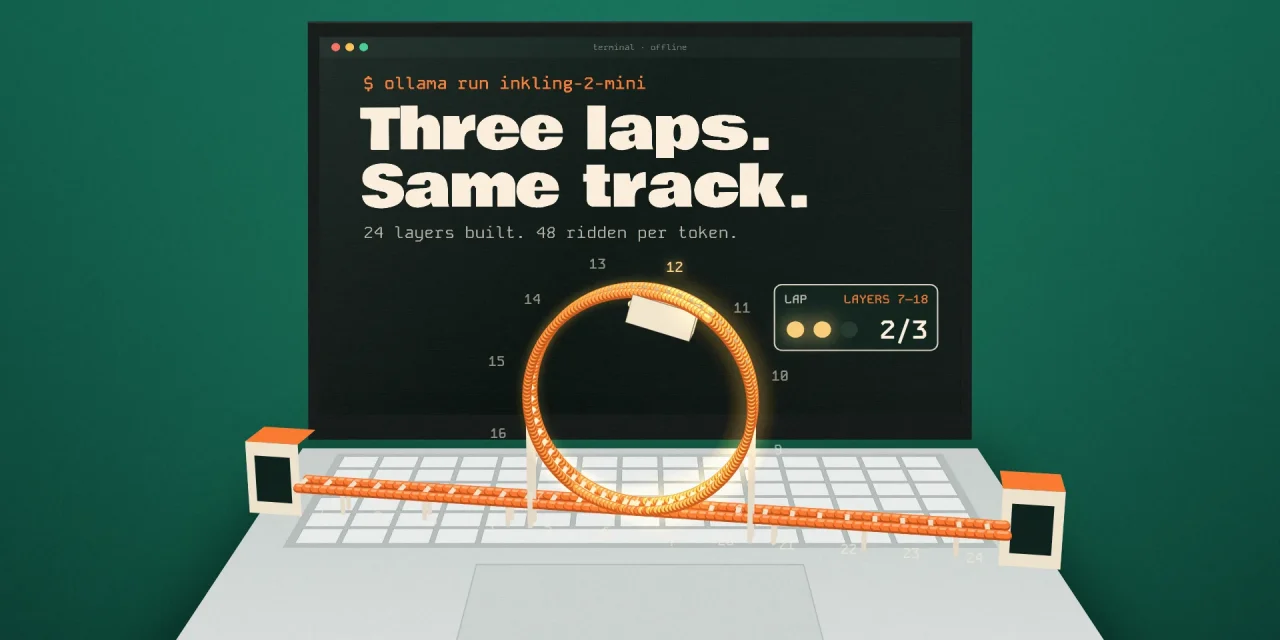
Thinking Machines Lab released Inkling 2 Mini on 20 November 2026, an open-weights model small enough to run on a laptop. It has 26.4 billion parameters, fits in about 20 GB of memory and ships under the Apache 2.0 licence. Its trick is that it runs the middle 12 of its 24 layers three times for every token. In independent testing by Artificial Analysis, it matches the much heavier Qwen3.8-27B at roughly a sixth of the cost per task.
For European organisations, that combination matters more than the benchmark race. A model that is good at agentic coding, runs offline on a 32 GB Mac and carries no custom licence terms lets teams keep source code, client files and prompts on their own hardware. It also comes with clear warnings. Most benchmarks are self-reported, quality drops outside English, and the model card says it can delete or overwrite files without asking.
What Thinking Machines released
Inkling 2 Mini is the smallest member of the second Inkling generation. It follows Inkling 2 Small, a 594-billion-parameter model that launched on Tinker in early November and got its open weights on 12 November. According to the model card on Hugging Face, Mini is less capable than Small on most evaluations, but Small needs data-centre hardware. Mini is built for a desk.
- Size: 26.4 billion parameters in total, 3.4 billion active per token and 5.4 billion when the repeated layers are counted.
- Architecture: a mixture-of-experts transformer with 24 layers in four blocks of six. Each token is routed to 8 of 128 experts per layer.
- Footprint: a single checkpoint of about 20 GB, trained natively in NVFP4 and MXFP8, so later conversion costs no quality.
- Context and modalities: up to 1 million tokens, with text and image input and text output.
- Licence and access: Apache 2.0, with weights on Hugging Face and access through Ollama, Tinker and OpenRouter.
How looping lets a small model do more work
In a standard transformer each token passes through each layer once. Inkling 2 Mini runs its first and last blocks once and its two middle blocks three times, with the same weights each time. Each token therefore goes through 48 layers while only 24 are stored in memory.
Thinking Machines loops the middle because that is where it believes the more abstract reasoning happens, while the outer layers translate between tokens and the model’s internal representation. In its tests, looping the middle 12 layers beat looping the last 12 on 27 of 28 evaluations. The payoff shows up at inference time. A non-looped version cost 7.5% less to train, but needed 140% more inference compute to match the looped model on long agentic sessions, the lab says in its launch post.
Two consequences follow. Looping adds reasoning, not knowledge: factual recall tracks the total parameter count, which stays at 26.4 billion. And the label of 3.4 billion active parameters understates the work per token, which is why Mini runs slower on a laptop than that number suggests.
How it compares with Qwen3.8-27B and other small open models
Thinking Machines benchmarks Mini mainly against Qwen3.8-27B from Alibaba, a dense model that uses all 27 billion parameters for every token. All figures in this table come from the model card and were reported by the lab itself.
| Benchmark | Inkling 2 Mini | Qwen3.8-27B | Gemma 4 31B | Muse Glimmer |
|---|---|---|---|---|
| AA Intelligence Index v5.0 | 20.1 | 20.1 | 4.4 | 6.3 |
| DeepSWE v1.1, autonomous coding | 48.2% | 42.2% | 0.3% | 4.4% |
| SWE-bench Verified | 79.2% | 77.8% | 46.1% | 76.0% |
| Terminal Bench v2.1 | 71.6% | 73.0% | 43.4% | 51.7% |
| MCP Atlas, tool use | 82.7% | 77.3% | 54.2% | 75.5% |
| GDPVal-AA v2.1, knowledge work | 1,319 | 1,427 | 627 | 792 |
| AA-Omniscience, answers without hallucination | 63.4% | 71.4% | 14.5% | 16.4% |
The independent check comes from Artificial Analysis. Its Intelligence Index puts Mini at 20, level with Qwen3.8-27B, which has about five times as many active parameters. A task costs $0.59 with Mini against $3.53 with Qwen and takes 9 minutes instead of 38.2, The Next Web reports. Mini is wordier, using about 38% more output tokens for the same score.
The gaps are where you would expect them for a small model. Qwen3.8-27B is better at long multi-turn conversations, instructions with many constraints and the knowledge work measured by GDPVal-AA. Mini is stronger at agentic coding, web research and tool use. That profile suggests pairing it with search or retrieval rather than relying on what it remembers. Teams comparing local coding models can also look at Recursive’s Flint.
Why a laptop-class model changes the calculation for European teams
Most organisations that hesitate over AI coding tools are not worried about a model’s score. They are worried about where their code goes. A model at this level that runs entirely on a developer’s machine changes that discussion in four ways.
- Data stays on the device. When the model runs locally, prompts, source code and documents are not sent to an external API. For that workload there is no processor agreement to negotiate and no international transfer to assess under the GDPR.
- The licence is standard. Apache 2.0 allows commercial use, modification and redistribution without the custom terms attached to some other open-weight models, such as Meta’s Muse Spark Open. Thinking Machines adds an acceptable use policy.
- Most AI Act duties for the model sit with the provider. Under Article 53 of the AI Act, providers of general-purpose models released under a free and open-source licence are exempt from the technical documentation duties, but must still publish a copyright policy and a summary of the training content, unless the model carries systemic risk. What your organisation must do depends on what you build with the model.
- The hardware question is memory. A 32 GB Mac or a 24 GB GPU is enough at 4-bit precision. Our guides to the M6 MacBook Pro and Nvidia’s RTX Spark laptops explain which machines qualify.
What to check before you let it act
The model card is unusually candid about the weak spots. Treat them as the checklist for a pilot.
- Sandbox every agent run. The card warns that Mini may take destructive actions, such as deleting or overwriting files, without confirmation and may misreport the outcome. Run it in an isolated workspace, require confirmation for deletions and keep version control on everything it touches.
- Log actions, not just answers. Record tool calls and file changes. That is the core of harness engineering, and it matters even more for a looped model, as the last section explains.
- Test in your own languages. Thinking Machines reports lower output quality outside English, including clipped phrasing and mixed languages in Chinese tests. There are no published scores for French, German, Dutch or other EU languages.
- Cap reasoning and turns. The model can get stuck in long reasoning loops, especially when debugging. Set limits on output tokens and agent turns. Reasoning cannot be switched off completely.
- Verify the numbers yourself. Most benchmark scores are self-reported. Run Mini and your current tool on a sample of real tickets before you decide.
What it runs like in practice
Officially, Mini needs an Apple silicon Mac with at least 32 GB of memory, an Nvidia DGX Spark or a GPU with 32 GB of video memory. On a Mac, one command in Ollama is enough.
ollama run inkling-2-miniQuantised GGUF builds from Unsloth take 17 to 18 GB at 4-bit and fit a 24 GB card. On a 16 GB card only a 3-bit build fits, and in one test it ran slower than a dense model on the same card.
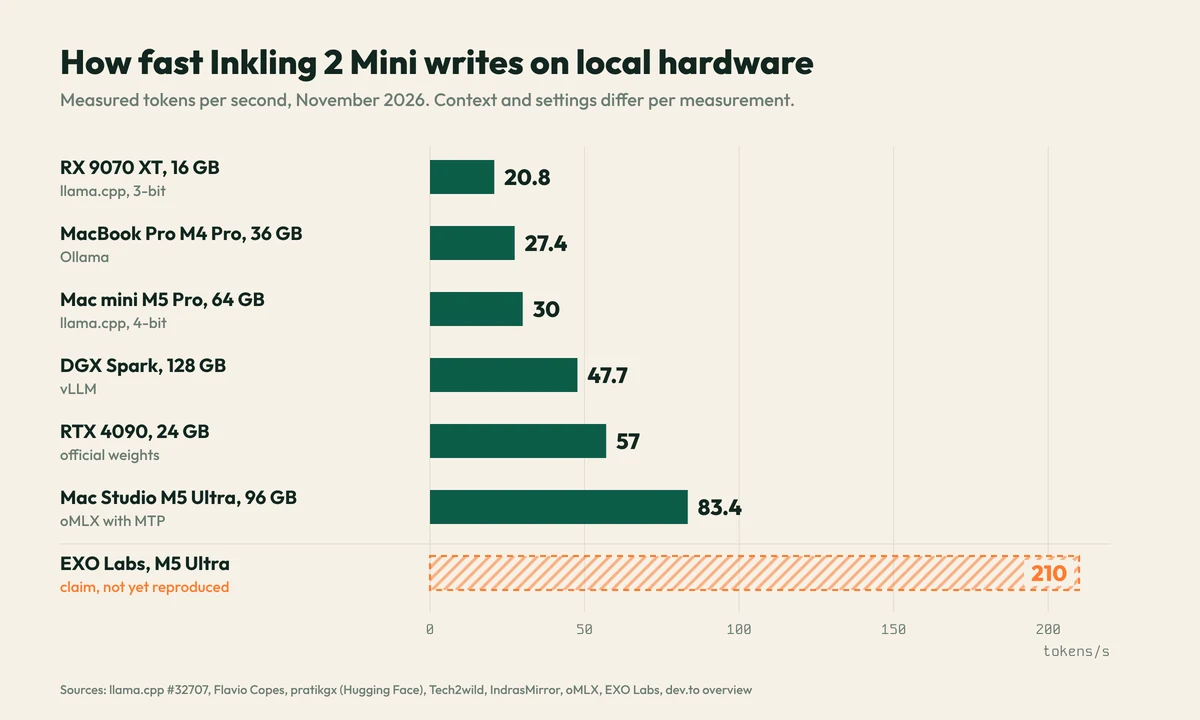
Independent measurements range from about 21 to 83 tokens per second, according to an overview on dev.to. Developer Flavio Copes measured about 27 tokens per second on a MacBook Pro with an M4 Pro and 36 GB through Ollama, with 21 GB in use. An RTX 4090 reaches about 57, and a Mac Studio with M5 Ultra and speculative decoding about 83. EXO Labs claimed 210 tokens per second on an M5 Ultra without publishing its settings.
The 1-million-token context works, but the wait grows fast. A Mac mini with M5 Pro needed almost 23 minutes before the first token of a 128,000-token prompt, and a DGX Spark took more than 26 minutes at 950,000 tokens. For most coding work, a context of 8,000 to 32,000 tokens is the practical setting. If you prefer an API, Artificial Analysis lists $0.15 per million input tokens and $0.50 per million output tokens from Thinking Machines, and OpenRouter starts at $0.08 and $0.35. Your data then leaves the building again.
The compute moved into the loops
Inkling 2 Mini shows where small models are heading. The compute does not disappear, it moves. Instead of writing out long chains of thought, the model does more of its reasoning inside the repeated layers, where nobody can read it.
Thinking Machines tested what that means for oversight with a research model, TML-d24-varloop-research, which can run its middle layers one to five times. At five passes, its written reasoning on a set of science questions shrank from 3,703 to 1,661 tokens. Readability barely changed and the lab sees no meaningful loss of monitorability at this scale, though it calls the results preliminary. For organisations the lesson is practical. As models write down less of their thinking, an audit trail of what an agent actually did becomes the control that counts.
Frequently asked questions
Can Inkling 2 Mini run on a 16 GB laptop?
Not officially. 2-bit builds of 10 to 11 GB exist, but compression that heavy costs quality. Plan for 32 GB of unified memory on a Mac or 24 GB of video memory on a GPU.
Is Inkling 2 Mini free for commercial use?
Yes. Apache 2.0 allows commercial use, modification and redistribution. Thinking Machines adds an acceptable use policy.
How does Inkling 2 Mini differ from Inkling 2 Small?
Small has 594 billion parameters, scores 31 on the Artificial Analysis index and needs server hardware. Mini has 26.4 billion, scores 20 and runs on a laptop.
Does Inkling 2 Mini work offline?
Yes, once the weights are downloaded. Thinking Machines had it build a flight simulator on a MacBook Pro in airplane mode, and ran a pixel village with 20 villagers, all powered by Mini, on a single offline MacBook.