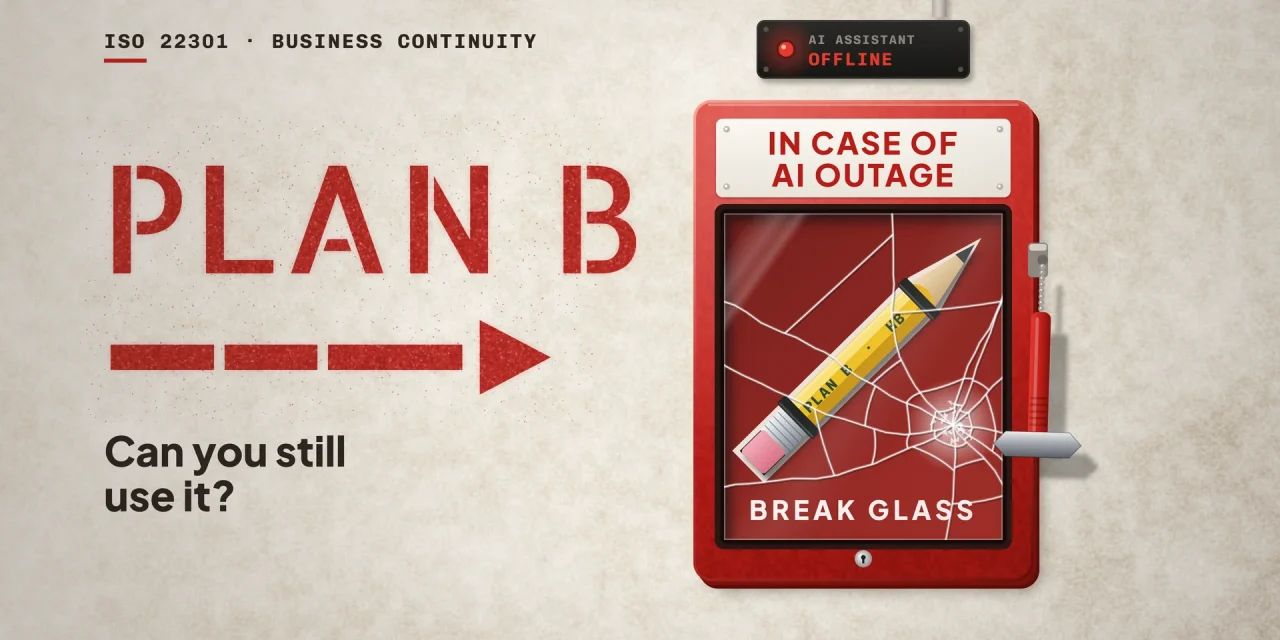
ISO 22301 does not mention artificial intelligence, and the third edition that might is still a committee draft. The gap is not in the standard so much as in how most organisations apply it. An AI dependency fails in ways a classic business impact analysis never asked about: it goes down, keeps running while its answers get worse, retires on a date the provider sets, or is switched off by a government order. This article maps those failures onto the clauses of ISO 22301:2019, shows where ISO/IEC 42001, DORA, NIS2 and the AI Act fit in, and ends with a 30-day plan you can start this week.
Four ways an AI dependency fails
Continuity planning grew up around systems that are either up or down, where everyone notices the moment they go down. The Business Continuity Institute put the problem plainly a year ago: an AI system can fail while it is still running, by drifting, giving biased answers or causing legal harm without tripping a single operational alarm. In 2026 every one of the following failure modes hit real organisations.
- Down. In the week before 15 September 2026, ChatGPT, Claude and Grok went down at the same time. OpenAI pointed to a routing error and xAI to an outage at its Memphis compute centre. No shared root cause was confirmed. Even a good record leaves hours on the table: over 90 days to mid-August, Anthropic’s status page put the Claude API at 99.44% uptime, which works out to roughly twelve hours without service.
- Degraded. The model answers, the status page is green and the output gets worse. Nobody declares an incident, and practitioners report that this kind of decline often goes unnoticed for weeks.
- Retired. Every model version has an end date. OpenAI gives generally available models at least six months’ notice and Anthropic at least 60 days. After that date the API call fails or is redirected to a successor, and prompts and evaluations tuned to the old version do not carry over by themselves.
- Withdrawn. On 12 June 2026, a US government directive made Anthropic disable Claude Fable 5 and Mythos 5 for all customers. Access only returned on 1 July, after the export controls were lifted. No service level agreement could have prevented that. Only a fallback could have softened it.
AI also became a cause of disruption, not just a dependency. On 25 April 2026, a Cursor coding agent running Claude Opus 4.6 deleted the production database of PocketOS together with its backups. The car rental software company reported an outage of more than 30 hours, and the data was later recovered with help from its cloud provider. It is not an outlier. In a Gartner survey of 298 infrastructure and operations leaders, 95% had faced at least one agent-related incident in the past twelve months, while only 15% had automatic circuit breakers to stop a runaway agent.
Where ISO 22301 stands in November 2026
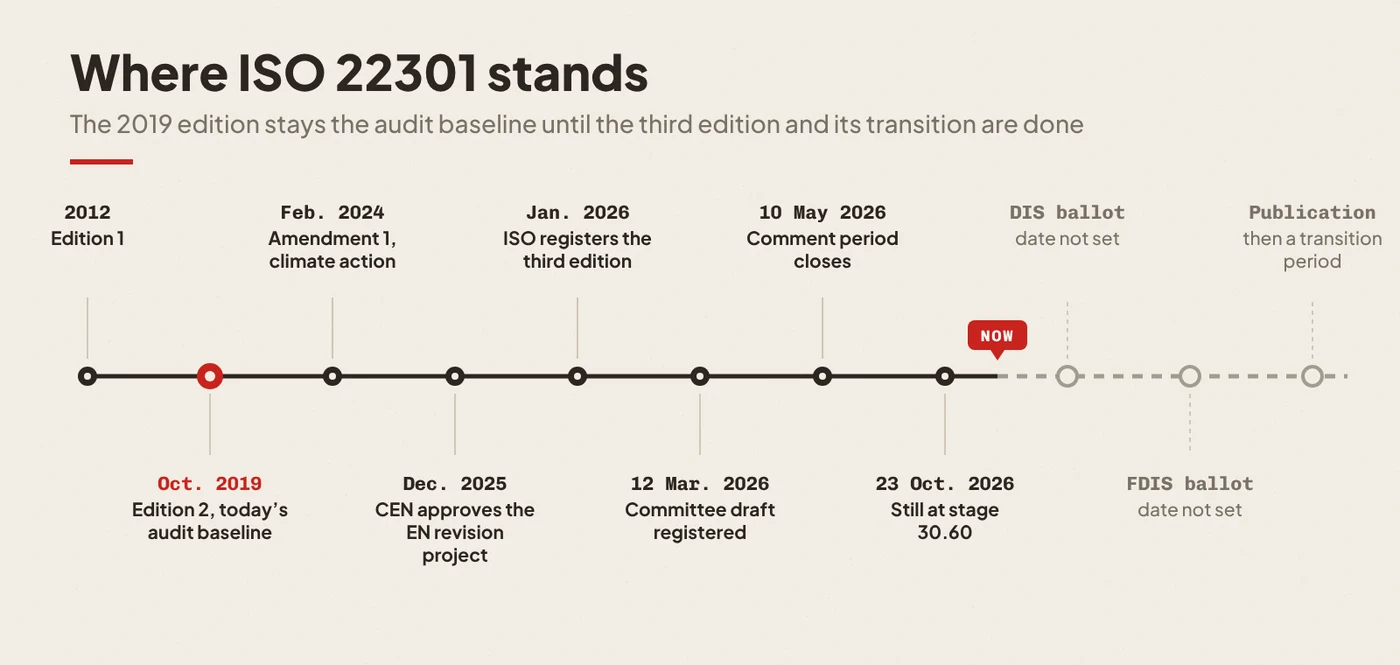
The edition you are audited against is still ISO 22301:2019. Its only change since then is the climate action amendment of February 2024, which asks you to consider climate change when you determine the context and the interested parties of your management system.
The third edition is on its way, but slowly. ISO/CD 22301 was registered as a committee draft on 12 March 2026, the comment period closed on 10 May, and on 23 October the draft was still at stage 30.60. A draft international standard and a final draft still have to be balloted, and ISO gives no publication date. The rest of the family is moving at the same time: the guidance in ISO 22313 and the guidelines on strategies and solutions in ISO 22331 are both being redrafted.
What the drafts say about AI is not public, and nothing confirms the new edition will name it. A generic management system standard may well not. Even if it does, publication is followed by a transition period. The move from the 2012 to the 2019 edition was planned for three years and stretched to three and a half during the pandemic. Waiting for the standard to tell you about AI could easily mean waiting until the end of the decade.
Two published standards already help. ISO/IEC 27031:2025 covers ICT readiness for business continuity, including dependencies on third-party services such as cloud providers. ISO/IEC 42001:2023 sets up a management system for AI itself, from design through operation and monitoring to retirement.
Clause by clause, what changes
The clauses do not need rewriting to cover AI. They need applying to a dependency with failure modes they were not written for. The table shows where the work sits.
| Clause | What it asks | What AI adds |
|---|---|---|
| 4.1 and 4.2 Context and interested parties | Understand the issues and requirements that shape your continuity needs | Model providers and the governments they answer to, regulators that expect AI controls, and customers whose service now runs on a model |
| 8.2.2 Business impact analysis | Prioritised activities, impacts over time, recovery time frames and resources | Tag every activity that depends on a model, copilot or agent, including AI inside SaaS tools, and add a minimum output quality next to the time frame |
| 8.2.3 Risk assessment | Risks of disruption to prioritised activities | Degradation, retirement and withdrawal as risk sources, plus agent actions and AI-assisted attacks |
| 8.3 Strategies and solutions | Options for before, during and after a disruption, with the resources they need, including ICT systems, partners and suppliers | A fallback ladder per activity, prompts and evaluations you can move to another model, and switching terms in contracts |
| 8.4 Plans and procedures | Response structure, warning and communication, recovery | Triggers based on output quality, a kill switch for agents and a named person who decides to switch models |
| 8.5 Exercise programme | Exercises that validate your strategies and solutions | Scenarios in which a model is removed, and staff who run the manual path for real |
| 8.6 and 9.1 Evaluation and monitoring | Evaluate capabilities and monitor performance | Drift checks, provider status and a retirement calendar |
| 9.3 Management review | Top management reviews the BCMS at planned intervals | The AI dependency register and upcoming retirement dates as a standing item |
The business impact analysis needs a quality floor
A recovery time objective says how fast an activity must be back. For an AI-dependent activity that is not enough, because a model that is back but wrong is still a disruption. The BCI suggests adding a Recovery Accuracy Objective, a minimum level of model performance after recovery, and a fairness objective so that the manual fallback does not bring back the bias the model was meant to remove. In practice that means a sample check: how often does the output still agree with a human reviewer? The minimum business continuity objective that ISO/IEC 27031:2025 already uses next to recovery time and recovery point is a natural place to record it.
Strategies come as a fallback ladder
For each prioritised activity, decide which rung of the ladder you fall back to, and how fast. The rungs are the same model in another region or cloud, a second provider with a different model, an open-weight model you host yourself, a degraded mode with queues, templates or cached answers, and finally the manual procedure. A model you run on your own infrastructure is the highest rung that survives both a withdrawal and a correlated outage, at a price in hardware and skills.
The top rungs are weaker than they look. A withdrawal like the one of Fable 5 removes the same model from every cloud that sells it, which takes out the first rung. A correlated outage like the one in September can take out the second as well. Forrester’s conclusion after that outage was that routing between models helps but is not sufficient on its own, and that critical workflows also need degraded modes, cached data, manual procedures and rules that pause automation. A second provider buys flexibility on price and quality. It does not buy continuity when the outages are correlated.
Plans and exercises have to test the people
Most continuity plans list a manual process as the last resort. Capgemini’s warning is that this fallback is often a human who no longer knows how to do the job, because staff turned over, procedures went stale or the process reorganised around the agent. Few organisations check. According to ISACA’s 2026 State of Cyber report, 71% have never run an AI incident response exercise and only 3% have mature runbooks for AI-specific incidents.
For agents, the plan also needs a way to stop them. Gartner’s guidance includes kill switches, data perimeters and human sign-off for high-impact actions, and the containment questions are the same ones that decide how far an agent sandbox really isolates.
How ISO 22301 fits with ISO/IEC 42001, DORA, NIS2 and the AI Act
ISO/IEC 42001 governs the AI system across its lifecycle. ISO 22301 governs the continuity of the activities that system supports. The BCI argues that organisations make a mistake when they treat the two as separate, because they are part of the same resilience problem. The practical answer is one dependency register read through two lenses.
Under DORA, financial entities keep a register of every contract for ICT services, and supervisors stress that the definition of an ICT service is very broad. A model API behind a critical or important function is hard to keep out of it. The first list of critical ICT third-party providers, published in November 2025, named 19 companies including Amazon Web Services, Google Cloud and Microsoft. The AI labs whose models run on those clouds are not on it, so oversight of the model layer stays with the financial entity. Our guides to DORA and third-party risk management cover the register and the exit plans it requires.
NIS2 puts business continuity and crisis management next to supply chain security among the measures in-scope entities have to take, as the Belgian cybersecurity centre summarises. The link between cyber resilience and business continuity now runs through your AI providers as well.
The AI Act requires accuracy, robustness and cybersecurity from high-risk AI systems under Article 15. After the Digital Omnibus, those obligations apply from 2 December 2027 for stand-alone high-risk systems and 2 August 2028 for AI embedded in regulated products. The revised AI Act timeline gives organisations that deploy high-risk AI a deadline by which robustness and continuity evidence will overlap.
AI as a tool for the continuity team
AI also changes how the continuity work itself gets done. In the BCI’s latest benchmarking report, 45.9% of professionals called AI an important supporting tool for their programme. Most use it to draft exercise and simulation scenarios. Post-incident analysis and summarising reports are the other main uses, while AI in analytical work such as the business impact analysis is not yet widespread.
The useful jobs are the ones where you check the output: drafting exercise injects, summarising interview notes from the impact analysis, comparing plans against the dependency register and building a timeline after an incident. Three limits apply. A model does not know your impacts, so a plan it writes without your data is a template. The impact analysis is a map of what hurts you most and belongs in tools whose data handling you control. And ISO’s own terms forbid using its content to prompt AI tools, so pasting the text of the standard into a chatbot is out.
A 30-day starting plan
- Week 1, build the AI dependency register. Record model, provider, version, the route you reach it by, owner, the activities it serves, notice period and retirement date. Include AI inside SaaS tools, which Forrester explicitly adds to the inventory.
- Weeks 1 and 2, tag the impact analysis. For each AI-dependent prioritised activity, set the recovery time frame and a quality floor.
- Week 2, pick the fallback rung. Check for each activity that the rung you chose survives a correlated outage and a withdrawal.
- Week 3, update the plans. Add quality triggers, a kill switch for agents and the name of the person who decides to switch models.
- Weeks 3 and 4, exercise. Run a 90-minute scenario in which your main model disappears without notice, and have one person do the most AI-dependent task by hand while you time it.
- Week 4, make it routine. Put retirement dates into change management and the register on the agenda of the next management review.
Frequently asked questions
Does ISO 22301 mention AI?
No. Neither the 2019 edition nor its 2024 climate amendment mentions AI. The standard is generic and covers AI through the requirements on dependencies, resources, suppliers and exercising.
Will the third edition of ISO 22301 cover AI?
That is not known. The committee draft is not public, and a draft international standard and a final draft still have to be balloted before publication.
Do I need ISO/IEC 42001 for ISO 22301 certification?
No. ISO/IEC 42001 manages the AI system, and ISO 22301 manages the continuity of the activities it supports. If you run critical AI, using both with one register avoids duplicate work.
Is a second AI provider enough as a continuity strategy?
Rarely. Three providers went down together in September 2026. Combine a second provider with a degraded mode or a manual procedure that people have practised.
Can AI write the business impact analysis for me?
It can draft questions and summarise interviews, but it cannot know your impacts. Keep the analysis in tools you control and keep the text of ISO standards out of your prompts.
The standard is generic, the evidence is not
ISO 22301 does not need to name AI to require that you understand your dependencies, set recovery priorities and test them. What changes is the evidence. An auditor reading your impact analysis next year is likely to look for the model behind the claims desk, the date it retires and the last time someone did the work without it. The BCI publishes its Horizon Scan 2026 on 24 November, and wherever it ranks AI, the four failure modes in this article have already happened.