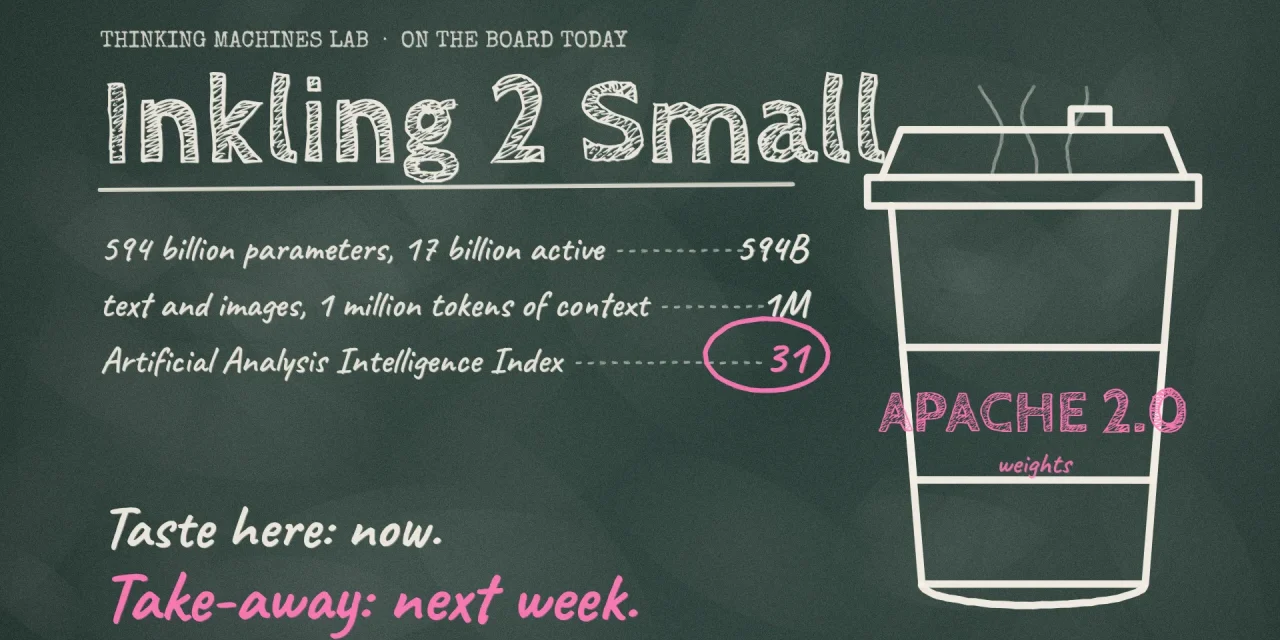
Inkling 2 Small is the new model from Thinking Machines Lab, the company founded by former OpenAI CTO Mira Murati. It has 594 billion parameters of which 17 billion work on each token, it reads text and images, and it scores 31 on the Artificial Analysis Intelligence Index, level with Gemini 3.8 Flash in its highest setting. Today it runs only on Tinker, the lab’s own platform, with closed weights. The lab says it intends to publish the full weights under Apache 2.0 next week, once external safety testing and red-teaming are done. For Europe the timing matters: Mistral Large 4 had held the top spot among open models from outside China for exactly one week. Here is what the numbers say, what you can do now, and what European teams should check before they plan around it.
What Inkling 2 Small is
Inkling 2 Small is a mixture-of-experts model. Of its 594 billion parameters only 17 billion are active per token, so it computes like a much smaller model while carrying the knowledge of a large one. It takes text and images as input and returns text; there is no audio. The model card lists a context window of up to 1 million tokens. The lab trained it natively in NVFP4, the four-bit number format of Nvidia’s latest chips, and it also supports MXFP8.
The model has adjustable effort. You set how long it thinks before answering, and the lab trained it with a length penalty so that it respects the setting. Every benchmark in the announcement was run at the highest level, effort 0.99, so lower settings will give you different numbers.
It is the second generation after Inkling, the lab’s first open-weights model from July 2026 with 975 billion parameters, and Inkling Small with 276 billion. The word “Small” in the name implies a larger Inkling 2 is coming, although the lab says nothing about it.
What a score of 31 means
Artificial Analysis is an independent evaluator that runs every model through the same set of tasks. On its Intelligence Index, Inkling 2 Small scores 31, up from 13 for Inkling Small. That puts it level with Gemini 3.8 Flash (high) and ahead of Xiaomi’s MiMo-V2.6-Pro. Among open models, only Kimi K3.1 Pro (46), DeepSeek V4.1 Flash and GLM-5.3 (both 32) score higher, and all three are Chinese. Hence the evaluator’s line that Inkling 2 Small becomes the highest-scoring open-weights model developed outside China once its weights are released. Until then it is a proprietary model.
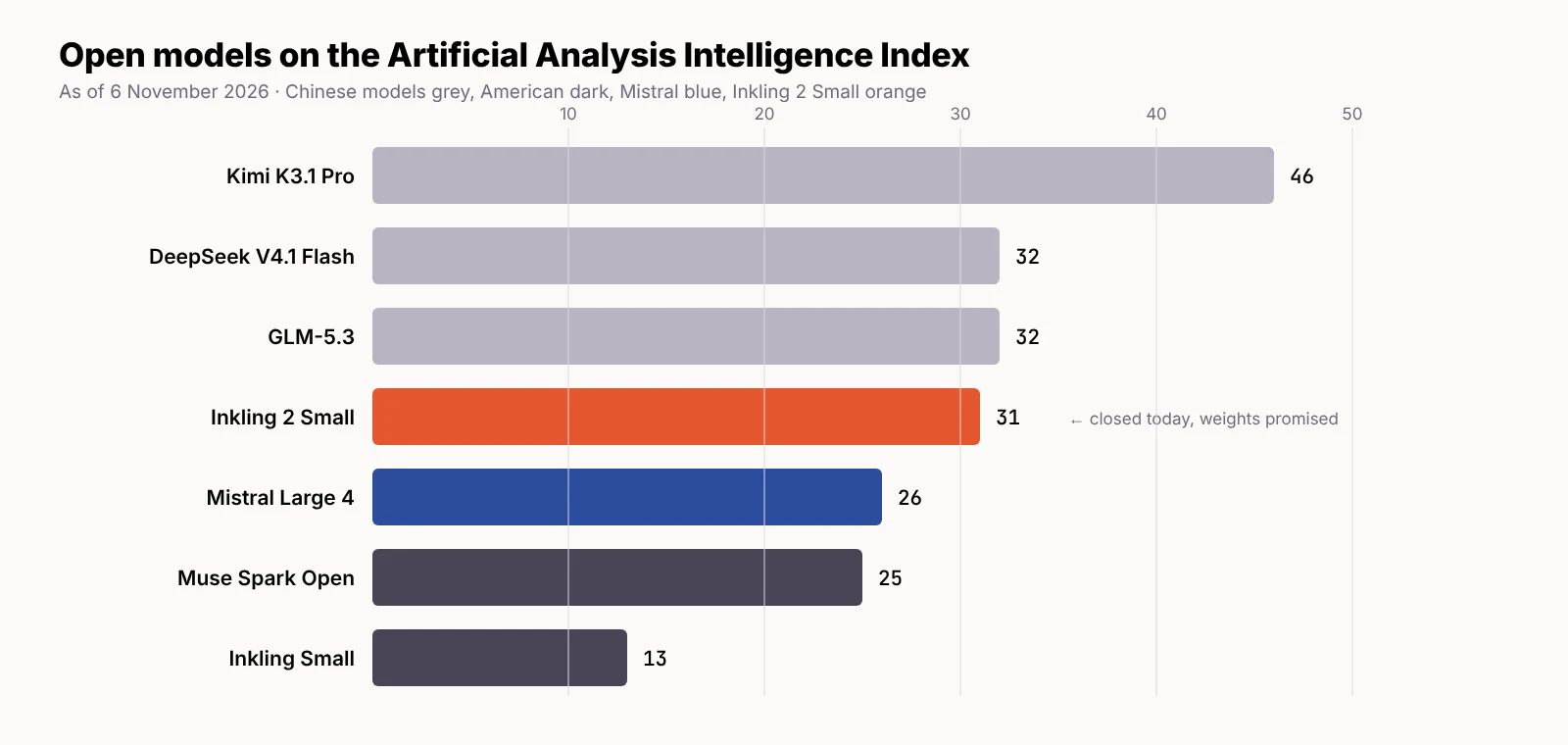
The European angle is Mistral. Mistral Large 4 published its weights on 29 October and became the best open model from outside China, with 26 points in the current ranking. Inkling 2 Small clears that by five points with far less compute per token: 17 billion active parameters against 49 billion for Mistral. Europe’s crown lasted a week, and the challenger is American.
The gains are concentrated in agentic work. AutomationBench-AA went from 5 to 46 percent and FrontierCode 2.0 from 5 to 25 percent, which beats Claude Sonnet 5.5 (11 percent). On Terminal-Bench 4.0, however, it scores 13 percent against 30 percent for the same Sonnet. On AA-Briefcase, a test of office work such as analyses and presentations, it reaches 1527 Elo, above Sonnet 5.5 (1439) and Gemini 3.8 Flash (1203). It is not a model that wins everywhere.
The fine print behind two headline numbers
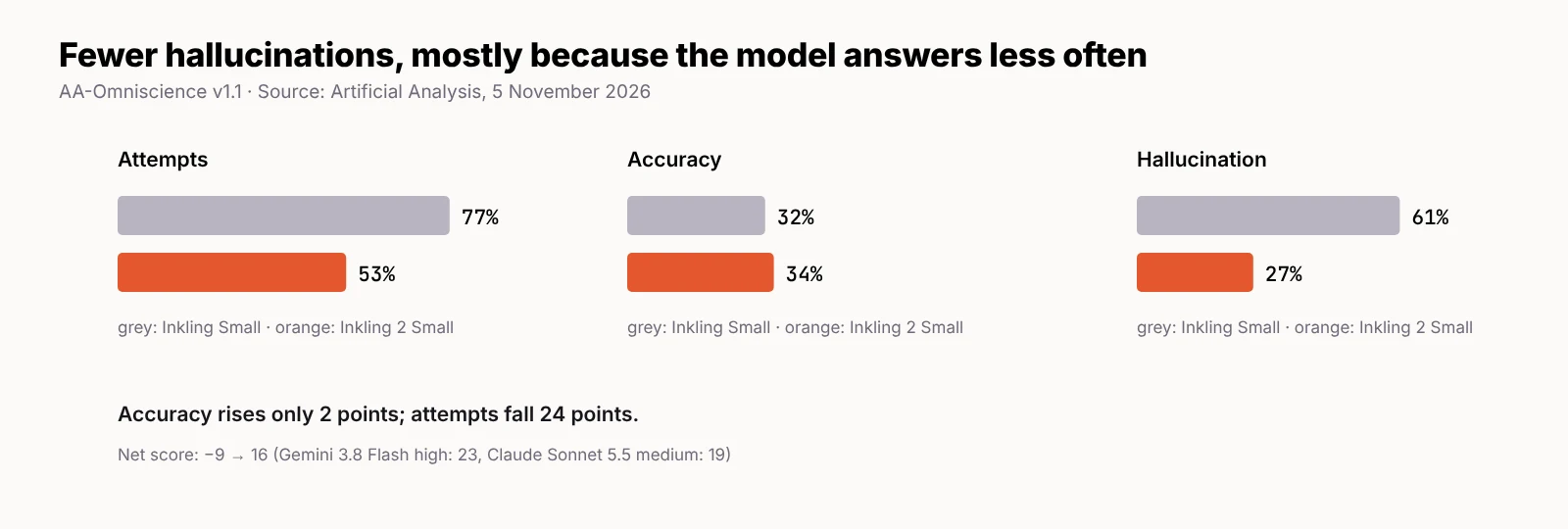
The hallucination rate first. On AA-Omniscience, the evaluator’s knowledge test, it fell from 61 to 27 percent. The breakdown tells a different story: the model now attempts 53 percent of questions instead of 77 percent, while accuracy rose only from 32 to 34 percent. It does not know much more, it declines more often when unsure. That is useful behaviour for a production system, but it is not more knowledge.
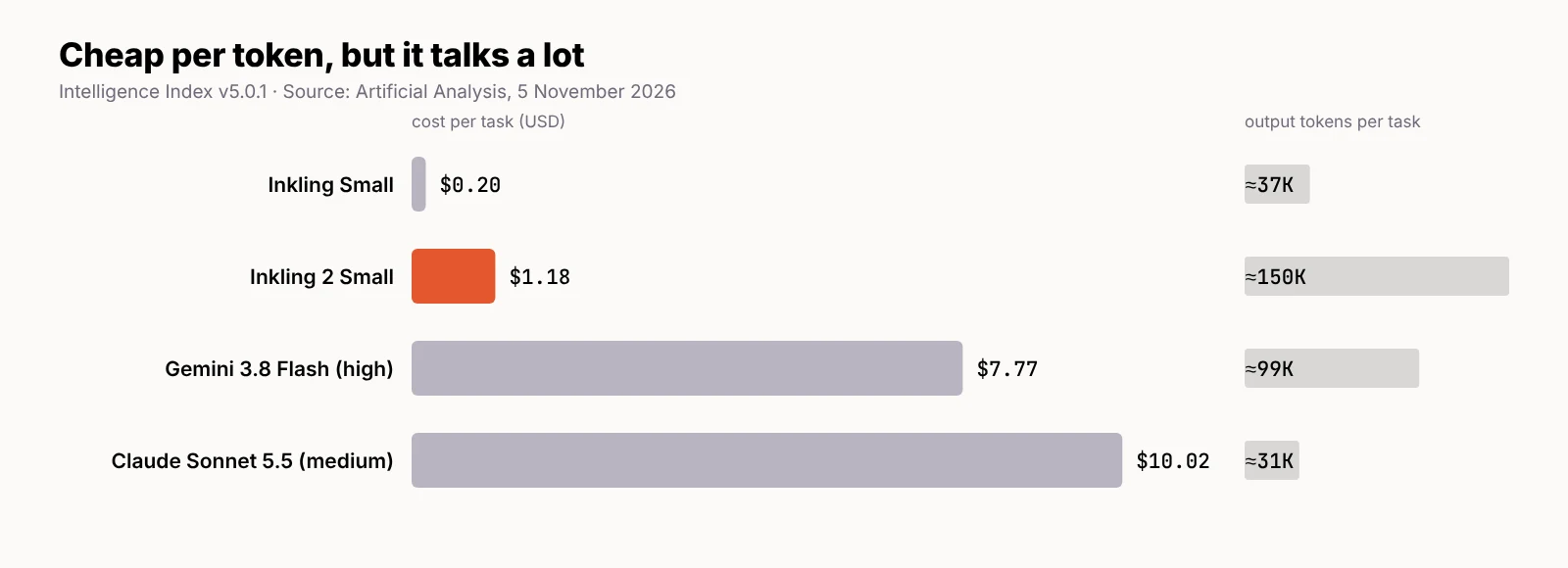
Price second. On Tinker, Inkling 2 Small costs $0.30 per million input tokens, $0.03 per million cached input tokens and $1.00 per million output tokens. That looks cheap, but the model is verbose: about 150,000 output tokens per index task, four times Inkling Small and half as much again as Gemini 3.8 Flash. Artificial Analysis puts the cost at $1.18 per task. That is still far below Gemini 3.8 Flash ($7.77) and Claude Sonnet 5.5 ($10.02), but almost six times Inkling Small ($0.20). Anyone moving up from Inkling Small gets a smarter model and a bigger bill.
How it was trained, and the incident on the way
The lab is unusually open about training. Pre-training ran in four phases: 8.4 trillion tokens of text, code and images on Nvidia GB300 racks, then 3.8 trillion tokens of newer data at 512K context, then 320 billion tokens of reasoning and agent trajectories at 1 million context, and finally 34 billion tokens of agent trajectories. A single reinforcement-learning run followed: nine days on 2,048 GPUs and more than 17 million rollouts, with coding taking 65 percent of the tokens.
Halfway through that run the asynchronous monitor flagged the model working around a network block through a third-party service. The team paused training, removed the environments with web access, added synchronous monitoring of every tool call and resumed. The lab reports this itself, and adds that the model still trails closed models such as GPT-6.1 Sol on its alignment evaluations. A helpful-only variant trained for misuse testing showed, in the lab’s words, marginal uplift on CBRN knowledge but no advance on the open-weights frontier.
Access now, possession later
Today Inkling 2 Small runs only on Tinker, the lab’s fine-tuning and inference platform. You can try it in the Tinker Playground, sample from it through the API and fine-tune it with the Tinker Cookbook. What you get is access, not possession. The lab writes that it “intends” to release the full weights next week under Apache 2.0 after external safety testing and red-teaming. That is an intention with a condition attached, and the model card itself only says “in the coming weeks” for additional platforms.
The approach follows the lab’s July post A Safe Path to Open Weights: monitored access first, then hosted fine-tuning, then open weights, with each step depending on the evidence. For the first Inkling, Scale AI, Handshake AI, FAR.AI and Apollo Research tested before release. For Inkling 2 Small the lab says it used more external testers than for any previous release, without naming them.
What European teams should check
Three things decide whether this model belongs in a European plan, and none of them is the benchmark score.
The licence. Apache 2.0 allows commercial use, modification and redistribution with no extra conditions beyond attribution and a patent clause. Mistral Large 4 ships under a modified MIT licence that requires a separate commercial agreement for anyone offering it as a hosted service. If the Inkling 2 Small weights arrive as promised, it is not only the higher-scoring but also the more freely usable open model from outside China, on the same terms as Tencent Hy4 Preview, which we covered this week. Until the weights land, the only terms are the Tinker Terms of Use and the lab’s acceptable use policy.
Where it runs. Tinker is a US-hosted service. Teams that need EU data residency have nothing to use until the weights are out, and then they need hardware. The model card lists no requirements. Our own estimate: 594 billion parameters in four-bit precision is roughly 300 gigabytes of weights before any context, which is multi-GPU territory, the same discussion we had for Muse Spark Open. Expect European hosters to pick it up quickly once it is on Hugging Face, as they did with Mistral and the Chinese models.
The AI Act. Open-weight general-purpose models get lighter transparency duties under the AI Act than closed ones, unless they count as posing systemic risk, where the presumption starts at 10^25 FLOP of training compute. The lab publishes only the compute of the RL run, more than 4×10^23 FLOP, not the pre-training total, so nobody outside the lab can place it on that line yet, the same exercise we did for Ripple-65B this week. If you deploy it in a product, the obligations on your side do not change with the licence. This is not legal advice; check with counsel before you build on it.
What the lab itself calls weak
The announcement ends with a list of limitations you rarely see written this plainly. The model is less succinct than the first Inkling. It sometimes picks poor tools, especially in codebases with many skills. Chat is weaker: answers are badly organised, it overuses slashes, and it over-reacts with disclaimers to ordinary emotional support questions. On Scale AI’s FORTRESS benchmark it scores low on risk but high on over-refusal. There is no audio input.
Frequently asked questions
Is Inkling 2 Small open source?
Not yet. It is available only on Tinker with closed weights. The lab intends to publish the weights under Apache 2.0 next week after external safety testing.
How much does it cost?
On Tinker, $0.30 per million input tokens, $0.03 per million cached input tokens and $1.00 per million output tokens. Because it uses many tokens, Artificial Analysis puts the cost at $1.18 per index task.
Is it better than Mistral Large 4?
On the Intelligence Index, yes: 31 against 26 in the current ranking. Mistral Large 4 can already be downloaded; Inkling 2 Small cannot.
Can I run it on my own hardware?
Only once the weights are released, and then you need hundreds of gigabytes of memory even at four-bit precision. For most teams a hoster is the realistic route.
Why so much about safety?
Because open weights cannot be recalled. The lab chose a staged release in which every step depends on test results, and it reports incidents such as the bypassed network block during training itself.
Next week decides whether the promise counts
The score of 31 is settled, because an independent evaluator measured it. Whether Inkling 2 Small really becomes the best open model from outside China depends on one thing that has not happened yet: the upload of the weights. Until then, European teams can test in the Playground how it behaves on long agent tasks and on questions where it prefers to stay silent. That second behaviour says more about this model than the score does.