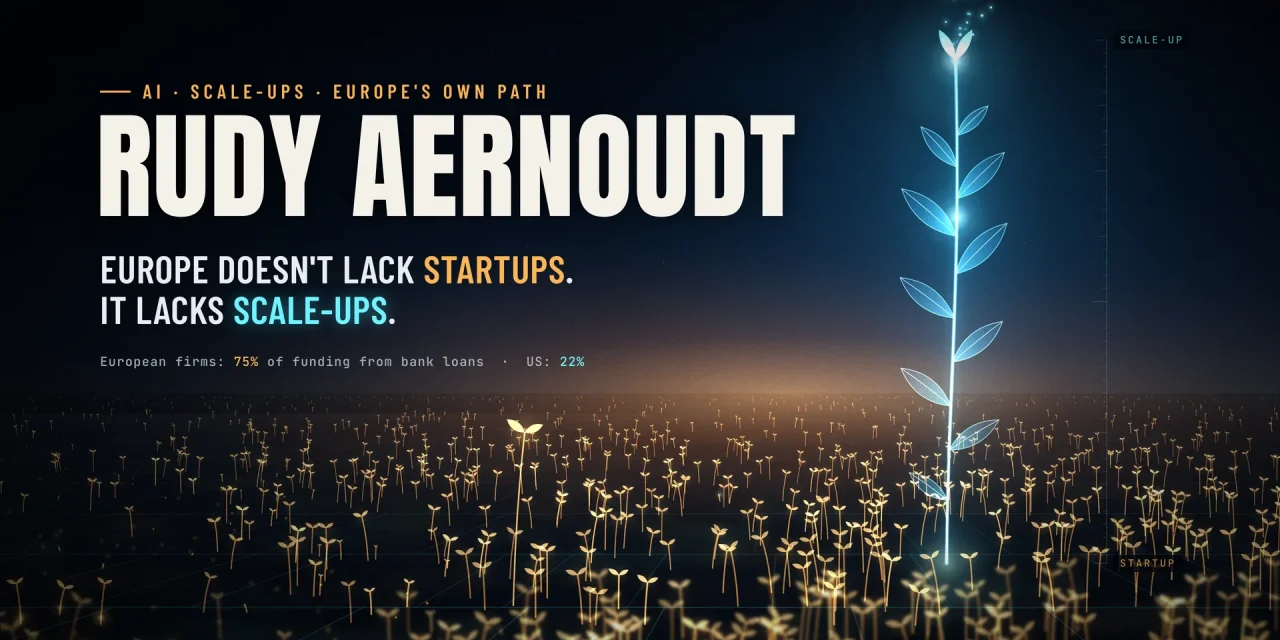
Rudy Aernoudt has a blunt message for anyone worried that Europe is losing the technology race. Europe does not have a startup problem. It has a scale-up problem. The Belgian economist, who helped build Europe’s business angel movement and now advises one of Belgium’s main party leaders, argues that the continent creates plenty of young companies but lets too few of them grow big. He also sees AI as “a source of freedom, not a threat”, on one condition: that people stay in charge of their own thinking.
This article brings together what Aernoudt said in interviews, columns and books between 2025 and 2026, and what it means for European founders, investors and business leaders.
Who is Rudy Aernoudt
Aernoudt is an economist and philosopher from Torhout in West Flanders. He is a visiting professor of corporate finance at Ghent University and an affiliate professor at the BMI Executive Institute, a business school co-founded by HEC Paris and UCLouvain. His career moves between three worlds that rarely meet in one person: European institutions, Belgian politics and early-stage investing.
- European Commission. He worked for years as a senior economist in the Commission’s directorate-general for internal market and industry (DG GROW), on SME and scale-up financing, and later joined its chief economist team.
- Business angels. In 1999 he co-founded the European Business Angel Network (EBAN), which earned him the nickname “father of Business Angels in Europe”.
- Politics and administration. He was chief of staff to ministers at Walloon, federal and Flemish level, and to the president of the European Economic and Social Committee. As secretary-general of the Flemish Department of Economy, Science and Innovation he was dismissed in 2007 after publicly criticising Yves Leterme. He lost the first case but won on appeal in 2010, and he links the dismissal to his criticism of cabinet practices. Since March 2025 he is chief of staff to MR party president Georges-Louis Bouchez.
- Technology. He was director-general of One Laptop per Child, the MIT spin-off that set out to give children in developing countries a cheap laptop, and curated TEDx Brussels.
He has written more than 40 books, according to Wikipedia and his conference bios, and his own website lists the main ones. The most recent include Entrepreneurship, A Mindset (2024) and three titles from 2026: Belgium 2040 with economist Peter De Keyzer, L’Europe, stop ou encore with Henri Malosse and Financial Management: from Angel to Zebra with Colin Mason. In March 2026 he was on the speaker list of the SuperNova festival in Antwerp.
Europe’s problem is scaling, not starting
In a long conversation on the Innovantage podcast, summarised by Sigli in November 2025, Aernoudt rejected the idea that Europe is behind the United States in creating startups. The gap shows up later, when companies need to grow from a promising team into an international player. High-growth firms drive innovation and employment, so failing at that stage costs Europe far more than a shortage of new ideas would.
He points to two brakes. The first is capital that does not reach growth companies. The second is a mindset. Many European founders want to keep control of their company, while the founders behind global winners often accepted a smaller share of a much larger business.
This is not a new theme for him. According to Wikipedia, Aernoudt conceived ESCALAR at the European Commission, an initiative inspired by the American SBIC model. On the podcast he described that model as one where public money absorbs the first losses so private investors dare to back bigger rounds. The Commission and the European Investment Fund launched ESCALAR as a pilot in April 2020 with up to €300 million, aiming to unlock up to €1.2 billion of investment.
Where Europe’s money gets stuck
Aernoudt’s answer to “why can’t we scale?” is mostly about where savings go. In a column from August 2025 he set out the figures he keeps returning to.
- Europeans save about 15% of their income, roughly three times the American rate.
- About 68% of European household financial assets sit in deposits, against 21% in the US. Americans hold 40% in shares, Europeans 10%.
- Bank loans provide 75% of corporate financing in Europe and 22% in the US.
- Europe has 35 stock exchanges and 18 clearing houses. The US has 3 exchanges and 1 clearing house.
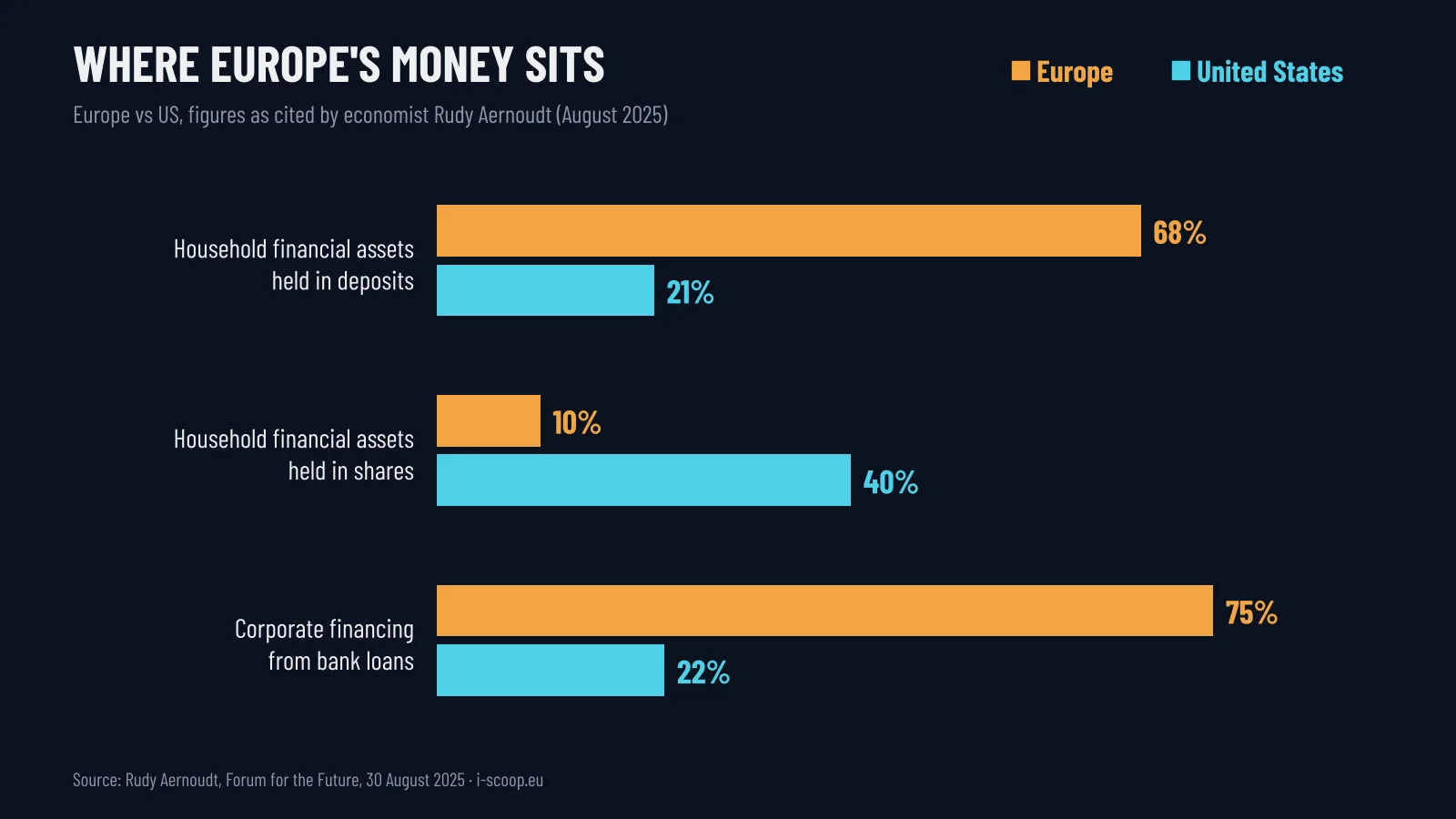
The result, in his view, is a bank-centred economy where young companies are undercapitalised, venture funds struggle to exit and successful firms go to the US to list. He presents the EU’s Savings and Investments Union as an attempt to fix this, by channelling savings into strategic priorities such as technology and defence. On the podcast he also noted that pension funds put less than 0.8% of their assets into venture capital.
Public money is part of the picture too. On the podcast he said public funds make up 42% of European venture capital, which risks crowding out private investors. He prefers schemes where public money absorbs the first losses and private investors keep most of the upside. He is sceptical of subsidies and would rather see venture capital, angel investment and repayable loans. Business angels still finance about 60% of European startups in their earliest phase, he said, and the number of angel networks on the continent grew from almost none to more than 350.
A growth lever investors keep missing
One of his sharpest recent columns, from March 2026, is about women founders. Women lead about 35% of new companies but receive around 2% of venture capital. Citing studies from BCG, EIT and others, he argues that women-led startups deliver better returns and repay bank loans more reliably than male-led ones, while still facing higher rejection rates and higher interest. His conclusion is that investors and banks are badly mistaken. He notes that 96% of business angels are men, and his advice to women founders is not to copy men.
Why Europe should not copy the US or China
Aernoudt does not want Europe to imitate the United States or China. Its strength, he told the Innovantage podcast, lies in growth within an ethical framework that reflects European values. That framework only helps if the rules are workable. He calls excessive regulation and bureaucracy the biggest barriers to innovation in Europe, warns against laws that change too often, as they do in Belgium, and holds up Switzerland and Singapore as places where rules are predictable.
His reading of the global economy has shifted as well. In a July 2025 column he argued that the old line “Europe regulates, America innovates and China imitates” no longer fits. After the Draghi report, Europe is quietly simplifying its rules, the US is using tariffs that hurt its own economy, and Chinese households are saving defensively.
He also argues for a different kind of company. Instead of unicorns valued on investor expectations, he favours “zebras”, firms that combine profit with social and ethical responsibility. In an October 2025 interview with BMI he named WeWork and Klarna as examples of how unreliable unicorn valuations can be, and said values are becoming the new measure of profitability. He calls the model of family offices, which invest for ten to twelve years rather than the five typical of venture funds, much more sustainable.
AI as a source of freedom, if you stay in control
For an economist who spends most of his time on capital and policy, Aernoudt has a clear and fairly optimistic view of artificial intelligence. “For me, artificial intelligence is a source of freedom, not a threat – if we use it consciously,” he told BMI. He mentions productivity gains of up to 40%. The real question, he says, is what companies do with the time AI saves: cut staff, or invest in creativity, new markets and new ideas.
On the Innovantage podcast he named three risks.
- Outsourcing thinking. He compares AI with GPS, which made many people lose their sense of direction. If people hand over critical thinking to machines, they lose a skill they need. Professors, he argues, should help students decide which knowledge they want to own and how much they want to depend on technology.
- Treating AI as a partner. He is wary of a society that treats AI as a substitute for human judgement. Technology itself is neutral in his view, including AI and military systems. The ethics depend on use, so humans must keep oversight and the final decision.
- An AI startup bubble. He referred to reports that up to 95% of AI startups may fail. For him that is part of how economies work: a crisis is also a moment of decision and opportunity.
That last point links back to his scale-up argument. Defence and dual-use technology, AI included, is an underused opportunity for European startups, he says, and Europe should not depend only on foreign suppliers. It is the same debate about sovereign AI in Europe: having strong researchers and founders is not enough if the capital to scale them sits in savings accounts. If you want to keep your own judgement while working with AI tools, the practical side is covered in our guide on how to collaborate with AI without losing control of your work.
Belgium 2040 and the cost of compromise
Closer to home, Aernoudt and Peter De Keyzer published Belgium 2040 in 2026, a book that, in the summary of 21News, portrays the Belgian state as too expensive, too complex, too personalised and too indebted. In an April 2026 interview with La Libre he said Belgium “can no longer afford the luxury of compromise” and needs an economic vision instead (translated from French). La Libre noted that he spoke as an economist, not as Bouchez’s chief of staff.
In the interview he argued for a depoliticised administration without ministerial cabinets, recruitment of civil servants by exam, term limits for politicians and a stronger focus on getting people into work. He notes that the employment rate of non-EU migrants is about 85% in Denmark against 48% in Belgium, and blames the system rather than the migrants. He also argues that Belgium’s prosperity rested on three assumptions that no longer hold: American security, cheap Russian energy and China as an export market. Citing the OECD, he says the necessary reforms could raise GDP per capita by 40%, which is why the authors give the country 15 years, until 2040.
Frequently asked questions
What is Rudy Aernoudt known for?
He is best known as a co-founder of the European Business Angel Network and as an outspoken economist on entrepreneurship, scale-up finance and Belgian state reform. He teaches corporate finance at Ghent University and BMI.
What is Rudy Aernoudt’s current role?
Since March 2025 he is chief of staff to Georges-Louis Bouchez, president of the Belgian liberal party MR. He also teaches, writes columns and invests in startups.
What does Rudy Aernoudt think about AI?
He sees AI as a source of freedom and productivity if people use it consciously. He warns against handing critical thinking to machines and insists that humans keep the final decision.
Why does Europe have fewer scale-ups according to Aernoudt?
Mostly because European savings sit in bank deposits instead of capital markets, companies rely on bank loans, markets are fragmented and rules change too often. A founder mindset focused on keeping ownership plays a role too.
What is Belgium 2040?
A 2026 book by Rudy Aernoudt and Peter De Keyzer about how Belgium can reform itself within 15 years. In interviews Aernoudt argues for a depoliticised administration, term limits for politicians and a higher employment rate.
Plan for the next crisis, not the next quarter
Aernoudt’s advice to business leaders goes beyond Europe’s funding gap. He told BMI that executives spend less than 1% of their time on geopolitics, while he attributes up to 45% of company performance to geopolitical change. His remedy is scenario thinking: prepare the most likely, the most desirable and the least desirable case, each with an action plan, instead of trusting one forecast in a spreadsheet. For companies weighing what AI will do to their business, that may be the most useful takeaway. Do not ask only how much time AI will save. Decide now what you will do with it, and how you will measure the result, a question we explored in our piece on return on tokens. For a broader view of the stakes, see how AI could shape economic growth in 2030.