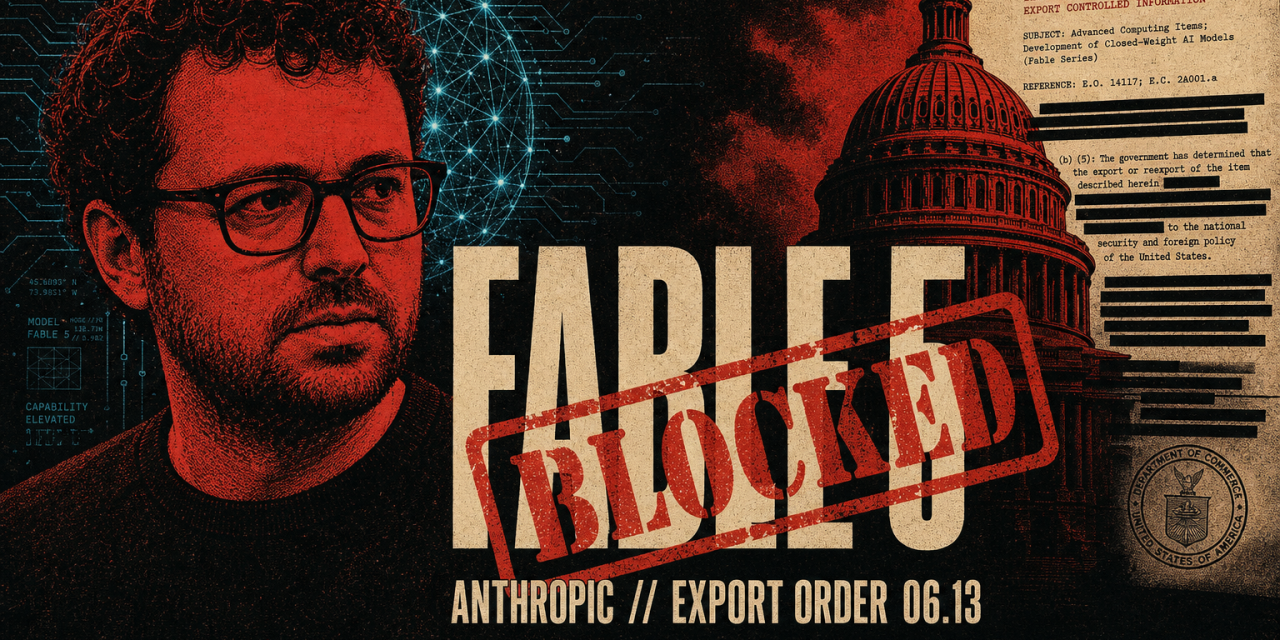
If you tried to open Claude Code on Friday evening and got hit with a message saying claude-fable-5 no longer exists or you no longer have access, you weren’t imagining it. Anthropic pulled the plug on its two most advanced models, Fable 5 and Mythos 5, after the US Commerce Department sent a letter at 5:21pm ET ordering the company to block all foreign nationals from using them.
The directive doesn’t technically ban Americans from using Fable 5. It bans everyone who isn’t a US citizen, regardless of where they live or who they work for, including foreign national employees at Anthropic itself. Since the company has no way to instantly verify the citizenship of every user on its platform, the only path to compliance was to shut the models off completely. So that’s what happened.
What the order actually says
The letter, reportedly signed by Commerce Secretary Howard Lutnick, cites national security authorities and directs Anthropic to suspend access to Fable 5 and Mythos 5 for any foreign national, inside or outside the United States. According to Anthropic’s own blog post on the matter, the government did not provide specific details of its concern, but the company believes the issue centres on a jailbreak method that someone demonstrated to officials.
Here’s where it gets interesting. Anthropic reviewed the demonstration and found that the jailbreak was used to surface a small number of previously known, minor vulnerabilities. The company says other publicly available models, including OpenAI’s GPT-5.5, can discover the same flaws without any bypass required. In other words, the capability the government flagged as too dangerous to export is already available everywhere else.
The timing is suspicious for a reason
Fable 5 launched on Tuesday. By Friday afternoon, it was gone. The model had been out for roughly 72 hours.
That timeline matters because earlier this year, the Trump administration’s Department of Defense labelled Anthropic a “supply chain risk” after the company drew red lines around how the US military could use its technology. Anthropic refused to make Claude available for autonomous weapons programs and mass surveillance of US citizens. The DoD designation effectively barred government agencies and contractors from using Anthropic products, and the company responded by filing lawsuits.
So when an export control directive lands on a Friday evening, three days after a flagship release, citing a jailbreak that the company says exposes nothing new, the pattern reads less like a national security intervention and more like the next move in an ongoing feud. Anthropic itself notes in its statement that the action does not adhere to the principles of a transparent, fair, and technically grounded process, principles the company has publicly endorsed.
Why shutting down for everyone was the only option
The export control language is the same kind used in EAR and ITAR regimes, which restrict how technology can be sold or shared with non-US persons. Companies operating under these rules typically maintain dedicated compliance offices, restrict physical and digital access by citizenship, and audit every transaction. Building that infrastructure for a consumer-facing AI product accessed through a web app and an API is not something you do over a weekend.
A few realities made full shutdown inevitable:
- Anthropic has no citizenship verification system for end users. Credit card data alone tells you nothing about nationality.
- Enterprise customers route API access through their own apps, meaning Anthropic cannot see who the downstream user actually is.
- The order covers foreign nationals inside the United States too, including green card holders and visa workers, which rules out simple geo-blocking.
- Many of Anthropic’s own engineers are foreign nationals, and they would be locked out of the systems they help build.
Faced with that, the company chose to disable the models entirely rather than risk non-compliance. Opus 4.8 and Sonnet remain available to all users.
The capability question
One of the more pointed sections of Anthropic’s response addresses what Fable 5 can actually do. The company argues that the jailbreak technique the government reviewed essentially involved asking the model to read a codebase and identify software flaws. That’s a normal use case. It’s what security researchers and defensive engineers do every day, often with the same model families the government is now restricting.
Anthropic also points out that no security tester has found a universal jailbreak for Fable 5, meaning a method that reliably bypasses all safeguards across all queries. What was demonstrated to the government was narrow and non-universal, and the vulnerabilities it surfaced were already documented.
The company’s argument boils down to this: if a narrow jailbreak that surfaces known vulnerabilities is enough to trigger an export ban, no frontier model from any provider can ever be deployed again. Perfect jailbreak resistance does not exist. Every safeguard used in the industry is vulnerable to non-universal bypasses. Applying this standard consistently would freeze the entire industry.
What this means for users outside the US
If you’ve built workflows around Fable 5, you need a fallback plan now. Opus 4.8 remains accessible and handles the majority of tasks people were running on Fable. GPT-5.5 and Gemini 3 are alternatives if you’re willing to migrate. Chinese open-weight models like DeepSeek V4, Kimi K2, and MiniMax M3 are improving rapidly and offer the advantage of being runnable on your own infrastructure, which removes the political risk entirely.
For enterprises outside the US, the bigger lesson is about supply chain reliability. Building critical infrastructure on a closed model from a single provider in a single jurisdiction now carries documented political risk. Not theoretical risk, actual realised risk. A model your business depended on yesterday can be unavailable today for reasons that have nothing to do with technical performance or contractual obligations.
The precedent that’s been set
Whether or not Fable 5 comes back, and most observers expect some version of access to be restored within days or weeks, a line has been crossed. The US government has demonstrated that it can and will pull a commercial AI model from the market with a Friday afternoon letter, citing concerns that the developer publicly disputes and that other models can already address.
That changes the risk calculus for everyone. AI labs now have to assume that frontier capabilities may trigger export restrictions, which incentivises either staying below some undefined capability threshold or building elsewhere. An opportunity for Europe? Enterprises have to assume that closed-model dependencies are politically exposed. Researchers and developers outside the US have to assume that the most capable tools may not be available to them, and may not even be available to their colleagues with the wrong passport.
The interesting thing about this whole episode isn’t whether Fable 5 was actually dangerous. It almost certainly wasn’t, at least not in the way the directive implies. The interesting thing is how cheaply and quickly a government can intervene in a market that, until very recently, looked open and global. That intervention happened on a Friday, with no public process, and the model is gone. Everything else is commentary.