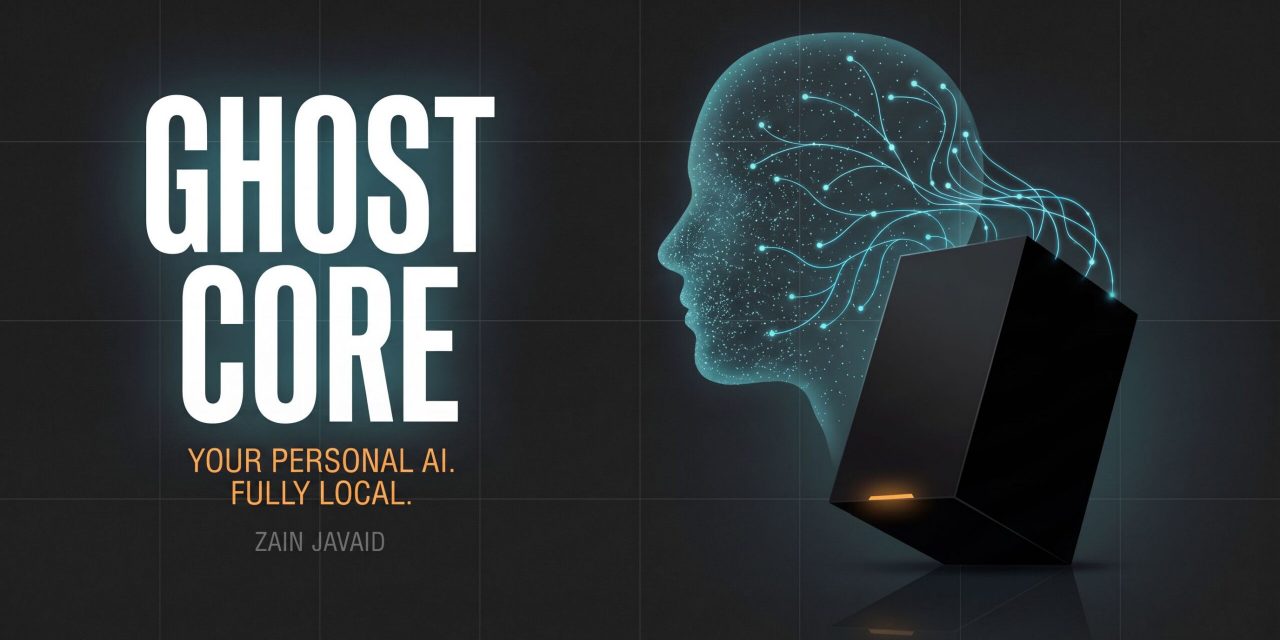
The Ghost AI PC, called Core, is built for software that works for you. Most computers wait for a click or a prompt. Core is designed to keep AI agents running continuously, pulling together your files, your browsing and your smart home into one device that learns how your life is organized and acts on it. Preorders are open at $3,499, and Ghost plans to ship in the last week of October.
Here is what the machine is, who is behind it, and how to decide whether it fits your setup.
Who is behind Ghost
Ghost came out of stealth with an $11 million seed round led by Andreessen Horowitz. Abstract, Audacious Ventures, SV Angel and Nova also joined the round. That is a sizable seed check for a hardware startup with a first product still in preorder.
The founding team is young. CEO Zain Javaid is 19. He spent years aiming for a career as a quant, using math and data to steer investment decisions. After working in that world for a while, he got bored. The launch of ChatGPT in 2022 pulled him toward personal AI, and that interest eventually became Ghost. He started the company with Nicholas Chua, also 19, Yifei Chen, 24, and Gautam Sharda, 23.
The team’s backgrounds lean toward data and software, which matters for a product whose value depends more on its software layer than on its case design.
What the Ghost AI PC actually does
Core is a personal computer designed specifically for AI agents. Javaid describes the goal as centralizing a person’s data, from desktop files to connected home devices, in one box that runs agents continuously. Those agents act as an assistant that understands the context of your life and handles tasks on your behalf.
Three components make that possible:
- A dedicated GPU. Core ships with an Nvidia RTX Pro 4000 SFF Blackwell card, a professional chip commonly used to run AI models. The GPU is included in the $3,499 price.
- Its own software layer. Ghost built a system that lets agents process information and complete tasks without you prompting them each time.
- A custom browser and filing system. Agents get a structured, consistent view of your data and the web, which makes it easier for them to retrieve the right information and act on it reliably.
The key idea is persistence. A chatbot in a browser tab forgets what it was doing when you close it. Core is meant to keep watching, sorting and executing in the background, closer to a home server than a laptop.
Why Ghost built dedicated hardware
You can already run open models on a gaming PC or a recent Mac. Javaid’s argument is that the experience falls apart in practice. In his words, “You can run models on existing hardware, but it’s a terrible experience on many levels.”
Anyone who has tried a local AI setup will recognize the friction. You install drivers, pick a model that fits in memory, wire it to your files through scripts or third party tools, and then hope it keeps running after an update. Your daily computer also has to share its resources with the model, so your editing software and your agent compete for the same GPU.
A separate device solves several of those problems at once:
- It stays on. Agents can run overnight or while you are away, so tasks finish whether or not your laptop is open.
- It keeps workloads apart. Your main machine stays responsive because inference happens on another box.
- It keeps data close. Files and home device data can be processed locally, which appeals to people who prefer to keep personal information off cloud servers.
- It removes setup work. Ghost controls the hardware and software together, so the stack is tested as one product.
The GPU inside Core
The RTX Pro 4000 SFF Blackwell is a small form factor workstation card from Nvidia’s professional line. Cards like this are built for compact systems that need serious AI throughput with modest power draw, which suits a device meant to sit on a shelf and run all day.
For buyers, the relevant question is which models it can handle comfortably. A card in this class can run capable open models for text, document search and image tasks locally. The very largest frontier models will still live in the cloud. Expect Ghost to mix local processing for private, frequent tasks with remote models when heavier reasoning is needed, though the company has not detailed that split publicly.
Is $3,499 a fair price
The price looks steep next to a standard desktop and reasonable next to a professional workstation. A few comparisons help frame it:
- Building your own. A professional GPU in this class plus a compact chassis, CPU, memory and storage adds up quickly. Building it yourself might save money, but you take on the software integration that Ghost is charging for.
- Other local AI boxes. Nvidia’s own DGX Spark targets developers who want a desktop AI machine and sits in a similar price range. It is aimed at people who build models and agents. Core is aimed at people who want agents working for them.
- Cloud subscriptions. Premium AI plans cost far less per month, but they keep your data on someone else’s servers and run only when you ask.
Put simply, you are paying for hardware, convenience and local control in one package. Whether that is worth it depends on how much you value the last two.
Lessons from earlier AI gadgets
Dedicated AI hardware has a rough track record. The Humane AI Pin and the Rabbit R1 both launched with ambitious promises and struggled with slow responses, limited usefulness and short battery life. Humane ended up selling its assets to HP.
Core takes a different route. Those devices tried to replace the phone with something smaller and weaker, then sent most of the work to the cloud. Ghost puts a powerful GPU in a stationary box and plugs it into the devices you already own. There is no battery to manage and no new screen to learn. That approach avoids the most obvious failure points of earlier gadgets, though it still has to prove that its agents deliver useful results day after day.
Who should consider the Ghost AI PC
Core makes the most sense for a few types of users:
- Busy professionals with scattered files, inboxes and calendars who want an assistant that organizes and follows up in the background.
- Privacy minded users who want AI help without sending every document to a cloud provider.
- Smart home enthusiasts who like the idea of one hub that understands their devices and routines.
- Early adopters who enjoy testing new categories and accept some rough edges in a first generation product.
If you mainly use AI for occasional writing help or quick questions, a subscription will cover your needs at a fraction of the cost.
Questions to ask before you preorder
Shipping starts at the end of October, so independent reviews will arrive soon after. Before committing, look for clear answers on these points:
- Which tasks run locally and which ones send data to external servers?
- What agents ship on day one, and can you add or build your own?
- Which services and devices it connects to, including email, calendars, cloud storage and smart home platforms.
- How permissions work. An agent that acts on your behalf needs firm limits on what it can send, buy or delete.
- How updates are handled and how long Ghost commits to supporting the hardware.
- Whether there is a subscription on top of the hardware price for cloud features or premium agents.
The real test is trust
The GPU and the funding are the easy parts to evaluate. The harder question is whether people will let software act for them without supervision. A device that runs agents all day is only useful if you trust it enough to stop checking its work. That trust comes from transparent logs, clear permissions and a track record of small tasks done right. If Ghost gets those details right, Core could set the template for how personal AI agents live in the home. If it does not, even strong hardware will end up running a very expensive chatbot.