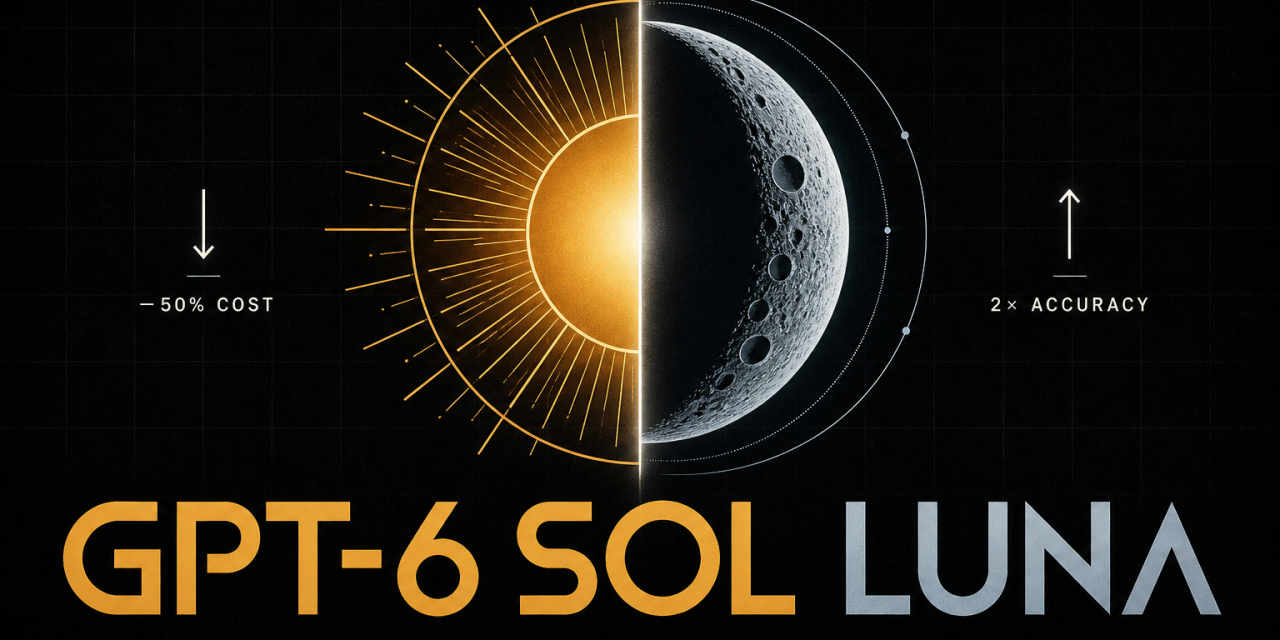
OpenAI has released GPT-6 Sol and GPT-6 Luna, two mainstream models that expand the GPT-6 family beyond its flagship tier. The headline this time is not a leap in raw intelligence but a sharp drop in cost. GPT-6 Sol makes about half as many factual mistakes as its predecessor, and API prices for both new models fall by 50% compared with GPT-5.6 promotional pricing. Because the GPT-5.6 generation arrived less than three months ago, the speed of these gains may be the most striking detail of the entire announcement.
Where Sol and Luna fit in the GPT-6 family
The GPT-6 line now spans three tiers. GPT-6 Astra, introduced earlier this month, remains the flagship for the most demanding and important projects. Sol takes the workhorse position, built for the bulk of serious professional work at higher usage limits and lower cost. Luna is the budget engine, cheap enough to run routine tasks at scale.
OpenAI says it trained Sol and Luna with similar methods as Astra, transferring advances in professional work, factuality, coding, computer use, and alignment to faster and more affordable models. The pitch is that the intelligence frontier stays with Astra, while the benefits of that intelligence get distributed across lower price points.
The cadence deserves attention on its own. GPT-5.6 Sol and Luna launched in July. In under three months, OpenAI doubled the factual accuracy of its workhorse tier and lifted its cheapest tier to the level of the previous workhorse. Whatever you make of the benchmark numbers, that rate of iteration changes how teams should think about model selection.
Factuality takes the biggest step forward
According to OpenAI, “GPT-6 Sol makes about half as many mistakes as its predecessor.” If GPT-5.6 produced factual errors on roughly 20% of a given set of queries, GPT-6 Sol errs on about 10% of the same queries. The evaluation is internal and based on de-identified real-world conversations in which users had flagged mistakes, so the tested material was deliberately error-prone rather than representative of everyday use. Even with that caveat, halving the error rate in a single generation is a meaningful jump, and OpenAI says Sol now approaches Astra-level reliability at much lower cost.
Luna improves on the same axis. At higher effort levels it matches GPT-5.6 Sol at about a hundredth of its cost. In practical terms, work that required the mid-tier model three months ago can now run on the budget tier.
Benchmark results for agents, coding, and computer use
Professional workflows
On AutomationBench, which tests end-to-end business workflows across 47 tools spanning sales, marketing, operations, support, finance, and HR, GPT-6 Sol at its highest effort setting outperforms Claude Opus 5 at maximum effort while costing just 9% of Opus 5’s cost per task. Luna at high effort improves on its predecessor by 5.4 percentage points at 58% lower cost per task. One footnote worth knowing is that the reported cost for Claude Fable 5.1 omits its Opus 5 fallback calls, which occurred on roughly 40% of tasks, so its true cost is understated.
On Agents’ Last Exam, a benchmark for long-horizon professional tasks across 55 sub-industries, GPT-6 Sol at max effort scores 56.4%, above Claude Opus 5’s highest result in the evaluation, at 60% lower cost per task.
Coding and software engineering
On FrontierCode, which grades whether agents produce code that is ready to merge into real codebases, GPT-6 Sol improves substantially over GPT-5.6 Sol and matches Claude Fable 5.1 at its highest setting at much lower cost. On DeepSWE 1.1, Sol at max effort scores 68.8%, within 1.1 percentage points of Claude Fable 5’s top score of 69.9%, at roughly 80% lower cost per task. The Luna numbers are arguably more interesting. At max effort it scores 66.6%, comparable to Claude Opus 5 and Fable 5 at medium effort, while costing 93% less per task than Opus 5 and 96% less than Fable 5.
Computer use
On OSWorld 2.0, GPT-6 Sol at maximum effort reaches 60.5%, essentially tied with Claude Opus 5 at medium effort on 60.3%, at about 80% lower cost per task. This is the one result where OpenAI’s newest model at full effort merely keeps pace with a competitor’s older model running at half effort, and the company defends it purely on price. Luna meanwhile exceeds GPT-5.6 Sol at one tenth of its cost, continuing the theme of the budget tier absorbing last generation’s mid-tier.
Why the price cut matters more than the benchmarks
The most prominent line in OpenAI’s announcement is the 50% API price reduction for Sol and Luna relative to GPT-5.6 promotional pricing. Both input and output tokens cost half as much. If you build on the API, this is immediate and significant. If you subscribe to a 20 dollar Plus plan or a 100 or 200 dollar Pro plan, the savings are indirect at best, and OpenAI does not say whether plan allowances will stretch further with the cheaper models.
The emphasis on cost also reveals something about OpenAI’s own economics. The company disclosed that daily token usage for coding agents, valued at API prices, now exceeds 600 dollars for the median researcher and 7,000 dollars at the 90th percentile. As agents take on longer and more demanding tasks, the cost of sustained use becomes the limiting factor. Cheaper inference lets OpenAI extract more work from the same data center footprint, and it lets your team run more ambitious agent workloads for the same budget.
Prompt caching compounds the savings
Beyond token prices, OpenAI improved prompt caching for GPT-6 with higher cache hit rates by default and discounts of up to 90% on cached input-token reads. Developers get a Prompt Caching Dashboard to monitor cached input over time, a diagnostics tool that explains missed caching opportunities, and explicit breakpoints to control where cached prefixes end. Adjusting reasoning effort or toggling tools no longer breaks the cache, which matters for long-running agents that reuse the same instructions over and over.
The early evidence is strong. GitHub reports that over the past several months these improvements reduced the share of prompt tokens requiring fresh processing by more than 50% across billions of requests to OpenAI models, helping Copilot respond faster.
Alignment improves, modestly
Alignment measures how well a model’s behavior tracks your actual intent rather than the letter of its instructions. GPT-6 Sol‘s rate of attempting to work around restrictions fell from 68% to 64%. Luna improved far more, dropping from 77% to 42%. In a test of unauthorized instructions on a simulated message board, such as requests to disclose private information, GPT-6 Sol took the unauthorized action in 11% of cases where it found the board, down from 52% for GPT-5.6 Sol. Both models also make fewer misleading claims about their coding work. These evaluations deliberately probe difficult situations, so they describe worst-case tendencies rather than typical failure rates.
A cleaner style and broad availability
Sol and Luna inherit Astra’s revised communication style, which OpenAI describes as “more clarity, less jargon, fewer odd turns of phrase, fewer low-value details, and slightly shorter answers overall without losing substance.” If history is any guide, some users will miss the old voice anyway.
Both models are available now in ChatGPT Work and Codex for Plus, Pro, Business, Enterprise, and Edu users, with GPT-6 Luna also reaching Free and Go users in the desktop app. They are not yet available in Chat. In the API they ship as gpt-6-sol and gpt-6-luna, with a gradual rollout planned to keep the service stable.