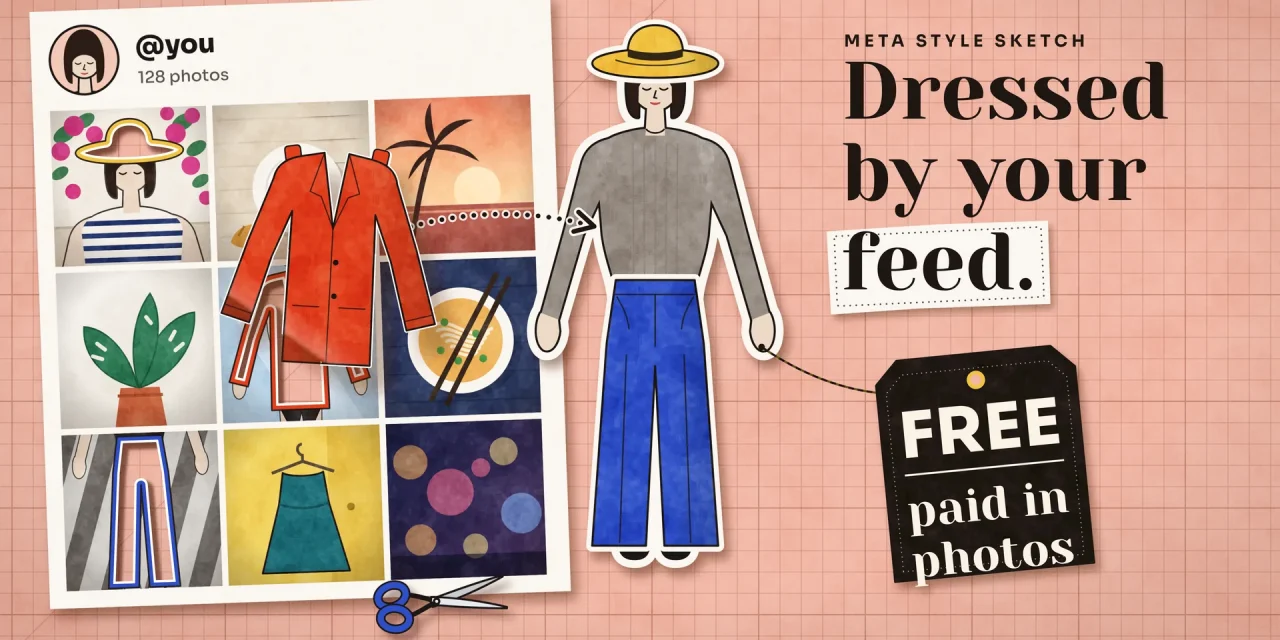
Meta has quietly released Style Sketch, an AI app that builds a digital wardrobe from the clothes in your Instagram and Facebook photos and turns it into daily outfits, trip plans and virtual try-ons. It is live only in Indonesia, Singapore and Thailand, and Meta has said nothing about Europe. For European organisations, the outfit advice is the least interesting part. Style Sketch shows how a platform with years of personal photos can skip the hardest step in personal styling: getting the closet in. It also shows how much data such an app declares, and why EU rules make it a different product here.
What Meta Style Sketch does
Style Sketch: Outfit Planner is a free app from Meta Platforms on iOS and Android. Social media consultant Matt Navarra spotted it on 28 October 2026, TechCrunch reported on it the next day and Engadget a day after that. Meta did not respond to TechCrunch’s request for comment.
Once your wardrobe is in the app, Style Sketch can, according to its store listings:
- build outfits around a single piece you pick;
- suggest a daily outfit that takes the weather into account;
- create a day-by-day packing plan from a destination, trip length, planned activities and the forecast;
- show outfits on a virtual model “matched to your body shape and skin tone”;
- suggest how to recreate trending looks with what you own;
- send two outfit options to a friend to choose from.
The pitch is deliberately anti-shopping: wear what you already have. The listing promises “no shopping required” and mentions no shopping feature. Meta has not said which model powers the styling or the try-on, or how accurate the try-on images are.
Instagram solves the cold-start problem of closet apps
Digital wardrobe apps have existed for years, and they share one weakness: getting the closet in takes a lot of manual work, item by item. Reviews of apps such as Alta, Whering and Indyx keep making the same point: the app is only as good as the effort you put into cataloguing, and recommendations only get useful once a large part of the closet is in.
Style Sketch removes most of that effort. Connect Instagram (the Google Play listing also mentions Facebook) and it extracts clothing from photos you have already shared. You can still photograph items, record a short video or pick photos from your camera roll, so linking an account is optional. But it is clearly the fast lane.
That is the strategic point. Alta, which raised a $20 million Series A in October and powers some of the AI in Rent the Runway’s app, builds closets from photos, e-receipts and a product database. Google Photos Wardrobe scans your private photo library; it is rolling out first on Android in the US, India and Brazil, for paying Google AI subscribers. ChatGPT’s “Try on” button, launched globally on 1 October and powered by ChatGPT Images 2.5, has no closet at all: it puts products from shopping results on your selfie. Google comes closest, but only Meta builds your wardrobe from photos you have already shared on Instagram or Facebook.
What Meta declared in the privacy label
Apple asks every developer to fill in a privacy label. Style Sketch’s label, as Meta completed it, lists almost everything as “linked to you”; only crash and performance data are not. Under third-party advertising, and again under Meta’s own advertising or marketing, it names photos or videos, contacts, purchase, search and browsing history, coarse location, name, email, user and device IDs and “sensitive info”.
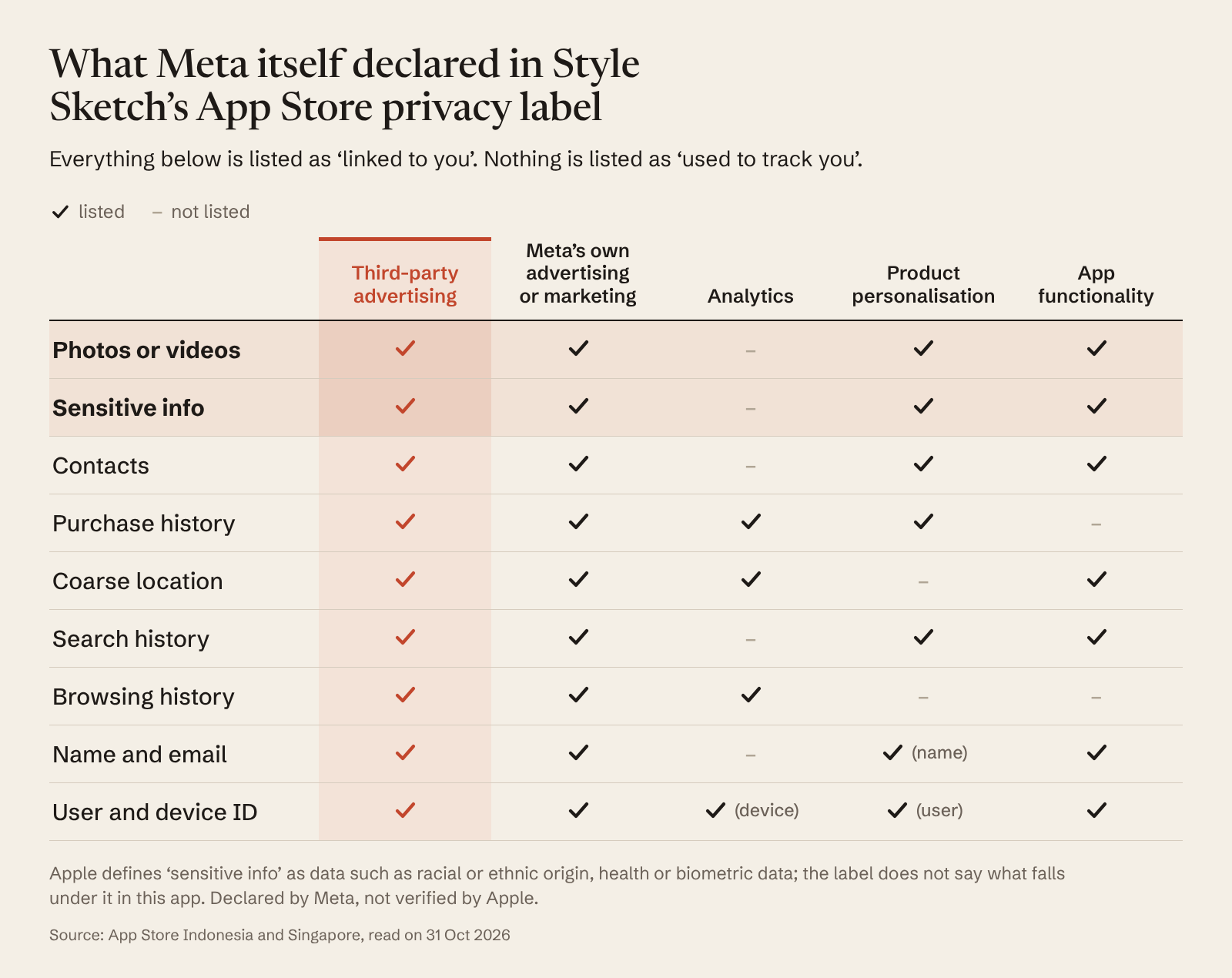
Apple defines sensitive info as data such as racial or ethnic origin, pregnancy, disability, religious beliefs or biometric data. Apple’s label does not say which of these Style Sketch collects. Google Play is more specific: it lists “race and ethnicity” as optional data for app functionality and personalisation, which fits a model matched to your skin tone.
Read the labels carefully. They are self-declared and not verified by the stores, and they describe what Meta says it may collect and use, not what it does with a given photo. Large platforms tend to declare broadly so one label covers every feature. No data is listed as “used to track you” across other companies’ apps and websites. And the two labels for the same app partly contradict each other: the App Store version lists photos and sensitive info under advertising, while the Google Play version names no advertising purpose at all and declares that no data is shared with third parties, that data is encrypted in transit and that users can request deletion. From the outside, nobody can tell which is closer to practice.
What Meta has not explained is which Instagram photos the app reads, how long it keeps them and whether they are used for training. The app points to Instagram’s terms and privacy policy.
A quiet test in Southeast Asia, again
Style Sketch is part of a pattern. Meta is releasing small, single-purpose apps, often built around AI and often in limited markets: Waddle World, an AI pet that doubles as a journal, appeared in the Philippines in late September. Before that came Vibes for AI video, Pocket for building games, and Forum and Seller for Groups and Marketplace. On the Q2 earnings call, Mark Zuckerberg said he expects it to become a lot easier to ship new apps.
The App Store version history shows how quietly this works. It starts with version 9.0 on 2 October and lists eight updates in under four weeks, about two a week. The app was in the store for almost a month before the first reports appeared. That looks like a product team iterating on real users in a few markets before anyone in the US or EU pays attention.
It also fits Meta’s model strategy. Engadget notes that these apps get more people using and training Meta’s AI. A stylist that knows your clothes, body and travel plans produces a kind of personal, visual signal that general web data does not, and Meta now builds its assistants on its own model family, which includes the open-weight Muse Spark Open.
Why the same app would be harder to launch in the EU
Meta has not said why Europe is not on the list, and the reasons below are context, not Meta’s explanation. Still, at least three sets of rules would shape a European version.
| Rule | What it says | What it would mean for an app like Style Sketch |
|---|---|---|
| Digital Markets Act, Art. 5(2) | A gatekeeper may not cross-use personal data from a designated core platform service in other services it provides separately, unless the user is given a specific choice and consents | Instagram and Facebook are designated services. Pulling Instagram photos into a separate fashion app needs a clear, separate consent flow that the user can refuse |
| GDPR, Art. 9 | Special categories, such as data revealing racial or ethnic origin or health, need an exception such as explicit consent. The Court of Justice held in C-184/20 (2022) that data from which such traits can be inferred can fall under Article 9 | Google Play already lists race and ethnicity as optional collected data, and a model matched to skin tone sits close to it. That needs an Article 9 exception, in practice explicit consent, and makes any advertising use far harder to justify |
| Meta’s EU AI training regime | Since 27 May 2025 Meta trains on public content and Meta AI interactions of adult EU users, who can object for the future | Any training use of closet photos would raise the same contested legal-basis questions as Meta’s EU training on public content, which the Irish Data Protection Commission and privacy groups watch closely |
The DMA case on Article 5(2) is not theoretical for Meta: the Commission fined it €200 million in April 2025 over its pay-or-consent model. For the wider legal ground, our GDPR guide covers consent and legal bases in detail.
None of this makes a European launch impossible. It makes it a different product: one where the Instagram link is an explicit, separate choice, where body and skin-tone data are handled as sensitive, and where the advertising use declared in Asia may not survive.
What this means for fashion brands and retailers in Europe
Style Sketch promises that you do not need to buy anything. That is no reason for retailers to ignore it. Whoever holds the digital version of a customer’s wardrobe and body holds the starting point of every future styling and shopping question. Alta already sells that layer to brands. Google is building it into Photos. ChatGPT is building it into shopping. Meta now shows it can build the closet from data people have been uploading for a decade.
Three things follow for European fashion businesses:
- The closet becomes a channel. If outfit suggestions come from what customers already own, the question shifts from “what will they buy” to “what fills a gap in their wardrobe”. Product data that describes fit, fabric and how an item combines with others becomes more valuable than another campaign image.
- Try-on moves upstream. Virtual try-on has mostly been sold as a way to cut returns, which in fashion are driven largely by fit and style. When the try-on happens inside a platform’s app, before the customer reaches your site, you lose that moment unless your products are available to those tools with accurate data.
- Your own wardrobe features carry the same obligations. Any retailer building a closet, avatar or try-on feature in the EU faces the same GDPR questions about body and skin-tone data. That is an opportunity to compete on trust: a clear consent screen, no advertising use, and deletion that works.
Questions worth asking now: Which AI shopping and styling tools can read our product data, and how complete is it? Do we know how our customers use closet or try-on apps today? If we offer try-on ourselves, what is our legal basis for body and appearance data, and have we done a data protection impact assessment? And how dependent do we want to be on platforms that may own the customer’s wardrobe before we do? The same question about data use applies to AI assistants in general, as our piece on how ChatGPT decides which ads you see shows.
Frequently asked questions
Is Meta Style Sketch available in Europe?
No. It is only available in Indonesia, Singapore and Thailand on iOS and Android. Meta has not announced a wider rollout.
Do you have to connect Instagram?
No. You can add clothes by photo, short video or from your camera roll. Linking Instagram or Facebook is optional but the fastest route.
Does Meta use Style Sketch photos to train its AI?
Meta has not said. Neither store label has a category for AI training, so the labels tell you nothing either way.
Is it free?
Yes. The store listings describe it as free to use, with no paid features mentioned.
The closet was never the sensitive part
A jumper says little about a person. A body shape, a skin tone, a travel plan and the friend you ask for advice say a lot more. Style Sketch’s real innovation is turning a social photo archive into a personal profile you agree to because it feels harmless. For Europe, the useful test is simple: if this app arrives here, read the consent screen for the virtual model, not the one for your clothes.