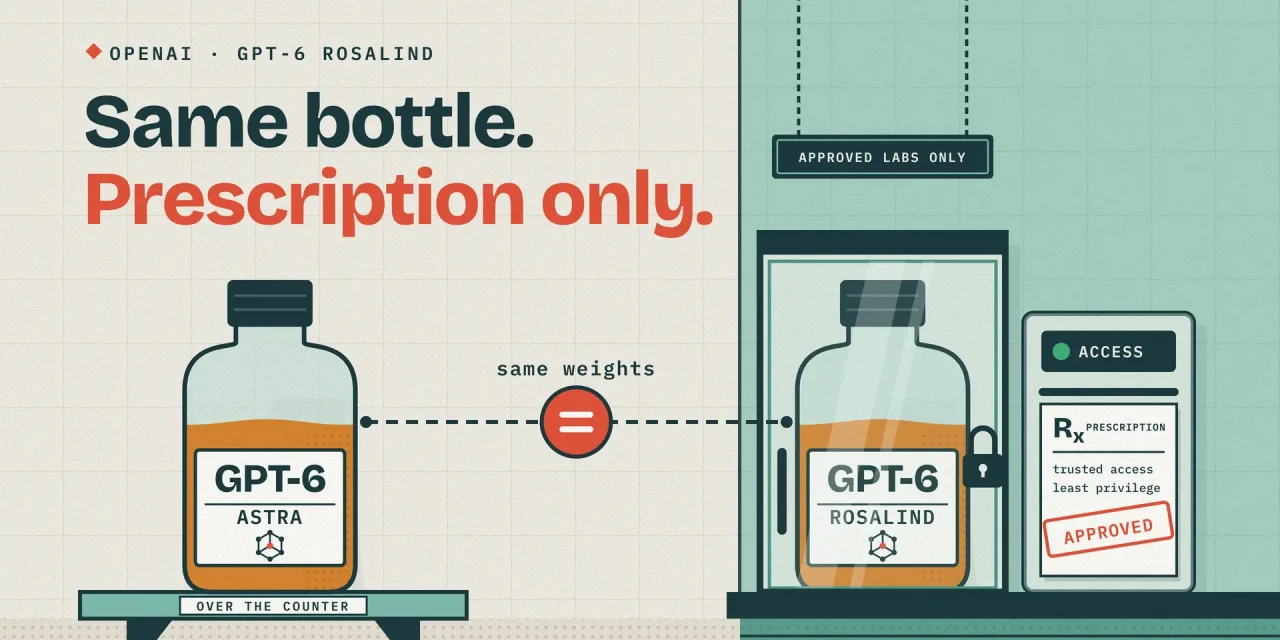
OpenAI released GPT-6 Rosalind on 30 October 2026, its new model for biology and drug discovery. The headline fact sits in the system card: GPT-6 Rosalind uses the same weights as GPT-6 Astra, OpenAI’s general flagship, with no additional training data or post-training. What changes is the refusal boundary and who is allowed in. For European life sciences organisations, that turns the buying question around. You are not choosing a smarter model. You are applying for permission, and accepting obligations that your own governance has to carry.
What GPT-6 Rosalind is
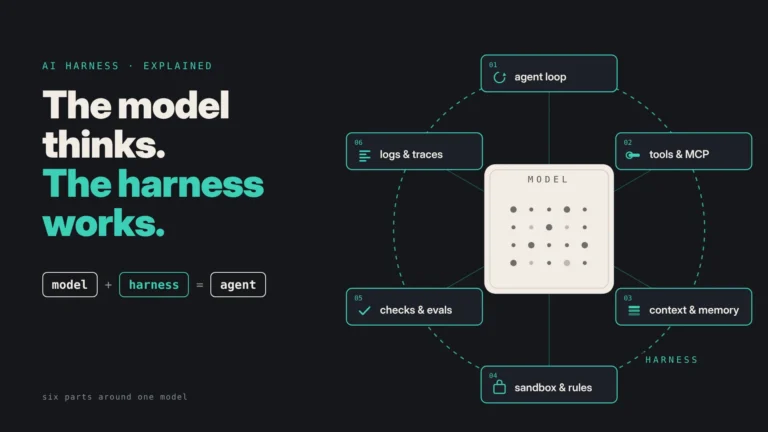
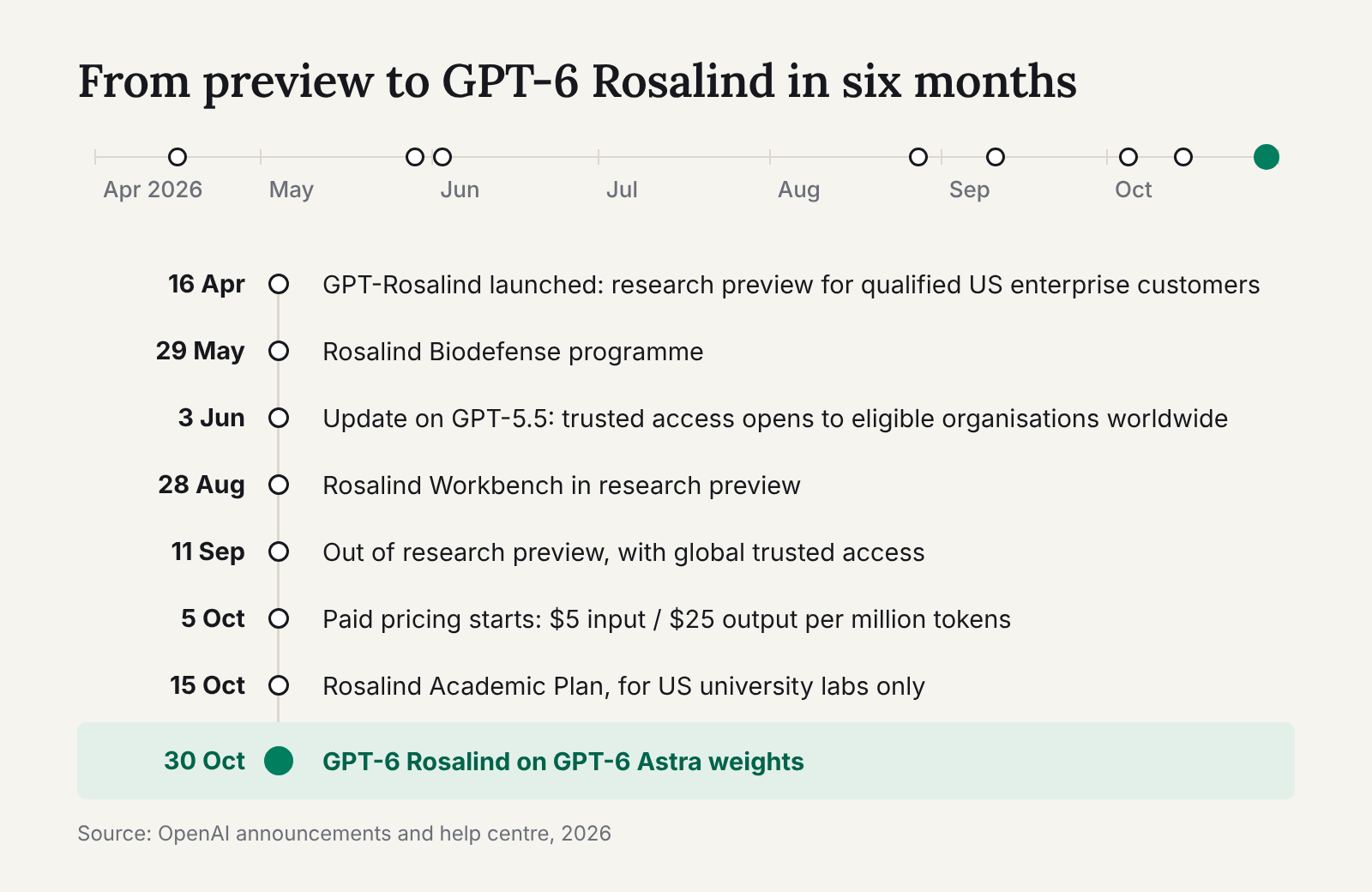
GPT-6 Rosalind is the third generation of GPT-Rosalind, the life sciences series OpenAI introduced in April. The product is called GPT-Rosalind-6 Research and the API model id is gpt-6-rosalind. It targets the early stages of research: synthesising evidence, generating hypotheses, planning experiments and interpreting sequence, protein and genomics data.
Its predecessor, GPT-Rosalind-5.5, was built on GPT-5.5. The new version runs on GPT-6 Astra, released in early September. In OpenAI’s words, Rosalind “has fewer refusals on dual-use biological queries” but is only made available through trusted access. OpenAI says it is tuned to refuse or safely respond to requests that would meaningfully enable biological weaponisation.
Access is now the product
Dual-use research is work where the same knowledge can protect or harm. A question about how a virus enters a cell matters to a vaccine team and to a bad actor alike. General models refuse more of these questions. Rosalind answers more of them, for vetted users.
The refusal tables in the system card, as summarised by Data Studios, show the effect. On a set of benign biology questions, Rosalind answered fully in 100% of cases against 91.6% for Astra. The system card’s own biorisk knowledge test makes the same point. Astra refused 29.2% of its questions, Rosalind 9.4%. Adjusted for refusals, Astra actually scored higher, 90.0% against 85.0%. Rosalind’s advantage there comes from answering more often, not from answering better. The flip side: on questions about sensitive biological material, Data Studios reports that Rosalind’s answers passed OpenAI’s safety grader 79.0% of the time against 99.8% for Astra. That is exactly why access is gated.
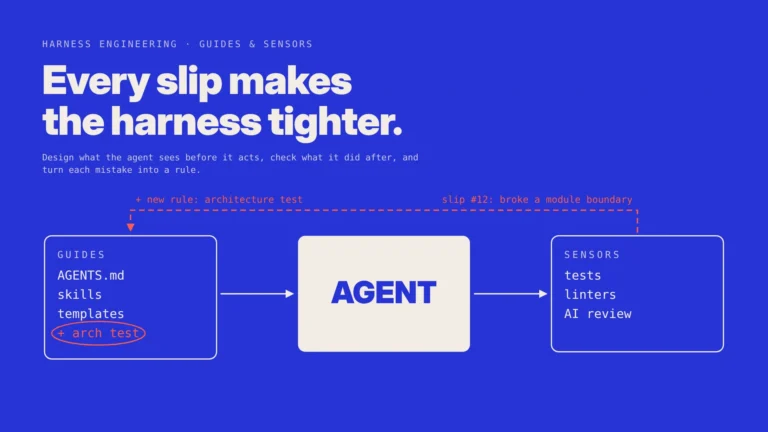
This is a pattern, not a one-off. OpenAI opened GPT-5.5-Cyber to vetted security teams through a Trusted Access for Cyber programme in May, and paired Astra with trusted access controls for Astra for Law in September. In each case, vetted customers get a model that is more permissive in a sensitive domain, under monitoring. With Rosalind, OpenAI now states openly that the model itself is unchanged and only the policy and the gate differ. For buyers, that means the real assets are the approval, the obligations and the audit trail, and those sit partly on your side of the contract.
What the benchmarks show, and what they don’t
OpenAI compared the new model with GPT-Rosalind-5.5 at the highest reasoning budget on three of its own benchmarks:
- MedChemBench v7 (medicinal chemistry, 99 tasks): 49.6% against 28.9%.
- GeneBench Pro v13 (genomics, 129 tasks, single attempt, in a test configuration that differs from production): 37.7% against 16.7%.
- LifeSciBench Gold (applied life sciences research, 94 tasks): 61.3% against 44.0%.
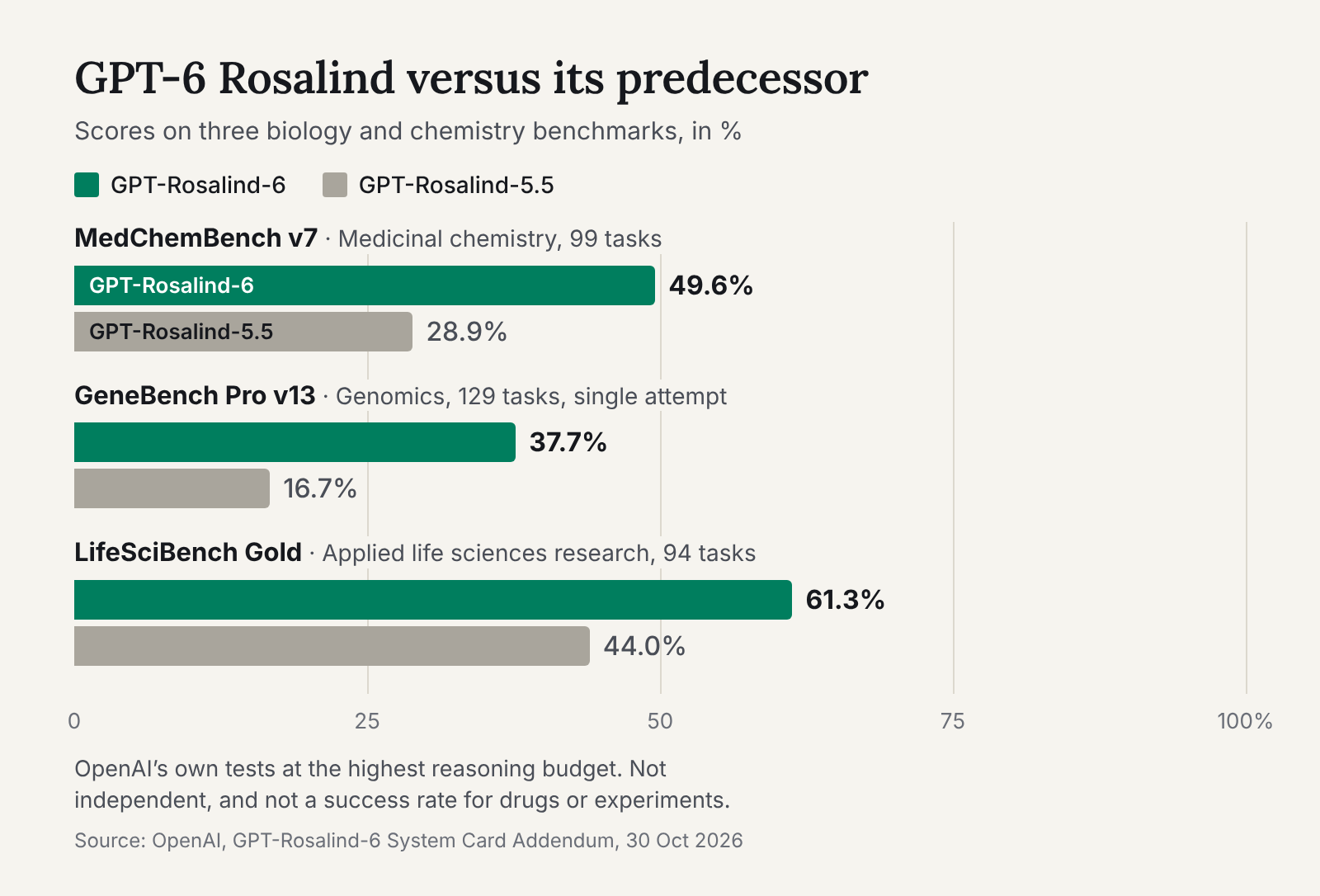
Read them with care. They are internal, not independently reproduced, and small enough that a few points mean little. A GeneBench score measures whether an analysis is done correctly, not whether a drug candidate will work. And because the weights are Astra’s, the improvement over Rosalind-5.5 comes from the new Astra base, not from life-sciences-specific training.
The safety ratings matter just as much for a governance team. OpenAI rates GPT-6 Rosalind High for biological and chemical capability, below Critical. It answered 491 of 832 TroubleshootingBench questions correctly, well above the 36.4% indicative High threshold, and none of the four biological design evaluations reached the Critical threshold. On cybersecurity it inherits Astra’s Critical rating and real-time cyber blocking, with a more conservative cyber refusal boundary on top. If your security team is already tracking how fast AI finds vulnerabilities, our piece on Europe’s security agenda explains why that label is not academic.
What approval obliges you to do
OpenAI reviews each applicant’s life sciences mission, use case, governance and ability to control access. Non-government applicants go through business verification and compliance screening; select government bodies have a separate route for biosecurity, biosafety, public-health preparedness and biodefence work. Eligible organisations worldwide have been able to apply since June, and the model left research preview on 11 September, so European organisations can apply. The new model does not widen eligibility.
Approved customers commit to controls that map neatly onto disciplines most regulated European organisations already run:
| OpenAI requirement | Where it lands in your organisation | Question to settle first |
|---|---|---|
| Access only for authorised users with a legitimate need, least privilege | Identity and access management, NIS2 and ISO 27001 access controls | Which roles need Rosalind, and which can stay on Astra or Sol? |
| Onboarding and insider-risk controls | HR and security screening, biosafety committee | Who signs off a new user, and who reviews dual-use projects? |
| Strong admin controls and a process to remove access when it is no longer needed | Joiner-mover-leaver process | How quickly is access revoked when someone changes project or leaves? |
| Qualified human review before outputs inform experiments, publications or consequential decisions | Research integrity, GxP quality systems, publication review | Who is qualified to review, and where is that review recorded? |
| Model access and data-retention terms approved separately | Procurement, legal, data protection officer | Where is data processed and stored, and for how long? |
OpenAI monitors use after approval and can restrict or revoke access. Plan for that as a business continuity risk: if a research workflow depends on Rosalind, losing the approval stops the workflow.
Where it runs
According to OpenAI’s help centre, GPT-6 Rosalind Research sits in the Research tier of GPT-Rosalind, alongside GPT-5.5 Rosalind Research. It is not available in the regular ChatGPT chat tab. Approved users reach it in Codex through the model picker, in ChatGPT’s work environment, and in the API as gpt-6-rosalind, for approved internal research only. An approval for GPT-Rosalind Discovery does not include it. Rosalind Workbench, launched in research preview in August and announced to the developer community, adds guided tasks and scientific viewers; the system card does not say which surfaces already carry the GPT-6 version.
The European questions
Data location. OpenAI offers data residency in Europe for eligible API projects and ChatGPT workspaces, with a 10% uplift on regional processing for eligible models released on or after 5 March 2026. Nothing published says whether gpt-6-rosalind is eligible. Ask before you send any patient-derived data.
GDPR. Genetic and health data are special categories under Article 9. Human review and access controls help, but you still need both a lawful basis under Article 6 and an exception under Article 9(2), such as scientific research with appropriate safeguards. Large-scale processing of genetic or health data also makes a data protection impact assessment mandatory under Article 35(3)(b). And you need clarity on retention.
The AI Act research exemption. Article 2(6) excludes AI systems and models specifically developed and put into service for the sole purpose of scientific research and development. A general vendor model used in a pharma pipeline is unlikely to fit that narrow wording. Get legal advice rather than assuming you are out of scope. Falling outside the exemption does not mean heavy duties, though: the model obligations sit with OpenAI as provider, and a deployer outside the high-risk categories mainly faces AI literacy and, where relevant, transparency duties.
Biotech policy. The European Commission’s Biotech Act proposal of December 2025 pairs regulatory sandboxes for innovative trial designs, including AI-enabled ones, with measures to prevent misuse of biotechnology, including risks linked to AI. Trusted-access models fit that direction, but your internal biosecurity review will be expected to keep up.
Academia. The Rosalind Academic Plan, with up to 30 free ChatGPT seats for up to twelve months, is currently open only to labs at US universities. European university labs go through the standard review, with a paid agreement or an approved API organisation.
What it costs
On 31 October, OpenAI’s pricing page listed two Rosalind models, gpt-rosalind-research and gpt-rosalind-discovery, at $5 per million input tokens, $0.50 cached and $25 per million output tokens, with billing for gpt-rosalind-research since 5 October. There was no separate row for gpt-6-rosalind. The help centre says only that GPT-6 Rosalind Research has different standard rates from the Rosalind 5.5 models. API reseller APIYI reports $15 input and $75 output per million tokens, 1.5 times Astra’s $10 and $50, but that figure does not appear on OpenAI’s own pricing page. Check your own console before you budget.
Alternatives worth comparing
Anthropic’s Claude Science, launched in June, is a workbench around the general Claude models that connects databases, notebooks and compute, and runs locally or on your own cluster. Google presented Gemini for Science at I/O in May. Both bet on the workflow layer; OpenAI bets on a gated model. For a European organisation, the deciding factors are less about benchmark points and more about where data runs, how outputs are logged and reproduced, and how much of your work actually hits the dual-use refusals that Rosalind relaxes. If sovereignty is the main concern, our analysis of Mistral Large 4 shows what owning the model does and does not buy.
Frequently asked questions
Is GPT-6 Rosalind a different model from GPT-6 Astra?
No. It uses the same weights, with no extra training. It differs in its refusal boundary for dual-use biology, a stricter cyber boundary and gated access.
Can European organisations get access?
Yes. Trusted access is open to eligible organisations worldwide, subject to OpenAI’s review. The free Academic Plan is limited to US universities.
Is GPT-6 Rosalind available in the EU data residency region?
OpenAI has not said. Confirm eligibility for regional processing before using it with personal or patient data.
Does the AI Act’s research exemption apply?
Only if the system or model was specifically developed and put into service for the sole purpose of scientific research and development (Article 2(6)). A general vendor model used for commercial R&D is unlikely to qualify, so check with counsel.
How much does GPT-6 Rosalind cost?
No official price was published on 31 October 2026. The older Rosalind models cost $5 input and $25 output per million tokens.
Govern the key, not just the model
GPT-6 Rosalind is a capable research assistant, but its intelligence is Astra’s. What OpenAI really sells here is a licence to ask harder questions, under watch. That makes the approval a governed asset in its own right, with owners, reviewers, logs and an exit plan. Before you apply, list the research questions Astra refuses today, name who would hold access, and get written answers on data location and pricing. If those three are clear, the application is the easy part.