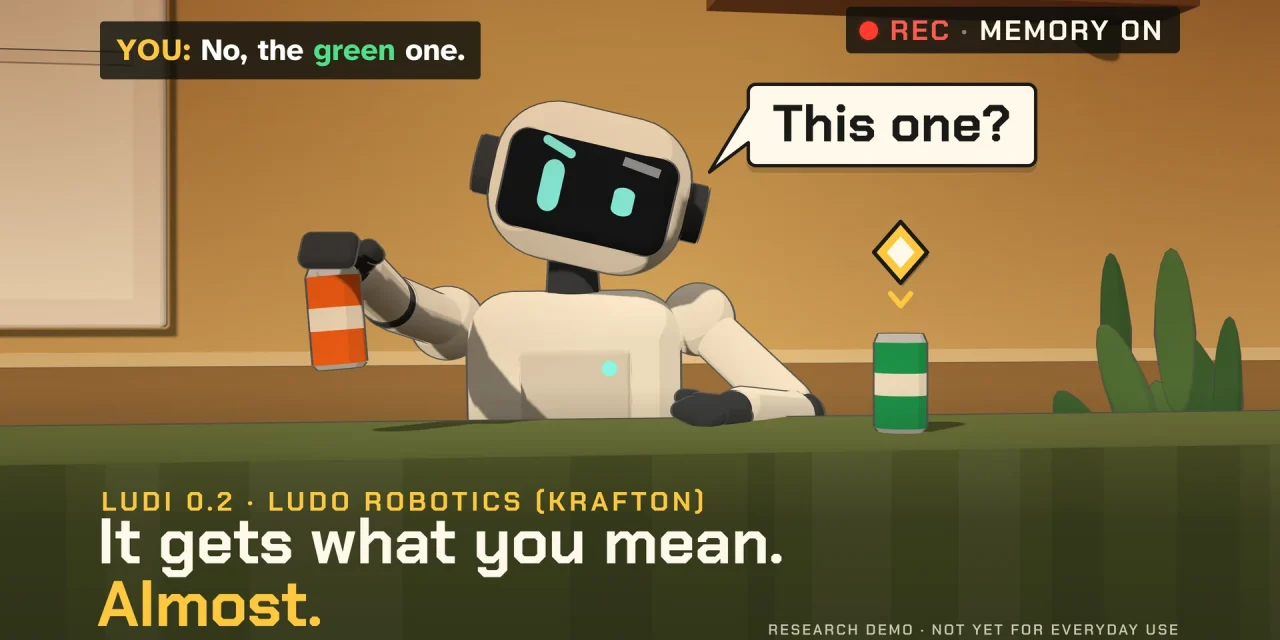
Ludo Robotics, the robotics subsidiary of PUBG publisher Krafton, presented Ludi 0.2 on 30 October. It is AI meant to help robots understand what people mean: read a gesture, remember what was said a minute ago and change course when someone changes their mind. It is a research demo, not a product, and no scores have been published for it. For European organisations the more useful lesson sits underneath: a robot that reads people is, by design, a system that watches, listens and remembers them. Here is what Ludi 0.2 is, what the evidence shows, and which EU rules already apply to robots like it.
What Ludi 0.2 is, and what it is not
Ludo Robotics is headquartered in Palo Alto with a research lab in Seoul. Krafton CEO CH Kim also runs Ludo, and Krafton’s Chief AI Officer Kangwook Lee is its CTO. Ludi 0.2 was shown at the Bay Area Robotics Symposium at UC Berkeley. Krafton lists five improvements over the first version from August:
- Social intelligence: better at interpreting intent, responding to feedback and accounting for social cues.
- Memory and reasoning: keeping context as tasks and situations change.
- Tool coordination: navigation, manipulation and conversation working together more smoothly.
- Gesture interpretation: recognising and responding to gestures during physical interaction.
- Physical movement: smoother, more adaptable motion in supported environments.
Lee frames the problem plainly: robots are getting better at physical tasks, but understanding and responding to people “remains a major challenge”. Some headlines say Ludi 0.2 was “released”. There is nothing to download, no API and no robot for sale. Krafton CEO CH Kim told Fast Company that Ludi is a research demonstration that is not yet reliable enough for everyday use.
How it works, a harness rather than one model
Ludo shared few technical details about version 0.2. The architecture is documented in the Ludi 0.1 paper, and according to Fast Company version 0.2 keeps it. Ludi is a small coordinating model that calls other models and tools:
- The coordinator is Qwen3.5-4B, Alibaba’s open vision-language model with 4 billion parameters, fine-tuned on 14,432 synthetic multi-turn conversations full of ambiguous requests, corrections and interruptions. It sees the camera feed, reads the transcript and picks the next step.
- Navigation works with named places on a map. The language model picks the destination; a separate planner works out the route.
- Grasping is handled by Nvidia’s GR00T N1.7, fine-tuned on recordings of people teleoperating the real robot.
- Speech is transcribed locally. Ten seconds of English take 94.7 milliseconds to process on average. That covers transcription only, not the full time until the robot responds.
- Memory is a shared log of what was said, seen and done, with a helper model compressing older context in the background.
In the experiments this ran on a Unitree G1 humanoid with a 360° camera on its head and a GPU workstation on site. Fast Company reports that for 0.2 the visual reasoning model was retrained to better judge how the robot’s body behaves around people.
The demo in the paper shows the point. You ask the robot to bring Chloe a Coke. It reaches for the can on the table. Halfway, you say she would rather have a Pepsi. Ludi aborts the reach, takes the Pepsi and delivers it to her room. If the request is ambiguous, it asks which one you mean instead of guessing.
The evidence so far
Ludo measures progress with Interaction Core28, its own benchmark of 28 household scenarios in the AI2-THOR simulator, including deliveries, requests that need clarification, failed searches and interruptions mid-task. In the Ludi 0.1 paper, the fine-tuned 4-billion-parameter model completed 17 of 28 scenarios, up from 10 before fine-tuning. A fine-tuned 9-billion-parameter version reached 20. OpenAI’s GPT-5.6 with an optimised prompt completed 26. Ludo still deployed the smallest model, because a robot has to answer quickly.
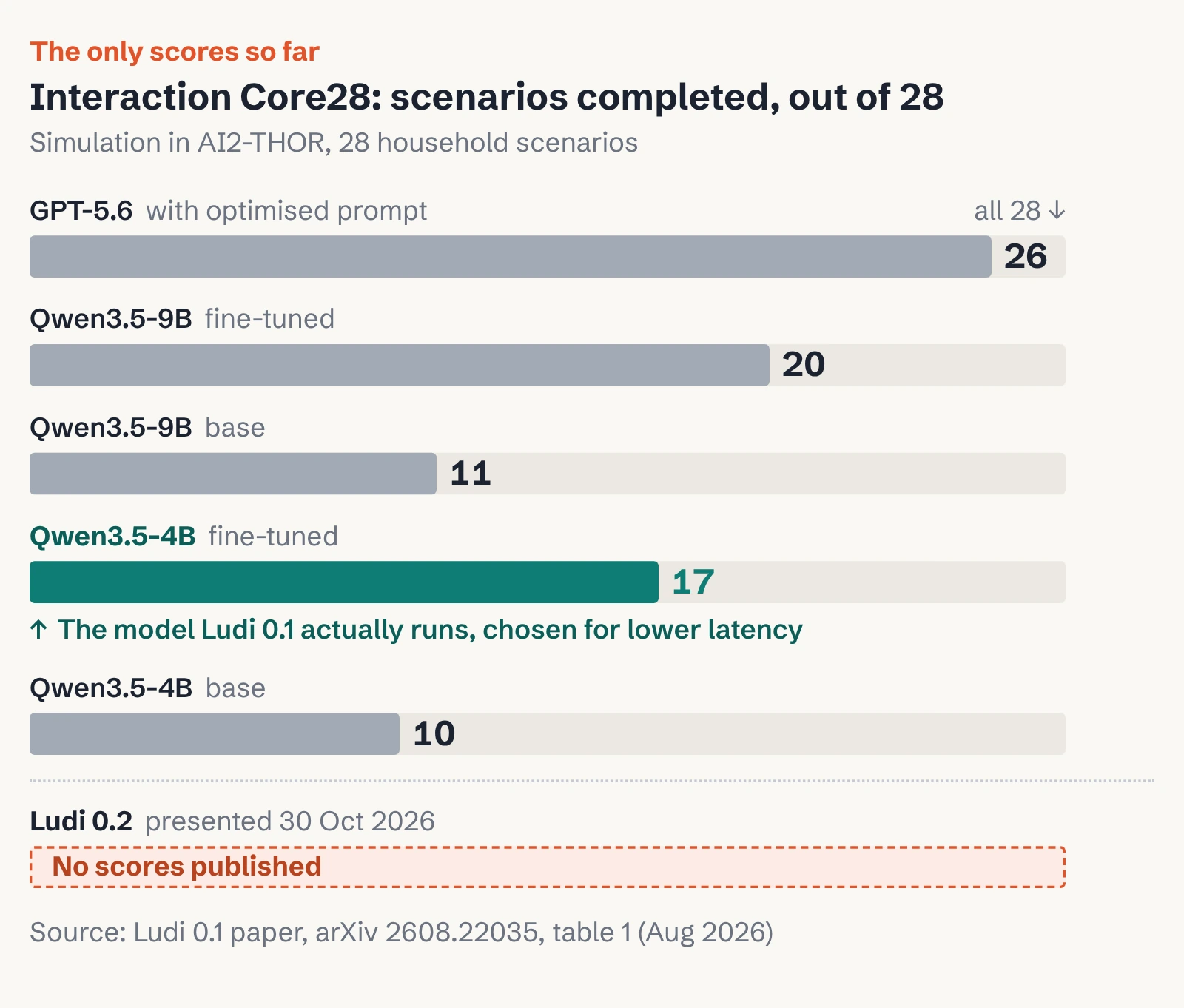
Three caveats matter for anyone evaluating vendors in this space. The figures describe 0.1, not 0.2: Ludo published no scores for the new version. They come from simulation, not from trials with people in real homes or workplaces. And Ludo designed both the synthetic training conversations and the test, so the two may resemble each other more than real life would. For comparison, Figure reported a 56% task-completion rate across 420 trials in a home environment that excluded interrupted chores and people sharing the space, and 1X sells its $20,000 NEO with a remote human operator who steps in when needed.
Why a game company is building this
Krafton has worked on a related problem in games. PUBG Ally is an AI teammate that listens to your voice, reads the match and acts in real time, built with Nvidia ACE. For the Ally Duo beta in June, anyone could team up with the AI character Ella. Ludo now applies the same idea to robots and trains on a mix of simulated environments, AI-generated social interactions and real human behaviour data. It is a similar bet to General Intuition’s use of gameplay to teach AI to act, focused on the conversation between people and machines.
The money is there: Krafton’s second-quarter revenue rose 95% to 1.29 trillion won, about $890 million. Kim still calls robotics a very long-term project. Ludo plans to stay in research through 2026 and choose a first real-world deployment setting in 2027. Long term, Ludo aims for robots in homes, workplaces and public spaces.
A robot that reads people is a data system
Everything that makes Ludi socially useful depends on personal data. The robot needs a camera that sees the people around it, a microphone that hears them, and a memory that keeps the interaction log so it can remember a preference or a correction. Ludo’s roadmap goes further: Ludi 1.0 should jointly model the user’s history and intent. In a warehouse, a hotel or a care setting in Europe, that means:
- the GDPR applies to the video, audio and memory log from the first pilot day;
- continuous recording of employees or visitors will often call for a data protection impact assessment;
- the memory log needs a retention period, access rules and a way to honour erasure requests;
- voice and face data become special-category biometric data when processed to uniquely identify a person, as in face or voice recognition.
There is one encouraging design detail. In the 0.1 paper, speech recognition ran locally and the models ran on a workstation next to the robot, not in a remote cloud. Whether 0.2 or a future product keeps that set-up is not stated, but it is the first question to ask.
Where EU rules land
Socially intelligent robots sit at the crossing of several European rulebooks. The dates below include the postponements of the AI Omnibus, Regulation (EU) 2026/1744, in force since 27 July 2026.
| Rule | What it means for a robot like Ludi | Applies from |
|---|---|---|
| GDPR | Camera, voice and memory data are personal data: lawful basis, minimisation, retention, DPIA where monitoring is systematic | Now |
| AI Act, art. 5(1)(f) | Inferring the emotions of workers or students from biometric data such as face or voice is prohibited, except for medical or safety reasons. Customers and guests fall outside the ban, but emotion recognition then counts as high-risk and must be disclosed. Reading a gesture is not emotion recognition; concluding from an employee’s face or voice that they are frustrated is | 2 February 2025 |
| Machinery Regulation (EU) 2023/1230 | Safety requirements for machines, including AI that affects safety; after the Omnibus, AI safety in machinery is handled under this regulation, with AI-specific requirements to follow by delegated act by 2 August 2028 | 20 January 2027 |
| AI Act, Annex III high-risk | Applies if the robot’s AI is used for areas such as employment decisions or worker management | 2 December 2027 |
| AI Act, Annex I high-risk | AI as a safety component in other regulated products; machinery now follows its own route | 2 August 2028 |
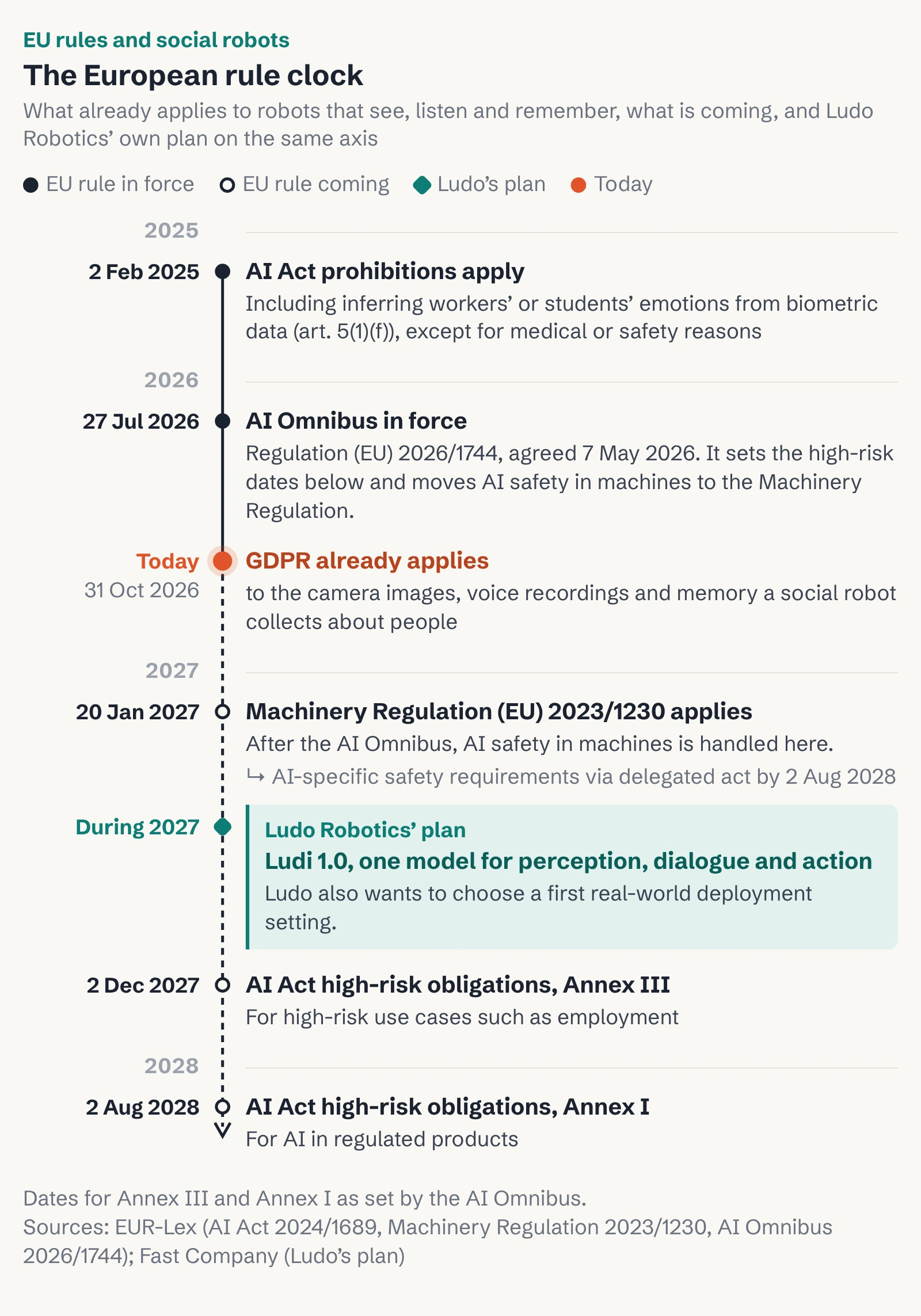
The Machinery Regulation is the date to watch. Robots of this generation combine hardware from one company with a “brain” from another: Ludi 0.1 ran on a Unitree G1 from China with software from a Korean-owned US lab. Under the new regulation someone must take responsibility as the manufacturer of the machine as placed on the market, including how the AI behaves. Our explainer on ISO 25785-1 and humanoid robot safety covers the standards side.
Questions to ask before you pilot a socially intelligent robot
| Question | Why it matters |
|---|---|
| What runs on the robot or on site, and what goes to a cloud? | Decides where camera and voice data travel, and which transfers you need to document |
| What does the memory store, for how long, and can a person be forgotten? | Memory makes the robot useful and makes it a personal data store |
| Can emotion inference be switched off? | For workers and students, inferring emotions from biometric data is prohibited outside medical or safety uses |
| Which results come from real-world trials, with people interrupting and sharing the space? | Simulation scores, like Ludi’s, say little about a busy shop floor |
| Who is the manufacturer under the Machinery Regulation? | Hardware and AI often come from different firms; one must sign the conformity |
| What happens when the model is updated? | A new version can change behaviour; you need test evidence per release |
For the broader timeline of where physical AI is heading, see our analysis of physical AI in the next decade.
The robot that asks first is the one Europe can work with
Ludi’s most interesting behaviour is not speed or strength. It is the clarifying question: “Which one do you mean?” That fits the spirit of European rules, which want people able to oversee and correct automated systems in sensitive settings. A robot that pauses, asks and accepts a correction is easier to supervise, easier to document and easier to trust. Whether Ludi can do that reliably outside a lab is still unproven. When Ludo publishes results from real homes and workplaces, those will be the numbers worth reading.
Frequently asked questions
Can European companies use Ludi 0.2?
Not yet. Ludi 0.2 is a research system presented at a symposium. There is no product, licence or API, and Ludo plans to pick its first deployment setting in 2027.
Does the AI Act ban robots that read emotions?
For workers and students, inferring emotions from biometric data such as face or voice is prohibited since 2 February 2025, except for medical or safety reasons. Recognising gestures or spoken corrections is not emotion recognition.
When does the Machinery Regulation apply?
From 20 January 2027. Under the AI Omnibus, Regulation (EU) 2026/1744, AI-related safety requirements for machinery are handled through this regulation rather than directly under the AI Act.
When is Ludi 1.0 expected?
Fast Company reports 2027. Krafton describes it as a longer-term project to combine perception, dialogue and physical action in one model, without giving a date.