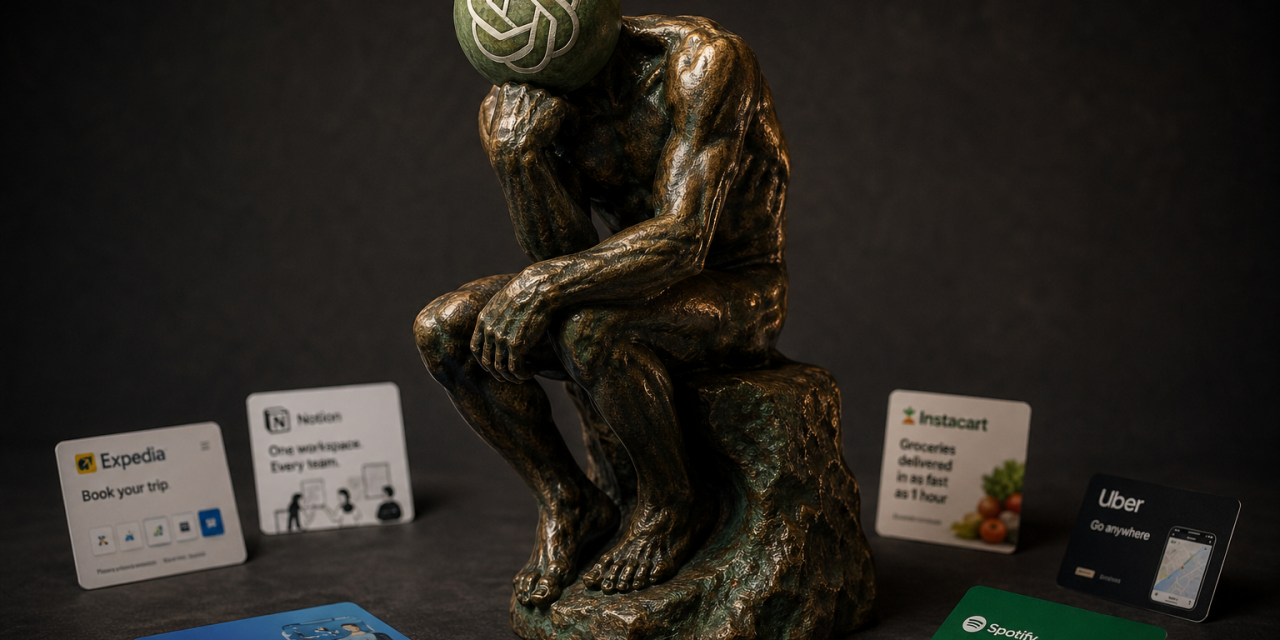
ChatGPT now shows ads. If you use the free tier or the new Go plan, you’ve probably already noticed sponsored cards appearing under some of the chatbot’s answers. The format looks innocent enough: a short pitch, a brand favicon, a button linking out to a website. But behind that small card sits a full advertising machine, complete with contextual targeting, encrypted click tokens, and a conversion pixel that tells advertisers exactly what you did after clicking.
So how does ChatGPT actually decide which ad lands under your answer? Let’s break it down.
The signals ChatGPT uses to pick an ad
OpenAI has confirmed that three main inputs feed the ad selection system:
- The topic of your current question. This is the strongest signal. Ask about planning a trip to Palm Springs and you’ll likely see a Booking.com ad. Ask about productivity tools and Canva or a slide-deck app may pop up.
- Your past chats. If you’ve enabled chat history, previous conversations help build a profile of your interests.
- ChatGPT’s stored memory about you. Anything ChatGPT has saved, your job, your hobbies, your city, can shape which ads you’re considered relevant for.
OpenAI says full conversations are not handed over to advertisers, and that ads do not influence the chatbot’s actual answers. The targeting happens on OpenAI’s side, and only metadata about the click flows outward.
Contextual targeting in practice
Researchers who logged ChatGPT traffic across multiple test conversations found a clear pattern: the ad almost always matches the topic of the most recent prompt. One account saw six different ads across six different chats:
- A Beijing trip-planning chat triggered a GetYourGuide ad for a Great Wall tour and a Grubhub ad for Chinese food delivery.
- A spring fashion chat surfaced an Aritzia campaign tagged chatgptpilot_trav3.
- A productivity chat about slides surfaced Canva.
- An NBA-related question pulled in a Gametime playoffs campaign.
Interestingly, when prompts mention a specific brand, ChatGPT sometimes serves an ad from a competitor. Ask about DoorDash and you might see a Grubhub card. Marketers call this poaching, and it’s been a staple of search advertising for two decades. It now appears to be standard practice inside large language model advertising too.
What happens technically when an ad appears
When you send a message, ChatGPT’s backend opens a streaming response. Most of what flows back is the model’s text output, but occasionally a structured object called single_advertiser_ad_unit is injected into the stream. That object carries:
- An advertiser ID stable across campaigns.
- The brand favicon and ad image, both hosted on OpenAI’s own CDN rather than the merchant’s servers.
- A click target that opens inside ChatGPT’s in-app webview, so OpenAI can observe the navigation that follows.
- Four encrypted tokens that handle integrity checks, click attribution, and impression logging.
One of those tokens, called oppref, is the key piece. When you tap the ad, the merchant’s site reads oppref from the URL and stores it in a first-party cookie for 30 days. From that moment on, every action you take on the merchant’s site can be tied back to the ad you saw inside ChatGPT.
The conversion pixel closes the loop
OpenAI has been quietly building a conversion-tracking pixel, the same kind of invisible script Meta and Google use to measure ad performance. When you complete a defined action on an advertiser’s site, signing up, buying something, booking a trip, the pixel fires and sends the result back to OpenAI.
The available event types already include lead created, order created, page viewed, subscription created, and trial started. Selected advertisers in the pilot have access to the pixel today. Once it rolls out broadly, OpenAI will have a closed measurement loop comparable to what Meta and Google offer, and it will be able to compete for performance budgets, not just brand campaigns.
Why ads inside an AI assistant feel different
Search engines usually wait for buying intent before showing ads. Typing why do my feet hurt returns informational results. Typing best shoes for flat feet returns ads. The user signals readiness to buy.
An AI assistant works differently. The conversation can drift from a vague question into specific recommendations. Somewhere along that path, an ad can quietly shape what the right solution looks like, even if the model’s text answer wasn’t directly influenced. The line between helpful guidance and a transactional nudge becomes harder to see, especially in moments when people lean on a chatbot precisely because they feel uncertain or overwhelmed.
OpenAI has put guardrails in place. Ads won’t appear near sensitive topics like health, mental health, or politics. Users under 18 are excluded. Pro, Business, and Enterprise tiers stay ad-free. Ads are also visually labeled and separated from the model’s answer.
What you can do to limit ad targeting
If you’re on a tier where ads appear, you have a few practical options:
- Open Settings, then Ads controls. Tap Delete ads data to wipe your ad history and inferred interests.
- Toggle off Past chats and memory. This stops ChatGPT from using earlier conversations to personalize ads. Your current chat will still be used.
- Toggle off Personalize ads. You may still see generic ads, but they won’t be shaped by your profile.
- Use ChatGPT logged out. During the pilot, signed-out sessions don’t show ads, and your activity isn’t linked to an account.
- Block the ad domains. If you use a content blocker, the relevant hostnames are bzrcdn.openai.com and bzr.openai.com.
- Clear the cookies. After clicking any ChatGPT ad, the cookies __oppref and __oaiq_domain_probe hold the attribution link. Removing them resets the trail.
The bigger shift to watch
OpenAI has roughly 800 million users and only about five percent pay. The math behind ad introduction is straightforward: subscriptions alone won’t fund the infrastructure ambitions the company has signaled. Search advertising is a multi-billion-dollar market, and a slice of that money will follow people as their information habits move from search boxes into chat interfaces.
The interesting test isn’t whether ads work technically. It’s whether trust survives them. A chatbot people stop trusting is a chatbot people stop using, and the same conversational intimacy that makes ChatGPT feel useful is what makes ad placement feel exposing. The company that figures out how to keep both sides of that equation in balance will set the template for AI advertising. The one that doesn’t will hand the next generation of users to whoever does.