Since 29 October, Europe has its most capable open-weight AI model yet, one that organisations can download, run on their own servers and keep running whatever happens in Washington or Beijing. Mistral Large 4 has 1.05 trillion parameters, open weights and a licence that is free for internal use. That covers the layer of sovereign AI that matters most for continuity. It does not cover the chips it runs on, it is not the strongest open model available, and selling it as a service requires a commercial licence. This article looks at what changed since the preview, how sovereign Large 4 is layer by layer, and what European organisations should do with it now.
What changed between the preview and the open-weights release
Mistral launched Large 4 as an API-only preview on 6 October. Our first look at Mistral Large 4 covered its cybersecurity, coding and vision results at the time. After three more weeks of reinforcement learning, the weights are now on Hugging Face and several numbers have moved.
| Preview (6 October) | Release (29 October) | |
|---|---|---|
| Weights | API only | free to download |
| List price per million tokens, input and output | $1.36 and $4.18 | $0.70 and $2.10 |
| Cost per Intelligence Index task | $5.54 | $2.06 |
| Output tokens per task | 135,000 | 82,000 |
| Hallucination rate, AA-Omniscience | 41% | 28% |
| Reasoning levels | none and high | low, medium and high |
The cost, token and hallucination figures come from Artificial Analysis, as reported by VentureBeat. Pricing is taken from Mistral’s documentation as of 30 October 2026. During the first two weeks of the preview a 50% launch discount applied, so early testers already paid roughly the new price, which is now permanent. The architecture is unchanged: a mixture of experts with 128 routed experts, four of which plus one shared expert run per token, so 52 billion parameters are active at a time. The context window is 1 million tokens and, according to the model card, training covered more than 160 languages, including all official EU languages.
Where Large 4 ranks, and what it costs per task
Large 4 is the strongest open-weight model built outside China, but it does not close the gap with China’s best. On version 5 of the Artificial Analysis Intelligence Index it scores 26. Seven open-weight models score higher, all of them Chinese, led by DeepSeek V4.1 Flash and GLM-5.3 at 32. Meta’s Muse Spark Open, the best US open-weight option, scores 25. The leading closed models are in another league, with Gemini 4 Carbon at 59, Claude Opus 5.5 at 58 and GPT-6 Astra at 57.
The 38 points reported for the preview were measured on the previous version of the index. Version 5, published on 27 October, relies more on private tests and lowered the scores of nearly every open model. On the new scale the preview scored 25 and the release scores 26.

Cost remains the weak point. One index task costs $2.06 with Large 4, against $0.60 for DeepSeek V4.1 Flash and $0.26 for Xiaomi’s MiMo-V2.6-Pro, both of which score higher. Where Large 4 does stand out is efficiency in agent work. It scores 48 on the Coding Agent Index, one point behind GLM-5.3, while using 8.5 million tokens per task instead of 15.9 million. On the Cyber Index it scores 51, third among open models. As usual, the vendor’s own numbers run higher than independent ones: Mistral reports 41% on Terminal-Bench 4.0, Artificial Analysis measures 25%.
The June lesson: sovereignty became a continuity question
For years, sovereign AI in Europe was mostly discussed as industrial policy. In June it turned into an operational risk. On 12 June 2026 a US export control directive led Anthropic to disable Claude Fable 5 and Mythos 5 for all of its customers. Fable 5 returned on 1 July, almost three weeks later. Anthropic’s other models kept running, but any workflow built solely on Fable 5 simply stopped.
Open weights are not a given on the Chinese side either. Moonshot launched Kimi K3.1 Pro API-only and has promised the weights by 4 November, as we noted in our Kimi K3.1 Pro analysis. Pierre Stock, Mistral’s VP of Science, told TNW that there is no guarantee Chinese labs will keep publishing open weights, and compared AI to electricity that no company should depend on a provider to keep switched on. To TechCrunch he put it more bluntly:
“Access that can’t be cut off by definition because the model is open-weighted.”
Pierre Stock, Mistral, in TechCrunch
That is the strongest argument for Large 4. Downloading a model, however, does not make an organisation independent. Sovereignty has layers, and each layer has its own owner.
A sovereignty stack for assessing Mistral Large 4
A useful way to assess any AI model is to look at six layers, from the chips at the bottom to the capital at the top. Our broader piece on sovereign AI in Europe covers the policy background. Here is how Large 4 scores.

| Layer | Mistral Large 4 | Residual dependency |
|---|---|---|
| Capital | The €3 billion Series D was led by Samsung Electronics, with Scaleup Europe Fund (EQT) and PSG Equity as co-leads, and BlackRock, a16z and Nvidia among the investors. ASML, Bpifrance, BNP Paribas, Belfius and the Grand Duchy of Luxembourg are also on the cap table (tech.eu). | Mixed ownership; strategic choices are not purely European |
| Company and law | French company under EU law, signatory of the EU’s General-Purpose AI Code of Practice since 2025, API available in an EU region. | Low |
| Licence | Modified MIT. Internal use, modification and further training are free. Operating a model-as-a-service business requires a separate commercial licence. No revenue threshold. | Medium for service providers, low for internal users |
| Model weights | Public on Hugging Face. Once downloaded, they cannot be withdrawn. | None for access; updates and fixes still come from Mistral |
| Compute | Trained, according to Mistral, in its own European data centres, with reinforcement learning on its own compute in France. Expansion in Bruyères-le-Châtel and Borlänge, Sweden, in facilities of data centre partners, with a 200 MW target for end 2027. | Your own hosting choice decides this layer |
| Chips | Trained on 3,800 Nvidia Grace Blackwell GPUs, a dependency ITdaily calls unavoidable for now. Europe’s strongest card in that chain is ASML, which builds the lithography machines and is a Mistral shareholder. | High |
There is also criticism to weigh. In July Mistral signed a multi-billion-dollar deal to sell EU-based GPU capacity to Microsoft, and it hosts Z.ai’s Chinese model GLM-5.2 on its platform. Dealroom reports that these moves have raised doubts about Mistral’s sovereignty pitch, while CEO Arthur Mensch calls selling compute good business. For an organisation that downloads the weights, little changes. For one that relies on Mistral’s API, the vendor’s strategy is part of the risk assessment.
What the licence allows
The Mistral Ecosystem Open-Weight License grants the usual MIT freedoms: use, copy, modify, distribute, fine-tune and build derivatives. Section 2 adds one condition. If you or an affiliate operate a model-as-a-service business, you need a separate commercial licence from Mistral. The licence defines that as giving a third party inference or post-training access, for example via an API, with meaningful control over inputs, parameters or training data. End-user products where the model is embedded in specific features, and services that merely relay requests, are excluded. Internal use and use through Mistral’s own products are exempt.
That is more permissive than Mistral’s Devstral 2 licence of late 2025, which excluded companies above $20 million in monthly revenue. It is still not open source in the strict sense. The grey zone is a customer-facing product. A narrowly scoped feature likely falls under the exclusion; an open chat or API that lets customers steer the model freely likely does not. Have that use case checked by counsel before you build on it.
Running it yourself means a GPU project, not a download
The weights alone take about 1.05 terabytes in 8-bit precision, before any memory for context. Hugging Face’s release notes and Mistral’s announcement point to three typical set-ups.

- FP8 on eight Nvidia H200 GPUs. Full quality, around 65 tokens per second for a single user on Hugging Face Inference Endpoints.
- NVFP4 on four Blackwell GPUs. Mistral ships a 4-bit checkpoint that, according to TNW, runs on four B200 or B300 cards and halves the memory needed. Mistral claims the same performance, which has not yet been tested independently.
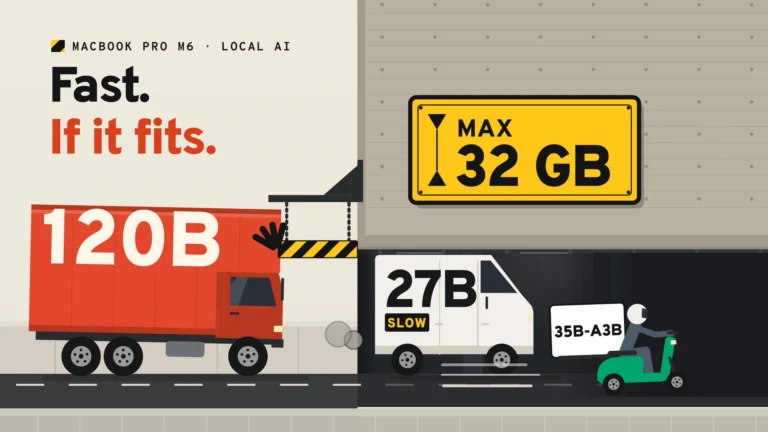
- 2-bit on a single Mac Studio with M3 Ultra and 512 GB. It fits, generates around 15 tokens per second and loses quality to compression. Fine for evaluation, not for a team.
Mistral says smaller distilled versions, including one for laptops, will follow in the coming months, without committing to dates.
Where EU policy is heading
Three developments shape how much this model will matter in practice.
- The Cloud and AI Development Act. The Commission’s proposal of June 2026 introduces four assurance levels for cloud and AI services. Public bodies in security, defence, justice and NIS2 sectors would only be allowed to use providers at levels 2 to 4, which require an independent audit covering staff location, the use of data for AI training and the software supply chain. Critical private entities in sectors such as banking, energy and healthcare may follow similar criteria. The text is still with Parliament and Council.
- AI gigafactories. The EuroHPC call for up to seven AI gigafactories closes on 12 November 2026, with selection expected in early 2027 and more than €20 billion in private investment anticipated.
- European compute. Mistral alone aims for 200 MW of European capacity by the end of 2027 and 1 GW by 2030. Every new European site makes the compute layer of the stack more realistic for organisations that do not want to run their own GPUs.
A five-step sovereignty plan for European organisations
- Map the workflows that must not stop. List the AI-dependent processes that would hurt if a non-EU provider cut access for two or three weeks, as happened in June.
- Pick a fallback open model and test it now. Run Large 4 on your own documents and languages, side by side with the model you use today. Measure quality, latency and cost per task, not per token.
- Choose a hosting route per workflow. The table below summarises the options.
- Check the licence and your procurement criteria. Decide whether any use case falls under the model-as-a-service clause, and add the CADA assurance levels to new AI tenders even before the act is adopted.
- Make your context portable. Prompts, evaluations, tools and knowledge bases are what you really own. As we argued in Models are rented, context is owned, they decide how fast you can switch.
| Route | Control | Effort | Fits when |
|---|---|---|---|
| Mistral API, EU region | Medium: an EU company, but Mistral can still change the service | Low | You want European jurisdiction quickly; the default endpoint is global and Mistral’s EU endpoint costs about 10% more |
| European cloud or partner hosting | High, if the contract leaves you the weights and the data | Medium | You need sovereignty without running GPUs yourself |
| Own servers, optionally air-gapped | Full | High: GPUs, operations and security | Data may not leave the building, or the workflow is critical |
Frequently asked questions
Is Mistral Large 4 open source?
Not in the strict sense. It is an open-weight model under a modified MIT licence. Use, modification and fine-tuning are free; offering the model as a service that third parties can steer themselves requires a commercial licence.
Does Mistral Large 4 qualify as sovereign AI?
Partly. The weights, the company and the legal framework are European, and once downloaded the model cannot be taken away. The chips are American and the capital is international.
What hardware do I need to self-host Mistral Large 4?
Eight Nvidia H200 GPUs for FP8, four Blackwell GPUs for Mistral’s 4-bit version, or a single Mac Studio with M3 Ultra and 512 GB for a slow 2-bit test set-up.
How does Mistral Large 4 compare with DeepSeek and GLM?
It scores 26 on the Intelligence Index v5 against 32 for DeepSeek V4.1 Flash and GLM-5.3, and costs more per task. It is more token-efficient as a coding agent and is the strongest option from outside China.
Rent the frontier, own the exit
Most European organisations will keep using the best closed models for their hardest work, and that is a reasonable choice. Sovereignty does not demand that every layer be European. It demands that you can keep working when a decision made elsewhere takes your model away. Large 4 is the most capable European open model yet to play that role: tested in advance, hosted under your own terms and ready to take over critical workflows. The part Europe still has to build is underneath it, from data centres to the chips that Nvidia makes and ASML makes possible.