Mage-VL-Cowork is a 4-billion-parameter AI agent from Microsoft that operates a desktop and decides at every step whether to click through the interface or to write a few lines of code in a terminal. It scores 66.0% on OSWorld-Verified, the best result for its size in Microsoft’s own comparison and ahead of several open models many times larger. It is a research checkpoint tested on a Linux desktop, not a product, and the best model on the official leaderboard for the same benchmark stands at 86%. For European organisations the more useful part of the release is the training recipe: it shows how to build a small, self-hostable agent for your own applications, and how much depends on the harness around the model.
Microsoft published the weights on Hugging Face on 30 October 2026 without an announcement, alongside a project page, evaluation code and a technical report. This article explains what the model does, how to read its score, what the recipe teaches and which controls you need before you let it touch anything.
What Mage-VL-Cowork is, and what it is not
Mage-VL-Cowork is a computer-use agent: it looks at screenshots and acts with mouse and keyboard, and it can also run shell commands and Python. It comes from Microsoft’s Mage team, the group behind the Mage-VL vision model and the Mage-Flow image generator, and it was post-trained from an intermediate Mage-VL checkpoint.
- Size: about 4 billion parameters, 9.48 GB of weights. The language backbone is Alibaba’s Qwen3-4B; the vision encoder is Microsoft’s own Mage-ViT.
- Licence: Apache 2.0, which permits commercial use, but Microsoft states the Mage models are “released for research purposes only and are not intended for product or service deployment”.
- Context: 32,768 tokens. It keeps the last three screenshots in full and folds older steps into one-line action summaries.
- Language: the model card lists English only.
The name invites confusion in any organisation that licenses Microsoft 365. Mage-VL-Cowork is not Copilot Cowork, the paid agent inside Microsoft 365 that launched on Anthropic models (with GPT-5.5 in the Frontier programme), and it is not Claude’s Cowork. Microsoft has announced its own model for Copilot Cowork, called Cowork 1, but neither the model card nor the report links it to Mage-VL-Cowork. Treat them as separate things until Microsoft says otherwise.
One policy that decides when to click and when to code
Most computer-use agents only work through the screen. That is universal, but slow and expensive: a single screenshot can cost thousands of tokens, and editing a spreadsheet through menus takes dozens of clicks. Mage-VL-Cowork has two action channels. The GUI channel offers eleven actions, from click and drag to type, keypress and scroll, and returns a new screenshot after each one. The terminal channel runs shell commands and Python and returns text.
There is no orchestrator on top deciding which channel to use. The model chooses per turn and switches mid-task: code for structured files such as spreadsheets and slides, the GUI for state that only exists on screen, such as a canvas in an image editor or settings that a running browser keeps in memory.
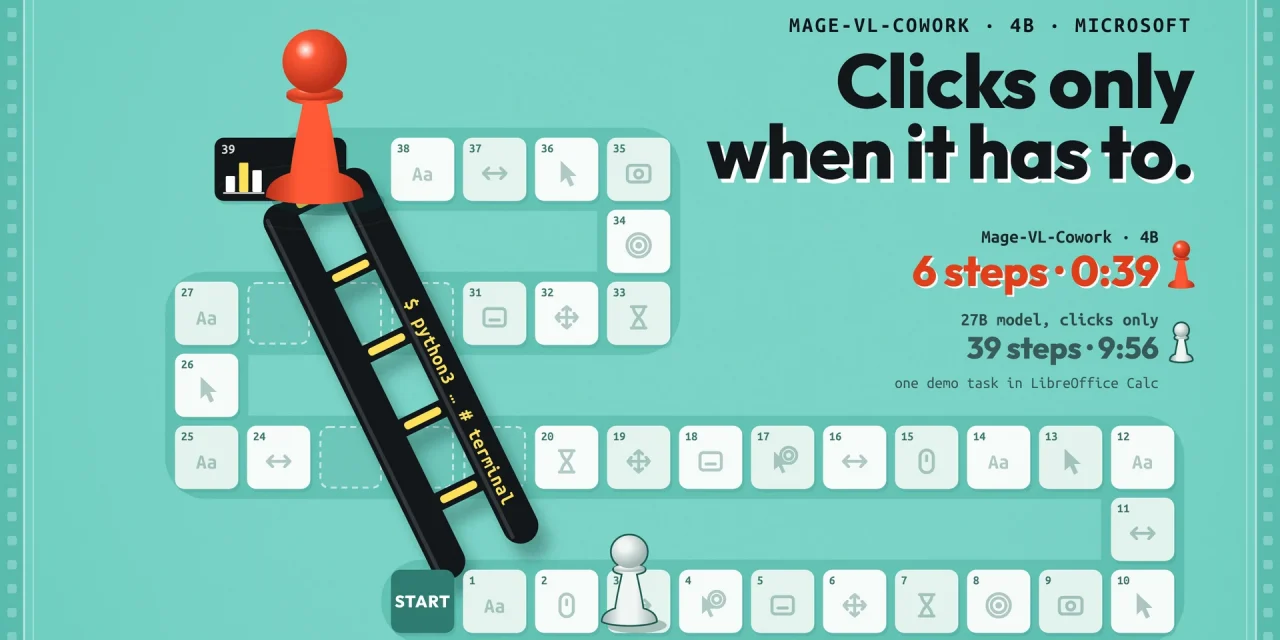
Microsoft’s demos make the difference concrete. In LibreOffice Calc the task was to merge two ranges, label them, add a column chart and save a new file. Mage-VL-Cowork finished in 6 steps and 39 seconds, almost entirely with Python in the terminal, touching the interface only once. Qwen3.6-27B, a 27-billion-parameter model limited to clicking in this demo, needed 39 steps and 9 minutes 56 seconds.
In the GIMP image editor the model chose the GUI instead, editing the image in 15 steps and just under two minutes, and then used the terminal to check that the saved file was correct. That second habit matters for any business process: code lets an agent verify its work against the actual file rather than against a dialog box that says “saved”. The larger GUI-only model stopped after 29 steps and seven minutes, with a file that failed the task check.
How to read the 66%
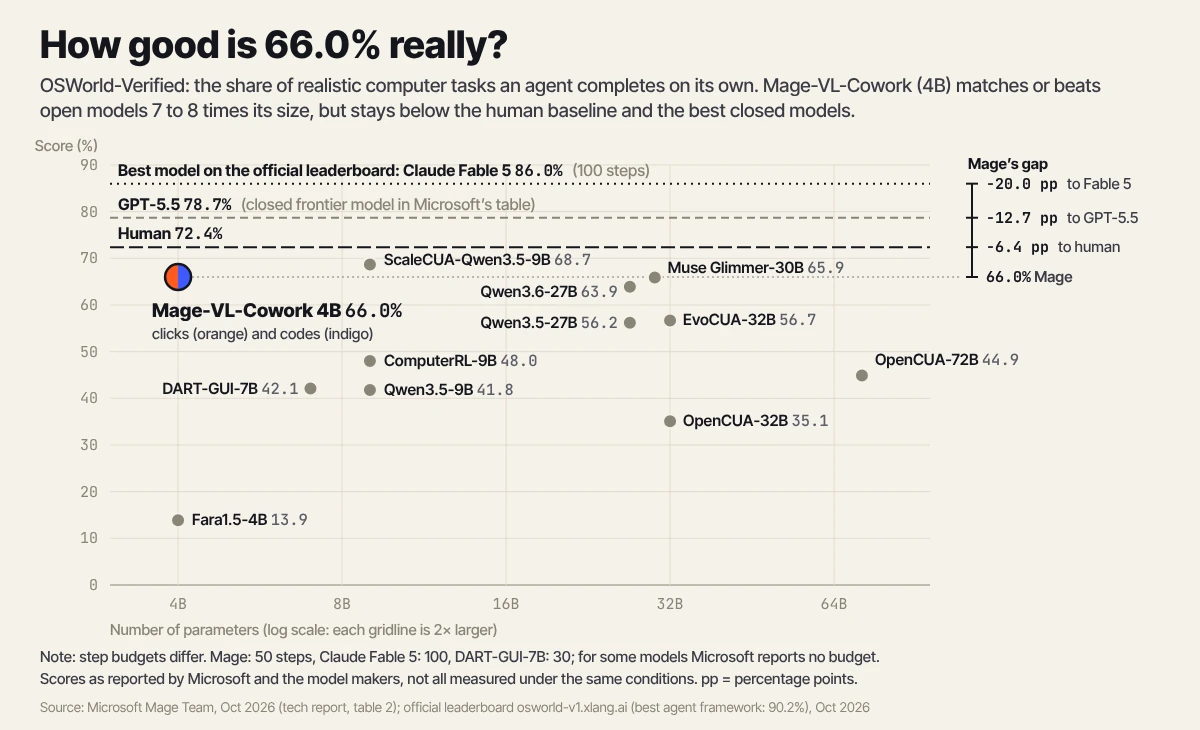
OSWorld-Verified asks an agent to complete real tasks on an Ubuntu machine with LibreOffice, VS Code, GIMP, Chrome, Thunderbird and similar applications. Microsoft ran 361 tasks with a budget of 50 steps each and averaged two full runs (65.3% and 66.8%). The model is strongest on operating-system tasks (87.5%) and weakest on workflows that span several applications (62.7%), although that is still the best multi-application score of any open model in the table.
In Microsoft’s table it beats much larger open models such as Muse Glimmer-30B (65.9%), Qwen3.6-27B (63.9%) and OpenCUA-72B (44.9%). One open model does score higher: ScaleCUA-Qwen3.5-9B, about twice the size, at 68.7%. Microsoft’s own 4B browser agent, Fara1.5-4B, reaches only 13.9% on this desktop test. The human reference is 72.4%.
Four caveats matter before anyone quotes the number in a business case:
- The frontier is much higher. Microsoft’s own table lists GPT-5.5 at 78.7% and Claude Opus 4.7 at 78.0%. On the official leaderboard, Claude Fable 5 has been the strongest model since late July, at 86.0% with 100 steps, and an agent framework built around a model reaches 90.2%. Because top systems now exceed the human baseline, OSWorld 2.0 with longer workflows arrived in June. Mage-VL-Cowork was not tested on it.
- The numbers are self-reported. Competitor scores are copied as reported, with different step budgets, and Mage-VL-Cowork itself is not on the official leaderboard.
- The evidence is Linux. Windows, Outlook, SAP or your line-of-business software were not tested.
- It is not the best small web agent. On an offline web benchmark an earlier checkpoint scored 58.6%, against 68.0% for the browser-only Fara1.5-4B.
Why the training recipe is the real release
The report is titled “a full training recipe”, and that is the part worth studying. Small agents usually learn by imitating a large model. The Mage team found that even frontier models often pick the wrong channel, for example by editing a file on disk while the application still holds the old version in memory. Distil those rollouts and the student inherits the habits.
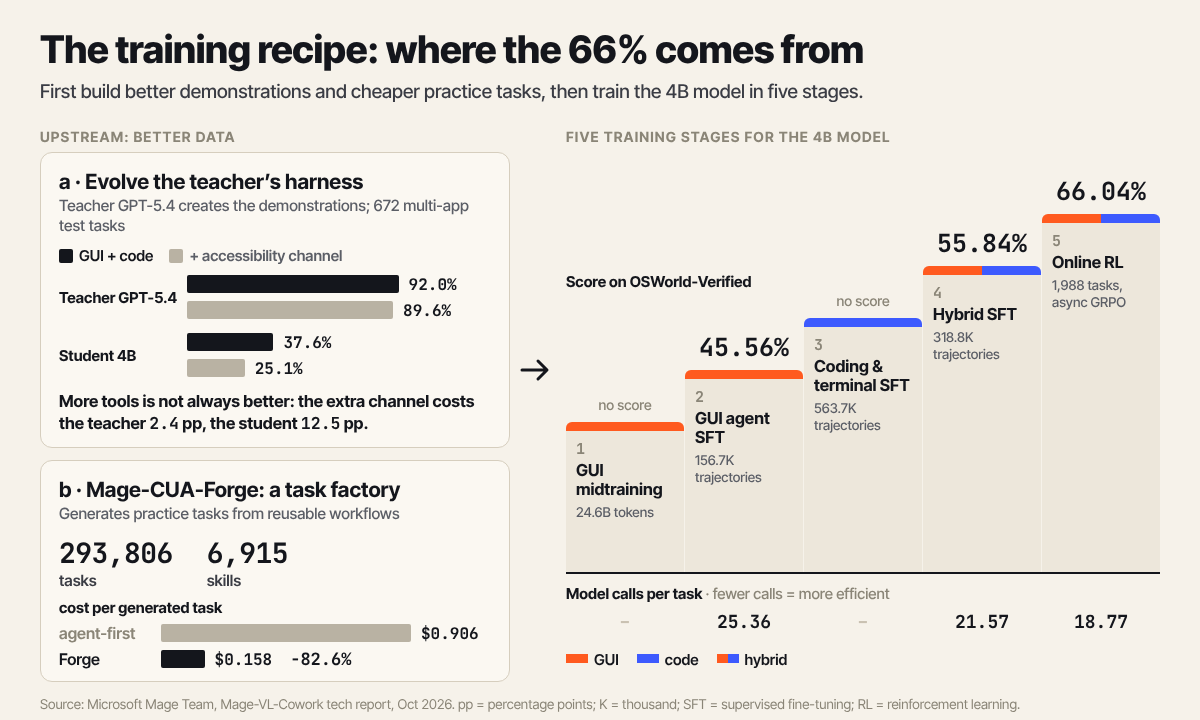
So they first evolved the teacher’s harness: its tools, prompt, scaffold and the software installed in the sandbox. That was as much pruning as adding. On 672 of the team’s own multi-application test tasks, giving the GPT-5.4 teacher an extra accessibility-tree channel lowered its success from 92.0% to 89.6% and added steps; the 4B student trained on those trajectories fell much further, from 37.6% to 25.1%. More tools did not make a better agent. It echoes what Google showed with Harness² and what Meta-Harness does with logs: the code around a model can shape its results substantially.
Two more ingredients make the recipe reusable:
- A task factory. Mage-CUA-Forge writes one reusable generation workflow per skill, producing task instructions, setup scripts and grading rubrics together, instead of having an agent build every task from scratch. That produced 293,806 tasks across 6,915 skills, and cut the recurring cost per task from $0.906 to $0.158 (−82.6%).
- A five-stage curriculum. Screen understanding, GUI actions, coding and terminal work, hybrid use, and finally reinforcement learning on tasks with automatic checks. The last stage lifted the score from 55.8% to 66.0% while cutting model calls by 13% and output tokens by a quarter per task.
For an organisation this is a template rather than a toolkit: the recipe is described in detail, but the task factory, training code and data are not released. If you want a small agent for a handful of internal applications, a large share of the effort sits in the environments and the automatic checks. A skill-by-skill task factory with automatic grading is something a capable team can build for its own software stack.
What a small, self-hosted agent means for European organisations
A 4B model with an open licence can run on your own hardware. For computer-use agents that is not a detail: screenshots of business applications routinely contain personal data, customer records and confidential figures. Keeping inference in-house removes one processor from your GDPR data map and avoids sending screen captures to a third-party cloud. It does not remove the need for a legal basis, data minimisation and logging. And Microsoft positions the Mage models as research models, not for product or service deployment, so for now this is a basis for experiments rather than production.
Under the EU AI Act, Microsoft is the provider of the model. If you fine-tune it on your own applications, the Commission’s guidelines use as an indicative criterion whether your modification uses more than a third of the compute used to train the original model, or a third of 10²³ FLOP if that figure is unknown. Microsoft has not published the model’s total training compute; its five post-training stages alone took a nominal 7.79 × 10²¹ FLOP on 32 B200 GPUs, excluding base pretraining. A typical in-house fine-tune will be far below either figure, so the obligations that matter are usually those for the AI system you build around it, and those depend on the use case. An agent that screens job applicants is a different category from one that formats spreadsheets. This is not legal advice; check the specific deployment with your counsel.
The practical constraints are as important as the legal ones. Microsoft gives no minimum GPU memory beyond the 9.48 GB of weights, and screenshots at 1920 × 1080 plus context come on top. A community quantised version of about 3 GB exists, but it needs an experimental llama.cpp fork and its scores were not re-measured. Language support beyond English is untested, which matters for any multilingual European back office.
Controls before you run a pilot
Microsoft’s model card is unusually direct: the agent executes arbitrary shell commands, so run it only in isolated, disposable sandboxes. A starting set of controls:
| Risk | Control |
|---|---|
| The agent damages data or systems | Run it in a disposable VM or container, reset after every task, never on a production desktop. |
| Credentials leak | Mount no passwords, SSH keys, cookies or password stores; use a dedicated test account with minimal rights. |
| Prompt injection from web pages or documents | Restrict network access to an allowlist; treat files from outside as untrusted input. |
| Irreversible actions | Require human approval for submitting, logging in, paying or changing permissions. |
| No audit trail | Log every tool call, bash command and screenshot separately from the sandbox, with retention rules that fit GDPR. |
| Scores that do not transfer | Measure on your own tasks, your operating system and your languages before you cite any benchmark. |
A sensible pilot takes about 30 days. In week one, set up the sandbox and the logging. In week two, mirror ten to twenty real but low-risk tasks, such as reformatting spreadsheets or renaming files, and record success, steps and time. In week three, compare against a cloud agent such as GPT-6.1 Terra on the same tasks and cost per task. In week four, decide whether a small local agent, a cloud agent or a fine-tuned version for your own applications is worth the next step. Keep your task sets and checks independent of any single vendor, because models are rented and context is owned.
Frequently asked questions
Is Mage-VL-Cowork part of Copilot Cowork?
No link has been announced. Copilot Cowork is a paid Microsoft 365 service that launched on Anthropic models, with OpenAI’s GPT-5.5 in the Frontier programme and Microsoft’s own Cowork 1 announced for it. Mage-VL-Cowork is an open research model from the Mage team.
Does Mage-VL-Cowork work on Windows?
It was only evaluated on an Ubuntu desktop. It sees pixels and a terminal, so it may work elsewhere, but there are no published results.
Can we use it commercially?
The Apache 2.0 licence permits it, but Microsoft states the Mage models are released for research purposes only and are not intended for product or service deployment. It also recommends running the model only in isolated sandboxes with human approval for irreversible actions.
How does it compare with small on-device models like LFM3?
LFM3 is a general agent model for phones and laptops that calls tools; Mage-VL-Cowork is specialised in operating a full desktop through screenshots and a terminal. They solve different problems.
What hardware does it need?
The full weights are 9.48 GB, the community quantisation about 3 GB, plus memory for screenshots and context. Microsoft publishes no official minimum.
The harness is the lesson, not the headline
Mage-VL-Cowork will not replace a frontier agent, and Microsoft does not claim it will. What it shows is that a small model gets much of its strength from the right action channels, a pruned toolset and tasks with automatic checks. That lesson applies to the agents your organisation already runs on large models: give them a terminal for structured files, let them verify their own output, remove overlapping tools, and test on your own work before you trust a benchmark.