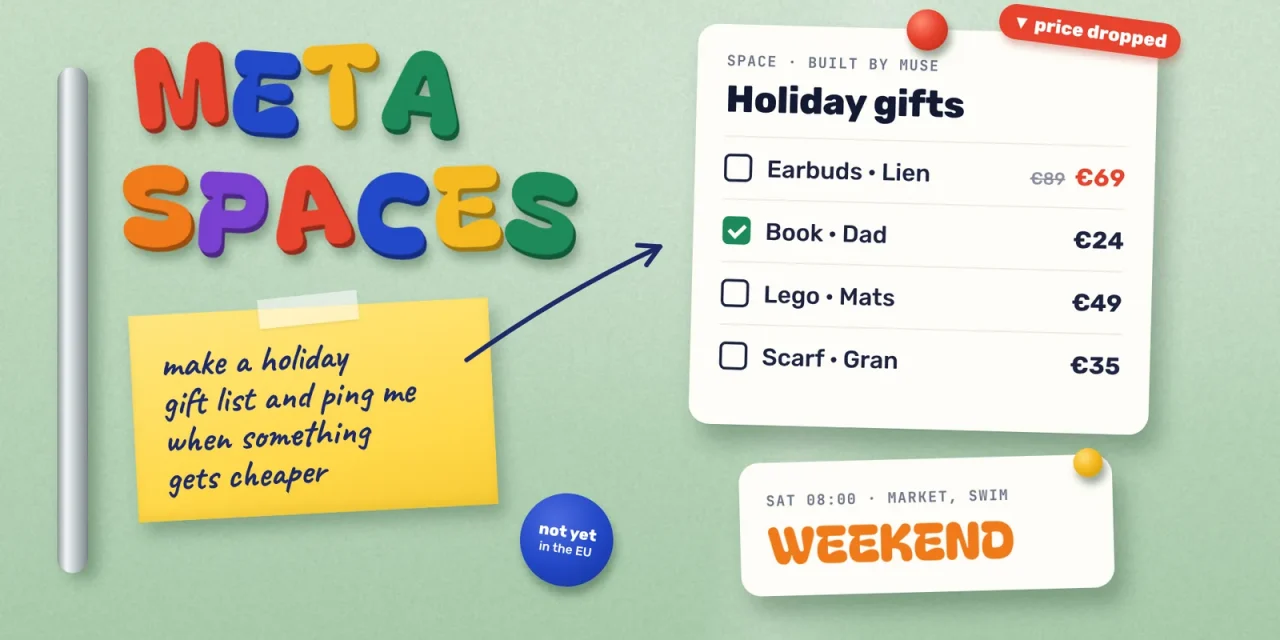
Meta Spaces lets you type what you need into the Muse app, for example “a holiday gift list that tells me when something gets cheaper”, and Muse builds a small app for it. That app stays put, updates itself with data from the apps you connect and shows up when you need it. Meta launched Spaces on 6 November 2026. In the EU you cannot use it yet, because Muse itself is not available here. This article explains what Spaces does, why it goes further than a chatbot that writes code, what it means for European organisations and what you can already use today.
What is Meta Spaces?
Spaces is a feature of Muse, the personal AI agent Meta launched in September. A Space is a self-contained piece of app inside Muse: a tracker, a planner, a project board, a dashboard or a game. You create one by describing what you want in plain language. Muse builds it, and you keep refining it afterwards: adding a missing piece, changing the look or changing how it works.
Meta lists its own examples. A shopping hub that gathers gift ideas, saved Instagram posts and Marketplace listings and messages. A school dashboard that pulls events from school emails into your calendar. A wedding planner for RSVPs, vendor invoices and to-dos. A trip planner with flights, hotels, reservations and an itinerary. For freelancers, a client hub with projects, deadlines and invoices, and for small businesses, an order tracker.
According to TechCrunch, Mark Zuckerberg showed on X what he built himself: a BBQ game, an event tracker and a dashboard to control his home.
How a Space comes to life
The difference with a regular chat answer lies in what happens after the Space is built. Meta names three things.
- The Space persists. It becomes a permanent part of your Muse app. You check off items, add notes and edit things, and those changes are saved.
- It updates itself. Connect your apps to Muse and the Space refreshes in the background without being asked. Meta mentions new concert dates, price changes and progress on a savings goal.
- It shows up when it fits. You pin a Space to the sidebar or the main tabs, move or hide it, or schedule when it appears. Meta’s example is a weekly planner that sits on top during workdays and makes way for weekend plans on Saturday.
For now, you cannot share a Space with other people. Meta says it is “exploring ways” to make that possible. At the same time, Meta is rolling out new, specialised model versions to Muse, trained on what it learned from its frontier model Muse Wonder. According to Digital Trends, they are better at holding on to important context and at recovering when a task goes wrong. Its open-weight sibling, Muse Spark Open, is the part of the Muse family European firms can already run themselves.
Why this is more than a chatbot that writes code
Chatbots that build small apps have been around for a while. Claude creates interactive artifacts and live dashboards on company data, Google brought its Opal tool to Gemini at the end of 2025 to build mini-apps, and Wabi builds apps inside a group chat. What sets Spaces apart is where it lives.
You usually have to open an artifact or a mini-app yourself. A Space sits inside an agent that already has access to your email, your calendar and your purchases, and that keeps working when you close the app. Muse can already send emails, book travel and fill in forms. Spaces gives that work a fixed place on your screen. The app comes to you, instead of you going to the app.
That also makes it commercially interesting for Meta. A Space that bundles Instagram posts and Marketplace listings keeps you inside its ecosystem. Muse is growing fast: on 21 October, Zuckerberg told analysts that more than 10 million people in the US and Canada have set up a Muse account, and that about a quarter use it on any given day.
Who sees what goes into a Space?
A Space that updates itself needs your data. When it launched Muse, Meta described how that data is isolated. Muse runs in its own virtual machine, the Muse Secure VM, next to a separate guard agent, Sentinel, which has to approve internet access and asks you for permission when needed. You choose per app what access Muse gets, for example read-only email or read and send. Muse asks for confirmation before sensitive actions such as sending an email or buying something, and you can see a log of what it did and plans to do.
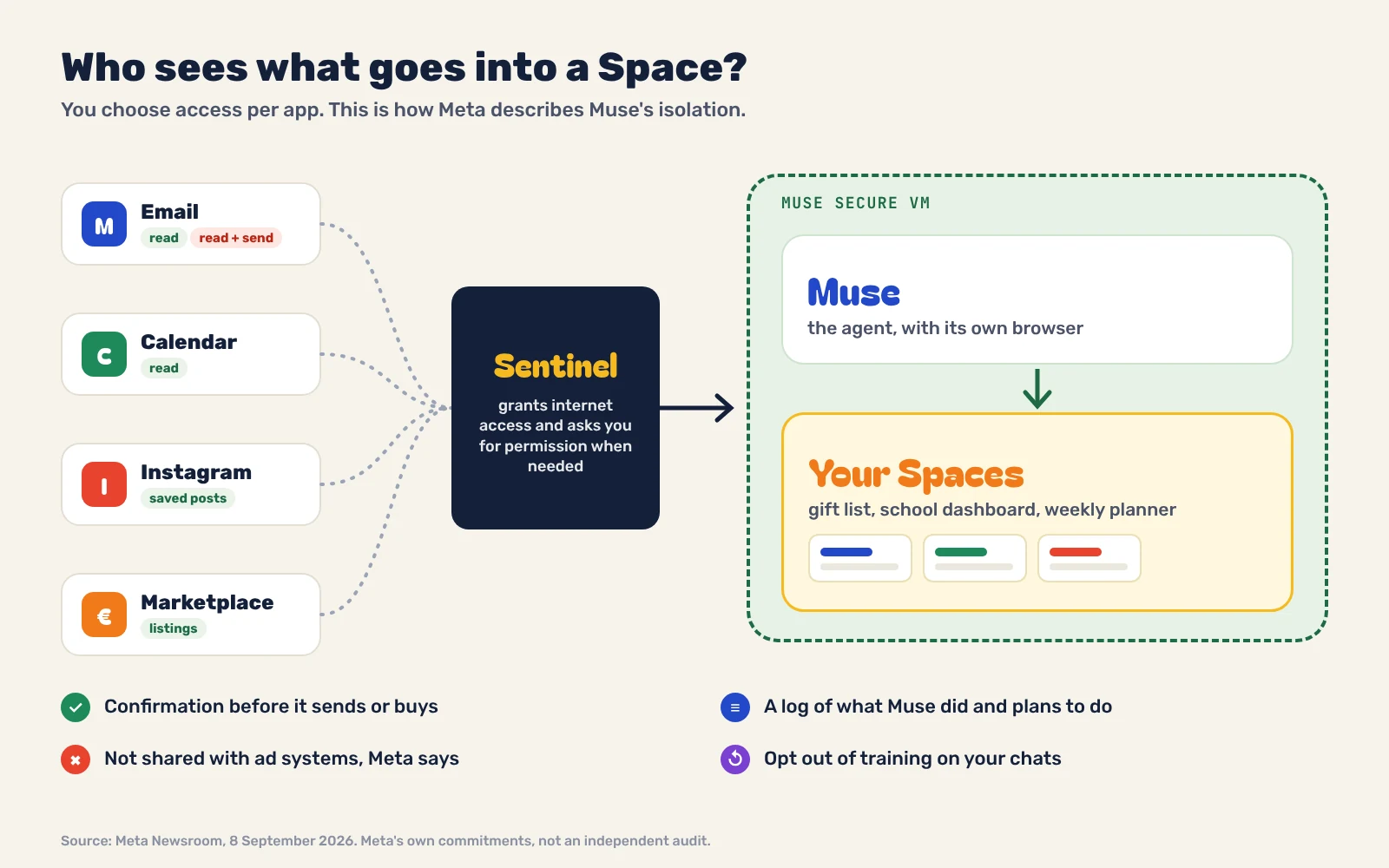
Meta also says conversations and data from that virtual machine are not shared with its ad systems, and that you can opt out of having your conversations used to train its models. Those are Meta’s own commitments. A fully encrypted version, the Muse Confidential VM with a key only you hold, has been announced for later this year. The Hacker News discussion about Muse shows that trust remains the sticking point: some users are enthusiastic about what the agent does for them, others refuse to give Meta more access to their lives.
Why Spaces is not available in Europe yet
Meta says Spaces is available “wherever Muse is available”. As of 7 November 2026, that means the US, Canada and a handful of countries outside Europe, such as Singapore. No EU country is on the list, and Meta has not given a date. The regular Meta AI in WhatsApp and Anthropic’s agent Claude Duet also reached Europe later, or not yet.
Meta itself gives no reason. An analysis by Swedish consultancy Technspire points to three European rules that touch exactly how Muse works:
- The GDPR. Muse runs on your email, calendar and purchases. That needs a solid legal basis per type of data, and explicit consent for sensitive data.
- The Digital Markets Act. Meta is a designated gatekeeper and cannot simply combine data from Instagram, WhatsApp and other services without consent. That combination is exactly what makes a shopping hub with Instagram and Marketplace data useful.
- The AI Act. Meta did not sign the voluntary code of practice for general-purpose AI models. And since August 2026, an AI system that interacts directly with people must make clear it is an AI, which affects an agent that emails on your behalf.
What it means for European organisations
Two of Meta’s examples, the order tracker and the freelance client hub, are business tools. That is the signal to watch. Personal agents are starting to build the small internal tools that teams used to make in a spreadsheet or a no-code app, and they do it with the data employees connect themselves.
- Set a policy before the tools arrive. Decide whether staff may connect a work mailbox or calendar to a consumer agent such as Muse. Technspire suggests naming the agents explicitly in an acceptable-use policy.
- Treat a Space like any other app with data access. Ask what it reads, what it can send and where the data is processed. Read-only access is enough for most dashboards.
- Prototype with what is available. The idea of a small app described in plain language already works with tools you can use in the EU, such as Claude’s artifacts and dashboards, or Wabi for group planning. The difference is that you supply the data yourself and the app does not appear on its own schedule.
Frequently asked questions
Is Meta Spaces free?
Meta does not list a separate price for Spaces. Muse itself is free for most common needs, with paid subscriptions for people who want more.
Can I use Meta Spaces in the EU?
Not yet. Spaces only works where Muse is available, and as of 7 November 2026 that is not the case in any EU country.
Can I share a Space with my partner or colleagues?
Not yet. Meta says it is exploring ways to let people share Spaces.
Do I need to know how to code?
No. You describe the Space in plain language and refine it with new instructions, or by clicking and typing in the Space directly.
The real test comes in week two
Building a Space is the easy part. Whether Spaces sticks depends on what happens next: does the gift list stay right when a shop changes its price, and do you notice when a connection fails? Meta does not say how often a Space refreshes. For Europe there is a second question: which version of Muse will eventually arrive here, and how much Instagram and Marketplace data it will still be allowed to combine. Until then, Spaces is a clear view of where personal AI assistants are heading: less talking, more small apps that are ready when you are.