On 4 November, Perplexity announced “teammates”: AI agents that hold on to a project for weeks, keep working when something changes and ask you in Slack what to do next. You only get them on the Max plan at $200 a month, and every run such a colleague makes is deducted from your monthly credits. This article explains what a teammate does, how it differs from Perplexity Computer, what a European team can use today and, above all, how to work out what that colleague really costs.
What is a Perplexity teammate?
A teammate is a personal agent with a standing role, such as “triage bugs”, “track the pipeline” or “research a market”. You give it a name, connect tools such as Slack, GitHub or Gmail, describe the work and assign it to a project. From there it plans the tasks, starts extra agents where needed, checks the results and hands finished work back to you for review. Between two assignments it forgets nothing: goals, task history and shared files persist, so each task builds on the previous one. In its announcement of 4 November, Perplexity calls this a new way of working with AI: you stop writing prompts in a session and give a goal instead.
The difference with Perplexity Computer, the cloud agent that has spread tasks across nineteen models since February, is duration. A Computer session ends when the task is done. A teammate stays. It is built on top of Computer and uses the same Projects, skills and memory, but it does not wait for a new prompt. It watches the connected tools, sends progress updates and asks for approval until the work is finished.
What does such a colleague do on a working day?
Perplexity gives four example roles, and they say a lot about the target audience: operations and marketing, not only developers.
- Marketing: manages social posts, email, ads and SEO, creates new ads based on what performs, monitors results and competitor promotions, and suggests a response when a competitor changes its prices.
- Sales: finds opportunities in inquiries, past purchases and stalled conversations, prepares outreach and quotes, follows up on replies and flags support issues that need solving first.
- Customer support: reads yesterday’s complaints every morning, summarises the trends, flags the cases that need a personal reply from the CEO and drafts those replies.
- Operations: tracks deadlines, checklists, vendors and paperwork, and chases missing items as soon as a deadline is 72 hours away.
The mechanism behind it is learning from feedback. Tell it once that an agency needs two weeks’ notice, and the operations teammate factors that into every following schedule. In a demo described by Digital Trends, an ads teammate noticed that creator ads were beating the customer acquisition cost target, prepared a bigger campaign and sent a contract extension to the legal team. The brand director replied that it could do that without asking next time.
Teammates also work with each other. One finds bugs on a website, another prepares the fixes. In an example from AlphaSignal, an on-call teammate spotted a spike in HTTP 502 errors after a deployment, traced it to a dropped retry budget and opened a pull request with a rollback plan. The rule attached to it: page a human if the fix needs approval or if the cause is not isolated within fifteen minutes.
How do you stay in control?
Each teammate runs on its own computer with its own browser, cookies and sessions. You can follow its thread, take over the desktop or redirect it mid-task. Saved credentials are encrypted and, according to the Help Center, the teammate cannot read them itself. That fits SPACE, the sandbox Perplexity open-sourced in October: every sandbox is a small virtual machine, network access and credentials are handled outside it, and snapshots let an agent pause for human review.
A teammate’s rights are the rights you already granted: the same plugins, the same Project permissions. For GitHub you choose which repositories it may see. In Slack you set the workspace, the channels, what to monitor and when it may report. Colleagues can give it work in a monitored channel, but its chat is visible only to the owner; shared chats are read-only for others. The default model is Claude Opus 5.5, and you can pick a different model per teammate.
What does a teammate really cost?
The entry price is clear: Max, $200 a month or $2,000 a year, which works out at about $167 a month. Pro subscribers have to upgrade. Enterprise Pro and Enterprise Max do not get teammates by default; ask your organisation’s admin. Perplexity calls it a research preview, web only, with iOS “soon”. A promotional period with free usage comes first, after which credits apply.
And that is where the real arithmetic starts. According to Perplexity’s credits page, Max includes 10,000 credits a month, plus a one-time bonus of 35,000 when you sign up. One hundred credits equal one dollar. So $100 of your $200 subscription is agent work. Everything above that you buy at the same rate. The spending cap defaults to $200 a month and can be raised to $5,000. Unused monthly credits expire on your billing date, the sign-up bonus after about thirty days.
Perplexity publishes reference values per type of task, and with those figures you can budget a teammate in advance:
| Type of task (Perplexity’s reference values) | Credits | In dollars |
|---|---|---|
| Quick fact or definition | 15 to 70 | 0.15 to 0.70 |
| Multi-step research report | 350 to 950 | 3.50 to 9.50 |
| Data dashboard | 2,400 to 9,800 | 24 to 98 |
| Entire app or multi-day build | 15,000 or more | 150 or more |
Take the example Perplexity itself gives for Slack: a summary of one channel every weekday at 9 a.m. Eastern time. That is 22 runs a month. If such a run counts as a “quick fact”, it costs 330 to 1,540 credits. If it looks more like a small research report, because the teammate also reads the linked documents, you are at 7,700 to 20,900 credits, more than twice your monthly budget for a single daily task. A marketing teammate that follows ads, competitors and reviews every day performs several such runs a day. Perplexity publishes no figures on what a teammate typically consumes; it only says that complex projects use more, especially with parallel agents, large codebases or frequent automations.
Experience with Computer confirms the picture. A reviewer at SentiSight spent two days and roughly $200 in extra credits on a single web page because of a silent failure in the sandbox. Product manager Karo Zieminski measured the same audit at 40 credits in a fresh thread and 200 to 320 credits deep into a long one, because the model re-reads the whole conversation each time. One daily automation of a hundred-plus credits already exceeds 3,000 a month. The lesson for teammates: short, bounded assignments, a clear schedule and a deliberately set spending cap before you let it loose.
Which always-on colleagues can a European team use today?
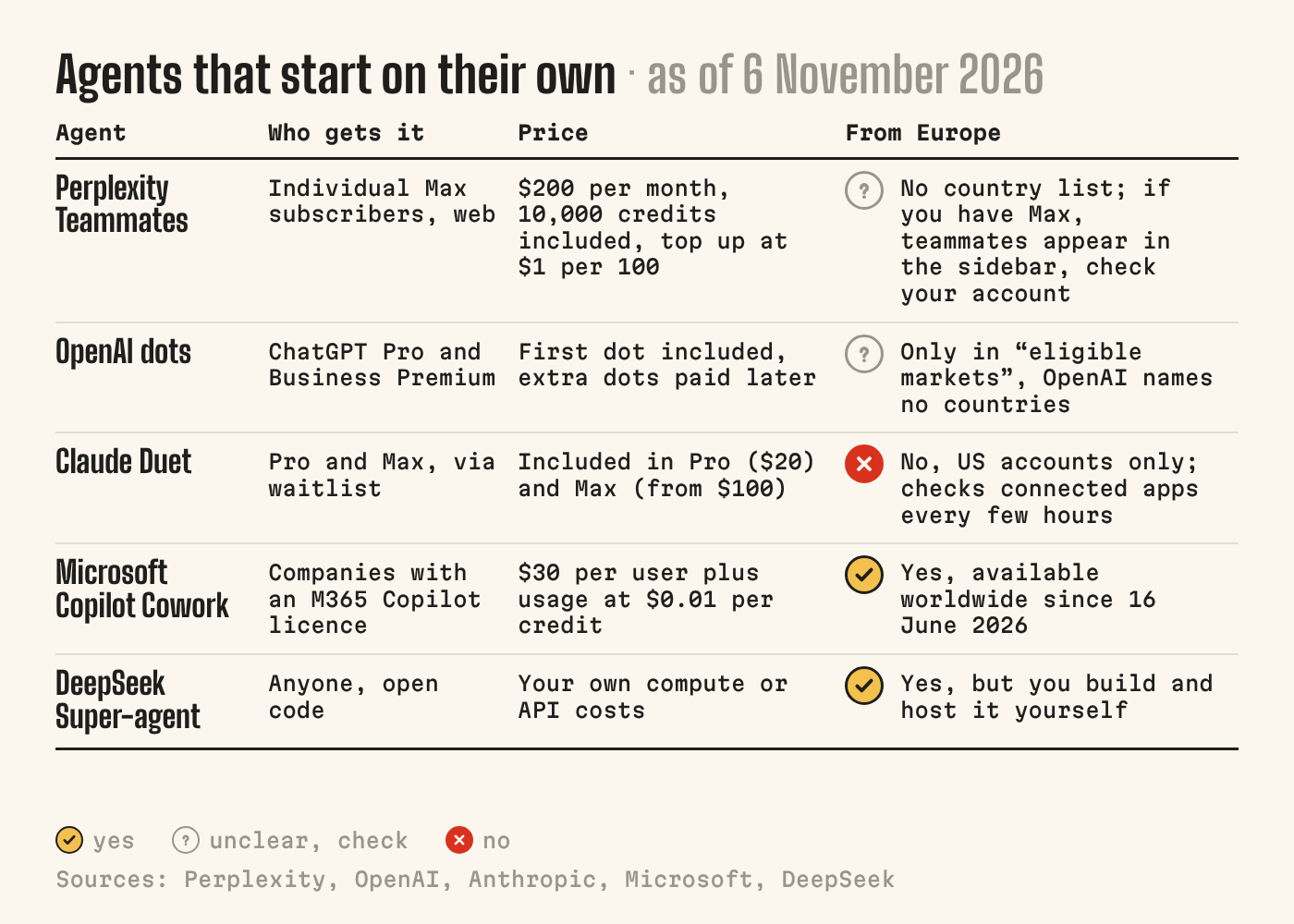
Teammates arrive in a crowded month. Every major player now offers an agent that does not wait for a prompt, and the difference lies in who can get it and what it costs.
| Agent | Who gets it | Price | From Europe |
|---|---|---|---|
| Perplexity Teammates | Individual Max subscribers, web | $200 a month, 10,000 credits included, top up at $1 per 100 | No country list; if you have Max, teammates appear in the sidebar, check your account |
| OpenAI dots | ChatGPT Pro and Business Premium | First dot included, extra dots paid later | Only in “eligible markets”, OpenAI names no countries |
| Claude Duet | Pro and Max, via waitlist | Included in Pro ($20) and Max (from $100) | No, US accounts only; checks connected apps every few hours |
| Microsoft Copilot Cowork | Companies with an M365 Copilot licence | $30 per user plus usage at $0.01 per credit | Yes, available worldwide since 16 June 2026 |
| DeepSeek Super-agent | Anyone, open code | Your own compute or API costs | Yes, but you build and host it yourself |
What sets Teammates apart is the combination of a dedicated computer per agent, a standing role with memory and collaboration between agents. Dots is one assistant per person today and Duet appears to be the same; Perplexity aims at several teammates per user. Copilot Cowork is the closest offer a European company can buy without detours today, but it lives inside Microsoft 365 rather than in your browser and your GitHub.
What a European organisation should check first
A teammate that reads your Gmail, Slack and GitHub has Perplexity process personal data on your behalf, which means you need a data processing agreement under Article 28 of the GDPR. By its own policy Perplexity processes on US infrastructure and offers no European data residency, as a GDPR guide for European teams also read it in May 2026, and according to the same guide even Enterprise customers got no full data processing agreement at the time; check the current documentation. Late in 2025 the company moved its EU representative from Ireland to Prighter in Austria, as court filings in Amazon’s lawsuit showed. So ask which agreement comes with your plan before you start, and begin with a teammate that touches no customer data.
If the teammate talks to customers or colleagues, for instance when it answers complaints or reports in Slack, Article 50 of the AI Act comes into play since 2 August 2026: whoever provides an AI system that talks to people must make that known, and as a deployer you do well to draw the same line. Keep it recognisable as a bot in the channel, which Slack does anyway, and let every reply to a customer leave through a human.
Then there is the outside world. On 4 November, the day of the announcement, Amazon filed a new brief in its ongoing lawsuit against Comet, Perplexity’s browser, arguing that Perplexity steers the agent at every step inside Amazon’s systems. More and more sites shut out agents, and a teammate with its own browser runs into the same doors. Expect some tasks to stall because a website turns it away.
How to start without surprises
- Choose one bounded role with a clear source, a clear deliverable and a fixed rhythm, such as “read yesterday’s support tickets every morning and summarise them in my chat”.
- Grant only the rights the role needs: one Slack channel, one repository, no payment methods.
- Set the spending cap at the amount you are prepared to lose and leave auto-refill off.
- Have every outbound action, from an email to a contract extension, approved by you first. Widen the scope only after a month.
- After that month, write down three numbers: how many tasks were delivered correctly, how often you had to intervene and how many credits it cost. That decides whether a second teammate makes sense.
Frequently asked questions about Perplexity Teammates
How many teammates can I create?
Perplexity has not published a maximum. CEO Aravind Srinivas talked about hundreds of teammates per person as a future picture, but every teammate draws credits from the same pool.
Does a teammate work when my laptop is closed?
Yes. It runs in Perplexity’s cloud on its own computer, so your device plays no part.
Can I try teammates on the free or Pro plan?
No. You have to upgrade to Max under Settings, Account, Subscription. Pro subscribers get Computer, but not teammates.
Which AI model does a teammate use?
Claude Opus 5.5 from Anthropic by default. You can choose a different model per teammate, and the agents it starts use that model unless you specify otherwise.
What happens when my credits run out?
Running tasks pause and resume once you buy credits or your monthly credits renew. New tasks that need credits do not start.
The colleague you have to learn to budget first
Teammates are the clearest version so far of what every lab is after: an agent that owns work instead of answering questions. That Perplexity spells out roles for marketing, sales and operations and puts Slack at the centre shows it is aiming at the small company, not the IT department. But the price of such a colleague is not a subscription, it is a meter. Whoever understands that, and lets the first teammate start small, measured and capped, has a head start on whoever looks at the invoice after a month and pulls the plug.