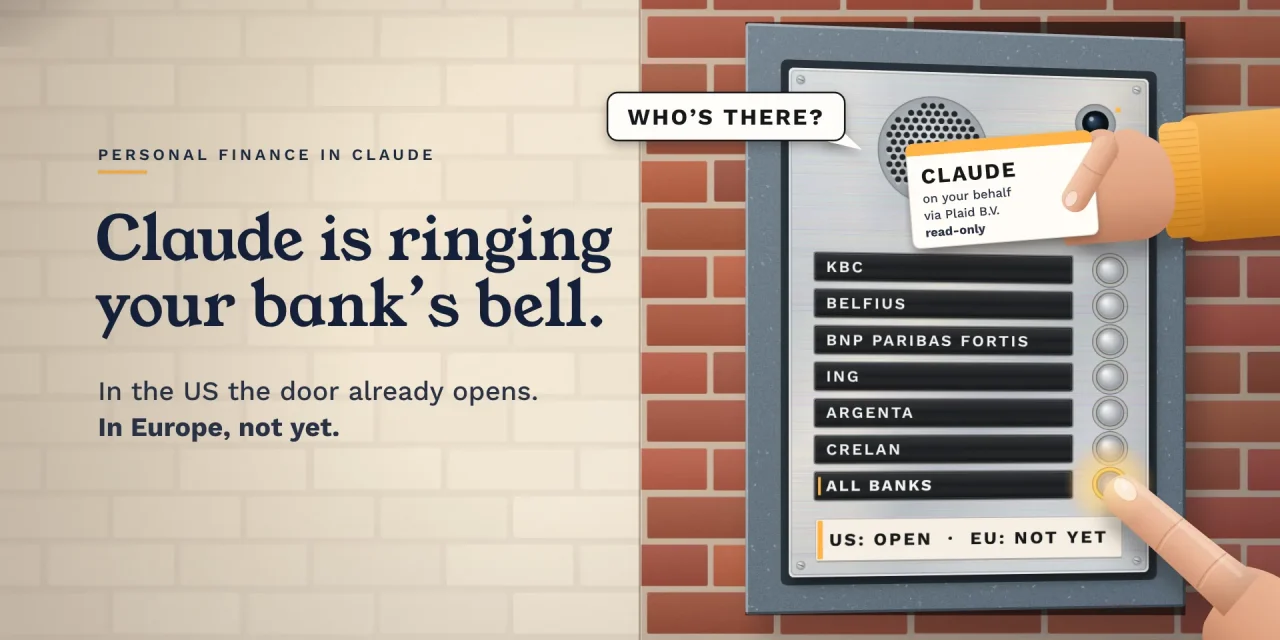
Since 5 November 2026, Claude can read your bank and card accounts in the United States. You connect them through Plaid, ask questions in plain language, and Claude answers from your real balances and transactions. Access is read-only, there are no ads or sponsored products, Claude sees up to two years of transactions on the accounts you pick, and conversations in the Personal Finance hub are not used to train models. The beta runs on Pro, Max and Ultra plans, US only, with no date for anywhere else.
For European readers, the interesting part is not the feature but the gap it exposes. Technically, a Claude that reads a Belgian, Dutch or German account could ship tomorrow: PSD2 gives every consumer the right to use a licensed account information service, Plaid holds that licence through its Dutch entity, and banks have been serving multibanking apps for years. Legally, Europe would turn Anthropic’s voluntary promises into obligations and add a few of its own. Politically, the data that matters most to a European household, savings, investments, pensions and mortgages, sits behind a regulation that has been stuck since June 2025. This article walks through what the US product does, what the European route looks like, which rules change the product, and what banks and compliance teams should take from it.
What Personal Finance in Claude does
The announcement is deliberately modest. You open Personal Finance from the sidebar, link accounts through Plaid, and ask things like “Where did my money go this month?” Claude totals spending across accounts, sorts it by category, compares it with previous months, flags duplicate charges, unexpected fees and subscriptions that crept up, lists the bills due before payday and explains terms like APR with your own numbers. It can build a weekly spending chart or a dashboard. It cannot move, manage or invest money, and Anthropic says it is not designed to give investment advice.
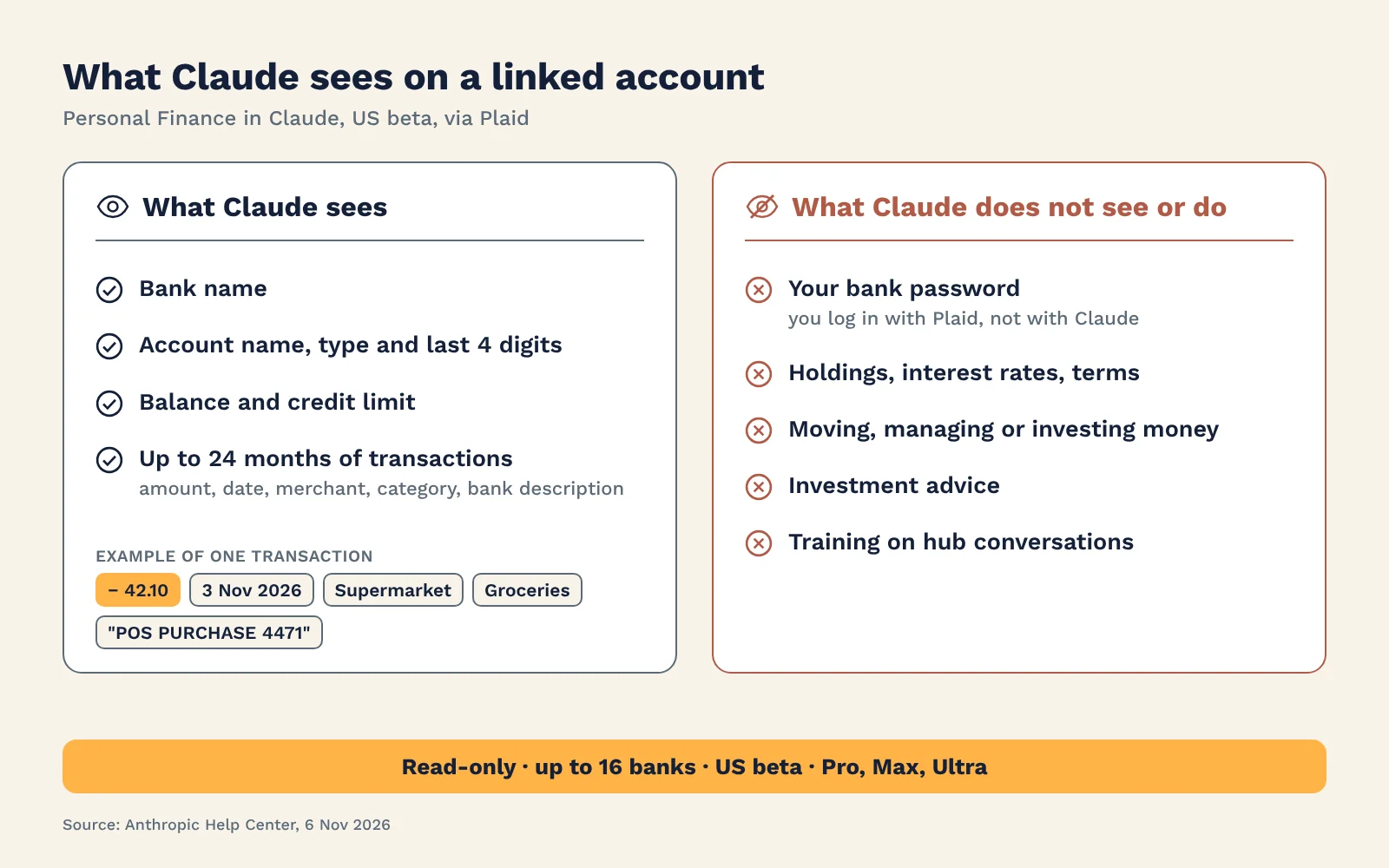
The help article is more precise about the data. For linked accounts only, Claude sees the bank name, the account name and type with the last four digits, balances and credit limits, and up to 24 months of transactions with amount, date, merchant, category and the bank’s description. It does not see holdings, trades, rates or terms. You can link up to 16 banks. Chats that use account data are kept out of Claude’s memory, are not searchable later and are excluded from the monthly recap; in those chats Claude may not be able to run code or work with Office or PDF files, while text, tables and CSVs still work. Unlinking a bank stops access immediately, but earlier answers stay in your chats, artifacts and shared links until you delete them. Deleting your Claude account unlinks all banks.
OpenAI got there first. ChatGPT’s Finances feature launched in May 2026 for Pro subscribers in the US, also on Plaid, with more than 12,000 institutions, including brokers such as Schwab, Fidelity and Robinhood. Anthropic’s version is narrower on purpose: read-only, no ads, no own credit cards or savings products, and a training exclusion for the hub. The first reactions on Hacker News still came down to trust: do you want an AI company holding read access to your accounts, and what happens in a breach or a misconfigured log? Those are exactly the questions European law already answers for account aggregation, which is why the European version of this product would look different.
The European route already exists
In the US, Plaid negotiates access bank by bank. In the EU, access is a right. PSD2 defines an account information service as an online service that provides consolidated information on one or more payment accounts, and obliges banks to expose those accounts through an interface to any licensed provider the customer authorises. Banks must treat data requests from such providers without discrimination, and no contract between the bank and the provider is required.
Plaid is such a provider. Its Dutch subsidiary Plaid B.V. is supervised by De Nederlandsche Bank under licence R179714, which is the usual basis for serving the rest of the EEA. Plaid’s institutions API lists Belgium, the Netherlands, Germany, France, Spain, Italy, Ireland, Austria, Portugal, Poland, the Nordics and the Baltics among its supported countries. Consumers already use this plumbing without knowing it: KBC Mobile in Belgium shows current accounts from eleven other banks, and Belfius lists Tink, Klarna and Ponto among the third parties it shares its API with and lets customers revoke each permission in the app. The “Link accounts with Plaid” button Anthropic shows in the US would, in Europe, send you to your bank’s PSD2 login, with itsme, a card reader or your banking app.
Four rules that would change the product
Purpose limitation is law, not policy
Article 67 of PSD2 is the clause that matters. An account information service provider may act only on the user’s explicit consent, may access only the designated accounts and their transactions, may not request sensitive payment data, and may “not use, access or store any data for purposes other than for performing the account information service” the user explicitly requested, in accordance with data protection rules. In the US, “we don’t train on hub conversations” is a product promise. In the EU, using account data for anything beyond the service the user asked for would need a separate, explicit GDPR consent or a legal basis in law. The practical effect is that the US hub, with its training exclusion, memory exclusion and read-only scope, is roughly the shape a European product would be required to have.
Re-authentication every 180 days
Under the amended technical standards on strong customer authentication, applying since 25 July 2023, a user must re-authenticate with each bank at least every 180 days for an aggregator to keep reading, and banks must as a rule not demand extra authentication for intermediate requests by a licensed provider, unless they have objective reasons such as suspected fraud. A European Personal Finance would therefore nag you twice a year per bank, while a US Plaid link runs until you cut it.
GDPR: controller, transfers and the silent party
Anthropic’s privacy policy (10 September 2026) names Anthropic Ireland Limited as the controller for users in the EEA, Switzerland and the UK, and relies on standard contractual clauses for transfers to the US. Transaction data is not a special category under the GDPR as such, but single transactions can reveal one, a union fee, a church donation, a clinic bill, and then Article 9 applies; and the European Data Protection Board’s Guidelines 06/2020 set out two points a European launch would have to address. First, the “explicit consent” in PSD2 is contractual, not the GDPR consent basis, so the lawful basis and the information to users must be designed with care. Second, a bank statement contains data about silent parties, the people who paid you or whom you paid, who never consented to anything. Any European product has to minimise and explain what happens with those names.
The AI Act and consumer credit: not high-risk, until it is
The AI Act classifies by use. Evaluating the creditworthiness of natural persons is an Annex III use case and becomes high-risk on 2 December 2027 after the Digital Omnibus. Summarising a user’s own spending is not a credit decision, so Personal Finance sits in the transparency tier: users must know they are talking to an AI, which is self-evident here. Anthropic, as a provider of a general-purpose AI model, carries its own GPAI obligations since August 2025. Two things would change the picture. If Claude were ever used to assess or pre-screen a loan, the high-risk regime applies. And from 20 November 2026 the new Consumer Credit Directive gives consumers a right to human intervention, an explanation and a review whenever a creditworthiness assessment involves automated processing. Anthropic is not heading there; its announcement says it wants Claude to work alongside licensed professionals and regulated firms for major money decisions, and invites banks and wealth managers to help shape that.
The real constraint is FIDA
PSD2 covers payment accounts: current accounts and cards. Savings, investments, pensions, mortgages and insurance are outside it. A European Claude on PSD2 alone would see half of a household’s financial life. The Financial Data Access regulation, FIDA, was meant to close that gap. The Commission proposed it in June 2023 and the Council adopted its negotiating mandate on 4 December 2024, but according to Projective Group the trilogues stalled in June 2025, and on 6 April 2026 the Commission circulated a non-paper to restart them with a narrower scope: fewer data categories, a shorter look-back of around two years, exclusions for small institutions, and a phased roll-out over roughly four years with an evaluation after each phase.
One of the open questions concerns companies like Anthropic and OpenAI directly. Part of the debate is whether big tech platforms, the Digital Markets Act gatekeepers, should be excluded from financial data access or admitted only under strict supervision. Anthropic is not a gatekeeper, but the debate shows the political mood: Europe wants open finance, and is uneasy about US platforms seeing a European’s entire balance sheet in one window. At the time of writing there was no agreement. Until there is, any European Personal Finance stops where PSD2 stops.
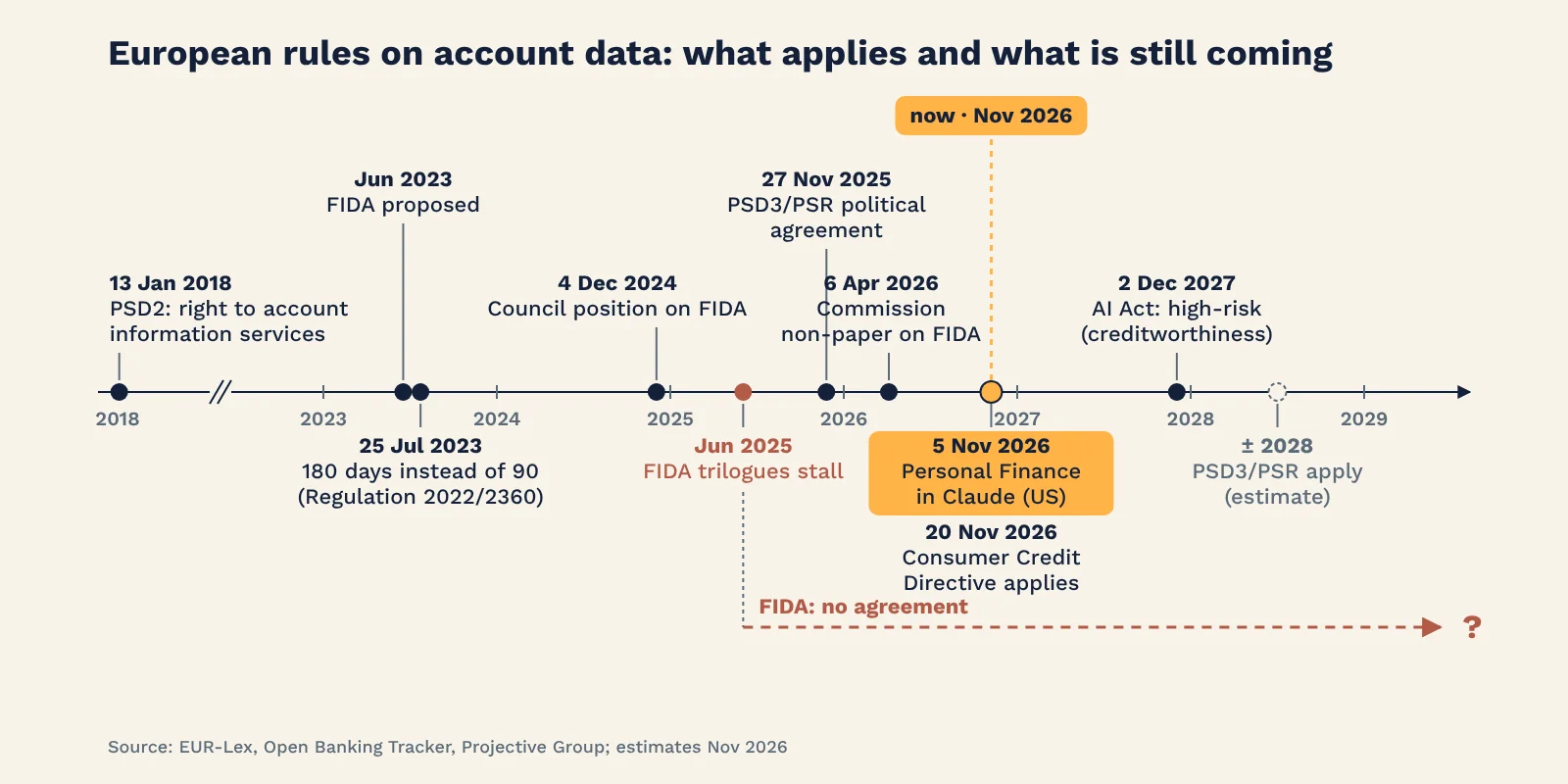
PSD2’s successors are closer. Parliament and Council reached political agreement on PSD3 and the Payment Services Regulation on 27 November 2025, the final texts were published on 23 April 2026, and Open Banking Tracker expects publication in the Official Journal in the second half of 2026 and application of most rules around 2028. Two provisions matter for a product like this: banks must offer a permission dashboard where customers see and revoke every third-party access, kept in sync with the provider, and bank interfaces must perform at least as well as the bank’s own app against harmonised KPIs. That addresses the oldest complaint of European aggregators, connections that silently fail mid-month.
The other road: the bank as the connector
There is a route that bypasses Plaid, and banks control it. In August 2025, Grasshopper Bank in New York let business clients connect their account data to Claude through the Model Context Protocol, Anthropic’s open standard for giving AI assistants access to tools and data. Technology partner Narmi built the feed on the bank’s existing authentication, with explicit consent per customer, read-only permissions and an application firewall on Narmi’s side. Clients opt in; nobody is obliged to connect, and the bank’s CTO expects to add other assistants as they adopt MCP.
For a European bank this is the attractive option. It keeps the bank as the party that holds consent, it works inside the existing PSD2 and GDPR framework, and it does not depend on a US aggregator. KBC already runs its own assistant, Kate; an MCP endpoint would let customers bring the assistant they already pay for. It also inverts the trend we described in our piece on websites blocking AI agents: instead of shutting agents out, the bank builds a controlled entrance. Anthropic’s invitation to banks and wealth managers reads as an opening for exactly this.
What European organisations should take from this
- Consumers and employees: you can already export transactions as CSV from any European banking app and ask Claude the same questions in a normal chat. The hub protections do not apply there: your general privacy settings do. Turn off training on your conversations before uploading a statement, or use a Team or Enterprise account where it is off by default (see what admins control in Claude), strip account numbers and counterparty names you do not need, and verify totals, as Anthropic itself advises for the US product.
- Banks: decide now whether you want to be an endpoint. A read-only MCP connector under your own consent flow is cheaper than losing the interface to a third-party aggregator, and the PSR’s permission dashboard will have to exist anyway.
- Fintechs and aggregators: Article 67’s purpose limitation is your competitive argument against US platforms, and the 180-day rule is your biggest churn risk. Plan for both.
- Compliance teams: any assistant that touches account data needs a lawful basis analysis for silent-party data, a data residency answer for transfers, and a line in the AI inventory that confirms it makes no credit decisions. If it ever does, the AI Act’s high-risk regime and the Consumer Credit Directive apply together.
- Policy watchers: FIDA decides whether open finance in Europe includes AI assistants at all. The gatekeeper question is the one to follow.
Frequently asked questions
Can I use Personal Finance in Claude in Europe?
No. It only appears for users in the US on Pro, Max or Ultra plans, and it disappears when you are outside the US or on a VPN connected from another country, while your banks stay linked. Anthropic has not given a date for other countries.
Would Claude need a licence in the EU?
Not necessarily. Access to payment accounts must go through a licensed account information service provider; Plaid B.V. is one, and Anthropic could use it as it does in the US. Anthropic would still be the data controller under the GDPR for what happens next.
Could a European version include savings and investments?
Not through PSD2, which covers payment accounts only. That needs FIDA, which had not been agreed at the time of writing.
Is this high-risk AI under the AI Act?
No. High-risk covers AI that evaluates creditworthiness or decides on access to credit. Personal Finance summarises a user’s own spending. Transparency rules and GPAI obligations still apply.
Does Anthropic train on my bank data?
Not in the US hub, by policy. In Europe, PSD2 limits account data to the service you requested, so a European version could not train on it without a separate, explicit consent.
Who opens the door
Whether Claude can read a European bank account is not the question; it can, through the same channel that powers multibanking in your bank’s app, and under stricter rules on what happens to the data. The question is who lets it in: Anthropic through Plaid, your bank through its own connector, or Brussels through FIDA, so that savings and investments count too. Nothing stands in the way of the first two but a decision. The third is waiting for a trilogue.