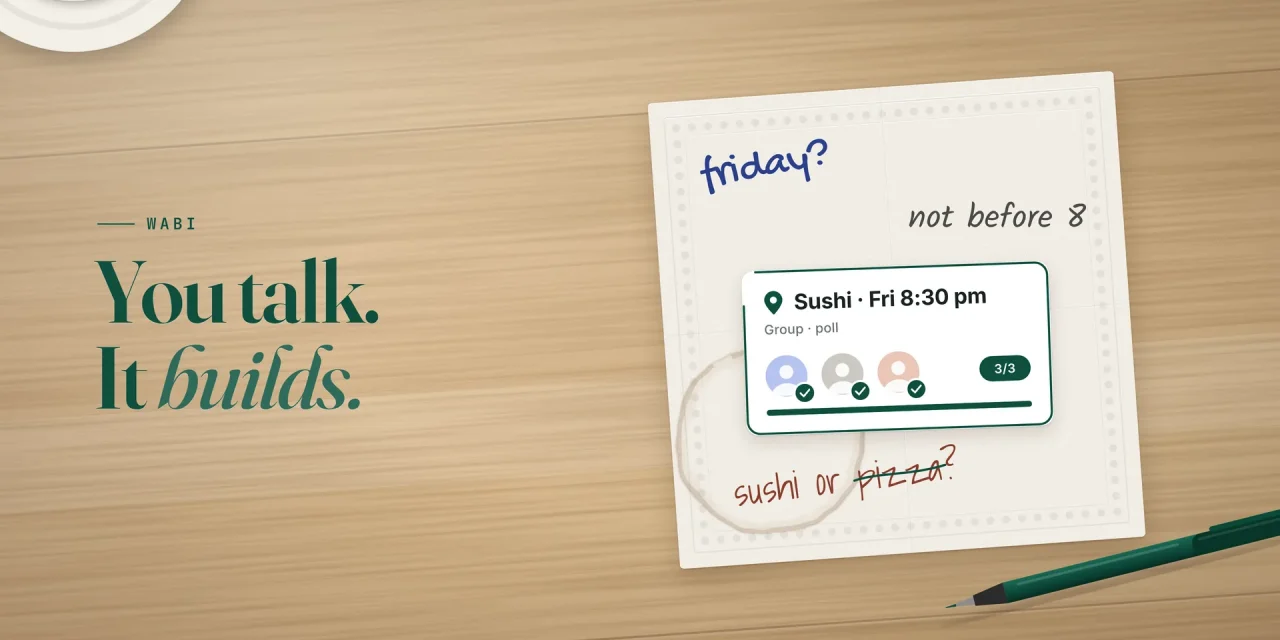
Wabi is a messaging app with an AI agent inside it. You chat with the agent the way you chat with a friend, alone or in a group, and while you talk it handles tasks and builds small apps right inside the conversation: a poll, a shared calendar, a budget, a map of the restaurants you all like. The app from Replika founder Eugenia Kuyda has been free to download for iPhone, Android and Mac since 19 October 2026. Ten days later Wabi raised $55 million at a $1.25 billion valuation. This article explains what Wabi is, how it works, what you hand over to use it, what the valuation does and does not tell you, and what European users should check first.
What is Wabi?
Wabi calls itself a messenger. It looks like WhatsApp or iMessage, a list of conversations, but every conversation has a personal AI agent in it that acts on your behalf. Kuyda describes it as a personal agent that does things for you and builds the interface you need in the moment. Three building blocks separate it from a chatbot.
- Threads per topic. Instead of one endless conversation you keep separate threads for health, the kids, a trip, your relationship. Each thread has its own memory and its own apps.
- Mini-apps the agent builds itself. Ask the family thread to keep track of the children’s activities and Wabi builds a calendar. Plan a trip and a countdown and an itinerary appear. You don’t code, and you don’t even have to ask: the moment you connect your email, the agent spins up a set of starter threads and apps on its own.
- People in the thread. Any thread can be shared as a group chat. Your partner can then ask the agent whether you are free on Friday, or whether the tickets were bought. Kuyda calls this “multiplayer” and says nobody has cracked it yet.
Wabi itself sums it up as an agent, personalised mini-apps and shared spaces, under the tagline “the AI assistant you use together”. In the funding announcement Kuyda goes further and says Wabi can become “an operating system for life”.
How a thread works
Say you are planning a weekend away with three friends. In a normal group chat that ends in forty messages and a decision nobody wrote down. In Wabi the agent reads along. It proposes a date that fits what everyone wrote, puts a poll in the sidebar next to the chat, builds a countdown and asks whether it may connect your calendars. Everything the agent builds lives in a sidebar of widgets that belong to the conversation: departure and arrival dates for a trip, cards with a photo and a short description for restaurant suggestions.
Kuyda uses it this way herself. Her health thread holds a calorie tracker, a weightlifting log and her medical appointments. The thread about her children holds an activity calendar, the daily preschool menu and an app that teaches her daughter Japanese, and the agent triages the school’s emails. The children’s father and the nanny sit in that same thread.
What Wabi actually does for you
The feature list on the App Store and in the press release is long, but it falls into four groups.
- Handling. Booking appointments, processing returns, chasing refunds, filling in forms. On Android you can start a voice or video call from any chat.
- Watching. A Gmail connector flags important messages. Through Plaid, a financial data sharing platform, Wabi builds a budget, points out subscriptions you no longer use and spots bill increases.
- Planning with others. A shared family calendar built from school emails, a trip itinerary with bookings, suggestions when the weather changes a group’s plans, a reading list for a book club.
- Building. To-do lists, trackers, trivia games and even simple 2D games that run in the chat window. This is the piece of vibe coding left over from the first version of Wabi, except that the agent now builds instead of you.
On iOS and Android you get home-screen widgets, and a conversation started on your phone continues on your Mac. A Windows app is, according to the company, the next priority.
Where Wabi comes from
Wabi is not last year’s idea. In 2014 Kuyda stood on the TechCrunch Disrupt stage with IO, a chatbot concierge that booked restaurants and trips. That company, Luka, became Replika, the AI companion app that a16z and SiliconANGLE put at 35 to 40 million users. Kuyda stepped down as Replika’s CEO in 2025 and started Wabi.

The first Wabi, in beta since autumn 2025, was a different product: a platform where anyone could prompt a mini-app into existence, share it and remix it. a16z led a $20 million pre-seed in November 2025 and TechCrunch called it the “YouTube of apps”. It turned out people wanted the personal apps but did not want to spend time building them. Wabi 2.0 arrived on 28 September 2026, invite-only at first and open to everyone since 19 October. Kuyda calls it an evolution rather than a pivot. The reasoning matters for anyone working with AI agents: the longer you talk to a single agent in a single chat, the worse it gets, because everything you asked earlier disappears under newer messages. People, she argues, don’t only want to type; they also want to tap, scroll and look. The strongest agent combines both.
What you hand over
An agent that handles returns and watches your budget needs access. Wabi asks permission per connection: email, calendar, contacts, location, photos and health data. On Android it can follow your location in the background to notice that you have arrived in a new city, and it reads Health Connect to answer questions about steps, sleep and heart rate. Every connection can be removed again, and the agent asks for approval before important actions.
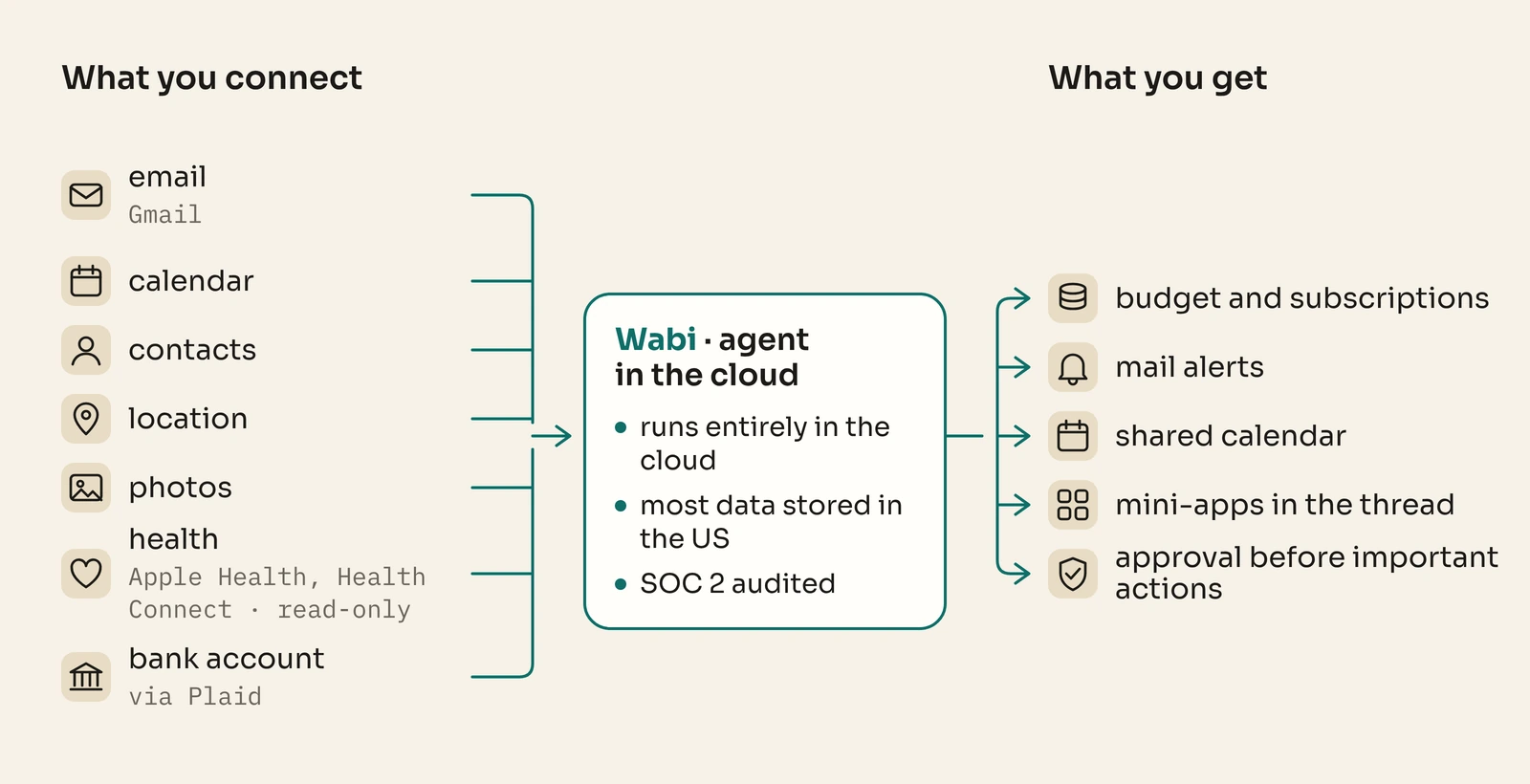
Three things are worth knowing before you start, and they matter more in Europe than in Wabi’s home market.
- Everything runs in the cloud, mostly in the US. Wabi runs entirely in the cloud and stores most user data in the United States, the company says. The company has passed a SOC 2 audit, an external review of its security measures. We found no public statement about a European data region, a GDPR representative or how it handles data subject requests. For a consumer that is a personal choice; for anyone who would put work email or a company calendar into a thread, it is a question for the data protection officer first.
- Sharing is sharing. In a shared thread everyone can ask the agent about whatever is connected to it. Access is scoped to that one chat, Kuyda says, and everyone in the chat can see when someone requests personal information. Putting your bank account into a family thread is a decision you make together, and it is personal data about third parties as soon as a bank statement names them.
- Email is input. An agent that reads your inbox and acts on your behalf is exposed to instructions hidden inside a message. We found nothing published by Wabi on how it isolates untrusted content. The per-action approval is, for now, your best protection; keep it on for anything that spends money or sends messages.
For how a work-grade proactive agent handles the same questions, see how Claude Duet decides when to interrupt you and why every organisation now needs an agent policy.
What the $1.25 billion does and does not say
IVP led the $55 million round. Andreessen Horowitz, Forerunner and the Amazon Alexa Fund took part, alongside a line of well-known angels: Shopify CEO Tobi Lütke, Salesforce CEO Marc Benioff, former Yahoo chief Marissa Mayer, former Twitter CEO Dick Costolo and Alex Pall of The Chainsmokers. Wabi’s total funding now stands at roughly $75 million, according to Tech Funding News. The money goes to growth and product development, starting with the Windows app. IVP’s Alex Lim summed up the thesis: Kuyda has a track record and a sense for where AI is headed.
What the announcement leaves out is just as visible. Wabi reports “strong early demand” but no user numbers. The app is free and no business model has been chosen. The valuation came 31 days after the change of direction. Investors are paying for the founder and for the category, and the category is hot: Instinct raised $1 billion at a $10 billion valuation in September, Meta launched Muse as its own personal agent, Google has Gemini Spark and open alternatives such as DeepSeek’s Super-agent start work on their own.
| Agent | Shape | What Wabi does differently |
|---|---|---|
| Instinct | One chat with your agent, $10 billion valuation | Wabi splits life into threads and lets other people into them |
| Meta Muse | Meta’s personal agent, launched 8 September 2026 | Wabi builds interfaces instead of only answering |
| Claude Duet | Anthropic’s proactive agent for mail and calendar, a US-only research preview for now | Wabi targets families and friends, not office work |
| Wabi | Messenger with agent, mini-apps and shared threads, free | No user numbers, no business model, data in the US |
The risk is equally clear. If the concept works, Meta, OpenAI and Apple can build the same thing into apps that already sit on every phone. Wabi then needs something they lack, and today that is the combination of threads, people and self-built apps, not a model of its own.
Can you use Wabi in Europe?
The app is in the App Store (iOS 26 or later, rated 13+), on Google Play and as a Mac download, with no waitlist. It is free and English-only. The iOS app is listed in European storefronts such as the Belgian App Store (checked 3 November 2026), though Wabi publishes no list of countries, and whether the Plaid bank connection works with European banks is unknown. If you want to try it, start with a thread that asks for little, a book club or a trip with friends, and connect mail or calendar only once you have seen what the agent does with a thread. Organisations should treat it as a consumer app: keep work accounts out until Wabi publishes its data processing terms for Europe.
Frequently asked questions
Is Wabi the same as Replika?
No. Replika is an AI companion that keeps you company. Wabi is an assistant that completes tasks and builds apps, and that you share with real people. Kuyda does say part of the Replika idea, making people feel less lonely, carries over: Wabi wants to help you spend time with your people, in real life.
Do I need to code?
No. In the first version of Wabi you typed a prompt to create an app. In Wabi 2.0 the agent decides which apps are useful and builds them itself. You can still ask for one.
What does Wabi cost?
Nothing, for now. The App Store listing does show in-app purchases, but Wabi has not announced a paid tier and says the business model is still undecided.
Which AI models power it?
Wabi does not say. Interviews and press releases name no models.
Is Wabi GDPR compliant?
We found no public statement from Wabi about GDPR, EU data residency or an EU representative. What it has said is that data is stored mostly in the US and that the company is SOC 2 compliant. Check the privacy policy before connecting anything you would not want processed in the US.
The interface is the product
The most useful sentence in this story is Kuyda’s own: people love what agents can do, but they also like software. A chat window is good for asking and bad for keeping track. Wabi bets that the winning agent will not have the smartest model but the best way of showing its work: in small apps, next to the conversation, for more than one person. Whether that holds up against the companies that make the phone itself will show in the numbers Wabi has not yet shared.