Meta AI, the assistant built into WhatsApp, Instagram, Messenger and Facebook, has been running on new models since 6 November. Meta says it now holds on to what you told it earlier and keeps going when a question or task gets hard. Nobody has to install or pay for anything. What the announcement leaves out is the other half of the deal: an assistant that remembers more also keeps more about you, and in Europe it is the GDPR, not Meta, that decides how far that goes.
This article covers what changed, what users will actually notice, how much the numbers are worth, what applies in the EU, and what individuals and organisations should check.
What Meta changed
On 6 November, Meta Superintelligence Labs introduced specialised versions of its existing models, trained using Muse Wonder, the frontier model Meta launched on 12 October. The full Muse Wonder sits mostly behind subscriptions and the developer API. These smaller, specialised models go to everyone who uses Meta AI or Muse, Meta’s agent app. Mark Zuckerberg wrote on X that he was bringing Active Memory and Active Focus “to everyone”, promising less repeating yourself and fewer dead ends.
Two capabilities are involved:
- Active Memory lets the model remember what matters and recognise when something from earlier becomes relevant again. Meta trained it to tell temporary information from permanent information and to reason about time: what is still true, and what is out of date?
- Active Focus keeps the model on task. In Muse, it means finishing jobs when something goes wrong along the way. In Meta AI, Meta says it makes the assistant a better thinking partner that breaks problems into steps, asks sharper follow-up questions and keeps up when you change direction mid-conversation.
What users will notice
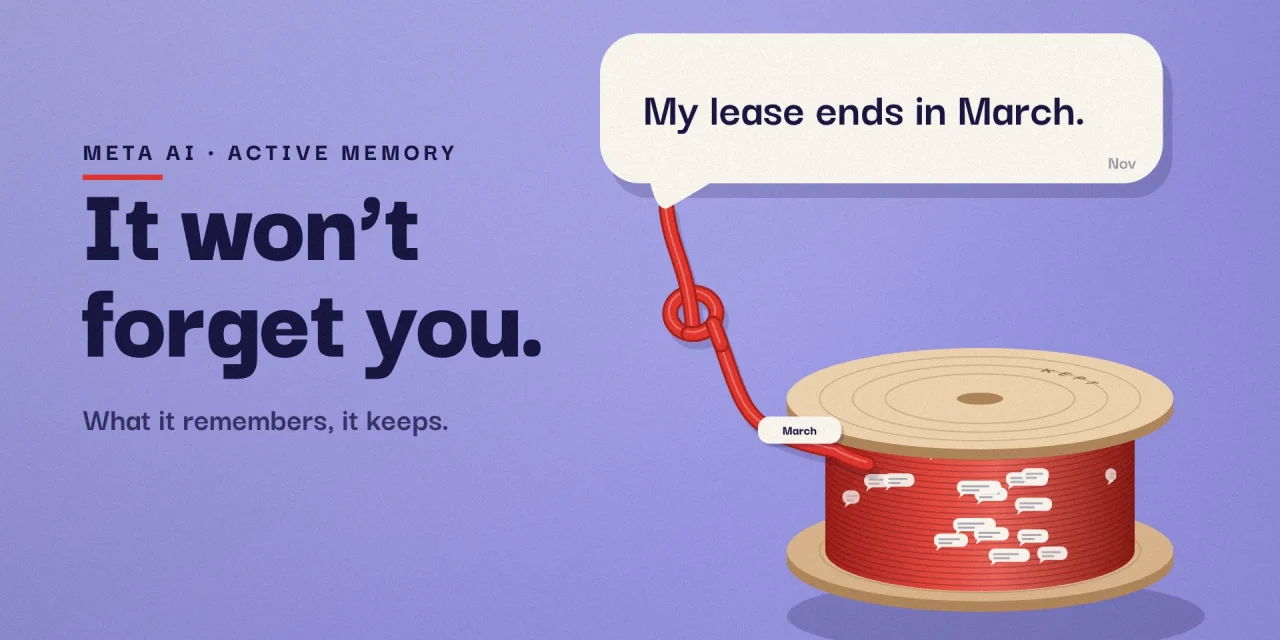
When Meta launched Muse Wonder, it used an example that sums it up. You mention your lease ends in March. Weeks later you ask what a move will cost, and the model connects the two without you repeating the date, as Digit described it.
In everyday use, that can look like this:
- Less repetition. You say once that your daughter has a nut allergy. Ask for a birthday cake recipe later and the assistant takes it into account.
- Temporary stays temporary. “I’m in Lisbon this week” should stop counting after that week. “I’m vegetarian” should not. That distinction is exactly what Meta trained for.
- Long conversations hold together. Planning a renovation or a trip over dozens of messages, the model is less likely to lose the thread, even when you change your mind.
- Fewer dead-end answers. A complicated question is more likely to get a step-by-step plan and a targeted follow-up question than a generic reply.
This is more than a convenience. Having to explain everything again is the most common frustration with chatbots. An assistant that holds context becomes useful for things that run over days or weeks: a house move, a job search, an insurance claim.
The numbers, and what they do and do not prove
Meta published four figures, all from its own evaluations:
- On Meta’s own memory test, the new model uses critical context correctly in 90% of tasks, against 76% for the previous Muse model.
- That works out at forgetting something important 2.4 times less often: from 24 misses per 100 tasks to 10.
- On Meta’s Personal Superintelligence Index, the score rises from 38% to 47%.
- Muse completes everyday tasks where something goes wrong 67% better.
Two caveats. Meta does not say how large these tests are or how they work, and nobody has reproduced them independently. And the 67% figure is about tasks in Muse, the agent app, not about an ordinary chat in WhatsApp. Treat the numbers as a direction, not as proof.
What applies in the EU
Part of it, and Meta does not make it easy to tell which part. Meta AI has been available in WhatsApp, Instagram, Messenger and Facebook across all EU member states since March 2025, but with fewer features than in the US. Muse, the agent app, launched for US adults only and has no European date. The 6 November update names no countries at all.
The better model itself, the one that follows long conversations and asks sharper questions, should reach European users of Meta AI. Personal memory across conversations is a different matter. Meta launched it in early 2025 in the US and Canada and has never said it is switched on in the EU. The quickest way to find out where you stand is to ask in the chat: “What do you remember about me?”
The trade-off: remembering more means keeping more
An assistant that knows you better needs data about you, and that data is stored somewhere. Three things are worth knowing.
Memory reaches beyond the user. In October, Muse’s instructions showed that the agent keeps hourly-updated pages on the people in a user’s life: names, birthdays, recurring topics, how close they are. That includes people who never used Muse themselves, as Gizmodo summarised from WIRED’s reporting. Meta responded that Muse only uses public information and what users choose to share, stored in an isolated environment per user. TIME added that asking Muse to forget did not always erase the original message. This concerns Muse in the US, but it shows where Active Memory can lead as it rolls out more widely. Under the GDPR, those third-party profiles would raise immediate questions about legal basis and information duties.
Outside Europe, AI chats feed advertising. Since 16 December 2025, Meta has used what people tell Meta AI to personalise ads and content, with no way to opt out. The EU, the UK and South Korea were excluded. For Europeans, data protection law is the brake. That is a legal boundary, not a Meta promise, and it can move if Meta switches to a consent model or regulators change course.
Private means forgetting. In May, WhatsApp announced Incognito Chat with Meta AI: conversations nobody can read, not even Meta, and that disappear. But chatting that way means no memory across conversations. The choice is yours: an assistant that knows you, or a conversation that leaves no trace. Meta does not currently offer both at once.
What European organisations should check
Meta AI is a consumer assistant, but it lives in the apps your employees already use for work. A memory that persists turns a quick question into a record.
- Update your AI use policy. If staff may use consumer assistants, say explicitly that customer names, contract details and HR matters do not go into Meta AI, or into any assistant with memory.
- Mind third-party data. What an employee tells an assistant about a customer or colleague is personal data about someone else. With memory switched on, it may be kept.
- Watch group chats. According to Meta’s own rules, Meta AI only remembers in one-to-one chats, not in groups. But anyone who invokes Meta AI in a group shares that request with the whole group.
- Track the EU carve-outs. The advertising exclusion and the missing Muse launch both rest on the GDPR. If either changes, your risk assessment changes with it.
For individuals, the routine is simple: ask what the assistant remembers, have it delete what it does not need and check afterwards that it is gone, keep health, money and other people’s details out, and use incognito for sensitive questions once it appears in your WhatsApp. Our guide to the GDPR explains the rights you can invoke, including access and erasure.
The same trade-off runs through every AI messenger. Wabi builds apps inside your group chat and Meta’s Style Sketch turns your Instagram photos into a wardrobe: each assistant gets more useful the more it knows. For organisations building their own AI, the lesson is the one we made earlier: models are rented, context is owned, and whoever holds the context holds the value.
Frequently asked questions
Do I need to install or pay for anything to get Active Memory?
No. The new models run on Meta’s servers behind Meta AI in WhatsApp, Instagram, Messenger and Facebook. You do not need to do anything. Only Muse has paid subscriptions, and that app is not available in the EU.
Does Meta AI read my normal WhatsApp chats?
No. Meta AI only sees what you ask or forward to Meta AI directly, including in a group where you invoke it. Your other chats remain end-to-end encrypted, and the memory concerns your conversations with Meta AI.
Does Meta use my AI conversations for ads in Europe?
Not in the EU. Outside Europe it has done so since 16 December 2025. The EU exclusion rests on data protection law and could change if Meta asks for consent or the rules shift.
Is Meta AI’s personal memory switched on in the EU?
Meta has not said. Memory across conversations launched in the US and Canada in 2025, and the November update names no countries. Ask the assistant what it remembers about you to see how it works on your account.
An assistant that knows you needs a user who pays attention
Active Memory makes Meta AI more useful for anything that runs over weeks, and that is a real step for an assistant already installed on tens of millions of European phones. But remembering is a choice Meta makes about your data, and Meta barely explains how that choice plays out in Europe. Ask the assistant now and then what it knows about you. It is the fastest way to find out that it remembers more than you thought, or less.