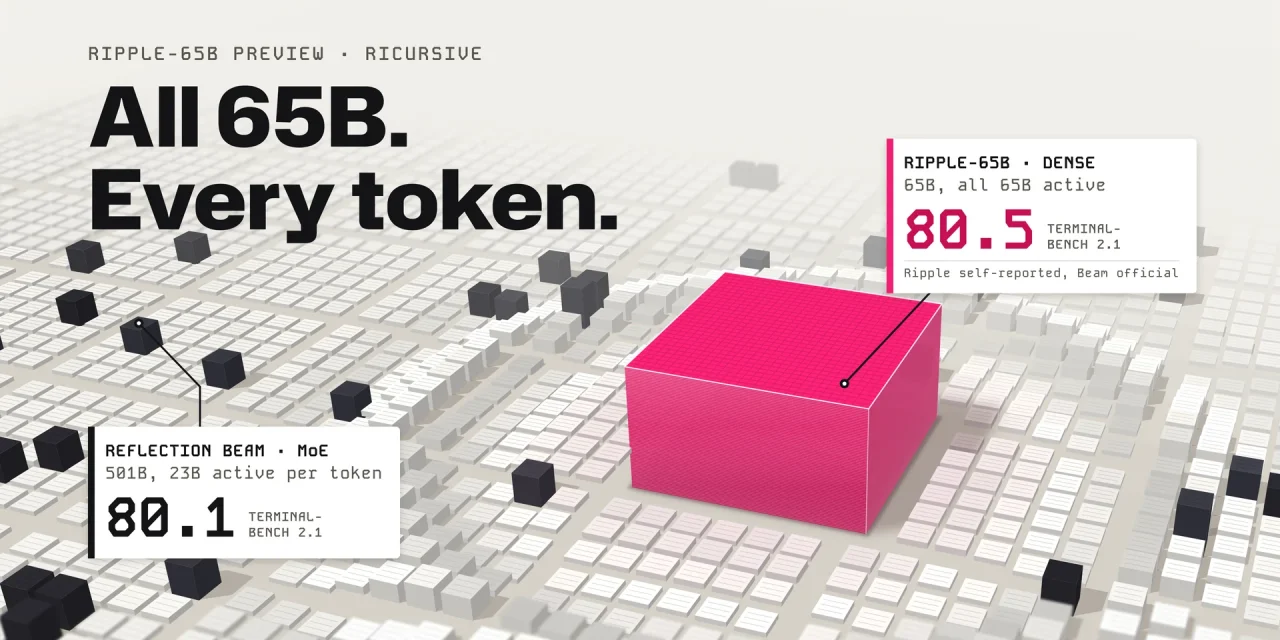
Ripple-65B Preview is the first language model from Ricursive Intelligence, an AI lab whose real business is AI that designs chips. It has 65 billion parameters, uses all of them for every token it writes, and according to Ricursive scores 80.5 on Terminal-Bench 2.1. That puts it ahead of US open models up to fifteen times its size, and 0.4 points ahead of the closest, Reflection Beam. The design choices make sense once you know who built it and why.
This article covers where Ricursive comes from, what Ripple does differently from the large open models of 2026, where the claims stop, and what a European team should check before using it. Ripple’s scores are self-reported by Ricursive, published on 4 November 2026. We found no independent evaluation yet.
Who is behind Ricursive Intelligence?
Ricursive was founded by Anna Goldie (CEO) and Azalia Mirhoseini (CTO). They met at Stanford, where Goldie did her PhD and Mirhoseini taught. They then worked together at Google Brain, joined Anthropic as early employees, went back to Google and left again. TechCrunch reports that they made every move on the same day. Internally they got the nickname “A&A”.
Two papers show how wide that track record is. In 2017 Mirhoseini co-authored the paper that introduced the sparsely-gated mixture-of-experts layer, the technique behind almost every large open model released in 2026. At Anthropic, both were authors of Constitutional AI, the method Anthropic uses to give Claude a set of principles.
AlphaChip, the work that explains the rest
Their best-known project is AlphaChip. It uses reinforcement learning to place the building blocks of a chip, a puzzle that keeps human designers busy for months. AlphaChip does it in hours and produces odd, organic layouts no engineer would draw. According to Goldie, Mirhoseini and Jeff Dean, AlphaChip layouts went into three generations of Google’s TPU (v5e, v5p and Trillium) and the Axion CPU, and MediaTek extended the method for its own chips.
AlphaChip was also contested. In September 2023 Nature added an editor’s note to the 2021 paper saying its performance claims had been called into question. Critics said, among other things, that they could not replicate the pre-training (Retraction Watch). In September 2024 Nature published an addendum by the authors and removed the editor’s note. Some researchers remain unconvinced. What counts for Ricursive is that the method ended up in chips that were actually manufactured.
Why a chip-design lab trains a language model
Ricursive launched publicly in December 2025 with a 35 million dollar seed round led by Sequoia. In January 2026 it raised a 300 million dollar Series A at a 4 billion dollar valuation, led by Lightspeed, with Nvidia’s venture arm NVentures also taking part. The company does not make chips. It builds software that designs them, from block placement to verification, and that learns across different chips, as TechCrunch describes it.
That software needs a language model that writes code, drives tools and stays on track through long agent tasks. So Ricursive trained one from scratch. The launch page calls Ripple-65B Preview a general-purpose variant of that in-house model. Downloading Ripple gives you the engine, in a general version, not the chip-design platform itself.
The company name explains the rest. AI designs better chips, better chips train better AI, and that AI designs better chips again. At TechCrunch Disrupt in October, Goldie predicted that demand for compute will grow at least ten thousand times within five years, and that the answer cannot be ten thousand times more data centres (TechCrunch). For Ricursive, compute efficiency is the business model, and Ripple shows it.
What Ripple does differently
Dense, while everyone else goes mixture-of-experts
Nearly every large open model of 2026 is a mixture-of-experts (MoE). These models hold hundreds of billions of parameters but use only a slice of them per token. Reflection Beam has 501 billion parameters and activates 23 billion per token. Ripple does the opposite: 65 billion parameters, and every token uses all of them.
Notably, a co-author of the MoE paper now picks dense on purpose. Ricursive says dense kept its pretraining and post-training infrastructure simpler, especially on Nvidia hardware. It reports 40 percent model FLOPs utilisation (MFU) with plain sharding, no custom kernels and no quantisation during training. An MoE has to route tokens to experts spread over many chips, and that traffic is exactly what makes large MoE training runs hard to engineer.
For users, dense mainly means the model is small enough to fit in the memory of one machine. The quantised NVFP4 version runs on an Nvidia DGX Spark. An MoE like Muse Spark Open needs close to a terabyte of memory, as we explained in our piece on Muse Spark Open. The flip side: because Ripple runs all 65 billion parameters for every token, it generates more slowly than an MoE with fewer active parameters on machines with limited memory bandwidth.
Thin and deep, built the way chip designers think
Ripple is narrow and deep: 80 layers with a width of 5,120. The team gave it more attention heads than usual to help reasoning, and offset that cost by letting more layers look only at a small window of recent tokens (sliding-window attention). It also uses gated attention, value residuals and no positional embeddings in its global layers. The starting point was the open training ladder of Olmo 3 from the Allen Institute for AI.
Using small test models, Ricursive changed that ladder step by step and added far more code to the data. At 4 billion parameters, its ladder matched Olmo 3’s code loss with up to sixteen times less compute, the company says. Goldie wrote on X that the team adapted the model and its training recipes to the hardware. That is what you would expect from people who design chips for a living.
Small team, small budget, few rollouts
The model card on Hugging Face says the team grew from one to five people during development. Ricursive puts the full cost, from the first experiments to the final model, at about 32 million dollars. That would be a tenth of what Reflection spent on Beam, but the comparison rests on an estimate of Reflection’s compute budget and is not audited.
Reinforcement learning was frugal too. Ricursive bought no post-training data and built its own synthetic tasks, which got harder as the model improved. Ripple reached its Terminal-Bench score after 1.4 million rollouts. Reflection reported more than 100 million for Beam.
Where the claims stop
The headlines say “US state of the art”, which holds only inside a narrow frame.
- Ripple’s scores are self-reported. Rival scores mix their official figures with Ricursive’s own reruns. When Ricursive re-ran rivals on the official Terminus 2 harness, their Terminal-Bench scores mostly dropped (Beam to 70.8), while Ripple stayed at 80.5. Those are Ricursive’s runs too.
- The lead is small and selective. Against Beam’s official figure, Ripple is 0.4 points ahead on Terminal-Bench 2.1. In Ricursive’s own table it trails Beam on most benchmarks outside agentic coding, and within coding on SWE-bench Verified, SWE-bench Pro v1.0, MCP Atlas and SciCode (model card).
- “US” leaves a lot out. Chinese open-weight models such as Qwen 3.8 and Kimi K3.1 Pro are not in the comparison, and Reflection’s own chart puts several Chinese models above Ripple on Terminal-Bench.
- It is a preview. Ricursive calls its post-training relatively light. There is no system card and no stated knowledge cutoff, and the corpus is mostly English and code, so other EU languages are not a strength.
| Benchmark (Ricursive’s table) | Ripple-65B | Reflection Beam 501B | Muse Spark Open 816B |
|---|---|---|---|
| Terminal-Bench 2.1 | 80.5 | 80.1 | 76.4 |
| SWE-bench Pro v2.0 Hard | 79.1 | 76.5 | 52.3* |
| SWE-bench Verified | 76.5 | 81.6 | 78.7* |
| SWE-bench Pro v1.0 | 61.4 | 66.1 | |
| SciCode | 39.4 | 49.2 | 58.5 |
| MCP Atlas | 71.7 | 80.8 | 89.2 |
| DeepSWE 1.1 | 44.3 | 43.3 | 60.0 |
Source: Ricursive’s model card, 4 November 2026. *Ricursive in-house run. VentureBeat notes that the card and the launch graphic differ for some rivals: for Muse Spark Open on SWE-bench Pro v2.0 Hard, the graphic says 72.4.
What European teams should check
A permissive US option that fits on one box
The weights are released under Apache 2.0: commercial use, modification and redistribution are allowed, with no revenue or user threshold. On Hacker News, one recurring argument in Ripple’s favour was that some organisations are not allowed to run models from Chinese labs. If your organisation has a similar rule, a strong open coding model that runs air-gapped on hardware you own is the real news, more than the benchmark.
Running it yourself keeps code and prompts inside your own walls, which simplifies GDPR questions. The hosted route is different: OpenRouter and GMI Cloud charge 0.20 dollar per million input tokens and 0.60 dollar per million output tokens. At launch the OpenRouter endpoint was capped at 16,384 tokens of context (eesel.ai); on 6 November it lists the full million. Check where that endpoint processes data before you send it anything sensitive. For a broader view of how sovereign a self-hosted model really is, see our analysis of Mistral Large 4.
Where Ripple sits under the AI Act
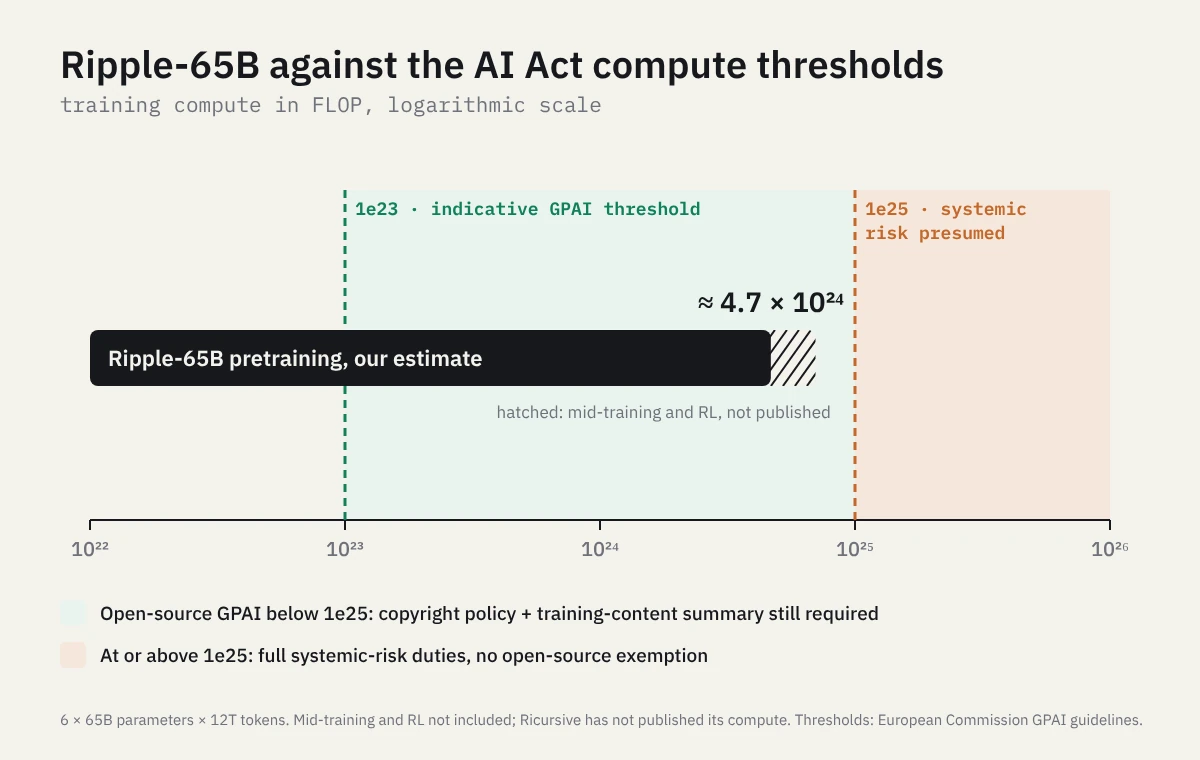
Ripple is a general-purpose AI model under the AI Act. Because the weights are public under an open-source licence and, as far as we know, are not monetised, the European Commission’s GPAI guidelines exempt its provider from most documentation duties, but not from having an EU copyright policy and publishing a summary of the training content. That exemption disappears for models with systemic risk, which the Act presumes above 1025 FLOP of training compute.
Ricursive has not published its compute. A common rule of thumb (six times parameters times tokens) puts pretraining at roughly 4.7 × 1024 FLOP, about half the threshold. That is our estimate. Mid-training, reinforcement learning and synthetic-data generation add to it, but by our count not enough to reach the threshold. We found no training-content summary on the model card or the launch page, which only describes the corpus as mostly English and code. For you as a user, the duties sit with Ricursive as provider. You become a provider yourself only if you modify the model with more than a third of its original training compute, a line we discussed in our article on weight-space programming.
How to test it
- Take ten tasks from your own codebase, run them in OpenCode, and compare with your current model: tasks completed, errors, time, tokens and how often a developer had to step in.
- Measure speed on your own hardware. Dense and low memory bandwidth do not mix well, and tools like Ollama and LM Studio cannot load Ripple yet.
- Test in the languages your team actually works in, and write down the licence, version and checksum of the weights you deploy.
One note to avoid confusion: Ricursive is not Recursive, Richard Socher’s company that released the coding model Flint. We covered Flint in a separate article.
The model is the calling card, the chip is the goal
Ripple is a solid open model, but for Ricursive it is mostly proof of skill. A model team that grew to five people, on a fraction of the usual budget, trained a model that ties the giants on one agent benchmark by designing the model around the hardware. That is the skill Ricursive wants to sell to chipmakers. The real test will not come from Terminal-Bench, but from the first chip its platform helps to design. Ricursive has not yet shown such a chip publicly.
Frequently asked questions about Ripple-65B
Is Ripple-65B open source?
The weights are open under Apache 2.0, including for commercial use. The training data and training code are not released.
What does dense mean for a language model?
A dense model uses all its parameters for every token. A mixture-of-experts picks a few sub-networks per token and leaves the rest idle. Dense often needs less memory, MoE needs less computation per token.
Can I run Ripple-65B on my own hardware?
Yes, with enough memory. The NVFP4 version fits on an Nvidia DGX Spark, and community builds exist for Macs with large memory. Expect lower speeds than with an MoE, and extra setup because common tools do not support the model yet.
Does the AI Act apply to Ripple-65B?
Yes, as a general-purpose AI model. As an open-source model below the systemic-risk threshold, its provider must still keep an EU copyright policy and publish a training-content summary. Organisations that only use it have no GPAI provider duties, although rules for the AI system they build with it can still apply.
Is Ricursive the same company as Recursive?
No. Ricursive Intelligence, founded by Goldie and Mirhoseini, builds AI for chip design. Recursive, Richard Socher’s company, makes Flint.