Google’s first AI glasses go on sale on 10 December in the United States and South Korea, from $395. They have no display. Gemini talks to you through open-ear speakers and looks through a 12-megapixel camera. Europe is not on the launch list, and Google has not said when it will be.
That gap matters less than what Google built into the hardware. Two months before the pre-order announcement, Europe’s data protection authorities published a statement on smart glasses that reads like a test specification. Google’s privacy design answers several of its points, at least on paper. This article puts the two side by side and lists what European organisations should settle now, before employees, visitors and customers start wearing camera glasses to work.
What Google is selling from 10 December
Google calls the product Intelligent Eyewear. Samsung engineered the hardware, Warby Parker and Gentle Monster designed the frames. Warby Parker offers three styles, Alden, Reid and Wren, from $395. Gentle Monster offers six bolder designs from $449, with some models at $489. Most frames take prescription lenses, which add $100 to $330 depending on the lens type, according to 9to5Google.
The frames weigh about 41 grams. The battery lasts up to nine hours and the charging case refills it up to seven times. Inside is a Qualcomm Snapdragon AR1 chip, a 12-megapixel ultra-wide camera that films up to 3K, four microphones and two open-ear speakers.
You say “Hey Gemini” or tap the frame. Gemini can then answer questions about what you see, check your calendar, read and send messages, give Google Maps directions in your ear and translate conversations live in more than 70 languages. Guided Vision describes surroundings for people who are blind or have low vision, and Aira connects you to a human visual interpreter. Both work only with Android phones at launch. The glasses pair with a Pixel 7 or newer, recent Galaxy phones on One UI 9 and an iPhone 13 Pro or newer.
These are audio-and-camera glasses, not the display glasses Google showed at I/O. Those are not expected in shops before 2027. Readers who followed Project Aura or the Even Realities G2 will find this a simpler, more everyday device. Early hands-on reports from Tom’s Guide praise the live translation and the frames, and note sound leakage at higher volumes and average photos.
Why Europe is not on the list
Google gives no reason. To use the glasses you need a Google Account from the US or South Korea and you must be 18 or older, so importing a pair does not work either. The timing, however, is hard to miss.
On 13 October the European Data Protection Board adopted Statement 1/2026 on smart glasses, after Belgium’s digital minister had asked the board to look at the risks. Around the same time, optical chain Hans Anders pulled Ray-Ban Meta glasses from its stores in Belgium and the Netherlands, the Dutch consumer association served Meta a formal notice, and the Dutch data protection authority said the recording light alone is not enough. Norway proposed a temporary ban in places such as parks, museums, shopping centres and around schools, and Hamburg wants camera glasses out of pools, saunas and public transport.
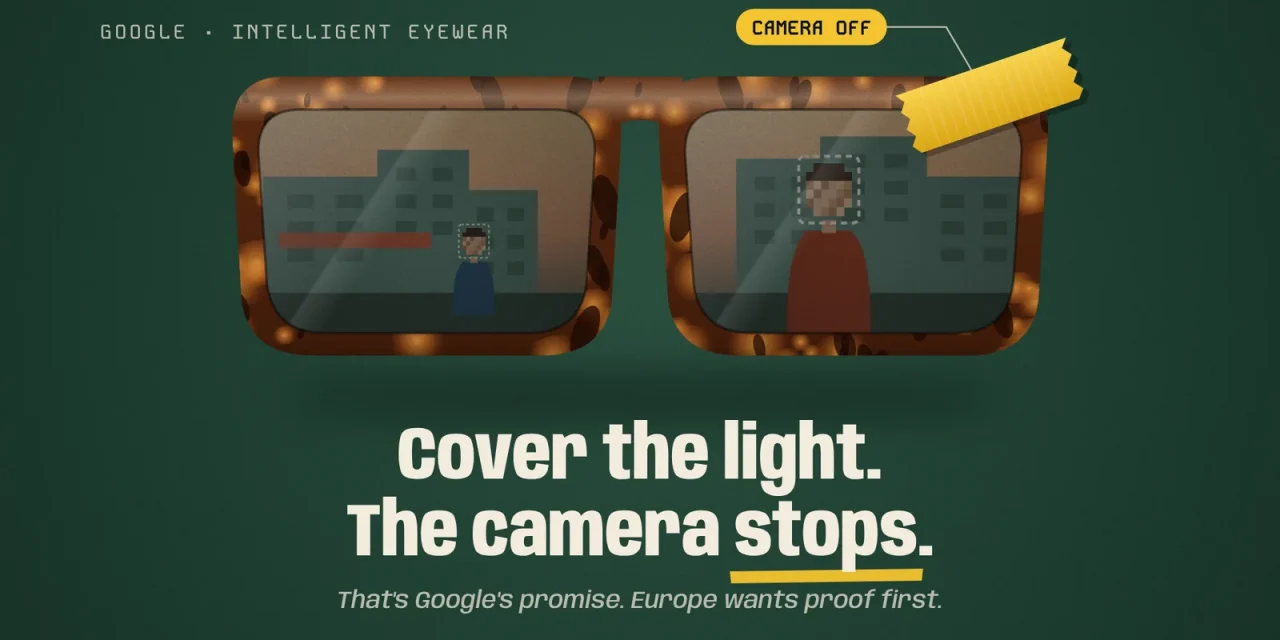
Belgian public broadcaster VRT tested Meta’s light by covering it with caps sold online. The glasses kept recording in 8 of 10 attempts. That is the bar any new pair will be measured against in Europe.
The camera glasses Europe can already buy
Europe is not short of glasses that run Gemini. Chinese maker Rokid entered Germany in April and France in June, selling through Krys, Fnac and Darty, and its Rokid Glasses are listed by LDLC in Belgium at €649.95. Since a March update they connect natively to Gemini as well as ChatGPT, DeepSeek and Qwen, and the wearer picks the model.
- Rokid Glasses, €699, add a green micro-LED display in both lenses for translations and transcripts, something Google will not ship before 2027. They weigh 49 grams and carry a 12-megapixel camera.
- Rokid Ai Glasses Neo, €449, has no display and works by voice, like Google’s pair.
Rokid publishes far less about privacy. Its spec sheet lists a camera indicator, but there is no public commitment that covering it stops recording, nothing on bystander blurring, and no explanation of what data goes to whichever AI provider the wearer selects. Under the EDPB statement, each of those providers is a controller for its own processing, and all four are based outside the EU. So the first AI glasses with Gemini that European organisations will meet are not Google’s, and they come without Google’s safeguards.
Google’s promises against the EDPB checklist
The EDPB statement is non-binding guidance, but it tells national regulators what to look for. The table below maps its main asks to what Google has said in its announcement, in the interview Juston Payne gave Tom’s Guide and in the press coverage. None of it has been tested independently yet.
| EDPB asks | Google says | Still open |
|---|---|---|
| Recording must be impossible when the indicator is covered · ¶24 | Covering or tampering with the LED stops the camera. Recording stops when you take the glasses off. | Whether the LED also lights when only Gemini uses the camera. Payne concedes “somebody will figure out a way around it”. |
| Blur or avoid identifying bystanders, on the device where possible · ¶33 | Faces are redacted before Gemini processes images. Qualcomm says this happens on the chip. | Whether gallery photos and videos are treated the same way. |
| Persistent storage off by default for real-time assistance · ¶33 | Images used to answer a question are not saved to Gemini History. | How long images stay in the cloud during processing. |
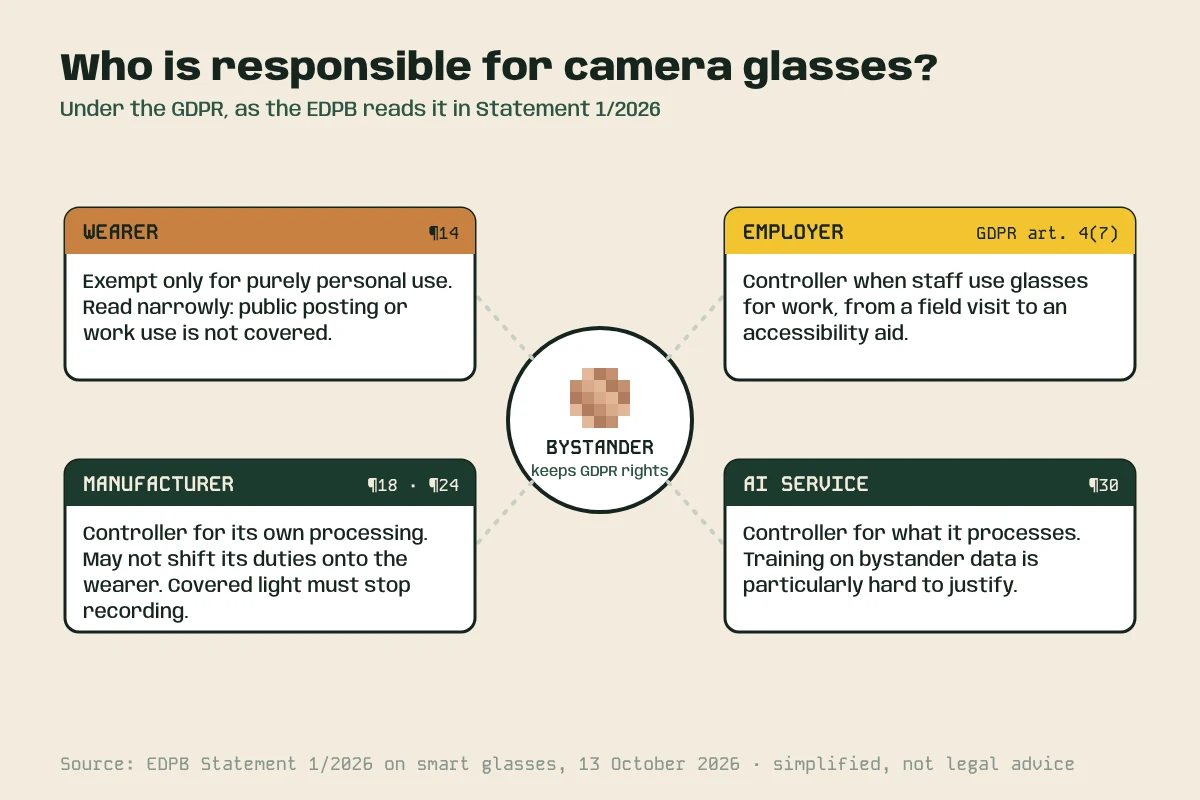
| AI training on bystander data is hard to justify · ¶30 | Visuals are not used to train models or target ads, and human raters cannot see them. | Applies to Gemini visuals. Rules for other data are less clear. |
| Producers may not shift their obligations to users · ¶18 | Play Store apps may not use the camera for live-streaming or facial identification. Google will not run ads for LED covers. | At setup, users agree not to record people without permission or in sensitive places. That puts part of the burden back on the wearer. |
| Geofencing in sensitive places · ¶33 | Not announced. | Hospitals, schools and changing rooms are named as sensitive settings in the statement. |
On paper, Google answers most of the list. The weak spots are the ones a regulator will ask about first: what happens to images outside the Gemini flow, how long data is kept, and who carries responsibility when a wearer breaks the rules. Notebookcheck raises the same questions.
What European organisations should settle now
The glasses are not on sale here, but staff travel, visitors arrive with US pairs, and Meta’s glasses are still on sale at several Belgian retailers. A smart glasses policy is cheaper to write before the first incident. Start with these points:
- Decide where camera glasses are allowed. Treat them like phone cameras with less visibility. Clinics, schools, labs, changing rooms and meeting rooms with confidential material are obvious no-go zones. Put it on the signage.
- Know when you become the controller. The EDPB says the household exemption must be read narrowly. An employee who records for work, or a field technician who uses Gemini to read a meter, processes personal data on your behalf.
- Run a DPIA before any professional pilot. Accessibility use, such as Guided Vision for a blind employee, is a strong case. Document it, limit storage and check where images are processed.
- Add smart glasses to procurement questions. Ask vendors whether covering the LED blocks every camera use, whether redaction runs on the device, how long cloud data is kept and whether you can switch off training. If the wearer can switch between AI providers, as on Rokid’s glasses, each provider needs its own check.
- Check the AI Act as well as the GDPR. Emotion recognition at work is prohibited under the EU AI Act, and pairing glasses with facial recognition is the high-risk combination the EDPB warns about most.
The same logic applies to any device that records the people around it. The questions we raised for AI conversation recorders carry straight over to glasses.
Frequently asked questions
Can you use Google’s AI glasses in Europe?
Not officially. Setup requires a Google Account from the US or South Korea and Gemini, and Google has announced no European launch date.
Do Google’s AI glasses have a display?
No. Everything runs through voice and audio. Google expects display glasses to reach shops in 2027.
Which AI glasses with Gemini can you buy in Europe today?
Rokid Glasses from Chinese maker Rokid. They are sold in Germany and France and listed by Belgian retailers, run Gemini and ChatGPT, have a small display in both lenses and cost around €650 to €699. Rokid publishes far fewer privacy commitments than Google.
Is the EDPB statement on smart glasses binding?
No. It is guidance from the board of EU data protection authorities. It shows how national regulators are likely to apply the GDPR to smart glasses.
Europe will see the test results before the glasses
With most new technology, the product comes first and regulators follow. With camera glasses in Europe, the order has flipped. The EDPB has published its expectations, Belgian and Dutch shops have shown they will pull products under public pressure, and Google designed against the checklist before shipping a single pair. The first independent test that tries to defeat the covered LED or the face redaction will therefore decide more about a European launch than any spec sheet. For organisations, that delay is useful. It gives you a few months to write the rules your people will need when the glasses do arrive.