If you want one device that records and summarises your phone calls, your Google Meet and Teams meetings and your conversations across a table, the Plaud Note Pro is the safe purchase today, paired with the free Plaud Desktop app for the online part. If you want to decide for yourself which speech model and which language model process your recordings, and where the audio lives, you need an open device such as Omi or the reSpeaker Clip and you build the layer behind it. And if you want all three situations in a single device, you wait for the Plaud One, the earbuds that ship in the fourth quarter of 2026. Below: what each device can and cannot do, what a year costs, what the GDPR means for a recorder on your desk, and what the next months bring. The thread running through it is a question European organisations know from every other AI purchase: are you buying a platform, or are you buying a microphone and keeping the intelligence yourself?
Three situations, and almost no device covers all three
An AI recorder has to do three very different jobs. A phone call lives inside your handset: the other voice comes out of the speaker or your earbuds, and a device has to get it from somewhere. An online meeting lives inside your laptop, where a recorder sitting next to it hears only the speaker, plus the echo and crosstalk that come with it. An in-person conversation is the easy one: microphone on, done.
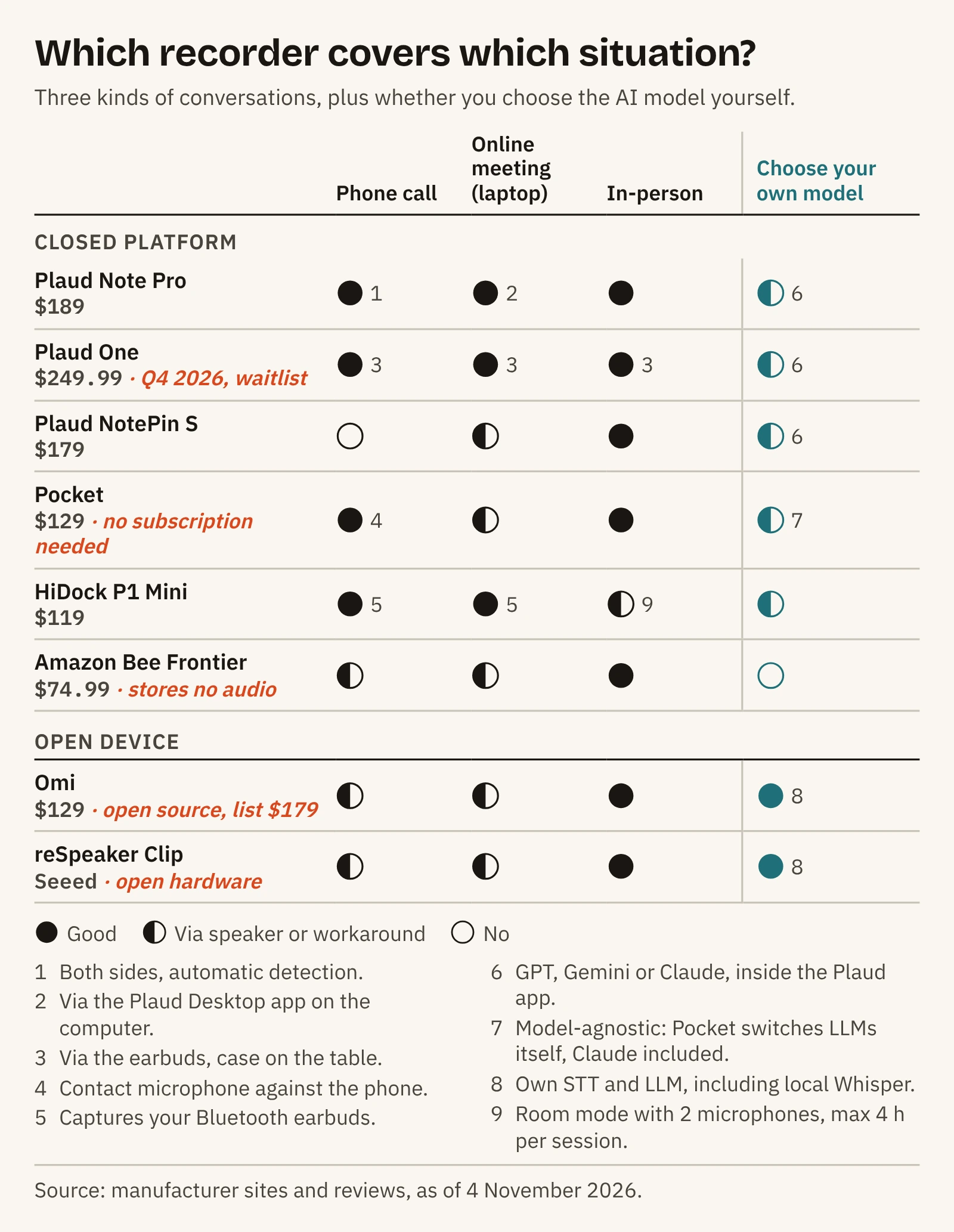
So the answer changes per situation. Phone calls need a device with a contact microphone or vibration sensor against the handset, or something that intercepts your earbud signal. Meet and Teams are better served by software on the computer than by any piece of hardware. In-person conversations are fine with almost anything. The matrix below puts it on one page.
Plaud, the Note Pro now and the One later
Plaud now sells five devices, and the difference between them is exactly the difference that matters here. The Plaud Note Pro ($189) is a card that sits magnetically on the back of your phone. It carries four microphones with a five-metre range, switches to call mode on its own when you make a call, and records thirty hours on a charge. The Plaud Note ($159) does the same with two microphones and a slider you flip yourself. The NotePin and NotePin S ($159 and $179) are wearables for conversations on the move, but Plaud does not list phone calls as a use case: they lack the vibration sensor. For calls, they are out.
For Meet and Teams, Plaud solves the problem with software rather than hardware. Plaud Desktop is free for anyone with a Plaud account and records your computer’s system audio without a bot joining the call. It detects Google Meet, Zoom and Teams in the browser, the Zoom and Teams desktop apps, Slack huddles and Webex, and the recording lands in the same app as everything your device captured.
Summaries come from other people’s models. For each summary you pick in the app from GPT, Gemini Pro and Claude Sonnet, and Plaud updates the list as new versions arrive. That is model choice inside Plaud’s walls: you choose the brain, but the audio, the transcript and the templates stay on Plaud’s platform. Every Plaud comes with 300 free transcription minutes a month; beyond that you pay $99.99 a year for 1,200 minutes a month or $239.99 for unlimited.
One caveat for teams working in smaller European languages. Dutch-speaking reviewers like the meeting summaries, but report that call mode in Dutch is not yet flawless. If your calls are not in English, test a few real ones before you build your week on it; our look at Nemotron 3.5 Transcribe shows how far coverage of the EU’s 24 languages still varies.
The Plaud One is the device most buyers are actually waiting for. It is a pair of earbuds with active noise cancellation and a charging case that records on its own. Calls, online meetings and table conversations go through the same product: the earbuds capture your calls and your Meet session, the case sits on the table for a meeting. The case carries an eSIM with 4G, so recordings upload without a phone nearby. Whether the other party hears that recording is on, Plaud does not say anywhere; assume you announce it yourself. The Explorer Edition costs $249.99 and includes $200 in credits for the agent layer that arrives with Plaud App 4.0 in the fourth quarter. The catch: Plaud is making only 2,000 units, the shop now points to a waitlist, and the shipping list covers the US, Canada, the UK, France, Germany, Italy, Spain and the Netherlands.
Pocket and HiDock, cheaper and without a mandatory subscription
Pocket from HeyPocket ($129 on offer) looks like a Plaud Note: a card on your phone with two studio microphones and a contact microphone for calls, 64 GB of storage and apps for iOS, Android, Mac and Windows. The business model is the difference. There is no subscription for unlimited minutes, and HeyPocket calls itself model-agnostic: it switches between language models, Claude among them, rather than tying you to one vendor. The choice sits with Pocket, though, not with you. In return, users report processing delays at busy times and inconsistent cloud sync, and Pocket publishes no compliance certifications. For confidential client calls, that weighs.
The HiDock P1 Mini ($119) takes a clever route to phone calls. The stick on your phone intercepts the signal going to your Bluetooth earbuds, so you never have to put the other party on speaker. That works in a café or co-working space, where nobody puts a Plaud on loudspeaker. HiDock itself claims 94 to 96 percent accuracy on clear calls. For meetings across a table it offers a room mode with two built-in microphones, but it remains a stick on your phone, not a table recorder.
Bee from Amazon, cheap but without the audio
Amazon bought Bee in July 2025 and on 15 October 2026 released two new devices: the Bee Frontier ($74.99, wristband or clip) and the Bee Eclipse ($99.99, a card for the back of your phone, “available soon”). You start a recording with a button, an LED shows when the device is processing, and you get summaries and to-dos. Bee Pro costs $11.99 a month. The model differs from Plaud’s in one important way: Amazon says no audio is ever stored. Good for privacy, but it also means there is no recording to re-read with a different model later or to transcribe properly. For anyone who wants to interpret conversations rather than merely remember them, that is a limit, and for a regulated business it also means the record of what was said is whatever Amazon’s model decided to keep.
Open devices where you choose the model yourself
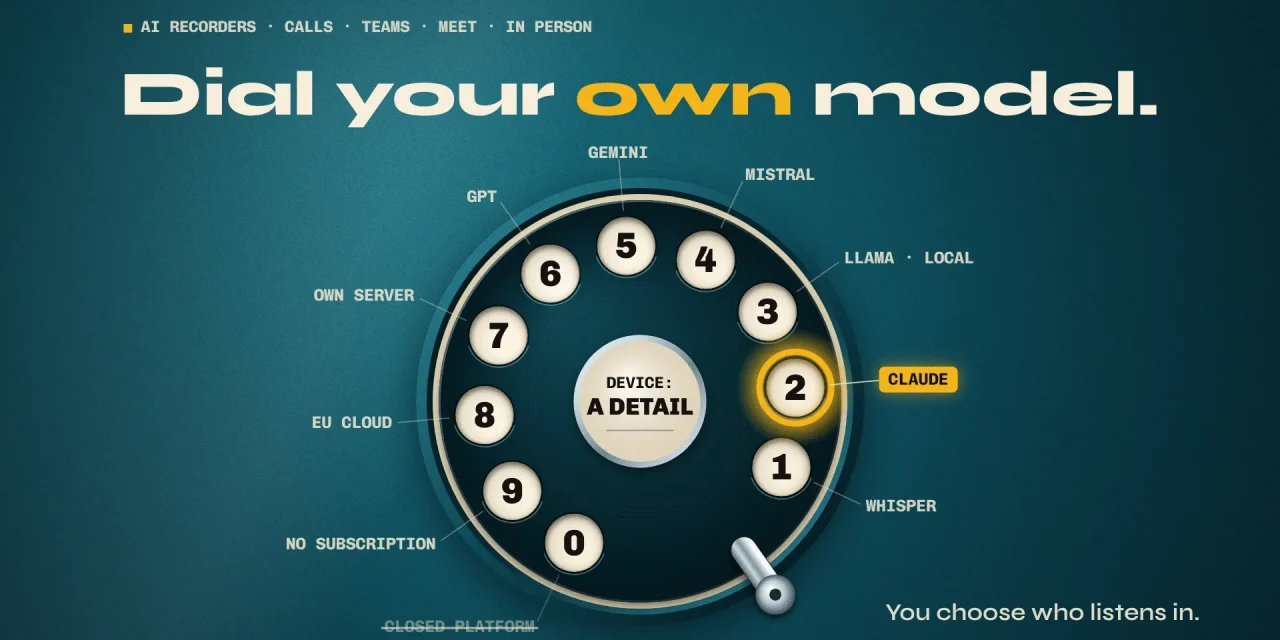
With every device above, the most you choose is which brand of brain writes your summary. If you want to decide which speech model understands your language, where your audio sits and which language model reads your conversations, you need an open device. Three matter.
Omi from Based Hardware is the reference. Hardware, firmware, app and backend are open source under an MIT licence, the pendant costs $129 on offer ($179 list) and pairs with your phone over Bluetooth. Omi exposes an API, webhooks and an MCP server, so conversations flow straight into Claude or your own tools. More importantly, you can plug in your own speech recognition through a WebSocket service, or use the SDK that transcribes locally or via Deepgram with no dependency on Omi’s infrastructure. According to Omi’s privacy policy, the version that runs on your own API keys collects no data. The price is that it remains a community product: ten to fourteen hours of battery, no dedicated call mode like Plaud’s (phone calls go through the speaker) and software that feels rough next to Plaud’s.
The reSpeaker Clip from Seeed Studio, announced this summer, is more open still and less finished: open firmware and SDK, your own API keys with several AI providers, meant as a building block for teams that make their own application. And for those who want everything in-house, projects like ADeus offer an open wearable that sends everything to your own server.
What are you buying, then? Not the device, but the layer behind it. A server of your own, at home on an ordinary gaming GPU or on a European VPS, receives all audio: from the pendant, from your phone and from your laptop. There, WhisperX runs the large-v3 model, ideally with a second pass through a fine-tuned model for your language, because stock Whisper stumbles over regional accents, place names and domain jargon. A diarisation step records who said each sentence. A glossary of your client names and products corrects what the recogniser misheard. Only then does the text, not the audio, go to the language model you choose: the Claude API for quality, a local Llama through Ollama when nothing may leave the building. The result lands as Markdown in an archive a small MCP server lets you query from Claude. That is two to four days of setup, and you are the help desk afterwards. But you switch models tomorrow without buying a new device, and your audio never leaves your environment. For how speech models learn the smaller European languages, see our piece on Nvidia’s Granary v2.
What a year costs
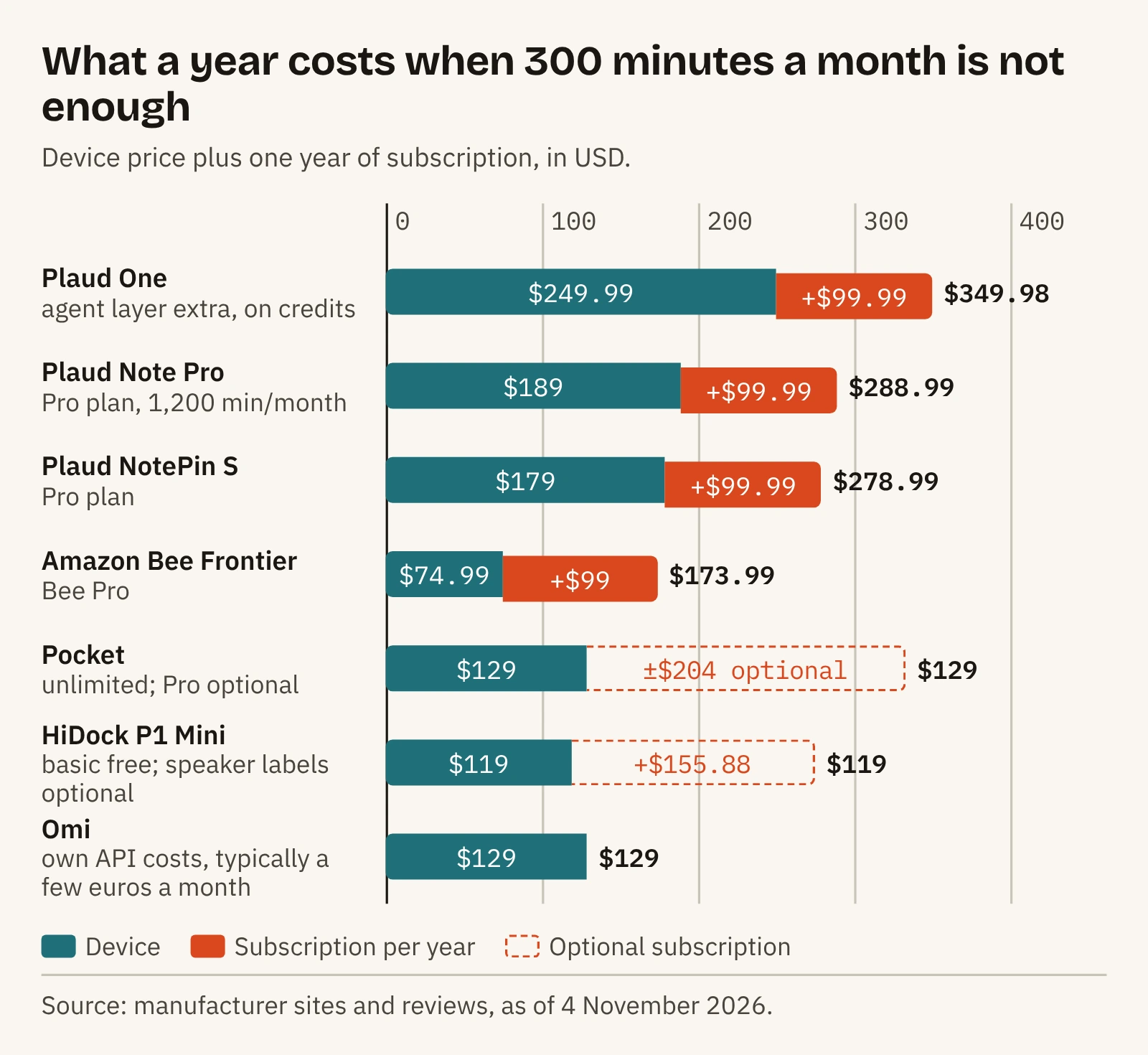
The device price says little. Plaud counts 300 free minutes a month, and anyone who calls and meets daily passes that quickly: the Note Pro then costs $189 plus $99.99 a year. Pocket and HiDock ask no subscription for the basics, but their extras (better speaker labels, more AI features) do cost money. Omi with your own API keys is pay-per-use after the device: for a couple of hours of conversation a day you are looking at a few euros a month in transcription and summarisation, depending on the models you pick.
What the GDPR means for a recorder on your desk
Whether you may record a conversation you take part in differs sharply across the EU. Belgium has no specific law against it, and its criminal code targets outsiders who listen in; Germany and France, by contrast, penalise recording a private conversation without consent, even by a participant. An employer recording staff calls is a different matter and typically needs the consent of every participant. Check the rules for every country your calls touch.
Making the recording and using it are two separate questions. The moment you transcribe a conversation, store it and have an AI summarise it, you are processing personal data and the GDPR applies in full: you need a lawful basis, you inform the people on the call, you set a retention period, and if a vendor processes the audio you need a processing agreement and a view on where the data goes. That last point separates the devices more sharply than any microphone spec. Plaud publishes GDPR and HIPAA claims with end-to-end encryption, Omi claims SOC 2 and HIPAA for its cloud, HiDock points to its Azure hosting in the US, Pocket publishes nothing, and Amazon’s Bee keeps no audio at all; and a self-hosted pipeline keeps everything inside your own tenancy, which also makes it the only option that sits comfortably under a strict data residency policy. Three habits cover most of it: say at the start of a call that you record, because no device in this overview demonstrably does it for you, put the recorder in the invitation of every Meet or Teams call because nobody will see it otherwise, and fix a retention period, say thirty days for audio and a year for transcripts. None of this is legal advice; your DPO will have a view.
What comes next
The market moves fast, and the next checkpoint is January 2027. CES 2026 brought at least ten new AI recorders, and the next edition will not be quieter. Until then, these are on the calendar.
- Plaud One ships in the fourth quarter of 2026, with Plaud App 4.0 and the agent layer that drafts emails and builds documents from transcripts. That layer also reaches the Note Pro.
- Bee Eclipse, Amazon’s $99.99 card, still had no release date at the end of October.
- Apple announced free features that let the new Apple Watch summarise conversations after opt-in. For anyone already wearing a Watch, that may become the free answer for in-person conversations.
- Meta bought Limitless in December 2025, maker of the best-known memory pendant, and has since released a palm-sized device and audio-only smart glasses. The Limitless pendant itself is end-of-life. Europe will want to read the fine print of whatever follows, as it did for voice AI under the AI Act.
- Omi and reSpeaker get their updates from the community: new speech providers and local modes land there faster than at the closed brands.
Frequently asked questions
Can the Plaud NotePin record phone calls?
Not officially. Plaud does not list phone calls as a use case for the NotePin and NotePin S, because they have no vibration sensor. It only works through your phone’s loudspeaker. For calls, pick the Note, the Note Pro or, later, the One.
Does an AI recorder work with Google Meet and Teams?
A device next to your laptop hears only the speaker and produces mediocre audio. Software on the computer is better: Plaud Desktop (free with a Plaud account), Granola, or the built-in recording in Teams or Meet. The Plaud One and the HiDock P1 record online meetings through your earbuds, which also works on the move.
Which device lets me choose the AI model myself?
Plaud and Pocket let you pick a model per summary (GPT, Gemini, Claude), but inside their own app. Real choice, including the speech model and where your data lives, exists only with open devices such as Omi and the reSpeaker Clip, where you connect your own API keys or a local Whisper.
Which option is easiest to defend under the GDPR?
A self-hosted pipeline, because nothing leaves your environment and you set every retention rule. Among the commercial options, Plaud and Omi publish the most on compliance. Whatever you choose, inform participants and write down how long you keep audio and transcripts.
The device is the small decision
Anyone buying a Plaud Note Pro today is well served for calls and meeting rooms, and Plaud Desktop covers the rest. Anyone who sees their conversations as company data that must still be readable and searchable in ten years should buy a microphone rather than a platform, and spend the time on the layer behind it. The models that read your conversations change every few months. The recordings and transcripts stay. Make sure they are yours.