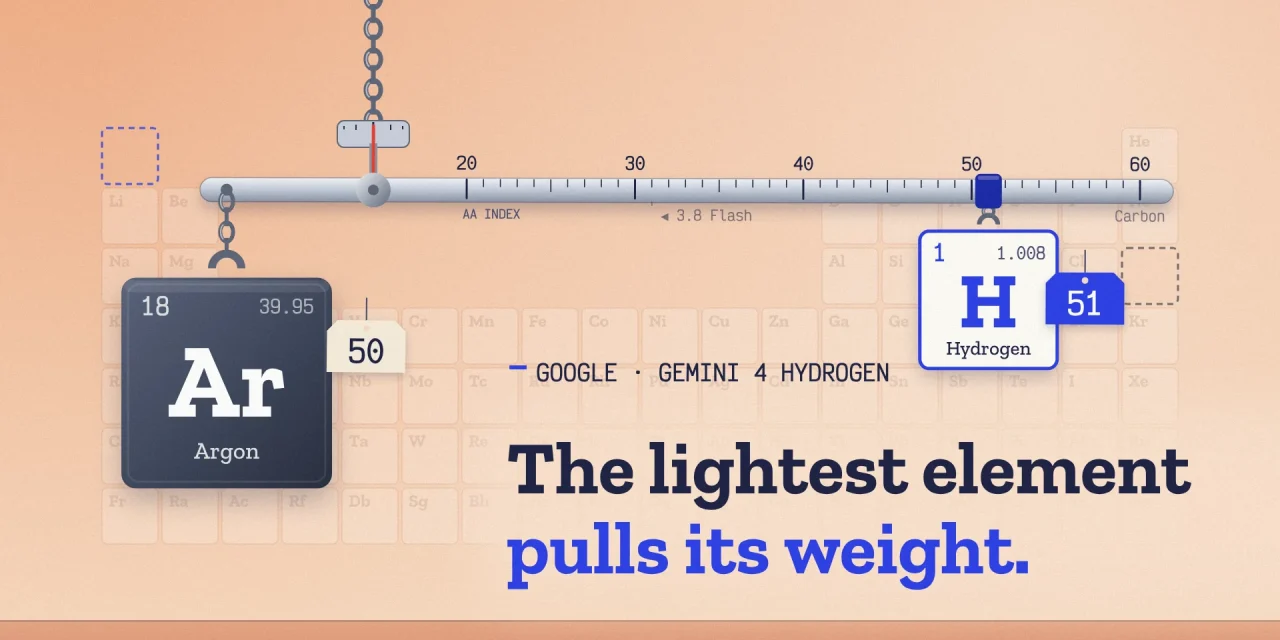
Gemini 4 Hydrogen is Google’s new everyday model, and it is built to do the work while larger models do the thinking. Launched on 12 November 2026, it replaces Gemini 3.8 Flash in the Gemini app, Google Search and the Gemini API. It scores 51 on the independent Artificial Analysis Intelligence Index, one point above Gemini 4 Argon, and costs $1.50 per million input tokens and $7.50 per million output tokens. For European organisations, the more useful numbers are elsewhere: what a finished task costs, where the model runs and what its model card says about refusals and risk.
Where Hydrogen sits in the Gemini 4 line-up
Google now sells four tiers. Gemini 3.5 Flash-Lite handles quick answers and routing. Hydrogen is the “daily driver for agentic workflows”. Argon covers deeper code and analysis, and Gemini 4 Carbon is the frontier model for the hardest problems. According to the Google DeepMind model card, Hydrogen is adapted from Carbon and tuned for fast execution, either on its own or as a sub-agent working for a frontier model.
It reads text, images, audio and video in a context window of about one million tokens and answers in text only. Its knowledge runs to March 2026. The element names confused many developers on Hacker News. The simple version: Hydrogen is the fast one, Carbon is the strongest.
The numbers that matter for a business case
Per token, Hydrogen is not a bargain. Gemini 3.8 Flash costs $0.75 and $3.75 per million tokens until 31 December, so Hydrogen’s list price is twice as high. From 1 January 2027, Flash rises to the same $1.50 and $7.50. Thinking tokens are billed as output.
Per task, the picture flips. Artificial Analysis measures what one task from its evaluation suite costs on average. Hydrogen at its default setting needs $1.87 and 8.3 minutes per task. Gemini 3.8 Flash needs $7.77 and 14.8 minutes for a much lower score. Hydrogen reaches an answer with far fewer tokens.
| Model | AA Intelligence Index | Cost per AA task | Time per task |
|---|---|---|---|
| Gemini 4 Hydrogen, high | 51 | $1.87 | 8.3 min |
| Gemini 3.8 Flash, high | 31 | $7.77 | 14.8 min |
| GPT-6.1 Terra | 51 | $0.96 | 14.2 min |
| Claude Sonnet 5.5 | 55 | $10.02 | 33.0 min |
Two things stand out. GPT-6.1 Terra reaches the same score for about half the cost, but takes longer. Claude Sonnet 5.5 scores higher, at more than five times the cost per task. Hydrogen’s pitch is the middle ground: a strong score, fast, at a price a team can run all day. These figures come from eesel’s summary of the Artificial Analysis results.
Early customer numbers point the same way. Box saw its agent’s accuracy rise from 74% to 79% in less than half the time, VentureBeat reports. On a Zapier test of 657 business automation tasks, Hydrogen succeeded on 51.1%, level with Argon’s 51.3%, at roughly half the estimated cost per task, according to Xenospectrum.
The default thinking level also matters for budgets. Hydrogen defaults to high, where Flash defaulted to medium. Medium scores 41 at $0.80 per task, high 51 at $1.87, and the new xhigh 54 at $3.16. The step from high to xhigh buys three points for 69% more cost.
Planner and executor, the pattern Google is selling
The clearest signal of how Google wants Hydrogen used is the new Orchestrator in Google Antigravity. Carbon first explores a codebase and writes a plan in a read-only phase. Hydrogen then edits files, updates packages and runs tests. When Hydrogen gets stuck, Carbon inspects the state, fixes the plan and hands back. Google reports near-Carbon success with about 24% less quota and 19% faster completion on average.
Orchestrator with Carbon is limited to Google AI Ultra, the Argon variant comes with AI Pro, and businesses get it through Gemini for business. You do not need Antigravity to use the pattern, though. The developer guide suggests routing planning turns to Carbon and execution turns to Hydrogen within one session using previous_interaction_id. It is the same logic as a well-designed AI harness: the model is one component, and the routing around it decides cost and quality.
Where your data is processed
For teams on Google Cloud, the Gemini Enterprise Agent Platform locations page, updated on 12 November, lists gemini-4-hydrogen on the global endpoint and in the US and EU multi-regions. It is not offered in single European regions such as Belgium, Frankfurt or Paris, and neither are Carbon, Argon or 3.8 Flash. If your data must stay in the EU, call the EU multi-region endpoint explicitly. The global endpoint does not guarantee where a request is processed.
The consumer side is simpler. Google describes the rollout as global, and Hydrogen is live in the Gemini app and Search in Europe. Free app users only get it when automatic model selection picks it. AI Plus subscribers can choose it, AI Pro adds Argon and AI Ultra adds Carbon.
What the model card says, and what it leaves open
Google makes strong safety claims for agent behaviour: up to 81% less overreach, up to twice as unlikely to bypass permission boundaries and more than five times fewer fabricated claims than 3.8 Flash. These are Google’s own evaluations. The model card adds details that compliance and risk teams should read:
- More over-refusals. Unjustified refusals rose 5.57 percentage points compared with 3.8 Flash, mostly on prompts with images. Health, insurance and finance assistants should be retested before switching.
- Alert thresholds reached. Targeted tests found Hydrogen below the critical capability levels for biological and cyber risk, but at the alert threshold for both.
- Report still pending. The full Safety and Security Report is marked “coming soon”.
- Vendor benchmarks. Most benchmark rows come from Google. Claude Sonnet 5.5 leads on Terminal-Bench 4.1, OSWorld-2.1 and Terminal-Bench-Science, the tests closest to autonomous computer and terminal work.
For organisations preparing their AI Act documentation, these are the facts worth recording in a model register: version, date, the vendor’s own risk findings and the open items. The current AI Act timeline explains which obligations already apply.
A migration checklist for engineering teams
Swapping the model ID from gemini-3.8-flash to gemini-4-hydrogen is not enough. Google’s migration guide lists changes that break or reprice existing code:
- Set the thinking level explicitly. The default is now high. Leaving it open raises spend.
- Replace minimal with low. The minimal level now returns an error.
- Remove explicit caching.
cached_contentis unsupported. Implicit caching applies from 4,096 tokens, at a 95% discount on hits. - Drop sampling parameters. Temperature, top_p and top_k are ignored, so retest any output style that depended on them.
- Declare tools natively. Raw-text JSON tool calls can fail with
MALFORMED_FUNCTION_CALL. - Lift low output caps. One response segment runs to 64K tokens, and background mode goes further.
- Re-estimate costs per task. Thinking tokens, grounding instructions and function declarations are all billed.
What changes in Google Search for publishers and brands
Hydrogen now powers Google Search for all users worldwide, which Google calls “the biggest model upgrade to Search yet”. The model expands query fan-out, the set of sub-searches AI Mode runs in parallel, and Google says this surfaces a broader set of links, including sites users would not have found before. Answers also get more images, tables and comparisons. Google gives no numbers on traffic to websites. For European publishers and B2B brands, it is a reason to watch referral data from AI Mode closely over the coming weeks.
Frequently asked questions
Is Gemini 4 Hydrogen available in the EU?
Yes. It is live in the Gemini app, Google Search and the Gemini API worldwide. On Google Cloud it runs in the EU multi-region, not in single European regions.
How does Gemini 4 Hydrogen compare with Gemini 4 Argon?
They score 51 and 50 on the Artificial Analysis index. Hydrogen is faster and cheaper per token. Argon reasons more deeply per turn and suits heavier code and analysis.
Does Gemini 4 Hydrogen have a free tier?
Yes, in the Gemini API and AI Studio with lower rate limits. Carbon and Argon have no free API tier.
Can Hydrogen generate images or audio?
No. It accepts images, audio and video as input but only produces text.
Route first, then commit
Hydrogen is less a new model than a new default for how agent work gets split. The frontier model plans, the fast model executes, and the bill depends on how often control passes between them. European teams get the most from it by measuring cost per finished task on their own workloads, pinning the EU endpoint and recording the model card’s open items before Hydrogen quietly becomes the engine behind every assistant they run.