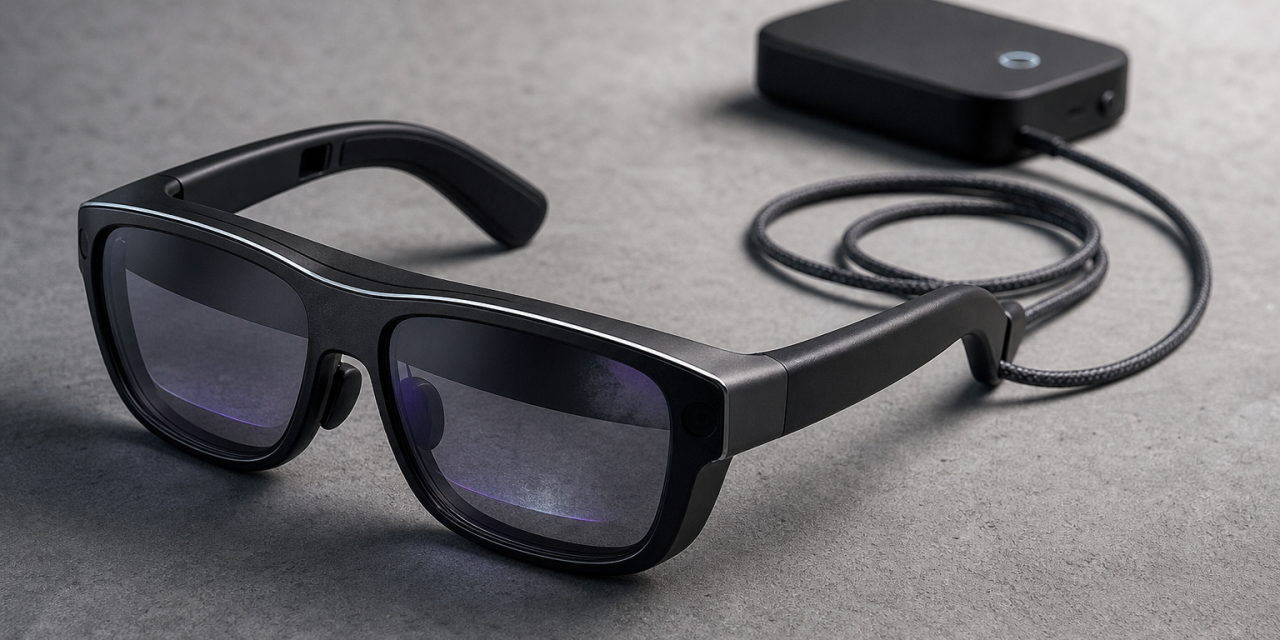
Project Aura, the Android XR intelligent glasses being developed by Xreal with Google, are not just another pair of smart glasses with a camera and voice assistant. They are closer to a compact mixed reality headset in a glasses form, built to run Android XR apps, connect to a Windows desktop, understand your surroundings through Gemini and bring immersive screens into the real world without strapping a large headset to your face.
That makes Project Aura one of the most important devices in Google’s renewed XR strategy. Google’s own I/O 2026 announcement framed Android XR as a platform for headsets, glasses and devices in between. Project Aura sits exactly in that middle ground. It is more capable than audio glasses, more portable than Galaxy XR and more dependent on a wider ecosystem than most earlier AR experiments.
What Project Aura actually is
Project Aura is a pair of wired XR glasses made by Xreal in collaboration with Google. It is expected to run the full immersive version of Android XR, the platform Google built with Samsung and Qualcomm. In simple terms, it brings the kind of spatial app environment seen on the Samsung Galaxy XR into a much smaller device.
Hands on reports describe Aura as a pair of chunky sunglasses connected by cable to a pocketable processing puck. That puck handles battery and compute. It also works as a large trackpad for pointer style input, alongside hand tracking. This approach keeps the glasses lighter than a full standalone headset, although it means Aura is not yet the seamless all day wearable that many people imagine when they hear smart glasses.
The most interesting part is the software. Google representatives have said that Android XR apps developed for Galaxy XR can run on Project Aura without needing to be rebuilt for the form factor. If that holds up at launch, it could solve one of the biggest problems in XR: every new device usually arrives with too few apps and too little developer incentive.
How Android XR changes the smart glasses equation
Google’s Android XR strategy is broader than Project Aura. In its I/O 2026 intelligent eyewear announcement, Google described two types of upcoming eyewear. The first is audio glasses, which offer spoken help through speakers. The second is display glasses, which show information when you need it. The audio models from Gentle Monster and Warby Parker are planned to arrive first, with Google, Samsung and Qualcomm providing the technology foundation.
Those fashion focused glasses are meant for quick tasks. You can ask Gemini about what you see, get directions, send texts, manage calls, hear message summaries, capture photos, translate speech or written signs and interact with phone apps like Uber and Mondly. Google also says these glasses will pair with both Android and iOS phones, although Android should offer deeper system integration.
Project Aura is different. It is not about short notifications or spoken answers. It is about spatial computing. You can place app windows around you, stream a Windows desktop, play immersive games, watch videos, use hand tracking and ask Gemini about objects in your environment. If the audio glasses are the lightweight daily assistant, Aura is the portable workstation and entertainment device.
Gemini is the interface, not just a feature
Google’s strongest argument for Android XR is Gemini. Earlier smart glasses often felt like accessories waiting for a reason to exist. Android XR tries to make the assistant the reason. Gemini can see through the device camera, hear your voice, understand where you are looking and act through your apps.
Google’s primary announcement gives clear examples. You can ask about a restaurant you are walking past, decode a confusing parking sign or identify a cloud formation. You can request turn by turn directions that account for where you are standing and which direction you face. You can ask Gemini to add a stop to your route or find nearby food based on your preferences.
The same idea extends to productivity. Google says Gemini Intelligence can handle multi step tasks in the background, such as preparing a DoorDash coffee order while your phone stays in your pocket. You still confirm the final order. That detail matters because it shows where Google wants the boundary to sit. The assistant can do the busy work, but sensitive decisions remain with you.
On Project Aura, the value of Gemini becomes even clearer. Hands on demos describe users looking at objects in a room, using Circle to Search and receiving results in front of them.
Display, field of view and immersion
Project Aura reportedly offers up to a 70 degree field of view. That is smaller than many dedicated VR headsets, but wide enough to make multiple virtual windows and immersive apps feel useful. Road to VR described it as the bare minimum needed for a full operating system like Android XR to feel valuable in glasses.
The glasses use transparent optics that let you see the world while digital content appears in front of you. This is not the same as a camera passthrough headset, where the outside world is reconstructed on screens. You are still looking through lenses. That has advantages for presence and device size, but it also brings optical tradeoffs.
Reports mention a dimmer real world view, similar to wearing sunglasses indoors. Aura also includes electronically controlled lens dimming, which can darken the outside world when an immersive app needs more visual contrast. Android XR can manage that dimming in software, so developers can request a darker background without needing to care whether a device dims physically or digitally.
This is not perfect. If the world remains too dim even at the clearest setting, some indoor uses become less appealing. A cooking companion in a kitchen, for example, needs recipes to float in view without making the chopping board harder to see. Aura points toward practical AR, but the optics still sound like a compromise.
Input without eye tracking
One notable limitation is the lack of eye tracking in Project Aura demos. On devices that support eye tracking, you can look at a target and pinch to select it. Without that, Aura relies more on hand tracking, pointer style interaction and the trackpad on the puck.
Input will be one of the deciding factors. Spatial computing becomes tiring when every action requires arm movement or precise pointing. Voice helps, but voice is not always private or socially comfortable. The puck trackpad could be useful for seated work, while hand tracking may work better for immersive apps. Aura will need all of these methods to feel natural.
Why the app ecosystem matters more than the hardware
Project Aura’s most strategic advantage is that it plugs into Android XR. Google has spent years building Android into a huge app ecosystem. If Android XR can let phones, watches, glasses and headsets share app logic, developers have a stronger reason to support it.
The Uber is a good example. The glasses showed pickup time, license plate information and walking directions to the pickup area. The key detail is that the experience was powered by Uber’s Android app rather than a completely new Android XR app built from scratch. Google Maps, YouTube Music and Google Meet can work in similar ways, presenting focused information through the glasses while the phone remains the app engine.
Project Aura versus Google’s everyday intelligent eyewear
It is easy to confuse Project Aura with Google’s upcoming intelligent eyewear from Gentle Monster and Warby Parker. They share Android XR, Gemini and phone integration, but they are built for different moments.
- Audio glasses are designed for lightweight help. They speak responses, handle calls, summarize messages, play music and translate speech without a visible display.
- Display glasses add glanceable visual information such as navigation, Uber status, video call details or live translation text.
- Project Aura runs a fuller Android XR environment with spatial windows, hand tracking, immersive apps and PC streaming.
That split is sensible. One device cannot yet be stylish enough for all day wear, powerful enough for immersive computing, bright enough for AR and affordable enough for mass adoption. Google appears to be building a family of devices instead of forcing every use case into one pair of glasses.
Privacy will decide whether people accept it
Smart glasses face a cultural problem that headsets do not have. A headset is obvious. Glasses can blend into daily life, which makes people around the wearer worry about cameras and microphones.
Google says it is taking this seriously. The Verge reported that recording will trigger a bright pulsing light when sensors are used to save anything. That includes camera based Gemini queries. Physical switches will use clear red and green markings so people can see whether recording features are off or on.
Trust will depend on the implementation. The indicator must be visible. The controls must be understandable. Third party camera access must be limited and reviewed. If people feel watched, even the best assistant features will become socially awkward.
Who Project Aura is really for
Project Aura is unlikely to replace your phone or laptop in its first version. It also does not sound like a device you wear from breakfast until bedtime. Xreal’s own positioning, as described in hands on coverage, suggests a device used for hours rather than all day.
That still leaves valuable use cases. Aura could be useful for travelers who want a private large screen on a plane. It could suit people who work from small spaces and want a portable virtual monitor setup. It could appeal to gamers interested in lighter mixed reality. It could also help developers test Android XR ideas without relying only on a bulky headset.
The PC Connect feature is important. Google is bringing a way to stream a Windows desktop into Android XR, with hand tracking for control. If it is stable, low latency and easy to launch, Aura could become a serious productivity device rather than a novelty. Virtual desktops are one of the clearest practical uses for display glasses because they offer something a laptop cannot: a large private workspace that fits in a small bag.
The limits Google still needs to solve
Several questions remain open. Google and Xreal have not shared full specifications, final pricing or an exact release date. We do not yet know how controller support will work for VR games that need precise input. Battery life, comfort, heat, display clarity, prescription support and room tracking stability will all matter in daily use.
Resolution is another concern. A wider field of view spreads pixels across more visual space. That can make fine text harder to read unless the displays are sharp enough. Early impressions praised brightness and sharpness, but also noted visual distortion known as pupil swim. For some people that may be a minor annoyance. For others it could cause discomfort during longer sessions.
There is also the question of price. Aura may cost less than premium mixed reality headsets, but that does not automatically make it mainstream. It needs to be cheap enough to feel like a practical accessory and good enough to avoid feeling like a compromise.
What to watch next
The most important details are still ahead: final hardware, price, comfort, app support and privacy controls in real environments. Google has strong ingredients with Gemini, Android, Samsung, Qualcomm and Xreal. Project Aura will show whether those ingredients can become a device people actually carry.
The sharpest insight is simple. The future of intelligent glasses will not be won by the thinnest frame alone. It will be won by the glasses that make the phone feel less necessary without making the people around you feel less comfortable.