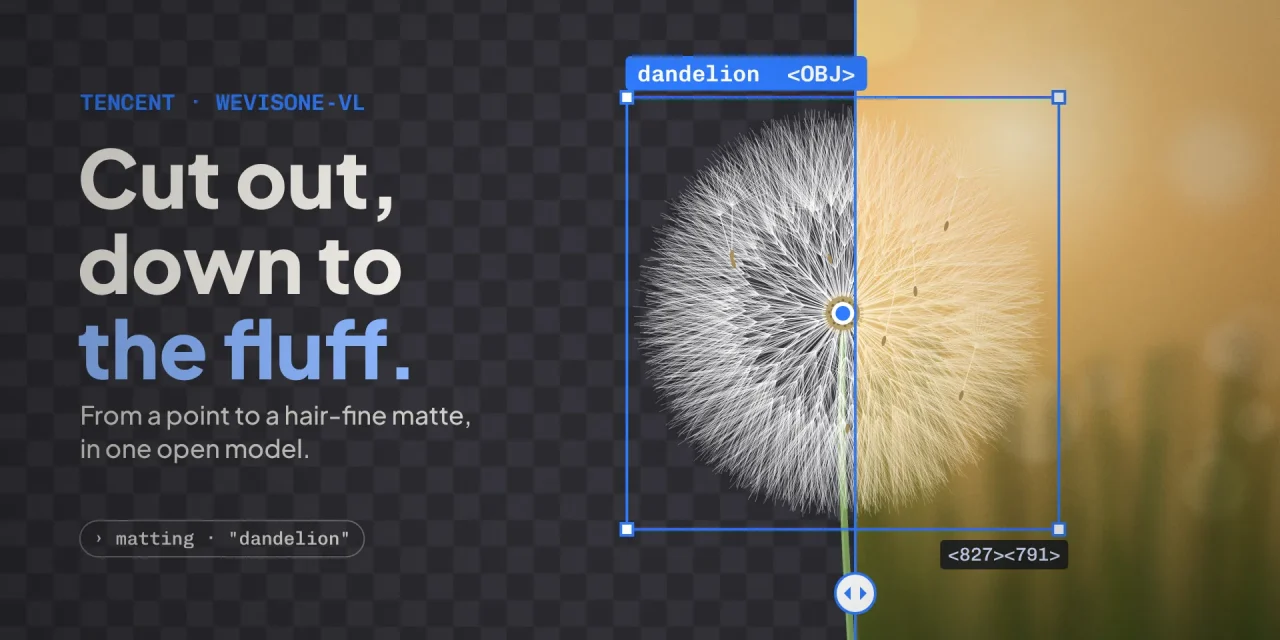
WeVisOne-VL is an open vision model from Tencent that finds, counts, points at, reads and cuts out objects in an image, down to individual strands of hair. Tencent’s WeChat Vision Team released it on 22 October 2026 in two sizes, 2B and 4B, under the Apache 2.0 licence. For organisations that run image processing today, the interesting part is not one benchmark score. It is that a chain of three or four separate models collapses into one small model that you can host yourself, and that answers None when the object you ask for is not in the picture.
Two weeks after Tencent shipped Hy4 Preview, a 770-billion-parameter language model, WeVisOne-VL goes the other way: small enough for a single GPU and built for one job, seeing. This article covers what it does, how it works, what the numbers do and do not prove, and what European teams should check before they put it into a workflow.
What WeVisOne-VL does
You give the model an image, a task and a short query. It answers in structured text with coordinates, plus masks for segmentation and matting.
| Task | What you ask | What you get back |
|---|---|---|
| Detection | a list of categories, such as pallet and forklift | a box around every instance |
| Referring | a description, such as the label on the left carton | a box, or None |
| Pointing | a category or description | points |
| Counting | a category or description | boxes or points plus a count |
| OCR | nothing, or the text you are looking for | text with boxes |
| Segmentation | a category or description | boxes and masks |
| Matting | a category or description | boxes and alpha mattes |
An alpha matte is the step beyond a mask. Instead of a yes or no per pixel, every pixel gets a level of transparency, so hair, fur, smoke and glass come out with their soft edges intact. It is what a clean product shot or a portrait on a new background needs.
The model is built on Alibaba’s Qwen3-VL. Despite its name, the larger version has about 4.8 billion parameters according to its Hugging Face metadata.
One model instead of a pipeline
Cutting out an object from a text description usually takes a detector, a segmentation model such as Meta’s SAM and then a matting model, each with its own weights, versions and failure modes. WeVisOne-VL replaces that chain with a language model and a small add-on.
The language model writes locations as words. The image becomes a grid from 0 to 1000 in each direction and every number is its own token, from <0> to <1000>. A point costs two tokens and a box four. After each box the model writes a special <OBJ> token. That token’s internal state, the predicted box and image features from four levels of the model’s own vision encoder go to a pixel decoder of 9.6 million parameters, which draws the mask or matte at full resolution, coarse to fine. The details are on the project page and in the technical report.
For an operations team, fewer moving parts means fewer things to patch, monitor and explain to an auditor. It also means one prompt format instead of three APIs.
The answer that matters most is None
Vision-language models tend to draw a box even when the object is not there. WeVisOne-VL is trained to return None instead. After supervised training, Tencent added a reinforcement learning stage on 178,000 hard examples aimed at sharper boxes and fewer invented objects.
On WeRef-Bench the 4B model correctly refuses 96.4% of absent-target queries, against 73.0% for the best comparison model. On another test, RefCOCOg-Rej, the rate drops to 67.4%, so roughly one query in three still produces something that is not there. If you automate shelf counts, quality checks or document extraction, a false positive usually costs more than no answer. Handle None explicitly in your code and include empty images in your own tests.
What the benchmarks show, and what they leave out
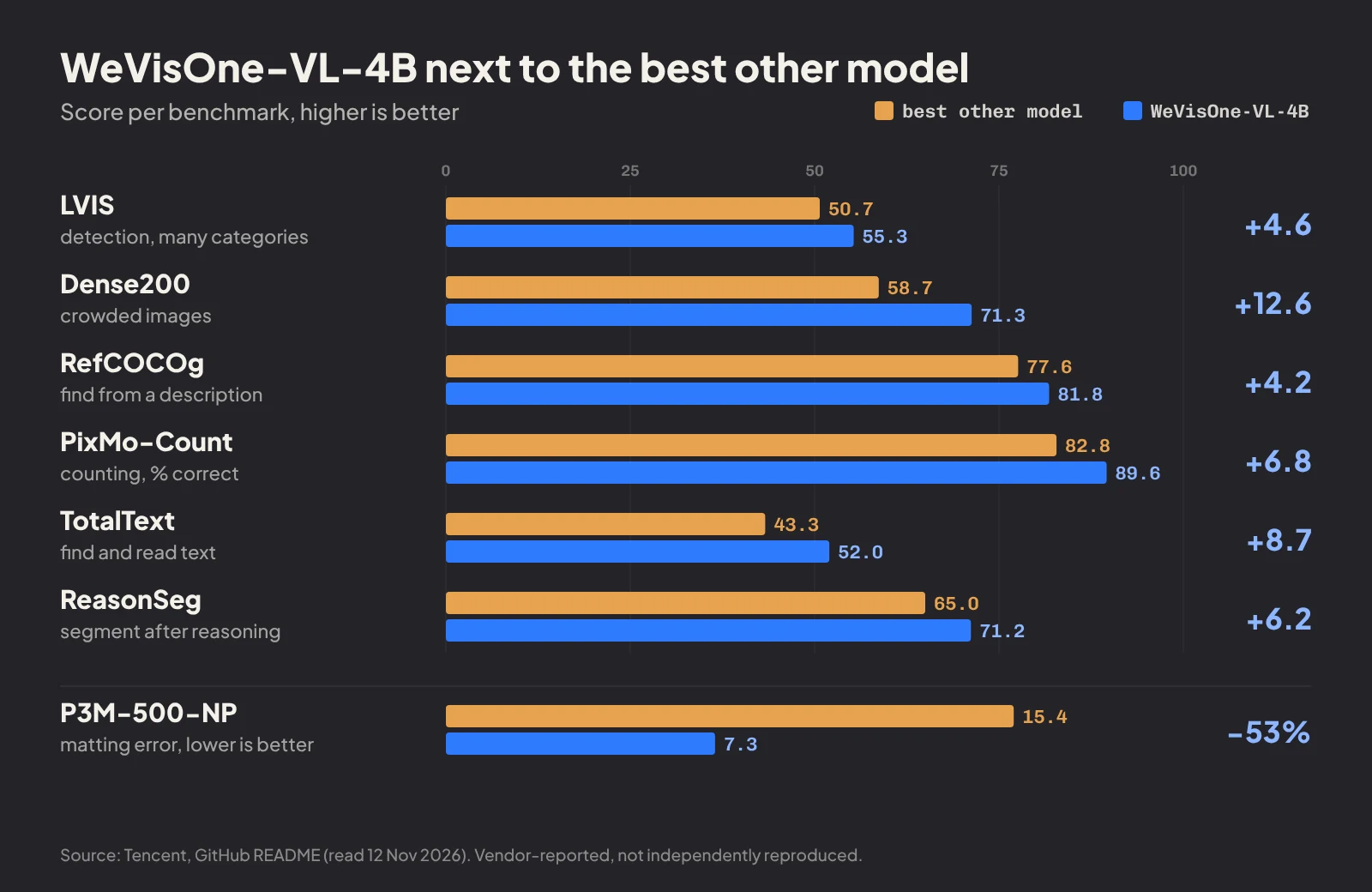
Tencent reports the top score on more than 30 benchmarks. These are the headline results for the 4B model next to the best other model in the same table:
| Benchmark | What it measures | Best other model | WeVisOne-VL-4B |
|---|---|---|---|
| LVIS | detection across many categories | 50.7 | 55.3 |
| Dense200 | detection in crowded images | 58.7 | 71.3 |
| RefCOCOg | finding an object from a description | 77.6 | 81.8 |
| PixMo-Count | counting, % correct | 82.8 | 89.6 |
| TotalText | finding and reading text | 43.3 | 52.0 |
| ReasonSeg | segmentation after reasoning | 65.0 | 71.2 |
| P3M-500-NP | matting error, lower is better | 15.4 | 7.3 |
Four caveats before you quote these numbers internally:
- They are vendor-reported. As of 12 November 2026 there is no independent reproduction that I could find.
- The comparison set is small models. According to the project’s tables, they include LocateAnything-3B, Rex-Omni-3B, Qwen3-VL-8B, Qwen3.5-9B, GroundingDINO and, for OCR, PP-OCRv5. Large closed models such as Gemini or GPT are not in the tables.
- The F1 scores are a custom metric, averaged over overlap thresholds from 0.5 to 0.95. They are not standard average precision and do not compare directly with other papers.
- Bigger is not always better. On P3M box matting the 2B model has a lower error, 6.6, than the 4B model’s 7.3.
Where it could fit in European operations
The task list maps onto work that many organisations already pay for or do by hand. These are candidates to test, not proven deployments:
- E-commerce and marketing: product cut-outs and background replacement for catalogues, where matting quality decides whether an image needs manual retouching.
- Documents and labels: OCR with grounding, so you know where on an invoice, delivery note or packaging label a value sits, not just what it says.
- Retail and logistics: counting items on shelves or pallets, where the gains on crowded scenes matter most.
- Inspection and drones: locating small objects in busy images; the 4B model scores 44.7 on VisDrone.
- Robotics and agents: pointing at the thing to pick or click, a building block also seen in small agent models such as Microsoft’s Mage-VL-Cowork.
What to check before you adopt it
- Licence. The code and both model repositories list Apache 2.0, which allows commercial use. Third-party components keep their own licences, so check them before you ship a product.
- Data location. There is no hosted API, so you run the weights on your own hardware or in your own cloud tenant. Images do not travel to Tencent, which simplifies the GDPR picture compared with a remote vision API.
- Code review. Masks and mattes need Tencent’s own inference package and a separate file,
mask_decoder.pt. Loading the model through plain Transformers, vLLM or SGLang gives boxes and text only. Treat the package like any third-party dependency in your software supply chain review. - People in images. Tencent states the model is not intended to identify individuals. Under the EU AI Act some biometric uses are prohibited outright and others are high-risk, with the high-risk obligations now due from December 2027 after the Digital Omnibus. Keep identification out of scope unless legal has signed off.
- Hardware. In bfloat16 the 4B weights alone take about 9.7 GB and the 2B weights about 4.9 GB, according to an estimate by AiCybr. Large images and masks need more. The package runs on Nvidia GPUs, on NPUs or, slowly, on CPU.
- Limits. One image per request, no video, no step-by-step reasoning, and fine edges that depend on resolution, occlusion and transparency. Fine-tuning code had not been released as of 12 November 2026.
How to pilot it in two weeks
- Pick one task you pay for today, such as product cut-outs or label reading, and collect 200 of your own images, including some where the target is absent.
- Install the package from GitHub on a GPU with 12 GB or more and run both the 2B and the 4B model.
- Score the output against your current tool or manual baseline, counting false positives separately.
- Measure time per image on your own hardware, since no official throughput figures exist.
- Decide with the numbers in hand, and document licence, hosting and AI Act scope in the same note.
Frequently asked questions
Is WeVisOne-VL free for commercial use?
The code and model repositories are licensed under Apache 2.0, which permits commercial use. Third-party components retain their original licences.
Do I need SAM to get masks?
No. The model’s own 9.6M-parameter pixel decoder produces masks and alpha mattes. SAM2 was used only in Tencent’s data pipeline to create training labels.
Can WeVisOne-VL process video?
No. It works on one image per request, and the pixel decoder rejects video input.
Is there a hosted API?
No. You can try demos on Hugging Face or run the model yourself with Transformers or vLLM.
The pipeline becomes a prompt
WeVisOne-VL arrived quietly, without a press release or an API, and the 4B model counted about 16,600 downloads in the month before 12 November. The shift it represents is bigger than the launch. Pixel-level output is becoming part of a language model’s answer, which turns a computer vision project from an integration job into a question of how you phrase the query and what you do with None. For European teams that prefer to keep images in-house, a capable open model of this size changes the build-or-buy calculation. For the wider picture of who is building these models, see our overview of the 40 most innovative AI labs in China.