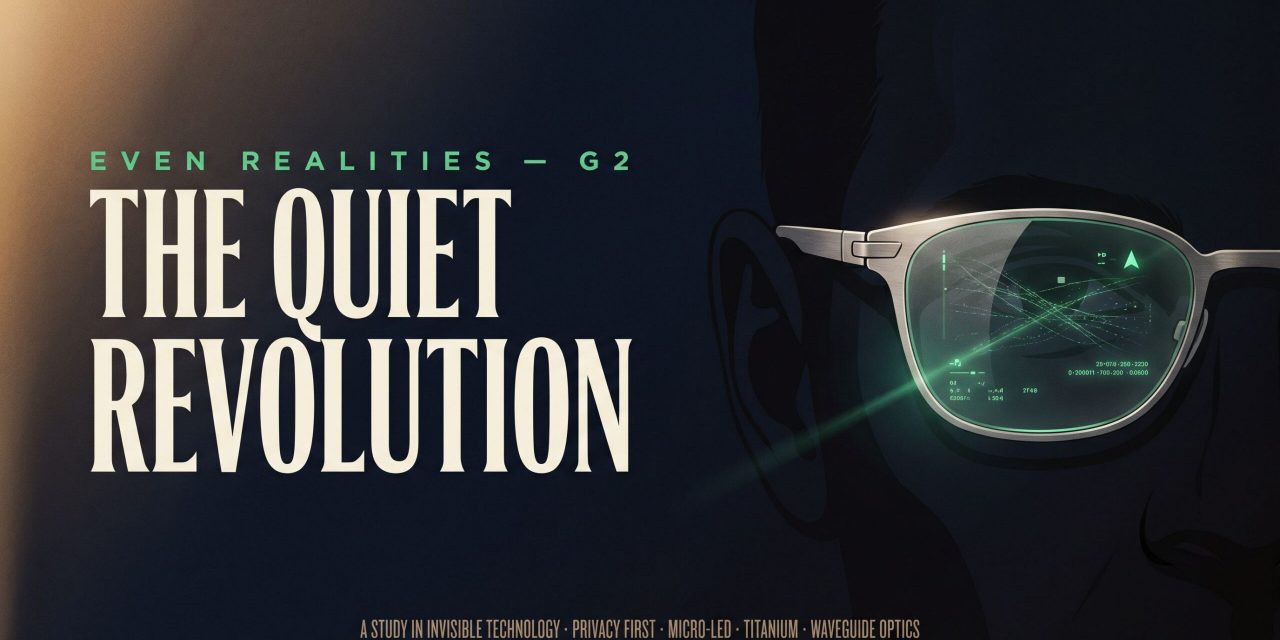
Smart glasses have spent years trying to convince you that a camera on your face is a good idea. Even Realities takes the opposite route with the G2, a pair of glasses that look like premium eyewear but hide a sharp micro-LED display behind the lenses. No outward camera. No speaker. Just information, delivered when you need it, invisible to everyone else. The result is a piece of wearable technology that finally feels like glasses first and gadget second.
What the Even Realities G2 actually is
The G2 is a lightweight pair of prescription-ready smart glasses that project a green monochrome display into your field of view through waveguide lenses. Think heads-up display, not screen. You get notifications, turn-by-turn navigation, live translation, a teleprompter, quick notes and an AI assistant, all rendered as crisp text and simple graphics on the inside of the lenses.
There is no camera pointed at the people around you. There is no speaker broadcasting your calls. The microphones exist for voice input and translation only. That single design choice reframes the entire product category. You can wear the G2 in a meeting, on a train or across a dinner table without turning the room into a recording studio.
Holistic Adaptive Optics, and why it matters
Even Realities builds its optical stack around a proprietary system called Even HAO. In the G2, that system has evolved into HAO 2.0. It orchestrates three components: miniature micro-LED projectors, multi-layer waveguides and digitally surfaced lenses.
The projector is 40 percent smaller than in the previous generation, yet it produces a brighter and sharper image. Inside the waveguide, a graded grating spreads light more evenly across your field of view, so the display looks uniform from edge to edge instead of fading at the corners. The lenses themselves use free-form technology and ray-tracing software, digitally surfaced with a diamond-tipped lathe. The centre of each lens is 30 percent slimmer than before and the edges are thinner still.
The practical outcome is a display that is 75 percent larger and around 50 percent sharper than the G1, without making the glasses look thicker. Peripheral vision stays clear, passthrough vision stays natural and the digital overlay sits comfortably in your visual field rather than fighting for attention.
Build quality that hides the technology
The G2 weighs roughly 36 grams. For context, average prescription glasses in the United States sit around 28 grams, and Meta’s Ray-Ban smart glasses are closer to 50 grams. That eight-gram gap between the G2 and normal eyewear is the difference between a device you tolerate and one you forget you are wearing.
The frame combines aerospace-grade titanium temples with a magnesium alloy body. Temple thickness has dropped by 53 percent compared to the G1, temple width by 20 percent and the end-piece by 15 percent. Screwless hinges have been opened and closed 40,000 times in testing. The glasses have been dropped from two metres, subjected to extreme temperature and humidity, and certified IP67 for dust and water resistance. Rain, sweat and daily commutes are not a concern.
Lenses receive over 100 layers of coating. That coating stack allows for high light transmission and accurate colour rendering, and it eliminates the outward reflections that usually give smart glasses away. Onlookers see a normal lens, not a glowing rectangle.
Prescription support and fit
The G2 supports single-vision prescriptions from -12 to +12 diopters, a wider range than most competitors. High-index lens options keep the profile slim even for stronger prescriptions. Behavioural labs analysed 100,000 three-dimensional head shapes across ages, nationalities and sexes to inform the frame geometry. Two silhouettes are available, a rounded panto and a rectangular shape, in grey, brown or green.
For customers who want a tailored fit, the UltraFit service lets an optician adjust tilt, vertex distance and wrap angle. It is the kind of detail you expect from a luxury eyewear brand, not from a piece of consumer electronics.
TriSync and the Even R1 smart ring
Alongside the G2, Even Realities launched the R1, its first smart ring. The R1 is built from stainless steel with a zirconia ceramic coating and slips onto your index finger. Tap and scroll gestures let you move through menus on the glasses without touching the frame or reaching for your phone.
The three devices, phone, glasses and ring, connect through what Even Realities calls TriSync. The temple tips of the G2 sync wirelessly with both the phone and the R1, and the interface adapts for left or right-handed use. It is a small detail that reveals a larger design philosophy: the interaction should follow you, not the other way around.
The R1 also tracks steps, heart rate, heart-rate variability, sleep and blood oxygen. All of this data can be viewed directly on the glasses without opening an app. The health-tracking side is basic compared to dedicated fitness rings, and early testers report software bugs that still need ironing out. Treat the R1 as a controller with useful extras rather than a full replacement for a health wearable.
Software features that earn their place
The G2 runs a focused set of tools. Notifications appear on the lenses in real time, filtered through the companion app so only your priorities break through. Navigation shows turn-by-turn walking or cycling directions with a live map, distance and speed. The teleprompter reads your script and adjusts scrolling speed based on how fast you are speaking, a feature that has already been used publicly on stage.
Translation supports 22 languages and displays subtitles of the person speaking to you directly on the lenses. The Even AI assistant, triggered by “Hey Even” or a long press on the temple, generates answers three times faster than on the previous model and can run on Perplexity or ChatGPT as the underlying engine.
The headline addition is Conversate. Turn it on during a meeting and the contextual AI generates subtitles, suggests follow-up questions, summarises the discussion and offers on-the-spot answers. Audio is never saved, only the transcription. Later this year, Even Hub will open the platform to third-party developers, expanding what the glasses can do without changing what they are.
Battery, durability and the daily reality
Even Realities claims two days of use from a single charge on the glasses, with the charging case providing seven additional full charges. The R1 lasts around four days on a charge and carries its own IP68 rating. For a device you wear every waking hour, that endurance matters more than any single feature.
A different bet in a crowded field
Meta and Ray-Ban dominate the current smart glasses conversation with cameras and speakers. Google, Samsung, Warby Parker and eventually Apple are all circling the same category. Even Realities is smaller, quieter and taking the opposite bet: that the future of wearable computing is not about capturing the world but about layering useful information over it, discreetly.
The interesting question is not whether the G2 outsells its rivals. It is whether the industry follows this philosophy or the camera-first one. Every design choice in the G2, from the reflection-free coatings to the absence of speakers, argues that the most valuable feature a wearable can offer is the ability to disappear.