A quiet Cambridge startup just reshaped the map of industrial robotics. Walden Robotics emerged from stealth with a $300 million funding round, a $1.1 billion valuation, and a bold technical bet: teach machines to work in real factories by showing them what to do, not by writing new code. The company spun out of Toyota Research Institute earlier this year and already has robots operating inside a Toyota plant in North America. That combination of research pedigree, deployed hardware, and heavyweight backers puts Walden Robotics at the center of one of the most competitive fields in technology today.
What Walden Robotics actually builds
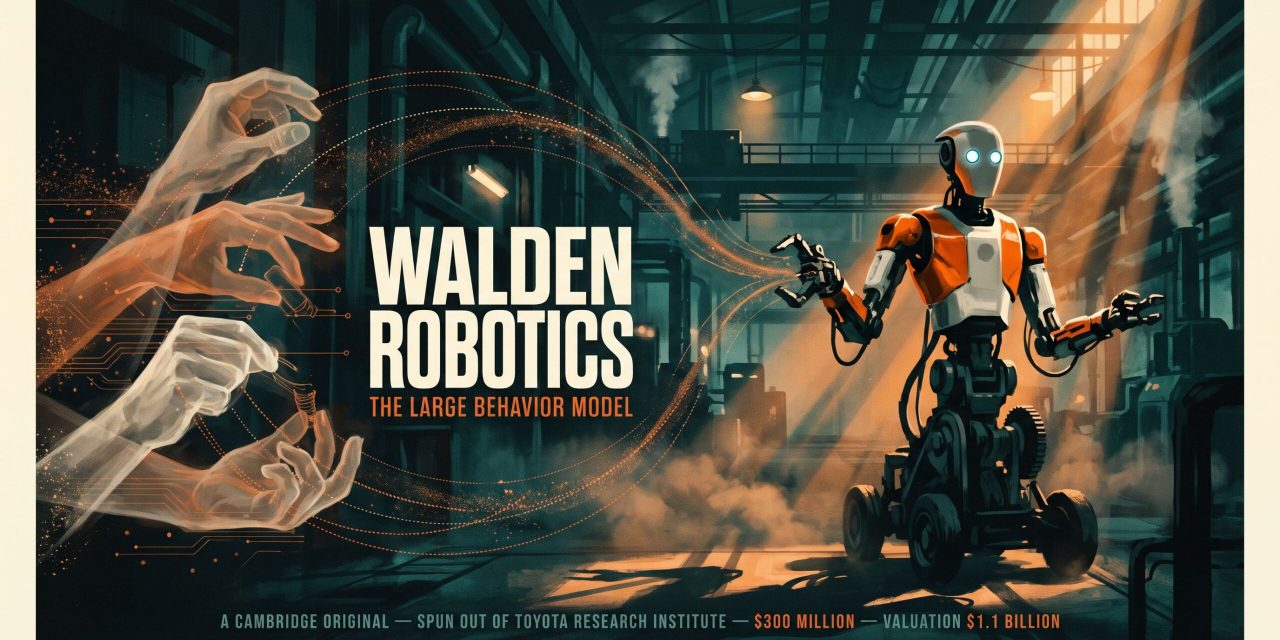
The company’s machines are only partially humanoid. The upper half has two arms and a head fitted with two sensors that resemble eyes. The lower half is a wheeled or fixed base rather than legs. The look is deliberate: bright orange and white, engineered for factory floors rather than showrooms.
That design choice reflects a pragmatic reading of the industry. Manufacturing safety standards already exist for rolling machines. They do not yet exist in the same mature form for walking robots. As chief executive Russ Tedrake explained, wheels let the company move fast and stay productive in factories today, while walking humanoids remain stuck in a regulatory gray zone. Wheels also carry practical engineering benefits. They are simpler to build, easier to certify, and they can support larger batteries than a bipedal frame.
The initial target markets are automotive, aerospace, semiconductors, electronics, logistics, and life sciences. All of these sectors face labor shortages and rising demand for domestic manufacturing capacity, which is exactly where flexible, teachable robots can make a measurable difference.
Large behavior models explained
Walden‘s technical foundation is what the company calls a large behavior model. The name is a deliberate echo of the large language models that power chatbots, and the parallel is more than marketing. Both approaches use neural networks trained on huge amounts of data to generate outputs that generalize to new situations. The difference is what those outputs represent. A language model generates the next token in a sentence. A behavior model generates the next action for a physical body.
The breakthrough that made this possible came several years ago, when Tedrake and collaborators at MIT adapted diffusion models, the same class of neural network used to generate images, to teach robots how to perform tasks. Instead of hand-coding motion planning for each new job, engineers show the robot demonstrations, and the model learns the underlying pattern.
“The barrier to entry has gone way, way down,” Tedrake said in an interview. “You don’t have to write any new code. You just have to show some demonstrations to the robot, and the robot can learn the new task.”
That is a significant claim. Traditional industrial robotics has always been rigid. A welding arm on a car line performs one job for years, and reprogramming it for a new part requires specialist engineers. If behavior models truly reduce retraining to a matter of demonstrations, the economics of factory automation shift. Small runs, custom parts, and mixed workflows all become viable for robotic labor in a way they simply were not before.
Why the funding round matters
The $300 million round is one of the largest robotics deals ever in the Boston area, trailing only fundraising by autonomous vehicle firm Motional according to PitchBook. Nationally, the biggest recent robotics investments have gone to humanoid startups elsewhere, including Figure in California and Apptronik in Texas. Walden’s raise brings serious capital back to the East Coast robotics cluster.
The investor list is worth reading carefully. Alongside Toyota, the round included Nvidia, Boeing, and New York venture firm Deviation Capital. Nvidia’s involvement signals confidence that behavior models will need substantial compute, and that Walden intends to buy it. Boeing’s presence points toward aerospace manufacturing as a real, near-term customer segment rather than an aspirational one. Toyota, of course, is both a shareholder and an early production customer, which gives the startup something most robotics companies lack: a live industrial deployment before the public launch.
A robots-as-a-service business model
Walden will not sell its hardware outright, at least not initially. Customers pay fees to use the robots, a model Tedrake described as robots-as-a-service. The reasoning is straightforward. The underlying technology is new, and the hardware is changing quickly. Locking a customer into a purchased machine that will be outdated in eighteen months serves neither party. A service model lets Walden upgrade fleets, iterate on designs, and keep customers on the current generation of behavior models without renegotiating every contract.
This approach also mirrors what has happened in enterprise software over the past decade. Perpetual licenses gave way to subscriptions because subscriptions align incentives around ongoing improvement. Applying the same logic to industrial hardware is not entirely new, but doing it at this scale with AI-driven robots is.
The team behind the technology
Walden is a young company with an experienced bench. Founding head of hardware Andy Marchese spent more than a decade at Amazon Robotics. Head of software Joe Romano worked at Berkshire Grey and Kiva Systems, the warehouse robotics company Amazon acquired in 2012. Chief product officer Dave Johnson came from Draper Labs and Dexai Robotics, a Cambridge startup he sold to Sony.
Tedrake himself remains an MIT professor, and the company benefits directly from the region’s academic pipeline. He was quick to point out that Boston’s advantage goes beyond robotics research alone. The manufacturing base, the local machine shops, the contractors who can prototype a new gripper on short notice, and the universities feeding fresh engineering talent all contribute to what makes the ecosystem viable.
The competitive landscape
Humanoid robotics is crowded. Tesla is pushing Optimus. China’s Unitree Robotics is shipping affordable bipedal machines. Boston Dynamics, owned by Hyundai, continues to develop the Atlas humanoid, a platform Toyota previously partnered on before backing Walden. Local firm Tutor Intelligence is another player in the same neighborhood.
Walden’s differentiation rests on two pillars. The first is the behavior model approach, which promises faster deployment and easier task transfer. The second is the deliberate choice to skip legs for now. While competitors race to build the most impressive bipedal demo, Walden is quietly booking factory hours with wheeled machines that already meet safety standards. Whether that trade-off pays off depends on how long it takes the industry to certify walking robots for regulated environments.
The name and what it signals
The company’s name comes from Walden Pond in Concord and the writings of Henry David Thoreau on living a purposeful life. Tedrake framed it as a reminder that automation carries responsibility. Robots that can learn any task will change what work looks like for millions of people. Building them thoughtfully, and thinking hard about the human side of that transition, is part of the mission he articulated.
What to watch next
The interesting question is not whether Walden’s technology works. It clearly works well enough to run inside a Toyota facility. The question is how quickly the large behavior model approach generalizes across industries with wildly different physical constraints, from semiconductor cleanrooms to aerospace assembly bays. If demonstration-based training scales the way Tedrake believes it will, the bottleneck for industrial robotics stops being software engineering and starts being data collection. That is a very different competitive game, and it favors whoever can capture the most demonstrations across the most environments first.