GENE 26.5 by Genesis AI is a full stack attempt to answer a hard question: can one robotic system handle the messy, contact heavy work that human hands do every day? Genesis AI says its first public release in the GENE family uses the same model, hardware platform, data strategy and control stack across tasks such as cooking, lab pipetting, Rubik’s Cube solving, smoothie making, wire harnessing, multi object grasping and piano playing.
That matters because manipulation is where robotics usually gets stuck. Moving through open space is one problem. Changing the physical world with fingers, tools, force, timing and feedback is another. A few millimeters can decide whether a pipette lands in a tip, an egg cracks cleanly or a cable bundle holds together.
Why GENE 26.5 focuses on robotic manipulation
Genesis AI frames manipulation as the core unsolved problem in robotics because it turns intelligence into useful work. Most human labor is not just movement from one place to another. It is sorting, cutting, fastening, pouring, sealing, gripping, twisting and adjusting. In other words, it is contact.
The company evaluates manipulation along five axes: spatial precision, temporal composition, contact richness, contact coordination and tool mediated interaction. This is a useful lens because it avoids reducing dexterity to pick and place. A robot that can lift an object may still fail when it has to stabilize it with one finger, rotate it with another, use a knife as a support surface and coordinate both hands at the same time.
The GENE 26.5 demonstrations are designed around that broader view. The cooking task, for example, lasts around four minutes in an unsimplified setting and includes more than 20 subtasks. Genesis describes egg cracking, tomato cutting, whisking, salt grinding and pan handling as part of the same autonomous 1× speed run. In the lab workflow, the robot handles pipetting, liquid transfer, tube sealing and centrifuge loading, including small button actuation and cap manipulation.
What GENE 26.5 can do today
The primary Genesis AI release emphasizes that most tasks are executed at real world speed by a single model with shared weights. Piano playing is a special case, described as a control stack stress test using a separately trained reinforcement learning policy in simulation.
The most important GENE 26.5 tasks show different kinds of dexterity:
- Cooking combines long horizon planning, delicate force control, cutting, stirring and bimanual tool use.
- Lab pipetting stresses millimeter level accuracy, tool pose control and fine finger coordination.
- Rubik’s Cube solving requires stable object handling while executing precise rotations across two hands.
- Smoothie making involves rigid objects, deformable items and liquids in one language instructed workflow.
- Wire harnessing targets an industrially relevant task with soft cables, tape and coordinated hand use.
- Multi object grasping shows one hand holding four different objects using different grasp types.
Genesis states that, to its knowledge, GENE 26.5 is the first general purpose bimanual robotic system shown solving a Rubik’s Cube. The company also claims that many of the demo skills require less than one hour of task specific robot data, equal to under 200 episodes for skills shorter than 20 seconds.
Why Genesis AI went full stack
A central point in the Genesis AI announcement is that robotic manipulation is not only a model training problem. Sensors, actuators, control software, hardware design, data collection and evaluation all shape what a model can learn. If one layer is weak, the whole system pays the price.
TechCrunch reported that Genesis AI raised a 105 million dollar seed round and that its founders decided they needed control over hardware as well as models. Co founder and CEO Zhou Xian told TechCrunch that the model remained the goal, but the company realized it needed to go full stack. That decision shows up most clearly in the hand.
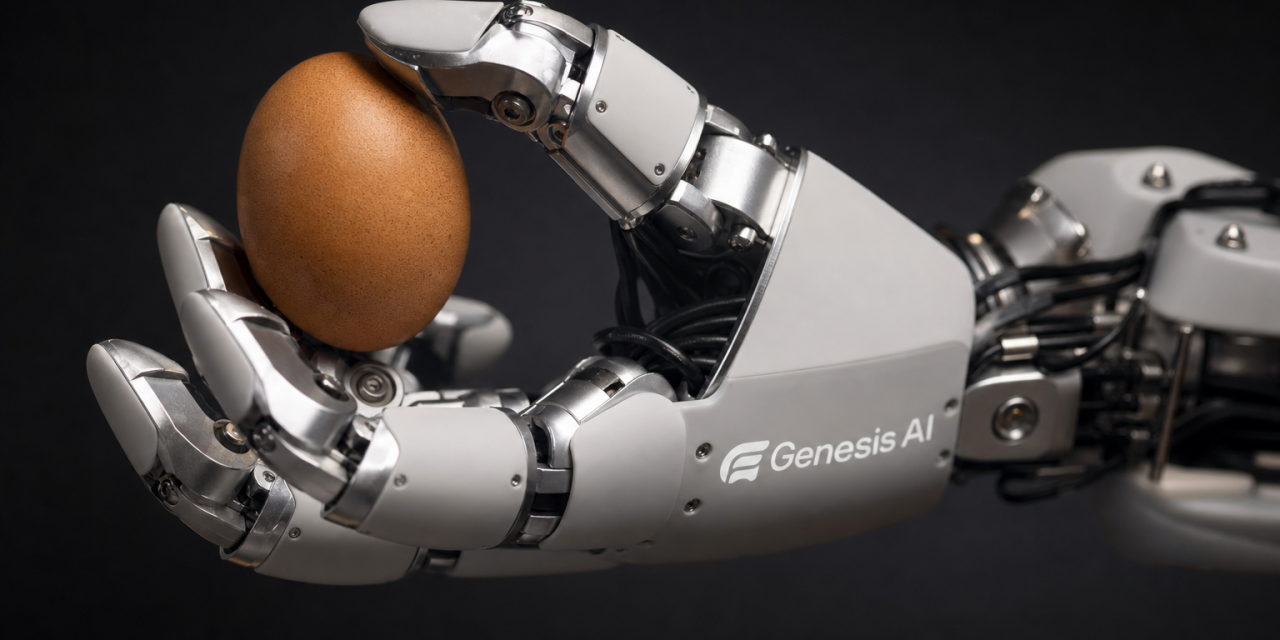
Genesis Hand 1.0 is described as a human sized, highly dexterous, direct drive robotic hand with 20 active, back drivable degrees of freedom. It uses soft material across the palm and fingers to better mimic the soft contact behavior of human skin. The point is not just realism. A hand closer to human shape reduces the embodiment gap, which is the mismatch between human demonstration data and robot execution.
This is where GENE 26.5 takes a different path from systems built around simple two finger grippers. The world’s tools, switches, containers and instruments were largely designed for human hands. If the robot hand is too different, every human demonstration becomes harder to translate.
The data strategy behind GENE 26.5
Genesis argues that human centric data is the scaling path for manipulation. The company says it has collected more than 200,000 hours of data across modalities, including glove data, egocentric video and third person video. The glove uses EMF based finger tracking and dense tactile sensing to capture hand motion and touch signals while preserving natural work patterns.
This is a direct response to one of robotics’ biggest bottlenecks. Teleoperation can provide clean robot data, but it is slow and often artificial. Internet video scales, but it misses force, touch, occluded fingers and exact hand state. A lightweight glove could sit between those extremes by collecting richer signals during real work.
There is also a practical and ethical question here. TechCrunch noted that workers may not always be eager to wear gloves and cameras that help train automation systems. Genesis’ technology may make data collection easier, but deployment will still depend on incentives, consent and how companies treat the people whose skills become training data.
Why touch and control matter as much as vision
The broader robotics field gives Genesis’ approach useful context. BBC reporting on robotic hands highlights how difficult it remains to build hands that are dexterous, durable and affordable. Researchers and companies can build impressive prototypes, but industrial reliability is a separate challenge. A hand that works in a lab for months is not the same as one that survives years of daily use.
Robotics veteran Rodney Brooks has also argued that dexterity will not emerge from video alone. His critique is simple but important: human hands rely on rich touch, force sensing and feedback. Watching hand motion does not fully reveal grip force, slip, pressure, texture or the subtle corrections humans make without thinking.
GENE 26.5 does not solve that entire problem, but its emphasis on tactile glove data, soft contact hardware and low latency control is pointed in the right direction. Genesis reports replacing vendor supplied arm controllers with its own middleware to reduce mismatch between intended and executed motion. In its benchmarks, the company says circular tracking error dropped from about 20 mm to about 2 mm, while single joint delay fell from roughly 80 ms to 9 ms and could reach about 3 ms with tuned gains.
Those numbers are not just engineering trivia. If a model learns from human motion, but the robot executes late or imprecisely, the learning target becomes distorted. Better control makes human data more usable.
Simulation as the evaluation engine
Genesis AI also places heavy emphasis on simulation. The company argues that real world evaluation is too slow for foundation model scale iteration because one robot, one evaluator and one trial at a time creates a bottleneck. Simulation allows many variations of lighting, scene layout, object properties and instructions to be tested reproducibly.
The key claim is that scaling pre training data improves zero shot generalization in closed loop simulated evaluations, and also improves task specific fine tuning in the real world. Genesis says future updates will share more about correlation between its Genesis World simulation and real world results. That correlation is crucial. Simulation only accelerates progress if it predicts what matters outside simulation.