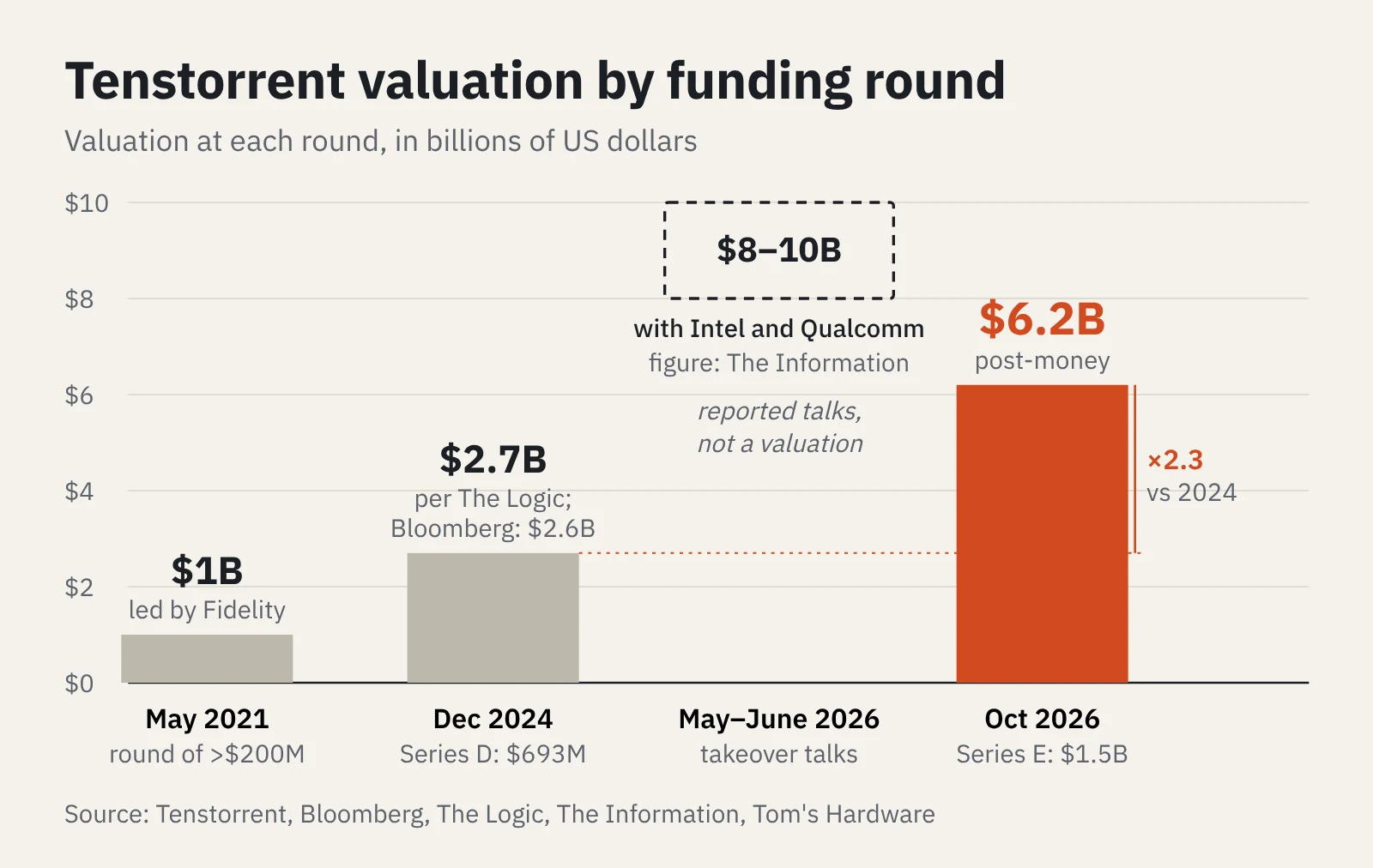
Tenstorrent, the AI chip company led by Jim Keller, raised $1.5 billion at a $6.2 billion valuation on 19 October 2026, more than double its value two years ago. The money goes into building Galaxy servers at volume and into chip designs it licenses to companies such as Samsung and LG. For anyone buying AI compute, the bigger story is not the cheque. It is that one open architecture is now on sale as a $999 card, a desktop workstation, a server rack and a building block inside someone else’s chip.
What Tenstorrent will do with $1.5 billion
Trace Capital and Innovation X led the Series E. Fidelity, ARK Invest, Morgan Stanley, T. Rowe Price, Sandisk, Eclipse and the trading firms Virtu Financial and XTX Markets joined them. Virtu already runs Galaxy servers on-premises for AI trading agents, according to SiliconANGLE. A customer that also becomes a shareholder says something about confidence in the hardware.
The press release names three uses for the money: manufacturing and deploying Galaxy servers worldwide, continuing to serve open-weight language and video models on them, and developing the CPU and AI designs Tenstorrent sells as intellectual property. Bloomberg puts the headcount at about 1,150 across Santa Clara, Austin, Toronto, Belgrade, Tokyo and Bangalore. Revenue is not disclosed.
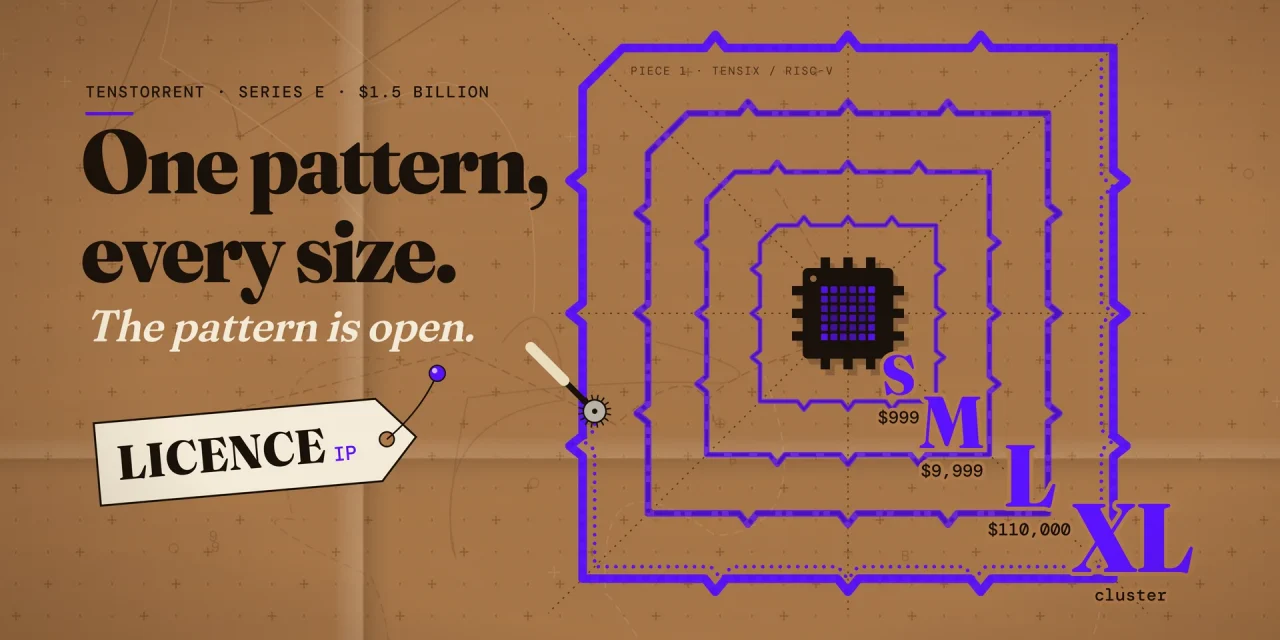
Keller summed up the strategy in one line: “We built one architecture and sell it at every size.”
Why Keller did not sell to Intel or Qualcomm
This spring Tenstorrent looked more like a takeover target than a growth company. In May, Bloomberg reported talks with Intel and Qualcomm. In June, The Information wrote that Qualcomm was weighing a deal valuing Tenstorrent at $8 to $10 billion, as Tom’s Hardware summarised. Qualcomm was reportedly most interested in the RISC-V accelerators and data center CPU designs.
Keller chose to raise instead. He told Bloomberg that a May demo of Galaxy servers running DeepSeek models at high speed was the turning point, The Next Web reports, and that Tenstorrent can compete on price and take orders too small for the giants.
Note that $6.2 billion sits below the range reported during the takeover talks. Tenstorrent chose independence over a possibly higher sale price.
One architecture in five sizes, and what each costs
Everything starts with the Blackhole chip. Current cards enable 120 Tensix cores for AI maths per chip, alongside 16 larger RISC-V CPU cores. RISC-V is an open instruction set: anyone can build processors on it without paying licence fees, unlike x86 from Intel and AMD or Arm. The chips talk to each other over standard Ethernet, so you can link them without proprietary interconnects.
Tenstorrent sells that chip in five forms:
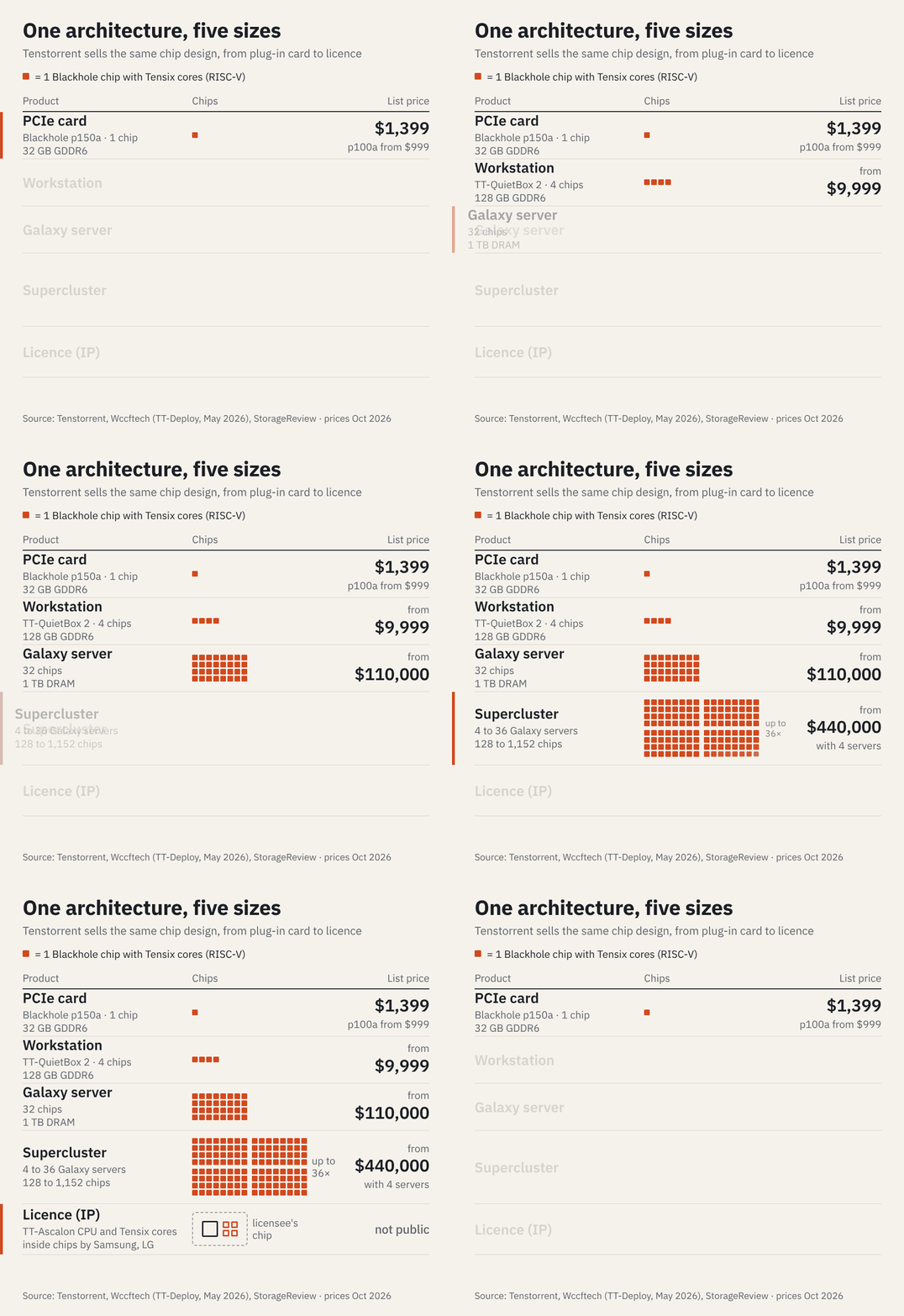
| Form | What’s inside | Price (Oct 2026) |
|---|---|---|
| Blackhole p150a PCIe card | 1 chip, 32 GB GDDR6, 300 W | $1,399 (p100a with 28 GB: $999) |
| TT-QuietBox 2 workstation | 4 chips, 128 GB GDDR6, liquid cooled | from $9,999 |
| Galaxy server | 32 chips, 1 TB DRAM, 23 petaflops FP8 | from $110,000 |
| Supercluster | 4 to 36 Galaxy servers | 4 servers from $440,000 |
| Licence | TT-Ascalon CPU and Tensix cores inside another company’s chip | not public |
Prices come from Tenstorrent’s product page, the QuietBox 2 announcement and the Galaxy Blackhole launch in May. For comparison, a single-GPU AI PC such as the Ghost Core costs $3,499.
The licensing arm is less visible but strategic. Samsung and LG build Tenstorrent designs into their own chips. In Japan, Tenstorrent supplies the RISC-V CPU chiplet for the national 2-nanometre programme with Rapidus, the company said in June. If you don’t want a server, you can license the blueprints.
What the benchmarks claim, and who measured them
Tenstorrent competes mainly on inference. On a cluster of 16 Galaxy servers it reported more than 350 tokens per second per user on DeepSeek-R1, a 671-billion-parameter model, in May. By June Tenstorrent reported over 400, and 900 tokens per second per user on Kimi K2.6. Tenstorrent puts the cost at roughly $6 per million tokens, against about $30 on an Nvidia GB300 NVL72 rack.
Two caveats. Every figure comes from Tenstorrent, and the Nvidia cost is SemiAnalysis data that Tenstorrent placed next to its own measurements. We found no independent tests of Galaxy clusters. And speed per user is not the same as total data center throughput. Futurum analyst Brendan Burke lists the same open question: will the benchmarks hold up in customer case studies?
There is evidence of production use. Japanese AI platform ai& runs more than 120 Galaxy systems for chat, RAG and vision workloads served inside Japan. Equinix offers Galaxy through colocation, and Cirrascale and India’s Turium AI run installations.
The weak spot is software
Building chips is one thing. Getting developers to run their code on them is another, and that is where Nvidia’s CUDA built its lead. Tenstorrent publishes everything as open source on GitHub: the TT-Forge compiler, the TT-Metalium SDK and the TT-LLK kernel library. Futurum says about 90% of tested Hugging Face models run on it.
Practice was rougher at the end of 2025. The Register tested the Blackhole QuietBox with four Blackhole cards and called it powerful, quiet and relatively affordable, but concluded that “right now the company’s software stack simply isn’t polished enough for most local AI enthusiasts.” The reviewer hit scattered documentation, a short list of supported models and non-standard quantisation. On Reddit a related complaint comes up: $10,000 for experimental hardware is too much for many home builders, and they want support for new open models sooner.
A firmware update also raised eyebrows. Tenstorrent cut p150 cards from 140 to 120 Tensix cores, including cards already sold. It says typical workloads lose 1 to 2% performance. The rated compute dropped from 774 to 664 teraflops.
What it means for European companies
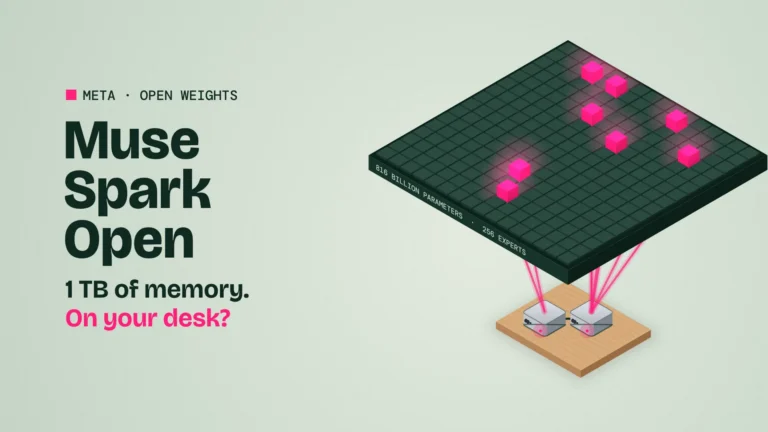
For European firms that prefer to run AI on their own infrastructure, the combination of open hardware, open software and open-weight models is what counts. You are not tied to one vendor for your instruction set or your software stack, and what you build you can maintain yourself. It fits the logic that models are rented, context is owned: open weights like Muse Spark Open give you the model, Tenstorrent sells the hardware to run it in-house.
Tenstorrent also targets governments. In December 2025 it signed a memorandum with Cyprus for sovereign AI infrastructure aligned with European rules, and it runs an engineering centre in Belgrade. A European Galaxy deployment on the scale of the one in Japan does not exist yet.
It remains a US company with American and Asian investors. Sovereignty here comes from openness and owning the installation, not from European ownership. That makes it a different proposition from sovereign AI plays such as Europe’s Verda or Canada’s Cohere, and from other challengers like Unconventional AI with its analog chips.
Frequently asked questions
Is Tenstorrent a public company?
No. Tenstorrent is private. After the October 2026 Series E it is valued at $6.2 billion. No IPO has been announced.
Who is Jim Keller?
Keller is Tenstorrent’s CEO and one of the best-known chip architects in the industry. He worked on Apple’s A4 and A5, AMD’s Zen architecture and Tesla’s Full Self-Driving chip.
Can a company buy Tenstorrent hardware today?
Yes. Blackhole cards and the QuietBox 2 are sold directly by Tenstorrent, and Galaxy servers through Tenstorrent and partners such as Equinix. Expect software work: not every model runs out of the box, and documentation trails Nvidia’s.
Is Tenstorrent faster than Nvidia?
Tenstorrent says Galaxy delivers more tokens per second per user and a lower price per token than Nvidia’s GB300. Those figures have not been independently verified. As a single card, a Blackhole p150 performed roughly like an Nvidia DGX Spark in The Register’s test.
The real test comes after the cheque
Tenstorrent now has the money and the customers to show that an open alternative to Nvidia is more than a good story. The amount mostly measures investor confidence. Whether it works will show in smaller things: how fast a newly released open model runs on Galaxy, and whether developers write software for it without Tenstorrent holding their hand. Watch those two signals more than the next valuation.