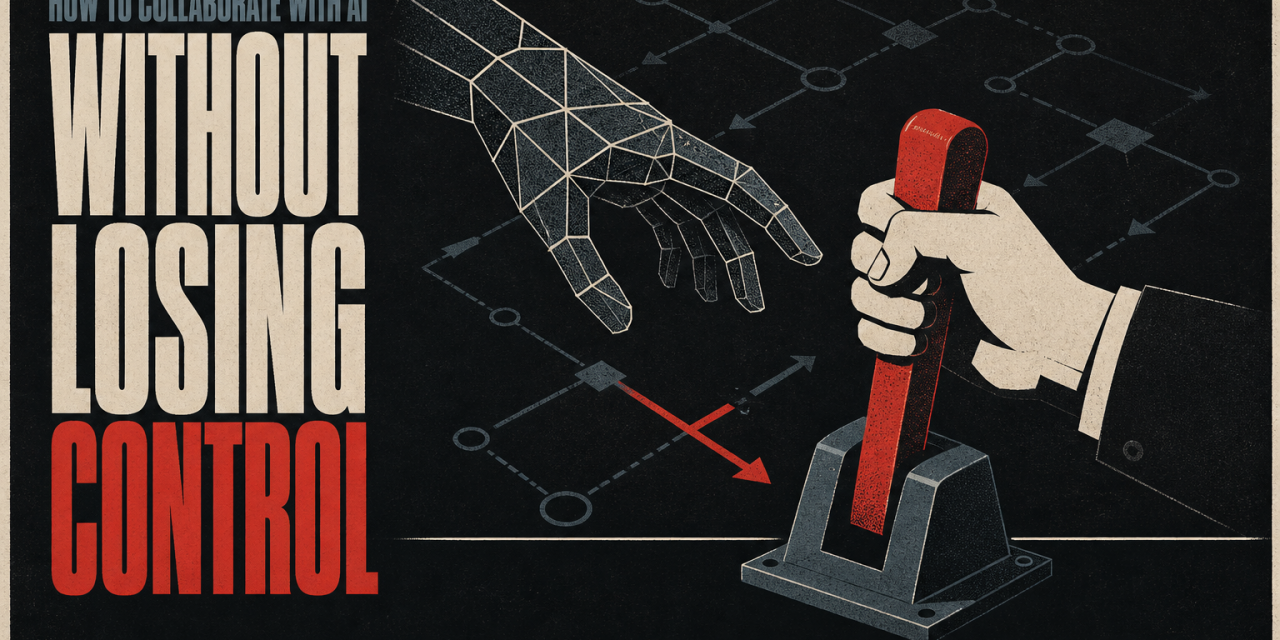
Most advice about collaborating with AI starts and ends with prompting. Write better instructions, get better output. Useful, but it misses the harder question. When AI enters your job, the real issue is not how you talk to the tool. It is how the work itself gets divided, checked, and owned once the tool starts acting like a colleague.
A recent whitepaper titled When Does AI Augment Work? A Workflow-Level Framework for Human-Agent Collaboration, written from the discussions at the CIVIC-AI 2026 workshop, makes exactly this argument. The authors show that judging AI by task-level speed or adoption rates misses most of what matters. They propose six conditions that separate genuine augmentation from what you could call performative augmentation, where AI looks helpful on paper while quietly shifting costs and risks onto people. This post turns that framework into practical guidance for working with AI in a way that actually improves your work.
Why faster tasks can still mean worse work
The natural way to judge an AI tool is to time it. A draft that took an hour now takes five minutes, so the tool must be a win. The problem is what happens next. Someone has to verify the output, handle the unusual cases the system fumbles, and repair the failures. The whitepaper calls this the hidden work of AI adoption, and it rarely appears in productivity statistics.
Organisations typically track usage logs, investment figures, output volume, and headcount. These numbers measure the scale of adoption, not the changing nature of the work itself. Headcount figures can mask team reorganisations and shifting responsibilities. Productivity estimates rarely capture how employees actually spend their time. Apparent gains often reflect effort that was moved elsewhere in the workflow rather than eliminated.
So the first principle of collaborating with AI is simple. Count total effort, not task time. If the system saves you twenty minutes of drafting but creates twenty minutes of checking, correcting, and escalating, the net value is zero no matter how impressive the demo looked.
The six conditions of genuine AI augmentation
The framework organises its six conditions into two layers. The first layer describes whether a workflow functions well right now. The second describes whether it keeps supporting the people inside it over time.
Layer one keeps the workflow honest
- Durable net value. The redesigned workflow must produce real gains after full accounting of quality, human review time, exception handling, rework, recovery, and the cognitive burden shifted onto workers.
- Meaningful human control. You need the competence, time, information, and authority to detect errors, challenge assumptions, override decisions, and keep working when the system is unavailable. Approval you cannot realistically refuse is ceremony, not control.
- Clear accountability and recovery. Decision authority, provenance, escalation routes, and fallback procedures belong to explicitly named humans. An error without an owner, or a rare case that breaks the workflow, means augmentation has failed.
Layer two protects the humans in it
- Deepening learning. The redesign must preserve opportunities to build domain expertise, judgement, and AI literacy. Workers who lose their learning opportunities become dependent on outputs they can no longer evaluate.
- Viable career pathways. Entry points and upward progression must stay open, so junior staff can still become the senior experts who supervise the systems.
- Purpose and agency. The AI should not absorb the satisfying parts of the job while leaving humans with the residue nobody wants.
The two layers interact in an uncomfortable way. A workflow can pass every layer one condition on launch day and still fail layer two within a few years, because the human capabilities required for oversight quietly erode. That is why genuine augmentation can only be judged longitudinally, not in a pilot report.
Deciding what to delegate to AI
Where should the boundary between you and the agent sit? The whitepaper offers three properties of a task that answer this.
- Verifiability. Can a qualified person inspect the output and recognise failure? If not, the task is not safely reviewable.
- Reversibility. Can an error be corrected before serious harm occurs? Drafting a document is reversible. Sending an irreversible financial or medical decision is not.
- Stakes. What follows if the decision is wrong, delayed, or difficult to contest?
Delegation can increase where outputs are easy to inspect, mistakes are recoverable, and consequences are bounded. Human authority should stay strongest where the work defines goals, interprets ambiguous evidence, establishes validity, or shapes consequential use. Notice what this means for your daily routine. The question is never can AI do this task. The question is what happens to the whole workflow, and to you, when it does.
What good human-AI collaboration looks like in practice
The whitepaper illustrates its framework with AI-mediated social surveys, and the division of labour is instructive for any knowledge worker. An adaptive AI interviewer such as SparkMe can rephrase questions, ask context-sensitive follow-up questions, support data collection, and make a first pass over responses. Those are scalable, inspectable, reversible tasks. Human researchers keep strategic control over the research purpose, the constructs, the seed questions, the weighting, the interpretation, and the final coding decisions.
Two details deserve attention. First, the researchers deliberately draft protocols and do initial coding themselves. Anchoring bias makes it dangerously easy to rubber-stamp whatever the AI generates, and early judgement work is exactly how junior researchers build the mastery they will later need for strategic decisions. Second, an adaptive interviewer quietly becomes part of the measurement instrument. Its wording choices and follow-up selections shape the evidence itself. Final sign-off means little if you cannot reconstruct how the data was produced.
The deskilling trap nobody measures
Here is the sharpest insight in the paper. The tasks most amenable to AI delegation are high-volume, procedurally defined, and verifiable. Those are exactly the tasks through which junior workers develop the tacit judgement needed to catch failures and push back on algorithmic recommendations. Delegate all of them and you collect short-term gains at the cost of the review competence your organisation will need in five years.
Oversight skill does not persist automatically. The paper’s application to Singapore’s labour market data adds a sobering detail. Among young workers there, only 38 percent of those with secondary qualifications used new technology at work, against 74 percent of degree holders. Human control is an unevenly distributed capability, not a title on an org chart. The practical takeaway for collaborating with AI is to defend your own competence actively. Keep some substantive review work in your task mix, and stay exposed to AI failures often enough that your detection skills stay current.
Keep a workflow record
The whitepaper’s most actionable recommendation is the shared workflow record. For every AI-enabled process, document the baseline and its objective, which tasks and what level of authority the agent received, where humans review, override, and escalate, how exceptions and outages are handled, significant errors and unintended agent actions, total effort including verification and repair, and effects on skills, learning, progression, and satisfaction.
Review that record whenever you decide whether to expand, revise, or discontinue a deployment. It converts vague claims about productivity into something testable, and it forces the hidden work into the open where it can be managed.