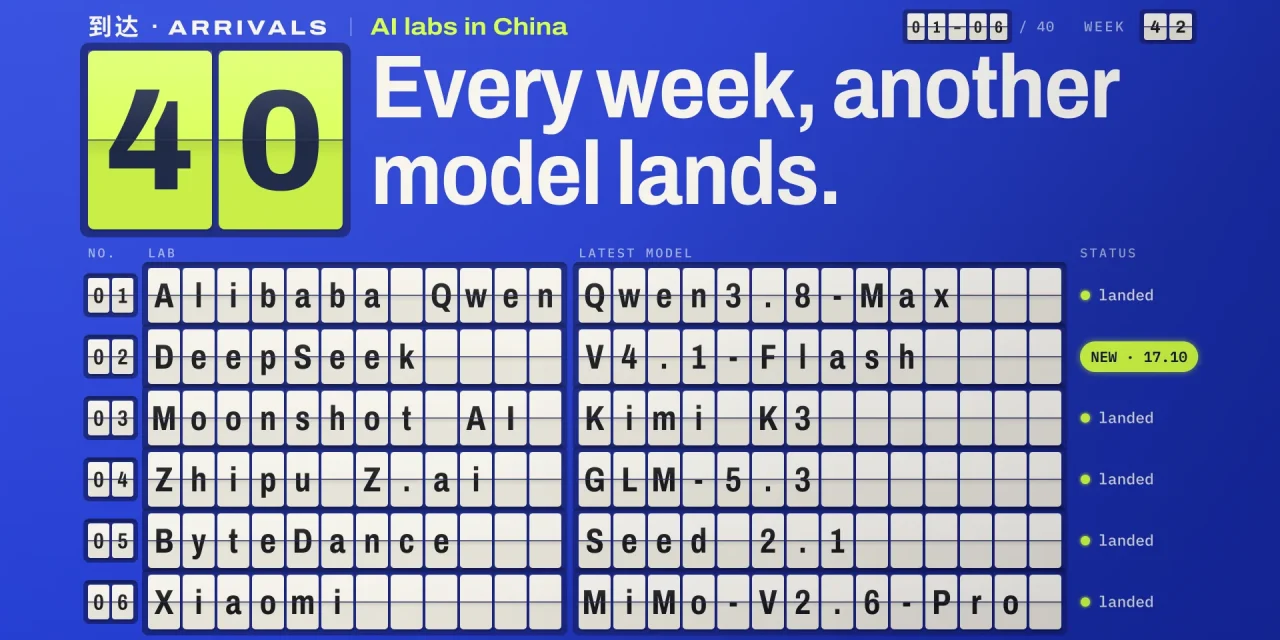
On 17 October 2026, the top six models on the Artificial Analysis open-weights leaderboard are all Chinese, with Meta in seventh place. They do not come from a single company. Xiaomi, Z.ai, StepFun, Moonshot and DeepSeek take turns at the top, and behind them dozens of labs work on video, robots, science and models that run on your phone. This is our ranking of the 40 most innovative AI labs in China, in order of importance, with each lab’s latest model and what makes it stand out.
Consider this the map. In the coming weeks, each lab and model gets its own deep dive on i-scoop.
How we ranked the 40 labs
The order is an editorial judgement based on five kinds of evidence. All figures are as of 17 October 2026.
- Quality on independent leaderboards: the Artificial Analysis Intelligence Index and LMArena for text, code, vision and video.
- Real-world use: token share on OpenRouter, downloads and derivative models on Hugging Face, users of the labs’ own apps.
- Technical novelty: new architectures, efficiency gains, training on Chinese chips.
- Influence through open weights: labs that release their models shape what the rest of the world builds on.
- Momentum in 2026: release pace, capital raised and stock market listings.
Robotics and autonomous driving labs were judged within their own field. Benchmark scores reported only by the company itself are flagged as such.
What stands out in October 2026
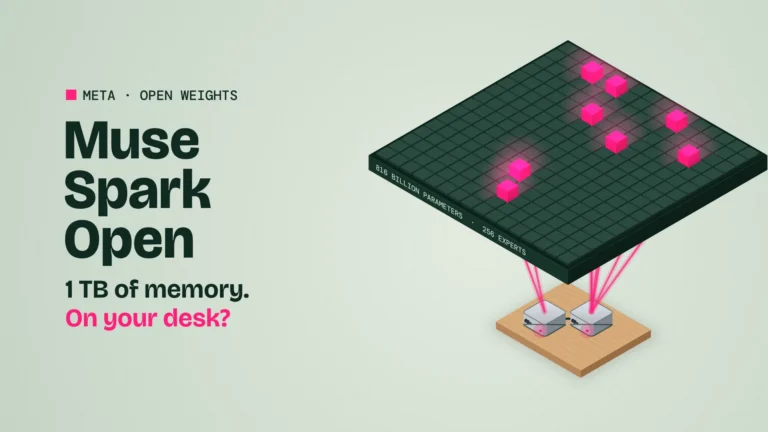
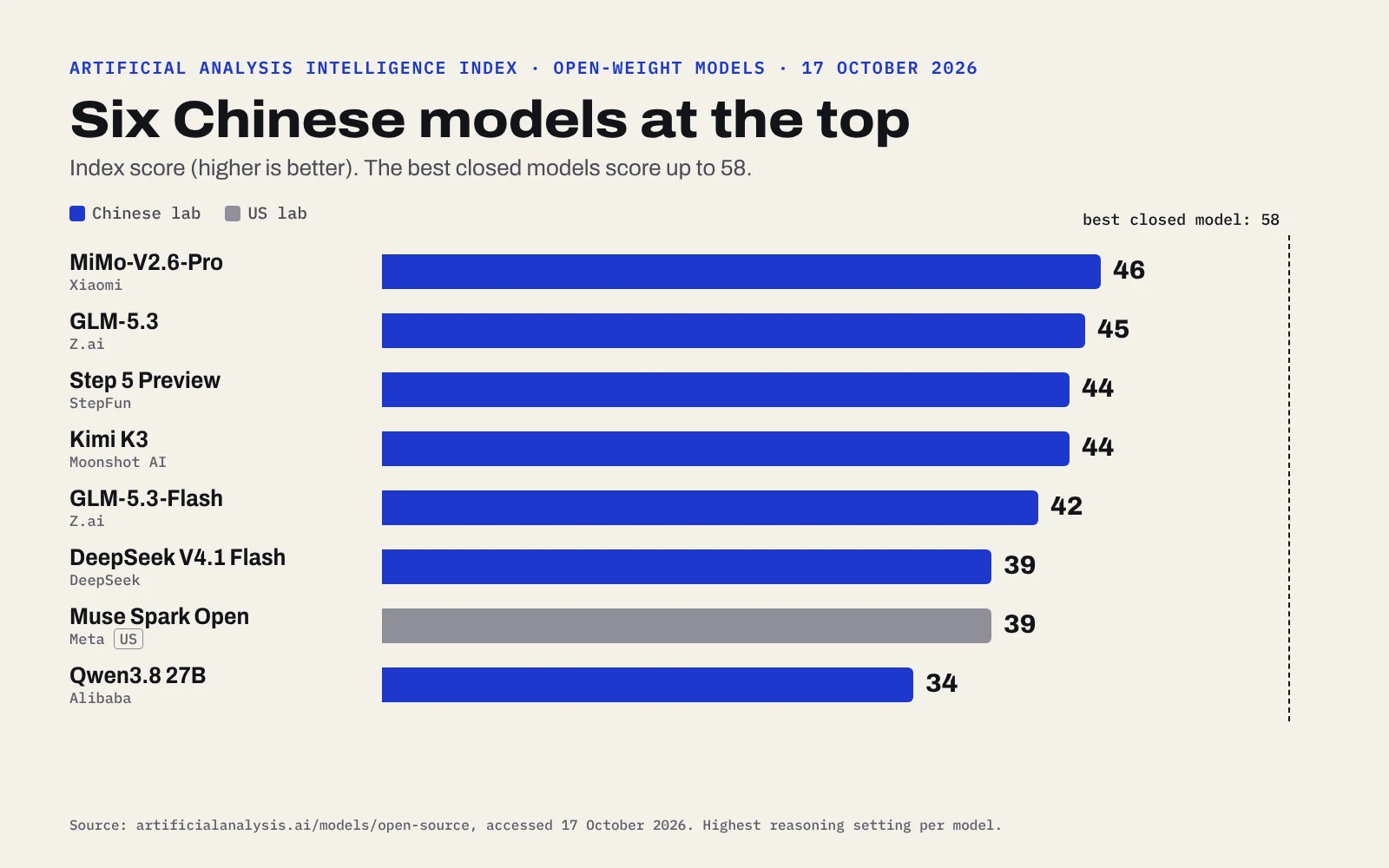
Open weights are the Chinese default. On the Artificial Analysis index, Xiaomi’s MiMo-V2.6-Pro (46), Z.ai’s GLM-5.3 (45), StepFun’s Step 5 Preview (44) and Moonshot’s Kimi K3 (44) lead the open models. The best closed model, Claude Opus 5.5, scores 58, so a gap to the frontier remains. Among open models, though, China is almost alone at the top. Even Meta’s new Muse Spark Open does not break into the top six.
A trillion parameters is now normal. Kimi K3 has 2.8 trillion parameters, Qwen3.8-Max 2.4 trillion, DeepSeek V4-Pro and LongCat-2.0 1.6 trillion each. All of them are mixture-of-experts models: only a small part of the network works on each token, often between 20 and 100 billion parameters. A context window of 1 million tokens is standard on most new releases.
Developers worldwide run on Chinese models. In the week of 5 October, DeepSeek (24.5% of text requests) and Z.ai (13.4%) together handled more requests on OpenRouter than OpenAI and Google combined. The most used model on the platform is DeepSeek V4.1 Flash.
Chips remain the bottleneck. Since December 2025, the US has allowed limited Nvidia H200 sales to China, but Beijing approves each purchase case by case. Labs are moving to domestic hardware: Meituan trained LongCat-2.0 on a cluster of Chinese ASICs, Huawei and China Telecom train on Ascend chips, and Chinese suppliers are trying to close the gap in chipmaking equipment too, as our piece on Shanghai Aishengna shows. China’s 15th Five-Year Plan makes that self-reliance a national priority.
The money is going public. Z.ai and MiniMax listed in Hong Kong in January, Unitree on Shanghai’s STAR Market in August. DeepSeek raised outside capital for the first time, at a valuation above $50 billion. Moonshot is valued at $35 billion.
There are open questions too. Anthropic accuses several Chinese labs of using Claude to train their own models (distillation). A US House investigation is looking at American companies that deploy Chinese open-weight models. And licences are getting stricter: the largest models from Alibaba and Moonshot come with custom licences that set conditions for large commercial users.
The top 10, the labs that set the pace
1. Alibaba Qwen (Tongyi Lab)
Latest model: Qwen3.8-Max, August 2026 · Hangzhou
Qwen is the largest open model ecosystem in the world. This summer Hugging Face counted more than 151,000 models derived from Qwen, about 2.6 times as many as from Meta. Qwen3.8-Max, available since 3 August, is a 2.4-trillion-parameter mixture-of-experts model with a 1-million-token context. An open version with about 95 billion active parameters followed in mid-August, under a custom licence: companies with more than $50 million in revenue that offer it as a service or AI assistant need a separate licence. Qwen3.8-Max ranks second worldwide in LMArena’s vision arena, and the smaller Qwen3.8-27B is a favourite for running locally. Alibaba also builds image and video models, including Wan 3.0 and HappyHorse. Qwen 4 is in training. Notably, Qwen lead Lin Junyang left in March to start his own company.
2. DeepSeek
Latest model: DeepSeek-V4.1-Flash-1017, 17 October 2026 · Hangzhou
DeepSeek is still the lab whose every release moves the market. A new checkpoint of V4.1-Flash went live on 17 October, together with DeepSeek’s own search API (DeepSeek changelog). V4.1-Flash itself launched on 10 September: a 552-billion-parameter mixture-of-experts model with only 8 to 16 billion parameters active at a time, a 1-million-token context, image understanding and an MIT licence. The larger V4-Pro, with 1.6 trillion parameters, has been generally available since August. V4.1 Flash is the most used model on OpenRouter, largely because of its low price, with an off-peak rate at half price. Which chips trained V4 is disputed: Fortune reports Huawei Ascend, ChinaTalk says Nvidia. What is certain is that Huawei confirmed full support on Ascend. In June, founder Liang Wenfeng’s company took outside capital for the first time, at a valuation above $50 billion.
3. Moonshot AI
Latest model: Kimi K3, July 2026 · Beijing
Kimi K3 is the largest open-weight model ever released: 2.8 trillion parameters, 104 billion active per token, spread over 896 experts (model card). Moonshot mixes its own Kimi Delta Attention with standard attention layers and used quantization-aware training in 4-bit format, which makes the model cheaper to run. K3 also reads images and has a 1-million-token context. It is the highest-ranked Chinese model in LMArena’s text arena. In Moonshot’s own benchmark table, the best US closed models still score higher on several tests. Our article on the Kimi K2.5 agent swarm shows how quickly the lab moves. In July, Moonshot was valued at $35 billion.
4. Zhipu AI (Z.ai)
Latest model: GLM-5.3, August 2026 · Beijing
Z.ai, a spin-off from Tsinghua University, became, according to Yicai, the first listed company focused on large language models on 8 January. GLM-5.3, released on 14 August, has 744 billion parameters with 40 billion active, sparse attention and a 1-million-token context. It is strong in coding and cybersecurity and ranks second among open models on Artificial Analysis. A smaller Flash version is MIT-licensed. In the week of 5 October, 13.4% of all text requests on OpenRouter went to Z.ai, more than to Anthropic and Alibaba combined. Z.ai has been on the US Entity List since 2025. Read more about its coding push in our piece on ZCode.
5. ByteDance Seed
Latest model: Seed 2.1 Pro, June 2026, and Seedance 2.5, July 2026 · Beijing
ByteDance has the biggest reach of all. Its Doubao chatbot had 330 million users in May, and its Volcano Engine cloud processed 120 trillion tokens a day in April. The Seed 2.1 Pro and Turbo language models are closed, and ByteDance does not disclose parameter counts. Where the lab really excels is image and video. Since 31 July, Seedance 2.5 generates 30-second single-shot clips with up to 30 reference images, and it sits in the top five of LMArena’s video arenas. Seedream 5.0 Pro is its image model.
6. Xiaomi MiMo
Latest model: MiMo-V2.6-Pro, September 2026 · Beijing
Xiaomi is the surprise of 2026. The MiMo team, led by former DeepSeek researcher Luo Fuli, shipped three model generations this year. MiMo-V2.6-Pro, open-sourced on 21 September under an MIT licence, has just over 1 trillion parameters with 42 billion active. It tops the Artificial Analysis open-weights leaderboard with a score of 46, and the smaller Flash version is among the five most used models on OpenRouter. According to TechNode, the team completed 30 reinforcement learning steps in under six days. Xiaomi plans to invest at least $8.7 billion in AI over three years.
7. Tencent Hunyuan
Latest model: Hy4-preview, August 2026 · Shenzhen
Tencent has rebranded its models as Hy internationally. Hy4-preview, open-sourced on 28 August, has 770 billion parameters with 49 billion active and a context of more than 1 million tokens (TechNode). It is among the five most used models on OpenRouter and performs well in the WebDev arena. Tencent also works on 3D and world models: the open HY-World 2.0 generates explorable 3D worlds, building on image work such as HunyuanImage 3.0-Instruct. Together with ByteDance, Tencent was among the first Chinese companies to receive Nvidia H200 shipments in August.
8. StepFun
Latest model: Step 5 Preview, October 2026 · Shanghai
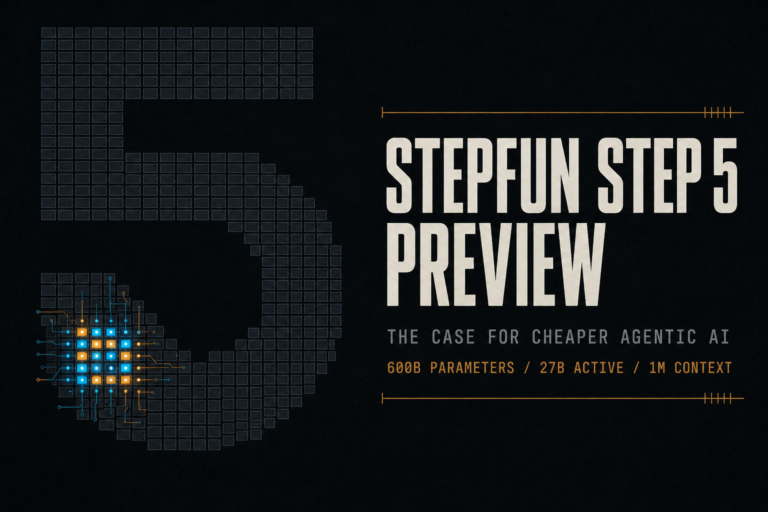
StepFun was written off as a fading “AI tiger” for a while, but it is back at the front. Step 5 Preview launched as an API on 20 September, and the weights followed on 14 October (MarkTechPost). With 600 billion parameters but only 27 billion active, it takes third place among open models on Artificial Analysis, which is remarkably efficient. This week it is the second most used model on OpenRouter. Its predecessor, Step 3.5 Flash, already showed the lab’s focus on efficiency. According to Bloomberg, StepFun is preparing a Hong Kong IPO.
9. MiniMax
Latest model: MiniMax-M3, June 2026 · Shanghai
MiniMax has been listed in Hong Kong since 9 January and plays on two boards. Its M3 language model (announcement) has about 428 billion parameters with 23 billion active, understands text, images and video, and can operate a computer. MiniMax says its own sparse attention cuts per-token compute to one twentieth of its previous model at a 1-million-token context. On general leaderboards M3 trails the leaders. In video, though, MiniMax is world-class: its H3 video model ranks first in LMArena’s image-to-video arena.
10. Kling AI (Kuaishou)
Latest model: Kling 4.0, 15 October 2026 · Beijing
Kling is Kuaishou’s video model. In July it raised $2.8 billion from backers including Alibaba, Tencent and Baidu, and Kuaishou is preparing a separate IPO. It is also the most commercially successful Chinese video model, with more than RMB 850 million in revenue in the second quarter. Kling 4.0, launched on 15 October, generates videos of up to 30 seconds in a single pass, with up to 10 keyframes, up to 15 references and 10-bit HDR (announcement). 4K support has been announced. Kuaishou also builds coding models: KAT-Coder-V2.5 was trained on more than 100,000 verifiable software repositories.
11 to 20, big tech and specialists breaking through
11. Meituan LongCat
Latest model: LongCat-2.0, June 2026, and LongCat-2.5-Preview, September 2026 · Beijing
That a food delivery company runs a frontier lab says a lot about the Chinese market. LongCat-2.0 has 1.6 trillion parameters, about 48 billion active, a 1-million-token context and an MIT licence (MarkTechPost). Meituan says it trained the model on a cluster of 50,000 Chinese ASICs, without Nvidia. The 2.5 preview, in the API since 25 September, adds image understanding.
12. Ant Group (inclusionAI)
Latest model: Ling-3.1-flash, October 2026 · Hangzhou
The fintech arm of the Alibaba group is the most prolific open-source builder among China’s tech giants. Ling-3.1-flash, open-sourced on 16 October, has 560 billion parameters with about 25 billion active. The Ring-2.6-1T reasoning model has a trillion. Ant experiments heavily with hybrid linear attention, which processes long texts more cheaply. Through its subsidiary Robbyant, Ant also builds robot models: LingBot-VLA 2.0 was trained on 60,000 hours of data from 20 types of robots.
13. Baidu
Latest model: ERNIE 5.1, May 2026 · Beijing
Baidu was one of the first Chinese companies with a ChatGPT rival in 2023, but it is less prominent today. Baidu says ERNIE 5.1 cost only about 6% of typical pretraining compute, thanks to what it calls elastic pretraining. In LMArena’s search arena, ERNIE 5.1 ranks in the top ten, the only Chinese model there. Baidu also has its own chips: its chip unit Kunlunxin filed for a Hong Kong listing in January. Its open Unlimited-OCR model is trending on Hugging Face this week. We found no successor to ERNIE 5.1 yet.
14. Huawei
Latest model: openPangu 2.0, June 2026 · Shenzhen
Huawei matters most as a supplier of compute. Its Ascend chips are the Nvidia alternative much of the Chinese AI sector relies on, and its cloud cluster with the new Ascend 950 has been commercially available in China since 30 September. Huawei builds its own models too. openPangu 2.0 Pro has 505 billion parameters with 18 billion active and a 512,000-token context, and was trained on Ascend chips with about 34 trillion tokens (model card). The weights have been available since August.
15. Shanghai AI Laboratory
Latest model: Intern-S2-Preview, August 2026 · Shanghai
This state-backed research lab focuses on AI for science. Intern-S1-Pro, open-sourced in February, has 1 trillion parameters and, according to the lab, was fully adapted to Ascend chips. Its successor Intern-S2-Preview (397 billion parameters, Apache 2.0) reads scientific papers directly as images, formulas and charts included, and was trained on tasks from more than twenty fields. With Intern W0, the lab is also working on a world model for robots that senses force and touch.
16. AgiBot (Zhiyuan Robotics)
Latest model: GO-2, April 2026 · Shanghai
AgiBot has the broadest software stack of China’s robot makers. GO-2 is a foundation model that brings planning and motor control together in one architecture and reasons step by step about actions (The Robot Report). Genie Envisioner 2.0 is a world simulator where robots can practise. AgiBot also releases datasets from real robot tasks, failed attempts included. In July it started the process towards a Hong Kong IPO.
17. ModelBest and OpenBMB
Latest model: MiniCPM-V 4.7, 15 October 2026 · Beijing
ModelBest, which grew out of a Tsinghua University lab, specialises in on-device models. MiniCPM-V 4.7 is a 35-billion-parameter multimodal model with 3 billion active that runs in about 3 GB of memory and reaches more than 17 tokens per second on an M4 iPad Pro. The trick: most experts stay on storage, and the model preloads the experts of the next layer ahead of time. It is among the most popular models on Hugging Face this week.
18. RedNote (Dots)
Latest model: dots3-note preview, August 2026 · Shanghai
Xiaohongshu, known internationally as RedNote, turned its AI lab into a full department called Dots in April. The first open model in its dots3 series has 280 billion parameters with 16 billion active, handles text, images, video and audio, and reads up to 512,000 tokens, under an Apache 2.0 licence (model card). RedNote says the series achieved a gold-medal score at the 2026 International Mathematical Olympiad. That claim comes from the company itself.
19. Unitree
Latest model: UnifoLM-WLA-1.0, September 2026 · Hangzhou
Unitree is known for its affordable humanoids and robot dogs, and has been listed in Shanghai since 19 August. It builds open robot models as well. UnifoLM-WLA-1.0 combines reasoning, a world model and motion control in a single model of about 6 billion parameters. With one set of weights, the G1 humanoid performs 64 different tasks. Unitree is opening the model in stages, and part of the weights is already available.
20. XPeng
Latest model: VLA 2.0 and a world model, June 2026 · Guangzhou
Carmaker XPeng sees itself as a physical-AI company. Its VLA 2.0 goes straight from vision to action, without an intermediate language step, and builds on a 72-billion-parameter base model trained on about 100 million video clips. It has been driving customer cars since this spring. In June, XPeng presented its roadmap for world models that predict future traffic situations (XPeng). The same stack drives its robotaxi and its IRON humanoid, and Volkswagen is the first partner to license VLA 2.0.
21 to 30, video, world models and agents
21. Shengshu Technology (Vidu)
Latest model: Vidu Q4 Preview, 7 October 2026 · Beijing
Shengshu, which grew out of research at Tsinghua University, is the strongest challenger to Kling and Seedance. Vidu Q4 Preview generates 4K video with 10-bit colour, combines up to 15 reference images and keeps voices consistent through reference audio (announcement). With Tsinghua, the lab also released TurboDiffusion, an open framework that speeds up video generation dramatically. In April, Shengshu raised $293 million in a round led by Alibaba.
22. SenseTime
Latest model: SenseNova U1 Pro, September 2026 · Shanghai and Hong Kong
SenseTime, once China’s largest computer vision company, found a new architecture with SenseNova. NEO-Unify handles image understanding and image generation in a single model, without a separate visual encoder. The first version, SenseNova U1, was open-sourced in April (SenseTime). U1 Pro, available since September, produces images of up to 8K and reasons in interleaved text and images.
23. BAAI (Beijing Academy of Artificial Intelligence)
Latest model: Physis-v0.1 and RoboBrain Orca, June 2026 · Beijing
The non-profit BAAI builds foundations for the whole sector. At its annual conference in June it presented Physis-v0.1, a world model that predicts the next physical state from video, depth, point clouds and force signals, and RoboBrain Orca, a brain for robots. Just as important is FlagOS 2.1, software that lets AI models run on 32 chips from 18 vendors. That makes Chinese labs less dependent on any single chip supplier.
24. Li Auto
Latest model: MindVLA-o1, March 2026, and MACH VLA 2.0, September 2026 · Beijing
In September, Li Auto pushed its MACH VLA 2.0 driving model to nearly a million cars via an over-the-air update. The company says decision latency dropped from about 420 to 240 milliseconds. The research model MindVLA-o1, presented at Nvidia’s GTC conference in March, goes further: it builds a 3D picture of its surroundings with 3D Gaussian Splatting and includes a world model. Li Auto says the same model could one day drive both cars and robots.
25. Skywork (Kunlun Tech)
Latest model: Matrix-Game 4.0, 15 October 2026 · Beijing
Skywork, the AI arm of Kunlun Tech, does not build a frontier language model, but it is strong in interactive media. Matrix-Game 4.0, open-sourced this week, is a world model you can walk around in real time, at 60 frames per second in 480p on a single RTX 5090, according to the company. SkyReels V4 makes video with sound, and Mureka makes music. Kunlun makes money from it too: revenue rose 44% in the first half of the year, mainly thanks to AI-made short dramas.
26. iFlytek
Latest model: Spark X2.5, September 2026 · Hefei
iFlytek is the clearest example of a fully Chinese stack. Spark X2.5 has 293 billion parameters, 30 billion of them active, and was trained entirely on Chinese chips. It focuses on code and agents. The small 4-billion and 1.7-billion-parameter versions, with a 1-million-token context, are open. iFlytek is strongest in speech, education and healthcare, where it has a large user base in China.
27. Galbot
Latest model: AstraBrain, August 2026 · Beijing
Galbot builds robots with a layered brain: separate models for grasping, navigation and retail work, plus a “cerebellum” model that controls the whole body. That last one, AstraBrain-WBC 0.5, was trained on about 20,000 hours of human motion and is open source. In August came AstraBrain WAM, an architecture that combines a world model with action. Galbot robots already work around the clock on production lines of battery maker CATL.
28. Manus (Butterfly Effect)
Latest product: Manus 2.0, September 2026 · Singapore, Chinese founders
Manus does not build its own language model, but it is the best-known Chinese AI agent. Its year has been exceptional: Meta agreed to buy it for $2 billion at the end of 2025, Chinese authorities ordered the deal unwound in April, and Manus has operated independently again since August (TechCrunch). On 8 October it raised more than $500 million. Manus 2.0 runs on a new architecture, and the Cue app gives agents their own email address, phone number, wallet and computer. See also our earlier article on Manus agents.
29. Sand AI
Latest model: MAGI-2 Preview, August 2026 · Beijing and Singapore
Sand AI, founded by former Microsoft Research Asia researcher Cao Yue, makes open video models. MAGI-2 Preview is a 114-billion-parameter mixture-of-experts model with about 6 billion active that generates video and synchronised audio in a single transformer. It is released under Apache 2.0, which makes it one of the few open alternatives to the closed video models of ByteDance and Kuaishou.
30. X Square Robot
Latest model: WALL-OSS-0.5, May 2026, and WALL-B, April 2026 · Shenzhen
X Square Robot works on two tracks. WALL-B is a closed model for robots in real homes that trains perception, language, action and physical prediction together. WALL-OSS-0.5 is the open version, with weights, training code and its own optimizer. The company says that after fine-tuning it scores 17.5 points higher on average than the well-known π0.5. X Square is valued at more than $2.8 billion.
31 to 40, the next wave
31. Spirit AI (Qianxun Intelligence)
Latest model: Spirit v1.6, June 2026 · Hangzhou
Spirit AI was founded only in January 2024, yet it has already raised almost RMB 5 billion, including four rounds in three months. Spirit v1.6 ranks first on RoboArena, an independent leaderboard for robot models, ahead of Nvidia’s Cosmos and π0.5. The previous version, v1.5, was open-sourced in January and topped RoboChallenge at the time.
32. China Telecom TeleAI
Latest model: Xing4.0-29B-A4B, September 2026 · China Telecom
The AI institute of state-owned China Telecom builds efficient models for agents. Xing4.0 has 29 billion parameters with 4 billion active, reads 256,000 tokens and runs on a single GPU in about 15 GB of memory. TeleAI reports 75% on SWE-bench Verified. Earlier this year, TeleChat3 was one of the first large mixture-of-experts models trained entirely on Huawei Ascend chips.
33. JD.com (JoyAI)
Latest model: JoyAI-EchoWM, September 2026 · Beijing
JD.com is betting on world models and robots for its logistics business. JoyAI-EchoWM is an interactive world model with images and sound, open source according to JD. Its JoyAI-LLM-Flash language model, open-sourced in February, has 48 billion parameters with 3 billion active and uses its own reinforcement learning method. JD Logistics plans to deploy three million robots over the next five years.
34. Galaxea AI
Latest model: G0.5, June 2026 · Beijing
Galaxea breaks with the usual design of robot models, where a language model and a separate action module work together. G0.5 is a single transformer that writes out both reasoning and actions, trained on data from 14 types of robots (GitHub). The weights are available under a non-commercial licence.
35. Horizon Robotics
Latest model: HSD V2.0, June 2026, and HoloMotion-1, May 2026 · Beijing
Horizon supplies chips and driving software to many Chinese carmakers. HSD V2.0 combines a world model with end-to-end reinforcement learning and is its largest update so far. For robots, Horizon released HoloMotion-1, an open 0.4-billion-parameter model that controls a humanoid’s whole body at about 300 frames per second on the device itself.
36. ACE Robotics
Latest model: Kairos 3.0, March 2026 · Shanghai
ACE Robotics was founded by SenseTime co-founder Wang Xiaogang. Kairos 3.0 is a world model for robots, and a 4-billion-parameter version is open and commercially usable. In July, the company claimed first place on four international benchmarks for world models and robot manipulation.
37. Baichuan Intelligence
Latest model: Baichuan-M4, May 2026 · Beijing
Baichuan, once one of China’s “AI tigers”, has gone all-in on medical AI. Baichuan-M4 powers Bai Xiaoyi, an AI family doctor inside WeCom, and the company claims a hallucination rate of 3.3%. Its previous model, the 235-billion-parameter M3, is open under Apache 2.0. Founder Wang Xiaochuan is aiming for an IPO in 2027.
38. UBTech
Latest model: Thinker-WM, May 2026 · Shenzhen
Listed humanoid maker UBTech released Thinker-WM in May, a world model that generates video and robot actions together. Its smaller vision-language model Thinker-4B is open under a non-commercial licence (GitHub).
39. vivo
Latest model: BlueLM-Nano and BlueLM-RealTime, September 2026 · Dongguan
vivo is investing heavily in AI that runs on the phone itself. BlueLM-Nano, with 3 billion parameters, is multimodal and remembers what you did before. BlueLM-RealTime is a speech model. With BlueLM Harness, vivo exposes more than 6,000 system and app functions to agents.
40. Zhejiang Lab
Latest model: the 021 science model and the Three-Body Computing Constellation · Hangzhou
This provincial research lab runs the most unusual project on the list: AI compute in orbit. By the end of July, 20 AI models were running aboard satellites in its Three-Body Computing Constellation (Xinhua). The 021 model, with 236 billion parameters, processes scientific data and text together in more than 200 languages.
Ones to watch
These names do not yet have a model that fits the list, but you will probably hear about them soon.
- Pragmatik Labs in Shanghai, founded by former Qwen lead Lin Junyang, works on agents and is valued at about $2 billion.
- Winverse, started by Hu Han, previously Tencent’s lead scientist for vision and robot models. According to Bloomberg, DeepSeek agreed to lead its first funding round.
- 01.AI, Kai-Fu Lee’s company, no longer builds its own models and now sells enterprise AI systems built on open models.
- China Mobile (Jiutian) and Qihoo 360 mainly build applications and agent platforms on other labs’ models.
- OpenMOSS at Fudan University, whose MOSS-Image model is trending on Hugging Face this week.
Frequently asked questions
What is the best Chinese AI model in October 2026?
It depends on what you measure. On Artificial Analysis, Xiaomi’s MiMo-V2.6-Pro scores highest among open models, with GLM-5.3 and Kimi K3 just behind. In LMArena’s text arena, Kimi K3 is the top Chinese model. For video, MiniMax H3, Seedance 2.5 and Wan 3.0 are among the best in the world. The best US closed models still score higher overall.
Can European companies use Chinese models safely?
With open weights, you can run a model on your own servers or with a European cloud provider, so your data never leaves the EU. If you use the lab’s own API, your data goes to servers under Chinese law, which matters for GDPR. Check the licence as well: they range from MIT and Apache 2.0 to custom licences with conditions for large companies. Chinese models also follow Chinese rules on sensitive topics, which shows in political questions. For the wider debate, see our piece on sovereign AI in Europe.
Why are Chinese AI models so cheap?
Most are mixture-of-experts models in which only a small part of the network computes per token, and the labs invest heavily in efficient attention for long contexts. On top of that, the Chinese market is in a fierce price war. DeepSeek, for example, charges half price outside peak hours.
Which chips are Chinese models trained on?
A mix. Large players such as ByteDance and Tencent received a limited number of Nvidia H200 chips. More and more labs train on Huawei Ascend or other Chinese chips, including Meituan, iFlytek, China Telecom and Shanghai AI Lab.
The field is getting wider, not narrower
In early 2025, most people in Europe knew one Chinese AI name: DeepSeek. Eighteen months later, a smartphone maker, a food delivery company and a fintech firm have each released models with a trillion parameters or more. Even a social network has its own open frontier model, and the best open-weight models in the world are Chinese. For European companies, the question is no longer whether these models are good enough. It is which licence, which hosting and which risks you are willing to accept. Our series of deep dives will look at each lab and model separately, starting at the top of this list.