China’s next phase starts with industry, technology and control
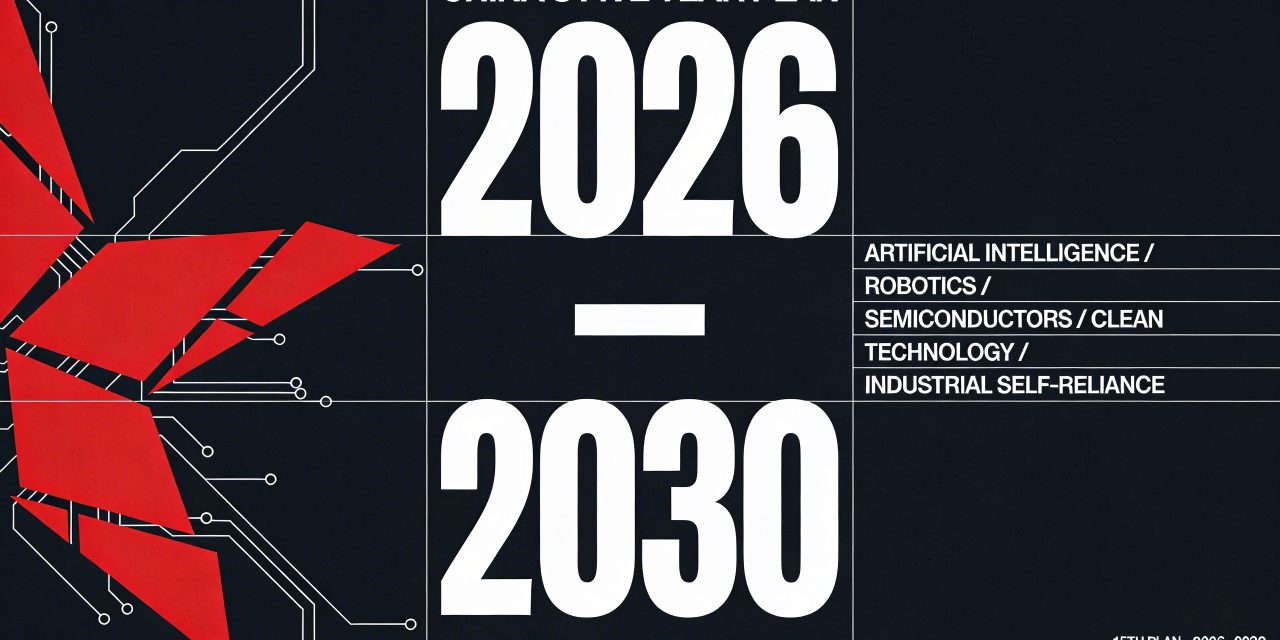
China’s 15th Five Year Plan, covering 2026 to 2030, is not just another policy document. It is a detailed signal of where capital, political support and industrial effort are expected to go over the next five years. If you want to understand where China is heading, and where investment is likely to concentrate, this plan matters.
The broad direction is clear. China wants faster progress in advanced manufacturing, stronger technological self reliance, deeper digitalization of industry, more scale in strategic sectors and better resilience against external pressure. At the same time, Beijing says it wants to strengthen domestic demand and make the economy more attractive to foreign capital. Those two goals sit next to each other throughout the plan, but they do not carry equal weight in practice.
For investors, technology companies and anyone following AI, robotics, semiconductors or energy systems, the message is straightforward. China is doubling down on industrial capacity and on the technologies it sees as foundational to long term power.
What the 2026 five year plan is really trying to do
At the highest level, the plan tries to solve three problems at once.
- Protect growth while China deals with weaker property markets, lower foreign investment and softer household consumption.
- Reduce dependence on foreign technology in sectors that matter for security and industrial competitiveness.
- Create new growth engines in fields such as AI, robotics, integrated circuits, biotech, advanced batteries and clean energy infrastructure.
That combination explains the structure of the plan. It is not simply about innovation for its own sake. It is about building industrial ecosystems that can keep China competitive even if trade frictions, export controls or geopolitical tensions intensify.
That is also why the plan puts so much emphasis on the full innovation chain. China is not only targeting frontier research. It is trying to connect research, pilot programs, supply chains, commercialization, financing and deployment. In practical terms, that means more policy support for taking technologies from lab to factory and then from factory to market.
Why AI and robotics sit near the center of the strategy
For readers of a technology focused site, one of the most important takeaways is how central AI and robotics have become. The plan identifies embodied AI, intelligent systems and advanced industrial technologies as part of the next wave of strategic industries. That matters because China is not looking at AI purely as software. It is treating AI as an enabling layer for manufacturing, logistics, healthcare, mobility and defense adjacent industrial capabilities.
Robotics fits especially well into China’s long term economic logic. The country faces rising labor costs, an ageing population and pressure to move traditional manufacturing up the value chain. Humanoid robots may get the headlines, but the deeper story is broader automation. Industrial robots, machine vision, edge AI, smart sensors and autonomous systems all help China increase productivity without depending on endless labor expansion.
Embodied AI also aligns with China’s strength in manufacturing. Building competitive AI systems is one challenge. Building AI systems that can be integrated into devices, factories, warehouses and physical machines is another. China wants to compete in both.
The two tracks of China’s industrial policy
The plan effectively runs on two parallel tracks.
1. Upgrading traditional industry
China wants to move established sectors such as steel, petrochemicals, shipbuilding, electronics, machinery, textiles and industrial equipment toward higher value production. This means better components, better materials, more precision, more software integration and more specialized products.
That sounds less exciting than AI or quantum technology, but it may be just as important. Countries do not become industrial leaders by focusing only on flashy sectors. They also need advanced bearings, control systems, industrial software, measurement instruments, hydraulic systems and reliable machine tools. China’s planners understand that weak links in these areas can limit the whole system.
2. Scaling emerging industries
The second track focuses on industries Beijing sees as future engines of growth. These include integrated circuits, embodied AI, biomanufacturing, new type batteries, green hydrogen, commercial aerospace, low altitude equipment, brain computer interfaces and high end medical devices.
What is notable here is not just the list itself, but the intention to commercialize faster. The plan talks about building the policy environment, financing channels and regulatory mechanisms needed for emerging sectors to grow. That includes experimentation with approaches such as sandbox style regulation in new business areas.
In other words, China wants fewer gaps between invention and industrial scale.
Self reliance is not isolation
One of the easiest mistakes is to read the plan as a simple retreat from globalization. It is more precise to say that China wants selective openness with strategic control.
On one side, the plan pushes hard for breakthroughs in semiconductors, industrial machine tools, advanced materials, software, instruments and biomanufacturing. It speaks openly about taking extraordinary measures in core technologies where dependence on foreign suppliers remains a vulnerability.
On the other side, China is still inviting foreign participation in areas it sees as useful for upgrading the economy. The plan points to advanced manufacturing, modern services, high technology and environmental sectors as areas where foreign capital can still play a role. There is also language about reducing barriers, revising the negative list for foreign investment and expanding access in parts of telecom, healthcare and biotechnology.
That balance matters. China is not saying foreign firms are no longer welcome. It is saying they are welcome where they support China’s strategic priorities and where the terms increasingly fit China’s policy architecture.
What this means for foreign investors
For foreign investors, the opportunity is real but more conditional than before. The old China story often centered on scale, labor and market access. The new one is more selective. To benefit, companies increasingly need to align with sectors Beijing wants to develop, contribute to local innovation or fit into domestic industrial upgrading.
Several areas stand out.
- Advanced manufacturing where foreign firms can bring process expertise, specialized equipment, high performance materials or niche technologies.
- R&D collaboration in fields where China still wants world class capability and local talent development.
- Healthcare and biotech where regulatory opening may create new room for investment.
- Digital and industrial infrastructure tied to automation, software, sensors, connectivity and smart production.
- Energy and environmental systems including batteries, hydrogen related infrastructure and industrial efficiency technologies.
But the risks are just as important. Competition will intensify in sectors receiving strong state backing. Policy shifts can change the economics of a market quickly. Local champions may gain advantages through procurement, financing, scale or data access. For companies entering China, having a technical edge is no longer enough. Strategic fit matters more than ever.
The consumption question remains unresolved
The plan gives significant space to domestic demand. Beijing wants higher incomes, better employment, a more stable property market and stronger service consumption. It also wants households to spend more on cars, tourism, leisure, culture and other higher value categories.
Still, there is a reason many analysts remain skeptical. China has talked about boosting consumption before, yet the core policy structure still favors industrial investment. Household consumption has remained low relative to major economies, and deeper rebalancing would require harder reforms in welfare, income distribution, labor conditions and the financial system.
This tension sits at the heart of the 2026 to 2030 plan. China knows it needs stronger domestic demand. But it continues to place its biggest strategic bets on production, technology and supply side upgrading. That does not mean consumption is irrelevant. It means industrial policy still appears to be the stronger priority.
Clean energy is also industrial strategy
Another major theme is the close link between climate policy, energy security and industrial expansion. China’s plan supports more non fossil energy, more clean technology deployment and more electrification. At the same time, it does not frame decarbonization as a simple retreat from fossil fuels. It frames it as a managed buildout of infrastructure while preserving energy security.
That is why sectors such as batteries, hydrogen, grid infrastructure, electric vehicles and energy storage matter so much. They are not just climate tools. They are pillars of industrial competitiveness.
For the rest of the world, this has two consequences. First, China is likely to remain a dominant force across major clean tech value chains. Second, overcapacity and export pressure in some sectors may continue, especially where domestic production grows faster than local demand.
Where the strongest signals for future investment are
If you strip away the formal language, the strongest investment signals in the plan point toward a few clear clusters.
AI and embodied intelligence
Expect continued support for AI applications in manufacturing, mobility, logistics, public services and industrial automation. China wants AI to improve productivity and support new products, not only generate consumer apps.
Semiconductors and core components
Integrated circuits remain central. So do machine tools, industrial software, sensors, advanced materials and precision components. These less visible layers are essential to self reliance.
Robotics and automation
This is where labour pressure, productivity goals and industrial policy align. China has every incentive to accelerate robot adoption and to build domestic champions in the process.
Biomanufacturing and medical technology
The plan places these sectors in the strategic category, suggesting long term policy backing and commercialization support.
Energy storage, batteries and hydrogen
These are tied to both decarbonization and industrial power. They will remain key sectors for capacity buildout, technology competition and international trade tension.
Low altitude and aviation systems
This includes drones, low altitude equipment and commercial aerospace. These sectors combine manufacturing, autonomy, regulation and national prestige.
What the plan says about China’s future model
The most important conclusion is that China is not moving toward a lighter, more consumer led and less state shaped economic model. It is refining a model where industrial policy, technology strategy, national security and infrastructure planning are more tightly integrated.
That does not mean every target will succeed. Large plans always contain contradictions. Some sectors may attract too much capital. Some may suffer from weak profitability or destructive competition. Some promised openings for foreign firms may prove narrower in practice than they look on paper.
But the direction is hard to miss. China wants to be stronger in the technologies that define industrial power. It wants more control over critical supply chains. It wants new domestic champions in sectors that connect software, hardware, energy and advanced production. And it wants all of this while preserving enough openness to keep attracting useful capital, talent and know how.
Why this matters beyond China
This plan is not only about China. It is also a message to the rest of the world. If China keeps building scale in AI enabled manufacturing, robotics, batteries, semiconductors and industrial infrastructure, other regions will face sharper questions about competitiveness, resilience and dependence.
For Europe and for global investors, the issue is no longer whether China has an industrial strategy. It clearly does. The real question is how everyone else responds to an economy that coordinates technology, infrastructure, financing and market shaping more aggressively than most liberal market systems can.
That is why the 2026 five year plan deserves attention far beyond policy circles. It offers a map of where China intends to place its next major bets. If you work in AI, robotics, semiconductors, advanced manufacturing or clean technology, this is one of the clearest guides to where competition and opportunity are likely to intensify before 2030.
A sharper way to read the next five years
The best way to read China’s 2026 to 2030 plan is not as a promise of balanced reform, but as a blueprint for techno industrial concentration. Consumption support is present, foreign investment is still invited in selected areas and regulatory language signals some openness. Still, the deepest conviction running through the document is that future strength comes from building technological capacity, industrial depth and strategic autonomy.
For investors, that means looking beyond headline GDP and focusing on where policy, financing, infrastructure and national priorities overlap. In China over the next five years, that overlap is strongest in AI, robotics, semiconductors, advanced industry and clean technology. That is where the future is being engineered.