SpaceXSI, the AI company that was called xAI until this year, has published how its data science team built Data Bot: a shared AI teammate in Grok Bot that queries the company warehouse, runs analyses and builds charts for anyone who asks, in the app or in Slack. The company estimates it absorbed about 70 hours of data science work in a single week. The announcement of 2 November 2026 reads like a product story, but the useful part is the operating model around the bot. It only reads from approved tables. It works from skills the data team maintains. And everything it learns on the job is held as a proposal until a manager approves it. Those three controls are what make a data agent safe to hand to a whole organisation, and they apply whether you use Grok Bot, Databricks Genie or an agent you build yourself. This article explains the pattern, reads the numbers critically, and sets out what a European organisation needs to settle before it runs a pilot.
What SpaceXSI actually announced
Data Bot is a Team Bot, the shared kind of bot that Grok Bot introduced in September 2026. A personal bot learns from one person. A Team Bot is shared with a team or a whole company and combines shared context (files, instructions and skills), shared plugins and credentials, and a shared memory. Each person’s conversation with it stays private. Teams can also invite it into a Slack channel, where it has its own handle.
The data science team at SpaceXSI built Data Bot for internal use because it had become a bottleneck. It received dozens of one-off requests a day that were simple in themselves but still needed a data scientist’s knowledge of which table, which definition and which trap. SpaceXSI also lists Data Bot among four pre-built Team Bots customers can add, next to a Customer Bot, an EPD Teammate and a Marketing Bot. What the post of 2 November describes is the internal version. According to the Team Bots announcement of 28 September, the analytics team had by then spent two years building a skills library for more than 45,000 tables. A customer gets the skeleton, not that library.
How the data team taught it
Data Bot knows nothing about SpaceXSI’s data on its own. Everything it can do comes from skills, the same kind of procedural documents that Anthropic uses for Agent Skills. SpaceXSI groups them in four areas.
- Metrics and analysis. Core metrics such as active users and revenue, with their source tables and query logic, plus the routine for a spike or drop: break it down by segment or region, and check for holidays or logging changes before attributing anything to a product change.
- Experiments. A/B test setup, power analyses, exposure balance and sample bias checks, rollout planning, and writing the readout once a test reaches power.
- Charts and dashboards. Line charts for trends, horizontal bars for categories, the team’s chart theme, and how to turn a chart from a chat into a Databricks or Hex dashboard.
- Data engineering. Writing and reviewing dbt models, conventions for pipeline alerts, and adding event logging to a new feature so usage is measurable from launch.
The bot queries the warehouse with shared, read-only credentials, limited to approved tables in Databricks, and connects to Datadog, Hex and Statsig. Teams can ask it for a one-off answer, a full analysis with a written report and charts, a reusable Hex dashboard, or a scheduled weekly metrics post in a Slack channel that colleagues can question.
The three controls that make it shareable
Most “chat with your data” demos fail at the moment you give them to a hundred colleagues. SpaceXSI’s design holds up because of three decisions, and each one is a governance control in disguise.
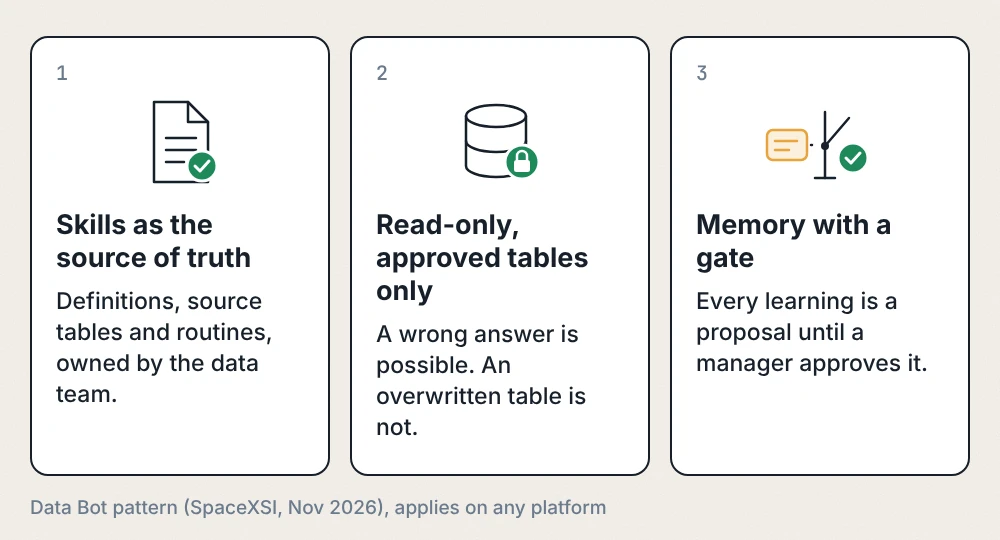
Read-only, on approved tables. The bot cannot write, drop or update anything, and it cannot wander through the whole warehouse. That limits the blast radius of a wrong query to a wrong answer. It also gives you a single service account to log and audit.
Skills as the source of truth. Metric definitions, join paths and investigation routines live in documents the data team owns and versions. The model does not guess what “active” means; it reads it. When the definition changes, one file changes, and every answer after that follows.
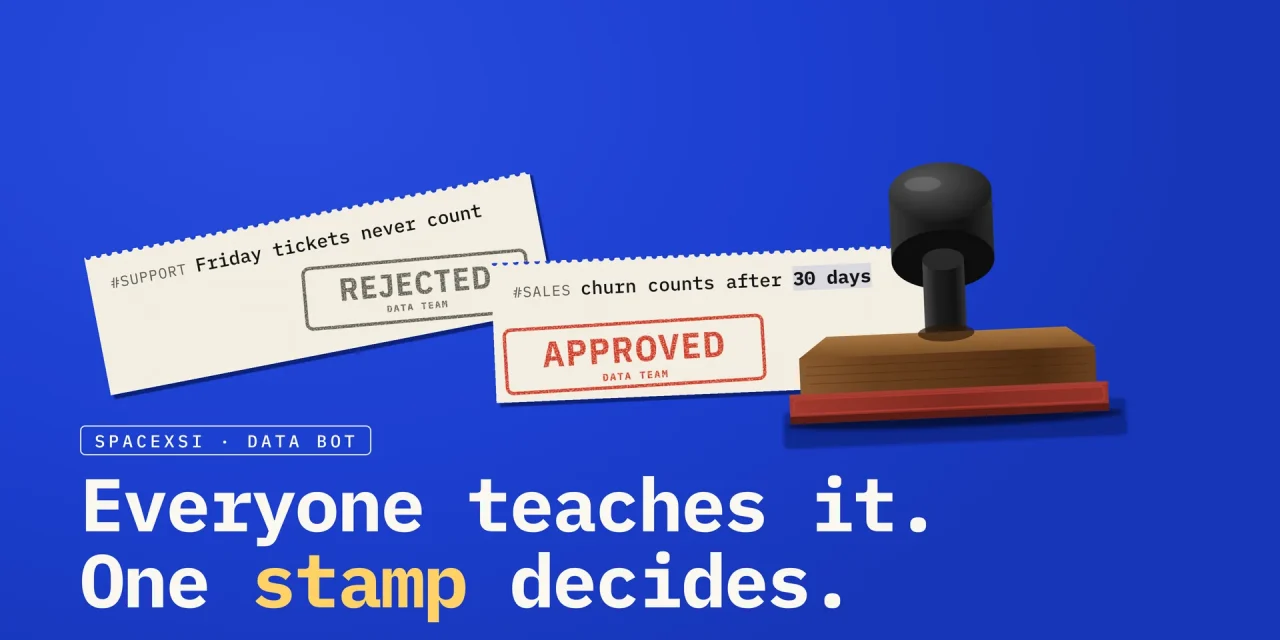
Reviewed memory. Data Bot learns from daily use: a corrected query, a regional holiday that explained a dip, who owns which pipeline. Those learnings go into shared memory only after a Team Bot manager approves or rejects them. Without that gate, “remember this” becomes a write operation on the company’s truth, open to anyone with a Slack account. With it, memory is a queue of proposals and the data team stays the editor. This is the same idea that Open Knowledge Format applies to company knowledge, where every fact carries an owner, a status and a date after which it should be rechecked.
Seventy hours, read carefully
SpaceXSI writes that Data Bot handled an estimated 70 hours of work in one week that would otherwise have landed on the data science team. It is the company’s own estimate, it has not been audited, and the post does not say how it was counted. It is also smaller than it sounds: roughly two full-time analysts. The more telling lines are the ones that follow. The team still handles the complex analyses that require judgement, and it is learning where the bot needs more guidance. The examples SpaceXSI gives are consistent with that. A product manager gets a headline and a chart within minutes and asks follow-up questions in the same thread. A lifecycle marketer hands over a Braze campaign ID and learns how many email recipients later switched plans, a number Braze’s own conversion metric could not give. The director of revenue growth tracks weekly progress against targets and has charts made for presentations. None of this is frontier data science. It is the queue that used to sit in front of it.
What the benchmarks say about agents on real data
Connecting a language model to a warehouse is easy. Getting correct answers is not. Spider 2.0, a benchmark built from real enterprise databases with inconsistent naming and sparse documentation, makes the gap visible: an agent based on o1-preview solved 91.2 percent of tasks on the older academic benchmark Spider 1.0 and 21.3 percent on Spider 2.0. Same model, real data.
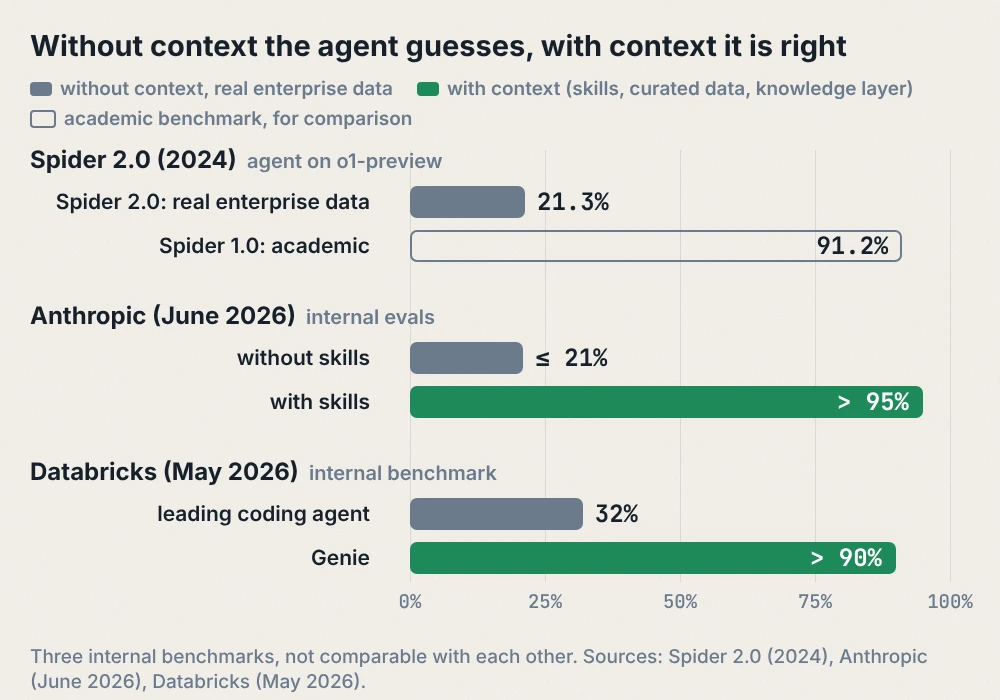
Everyone who closes that gap does it the same way: by adding context the model cannot infer. Anthropic described in June 2026 how it built its own analytics agent. Without skills, accuracy on its internal evals stayed at or below 21 percent. With skills, canonical datasets and a few dozen test questions per domain it rose above 95 percent. Databricks reported in May 2026 that Genie went from 32 percent to over 90 percent on an internal benchmark, against a leading coding agent, by indexing enterprise context and running several reasoning paths in parallel. Data Bot follows the same recipe: the skills are the context and the data team is the editor. The three figures come from three internal benchmarks and cannot be compared with each other, but they point the same way. Anthropic added one lesson SpaceXSI does not mention: in the month after launch, before maintaining the skills became a fixed process, offline accuracy drifted from about 95 to 65 percent. Skills decay. Reviewed memory catches some of that drift. Someone still has to maintain the skills.
What European organisations must settle first
Data Bot is available in principle: Team Bots are in public beta on Grok Bot’s Teams and Enterprise plans, Grok Bot comes with paid Cursor plans and SuperGrok subscriptions, and SpaceXSI publishes no country restrictions. Pricing for Team Bots is not published. The open questions are about data, and a data agent is the one agent that touches your most sensitive asset by design.
| Question | What the documentation says | What to do before a pilot |
|---|---|---|
| Where does processing happen? | The Grok Bot security documentation states that Grok Bot computers run in the United States and that the only residency programme on offer is US-only. The teams and enterprises documentation refers other residency commitments to the account team. | Treat every query result, chart and memory entry as a transfer outside the EU. Get the data processing agreement and standard contractual clauses in place, and record a transfer impact assessment. |
| Is our data used for training? | With Privacy Mode enabled, customer data is not used for training; the Legacy Privacy Mode blocks Grok Bot entirely. | Confirm Privacy Mode is on for the whole team and that nobody is still on the legacy setting. |
| What can the bot reach? | SpaceXSI’s own setup uses shared read-only credentials on approved Databricks tables. On a shared Bot, credentials are stored on the Bot by its owner or a manager through a masked secret card; the personal Vault is not available on shared Bots, and the documentation says never to paste credentials into chat. | Create a dedicated read-only service account on a short list of tables. Keep direct identifiers out of those tables or pseudonymise them. Log every query. |
| Who decides what the bot remembers? | SpaceXSI’s post says Team Bot managers approve or reject proposed memory additions before they are shared; the product documentation only says the Bot tells you when it saves something for the team. | Name the managers, agree a review cadence and a rule for expiring learnings. Keep the source of truth in the skills, not in memory. |
| Can we audit what it did? | Audit logs on Enterprise cover admin and control-plane events. Action Recording, which logs tool calls, approval decisions and shell commands as metadata without arguments or content, is Enterprise only, off by default and kept for 90 days. | Turn Action Recording on for the pilot and export it through OpenTelemetry to your own collector. Without it you cannot reconstruct which tools an answer used. |
| Does the AI Act apply? | An internal analytics assistant is not on the high-risk list in Annex III as such. | Apply the AI literacy duty of Article 4 to the people who will act on its answers, and keep humans in the loop for decisions about individuals, where Annex III can apply. |
One more point sits outside the documentation. Ireland’s Data Protection Commission opened an inquiry into X in April 2025 over the use of EU users’ public posts to train Grok, and Grok’s record on content safety has been a recurring story in the European press. That history does not change what Data Bot does with your warehouse. It does affect how your data protection officer and your board will read a proposal that puts a SpaceXSI agent on your customer data, so address it in the proposal rather than hoping it does not come up.
A 30-day pilot that copies the pattern, not the vendor
The pattern is portable. You can run it on Grok Bot, on Claude with a data connector, on Databricks Genie, or on your own agent harness. Whatever you pick, the work is the same.
- Week 1, pick the tables and write the first skills. One domain, such as marketing campaigns or product adoption. A dozen approved tables with one owner per metric. For each metric the definition, source table and query logic. For each routine the steps and the traps: holidays, product changes, seasonality.
- Week 2, lock access and build the evals. A read-only service account, logged. Twenty to forty question-and-answer pairs with a fixed snapshot date. Set a pass rate the bot must reach before anyone outside the data team may use it.
- Week 3, open it to one team in one channel. Every proposed learning is read by a named reviewer the same day. Keep a list of what the bot got wrong and why; most entries will be missing context, not model failures.
- Week 4, measure and decide. Count the requests the data team no longer received, the eval pass rate at the end versus the start, and the number of learnings approved, rejected and expired. Decide on a second domain only if the pass rate held.
What SpaceXSI reached with two years of skills, you will not reach in thirty days. A shorter queue in front of your data team is a realistic outcome, and the controls you build for the pilot are the ones you will keep when the model underneath changes. As we argued in models are rented, context is owned, the skills and the review process are the part you own.
Frequently asked questions
Is Data Bot a separate product?
No. It is one Team Bot inside Grok Bot, built by SpaceXSI’s data science team for internal use and offered as a pre-built Team Bot that customers can add and teach with their own skills.
Can it modify data in our warehouse?
Not as SpaceXSI configured it. The bot uses shared credentials that can only read, and only from approved tables. How you configure your own instance is up to you.
What happens when someone teaches it something wrong?
The learning is proposed, not stored. Team Bot managers approve or reject it, and only approved learnings reach everyone else.
Does it work with Snowflake or BigQuery?
SpaceXSI only describes Databricks, Hex, Datadog and Statsig. Team Bots can call other APIs through stored credentials, but you will have to test your own warehouse.
Where is our data processed?
On Grok Bot’s cloud computers, which the security documentation places in the United States, with other residency commitments available only through the account team. The bot queries your warehouse wherever it lives, but questions, results and memory are processed there.
The approval button is the product
Every vendor now sells a data scientist for everyone, and the models behind those promises look more alike every quarter. What separates a useful data agent from a confident one is who writes the context and who decides what it may remember. SpaceXSI put that decision with the data team, behind a button that approves or rejects. If you take one thing from Data Bot, take the button.