Dulo, the new company of self-driving pioneer Sebastian Thrun and serial founder Adrian Aoun, has raised a $130 million seed round to build foundation models that design and validate hardware such as planes and cars. It has not announced a product, customers or a launch date. For European engineering organisations the more useful question is not whether Dulo will work, but where the value in AI-driven engineering will sit, and who will own the data that makes it work.
This article covers what Dulo has disclosed, how its round compares with the rest of a fast-growing market, why validation rather than generation is the hard part, and what manufacturers in Europe can do now.
What Dulo says it is building
On 29 October 2026 Aoun wrote on LinkedIn that he and Thrun founded Dulo earlier this year “on a mission to create an Engineering Superintelligence, building foundation models for hardware design”, as quoted by Pulse 2.0. The Information, which broke the news, describes models that can design planes, cars and other complex hardware.
According to Dealroom’s summary of that report, Dulo wants to automate both design and validation and leave manufacturing to others. Former Autodesk CEO Carl Bass is an adviser. In August a bare Stanford-hosted page already promised “manufacturing at lightspeed”.
A foundation model for hardware differs from a language model in what it learns from. Instead of text, it needs geometry, materials, simulation results, test data and past designs. And its output has a harder test to pass: a paragraph can be slightly wrong, a load-bearing bracket cannot.
Who is behind it
Thrun led the Stanford team that won the 2005 DARPA Grand Challenge, started Google’s self-driving project that became Waymo, co-founded Google X and co-founded Udacity. He also ran Kittyhawk, Larry Page’s flying-car company, which wound down in 2022 without bringing an aircraft to market.
Aoun sold his first AI company, Wavii, to Google and later ran special projects for Larry Page. His healthcare company Forward closed abruptly in November 2024, a year after raising $100 million for its AI-powered CarePods. Torch, a health start-up founded by former Forward staff with Aoun’s involvement, was acquired by OpenAI in January 2026.
Investors are backing people here: two founders with large wins and large failures, both with experience of what happens when software meets the physical world.
A seed round the size of a growth round
The median AI seed round between November 2025 and October 2026 was $8 million across 181 tracked deals, according to AI Funding. Dulo raised roughly seventeen times that. Backers named by Aoun include Marc Benioff, John Doerr, Eric Schmidt, Ram Shriram, Yuri Milner, Construct Capital, Lowercarbon Capital, BoxGroup, SV Angel and Haun Ventures. No valuation or lead investor has been disclosed.
Dulo joins a crowded and expensive field. Earlier in October, Arda raised $232 million for an IDE for manufacturing engineering. Here is where the larger rounds in AI that designs and validates hardware stand on 1 November 2026.
| Company | Base | Focus | Latest round |
|---|---|---|---|
| Prometheus (Jeff Bezos, Vik Bajaj) | US | AI for invention and physical engineering | $12 billion, June 2026 |
| PhysicsX | London | Physics AI that replaces slow simulations | $300 million at a $2.4 billion valuation, June 2026 |
| Vinci | Palo Alto | AI simulation for chips and other hardware | $250 million at a $1.5 billion valuation, October 2026 |
| Dulo | San Francisco | Design and validation of hardware | $130 million seed, October 2026 |
| Neural Concept | Lausanne | CAD-native AI that evaluates designs | $100 million, December 2025 |
| Circuit Mind | London | AI agents that design and verify circuit boards | $25 million, October 2026 |
| Dynatomics (Larry Page) | US | AI-optimised designs for manufacturing | not disclosed |
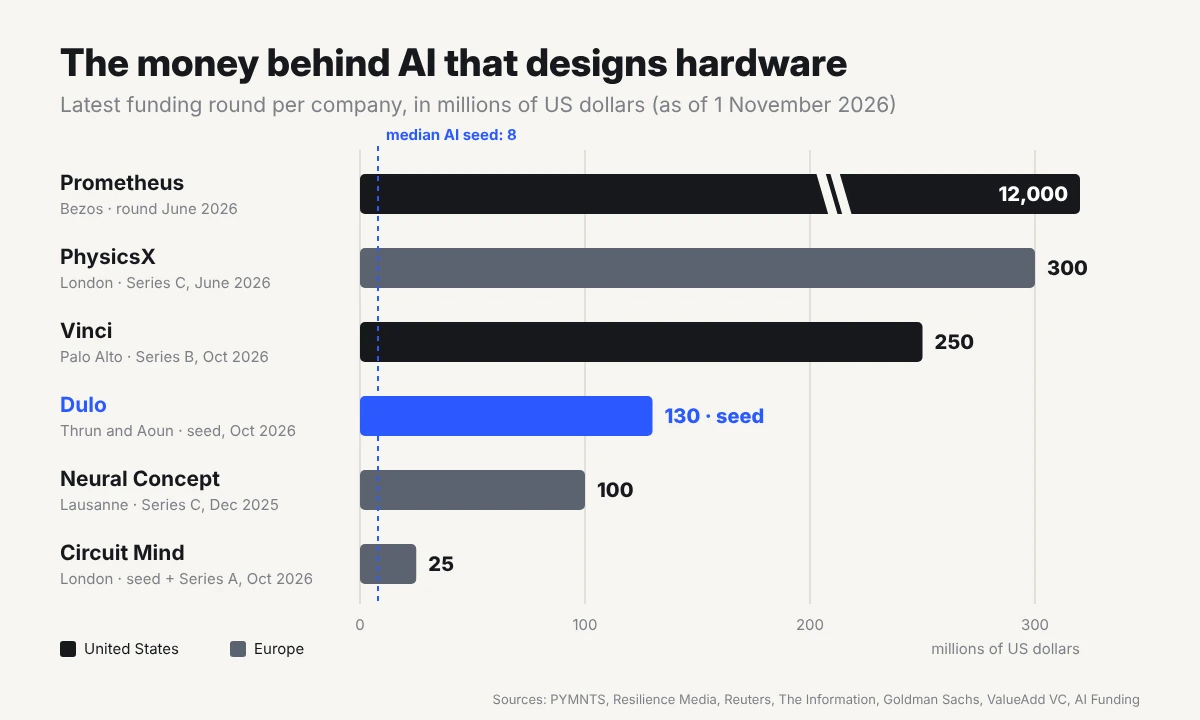
The contrast is telling. The European players are further along: PhysicsX and Neural Concept sell to industrial customers today, and Neural Concept counts General Motors, Safran, Renault Group and several Formula 1 teams among its customers. Two of the largest US rounds, Prometheus and Dulo, went to companies that have not yet shown a product. That is not a verdict on who wins, but it does suggest US investors are betting earlier and bigger.
Why validation, not generation, is the hard part
Faster design is worth a lot of money. Traditional carmakers need 48 to 54 months to develop a new model, against 24 to 30 months for new players such as China’s EV makers, according to Bain. Software is only part of the explanation, but a large share of every programme is spent designing, testing, changing and testing again. That is the loop Dulo wants to automate, although it has not said how much time it expects to save.
Generating a shape is the easy part. Text-to-CAD tools already turn a description into a 3D model, yet the output is often bare geometry without tolerances, materials, revision history or a bill of materials, as engineering-AI vendor Leo AI points out. In aerospace, automotive and machinery, safety-critical parts also need a traceable argument for why they are safe. An engineer who signs off a design needs to see the reasoning, not just the result.
That is where the real moat lies. Models for validation learn from simulations, measurements and test results that were checked against reality. Most of that data sits inside manufacturers and their suppliers, and in our view Europe’s industrial base holds a large share of it. Whoever gets access to it on good terms builds the better model. Whoever hands it over cheaply may end up renting back their own know-how.
What European engineering organisations can do now
- Treat design and test data as a strategic asset. Clean, searchable simulation results and test records will decide how much value you get from any engineering model, whether from Dulo, a European vendor or your own team.
- Read the training clauses. Before you upload CAD files or test data to any AI vendor, check whether they can be used to train shared models, where they are stored and who owns derived models.
- Start where AI already pays off. Simulation acceleration and automated design checks deliver time savings today without rebuilding your process. Our look at SKY-001 for CAD and BIM teams shows how to test such a tool on real work.
- Ask for evidence that matches your risk. Benchmarks on real tasks, parts that were actually built and tested, comparison with your current tools, and a clear account of how the model validates its own output.
- Keep the human sign-off. Certification and liability still run through a named engineer who approved a design and can explain why. Build AI into that chain, not around it.
For the wider picture of how AI is moving into machines, factories and products, see our overview of physical AI in the next decade.
Frequently asked questions
What is Dulo?
Dulo is a San Francisco AI company founded in 2026 by Sebastian Thrun and Adrian Aoun. It builds foundation models to design and validate hardware such as aircraft and cars, and raised a $130 million seed round in October 2026.
Can companies use Dulo yet?
No. As of 1 November 2026 Dulo has not announced a product, a public demo or a launch date.
Are there European alternatives?
Yes, though none does exactly what Dulo promises. PhysicsX (London) and Neural Concept (Lausanne) speed up simulation and design evaluation, and Circuit Mind (London) checks electronics designs. All three already have industrial customers.
Drawings are cheap, proof is not
An AI that draws a convincing aircraft already exists. An AI that can show it will fly, and that a factory can build it, does not. Dulo’s investors are betting $130 million that Thrun and Aoun can close that gap. For European manufacturers the opportunity runs the other way: the proof these models need is largely in their own archives, and that gives them more say over this market than the funding table suggests.