GLM-5.3-FlashX-Legal is the API name under which Z.ai priced GLM-Legal in late October 2026 and listed it on OpenRouter on 2 November, the legal variant of its small GLM-5.3-Flash model. It reads contracts, case files and company records, reasons about them and writes the result back into Word as tracked changes, at $0.37 per million input tokens and $1.25 per million output tokens. On Harvey’s Legal Agent Benchmark it fully completed 19.2% of real law-firm tasks for about $0.15 a task, where Gemini 4 Argon scored 19.6% for $10.55. That is the headline. The fine print matters more for a European legal team: the weights are closed, direct API access is by application, the data route runs through Singapore, the independent leaderboard has since changed version without the model on it, and the signature at the bottom of the document is still yours.
What GLM-5.3-FlashX-Legal is, and why the name changed
Z.ai, the international brand of Beijing-based Zhipu and one of the labs in our overview of China’s most innovative AI labs, announced GLM-Legal on 12 October 2026 in a research post titled “GLM-Legal: Advancing Agentic Legal Intelligence”. The base is GLM-5.3-Flash, a mixture-of-experts model with 320 billion total and 18 billion active parameters, native image and video input, a 1 million token context window and 128K output tokens. Flash shipped on 26 August under an MIT licence, after a week of anonymous testing on OpenRouter as “Ox Alpha”. On 18 September Zhipu added GLM-5.3-FlashX, the same weights served on faster infrastructure at up to 200 tokens per second and 2.5 times the price. Chinese reporting at the time noted that the inference cluster runs on more than 100,000 domestic chips.
The legal model was a gated beta for three weeks. On 29 October it appeared in AutoClaw, Z.ai’s desktop agent, and on 2 November it surfaced on OpenRouter and Vercel’s AI Gateway as glm-5.3-flashx-legal, at the FlashX price that Z.ai had quietly added to its pricing page about a week earlier. So the name tells you two things: it is the legal post-training on top of Flash, and it is served on the fast tier. Zhipu’s pricing page lists it at ¥2 in, ¥7 out and ¥0.57 per million cached tokens in China, the same as FlashX. In its documentation Zhipu still says API access is available to selected enterprise customers by application, so the gateway listings are the practical route for everyone else for now. Thinking mode cannot be switched off, which matters for cost and latency.
One more clarification, because Chinese and Western coverage disagree. QbitAI’s launch piece calls GLM-Legal an open-source model and Vals AI lists it as open weights. Z.ai has published no weights, the OpenRouter listing carries no weights link, and a Beijing tech outlet summarising the Sina Finance report stated plainly that, unlike the open GLM-5.3-Flash, the legal version is not offered as open weights for now. Treat it as a closed model on an open base.
What it did in Z.ai’s own demos
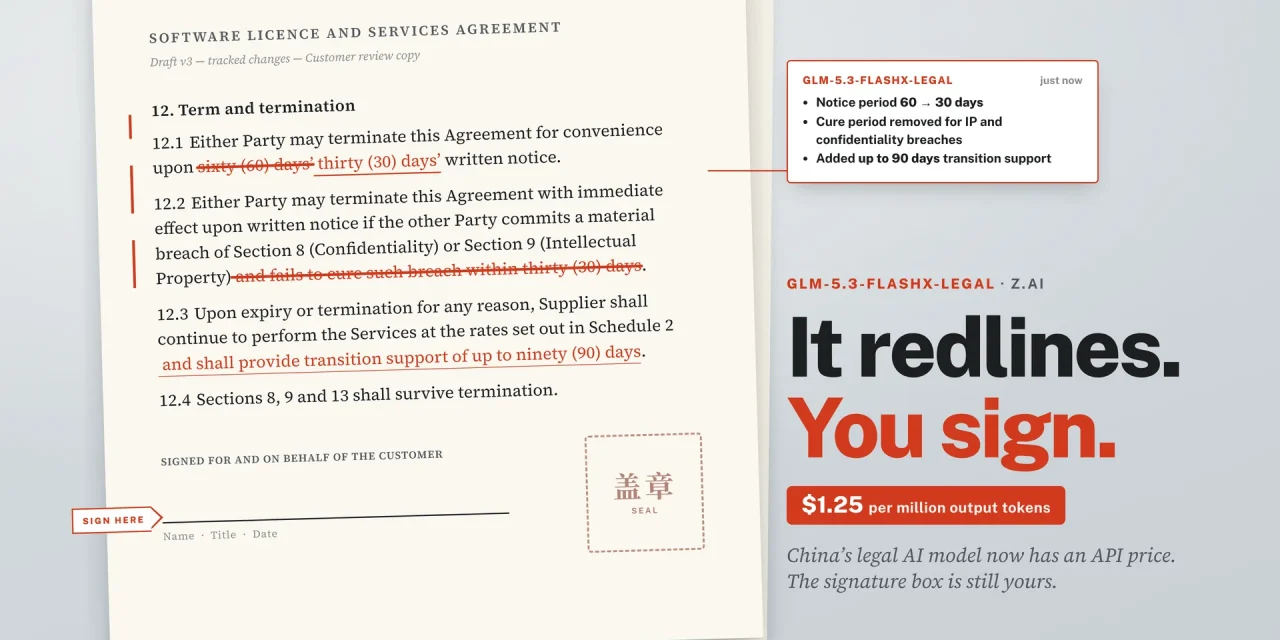
Z.ai published three side-by-side comparisons with the base model, and the Chinese write-ups of them are more detailed than the English ones. In the first, a client wants to switch software vendors and asks for a review of the exit clauses. GLM-5.3-Flash suggested shortening the notice period and asking for data back. GLM-Legal cut the termination-for-convenience notice from 60 to 30 days, removed the cure period for breaches of IP, confidentiality and data-security obligations so the client can terminate immediately, pointed at the ownership clause (work product belongs to the client) to demand return of all deliverables including unfinished and unpaid ones, and added up to 90 days of transition support. In AutoClaw those edits land in the Word file as tracked changes and comments.
The second demo is evidence analysis across roughly 40 project documents. Both models spotted that a progress report to the client claimed 60% completion while an internal snapshot recorded about 41%. The base model summarised and advised further review. GLM-Legal linked the gap to earlier risk warnings and internal mail asking to keep the risk quiet and keep invoicing, cited the document numbers, separated facts from inference and turned it into a line of argument. The third demo asks for a pre-launch privacy checklist for websites in Singapore, Malaysia and Indonesia; the model mapped each vendor (cloud, payments, email, analytics, CDN) to where its data goes and produced a prioritised action list with references, down to routing unsubscribe requests into a suppression list.
These are vendor demos, chosen to flatter. They do show the design goal: not a legal chatbot but an agent that reads a folder, decides, and hands back a document a lawyer can mark up.
Law school first, then a simulated law firm
Zhipu describes the training in two stages, which QbitAI summarised as “first law school, then an internship at a simulated firm”. Stage one is mid-training on a large legal corpus on top of GLM-5.3-Flash, so the model learns concepts, statutes and interpretive frameworks in dense context. Stage two is reinforcement learning in “tens of thousands” of task environments built from real legal workflows: read the materials, analyse, advance the task, deliver.
Two details stand out. First, Zhipu says the model and its agent harness were improved together: failures during training exposed bottlenecks in the harness (context management, tool calls, workflow state), the harness was changed, and the model learned to work within the new constraints. That is the same lesson Google drew with Harness², applied to a vertical. Second, practising lawyers graded outputs on four criteria, issue coverage, grounded argument, format compliance and zero rework, and those grades were turned into training signal. The vendor has not published the data mix, the share of Chinese versus English or common-law material, or any contamination check against the benchmarks. Harvey, for comparison, said its Tenet model was trained on synthetic material, public legal data and lawyer-written mock matters, not client files; Zhipu has made no equivalent statement that we could find.
What the benchmarks say, and what they do not
Harvey’s Legal Agent Benchmark (LAB) is the one that counts here. Harvey, the legal-AI company valued at $15.5 billion since September, open-sourced it on 6 May 2026: more than 1,200 tasks at launch across 24 practice areas, graded against over 75,000 expert-written rubric criteria, roughly 60 per task. A task passes only if every criterion passes. Vals AI runs a held-out set with two LLM judges and publishes the leaderboard.
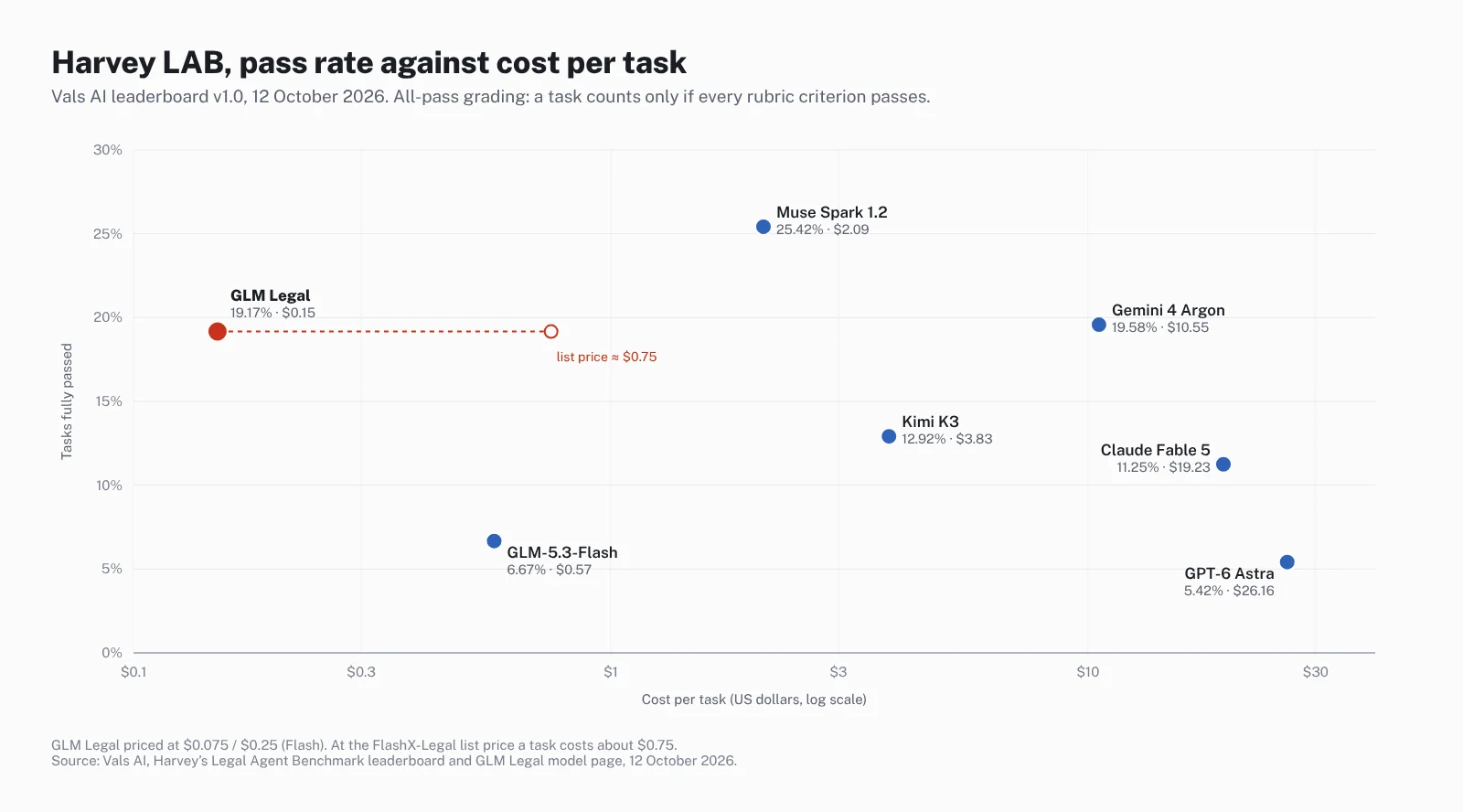
On 12 October Vals measured GLM Legal at 19.17% (±3.25), sixth of 77 models that day and seventh of 79 shortly after, at $0.15 per task and about 1 hour 12 minutes per task. The base model scored 6.67%, the flagship GLM-5.3 8.3%. The model passed 92.5% of individual criteria, up from 82.2% for Flash; it scored higher because it missed fewer small requirements and therefore finished whole tasks.
| Model | Harvey LAB, all-pass | Cost per task | Time per task |
|---|---|---|---|
| Muse Spark 1.2 (Meta) | 25.42% | $2.09 | about 24 min |
| Gemini 4 Argon (Google) | 19.58% | $10.55 | about 44 min |
| GLM Legal (Z.ai) | 19.17% | $0.15 | 1 h 12 min |
| Kimi K3 (Moonshot) | 12.92% | $3.83 | 14 min |
| Claude Fable 5 (Anthropic) | 11.25% | $19.23 | 27 min |
| GLM-5.3-Flash (base) | 6.67% | $0.57 | 52 min |
| GPT-6 Astra (OpenAI) | 5.42% | $26.16 | 25 min |
Source: Vals AI, Harvey LAB v1.0 leaderboard, 12 October 2026 (archived; v1.1 has replaced it). Vals priced both GLM models at $0.075 in and $0.25 out.
Three caveats, each of which changes the picture.
- The leaderboard moved. Between 27 and 30 October Vals published v1.1 of the benchmark, which fixes how the judges read tracked changes in DOCX files. Scores shifted a lot: Gemini 4 Argon now leads at 27.08%, Muse Spark Open has 25.00%, Mistral Large 4 17.50%, GLM-5.3 14.58%, GLM-5.3-Flash 10.42%, Claude Opus 5.5 9.17% and GPT-6 Astra 7.08%. GLM Legal is not on the v1.1 leaderboard as of 3 November. The 19.2% in Zhipu’s marketing is a v1.0 number; the model that writes tracked changes for a living has not yet been scored by judges that read them properly.
- The price changed. Vals ran the test at Flash pricing. At the FlashX-Legal list price a LAB task costs roughly $0.75, still about a fourteenth of Gemini 4 Argon, but the “70 times cheaper” line from the launch week is out of date.
- Research got worse. On Vals’ Legal Research Bench, which tests legal research with case-law search and the web, GLM Legal scored 41.83%, below its own base model at 45.19%. Vals wrote that its answers were mostly correct, earning 86.1% of rubric points, but fewer tasks passed in full. Specialising the model for document work cost it something in open-ended research.
On LegalBench, short non-agentic reasoning questions, Vals measured 86.23%, fourteenth of 150 on 12 October, one place above Kimi K3 and below Claude Fable 5’s 88.56%. Z.ai’s own chart adds PLawBench, a Chinese legal-practice benchmark: 77.3 against 77.7 for Claude Fable 5 and 73.8 for the base. That one is vendor-reported. Z.ai’s claim that the model “matches frontier models” holds for LegalBench and PLawBench, within a couple of points; on LAB it matched Gemini 4 Argon in October and nobody has re-run it since.
The Chinese stack around the model
What English coverage misses is that Zhipu does not sell GLM-Legal as a bare model. Its Chinese documentation recommends running it inside an agent connected to professional MCP servers, and names them: Beida Fabao (北大法宝) and Huayu Yuandian (华宇元典) for statutes, case law, company information and securities compliance; Tianyancha (天眼查) for corporate due diligence; Jianwei Data (见微数据) for A-share, NEEQ, bond and Hong Kong filings and IPO review records; Fatianshi (法天使) for contract templates; and two Zhipu MCP servers for drafting Word documents with format checks and for revising them with tracked changes and comments. The Chinese AutoClaw blog adds Tonghuashun (同花顺) for financial data and ships a Word and WPS plugin so a lawyer can review a contract inside the open document. Key conclusions carry source links back to the database entry.
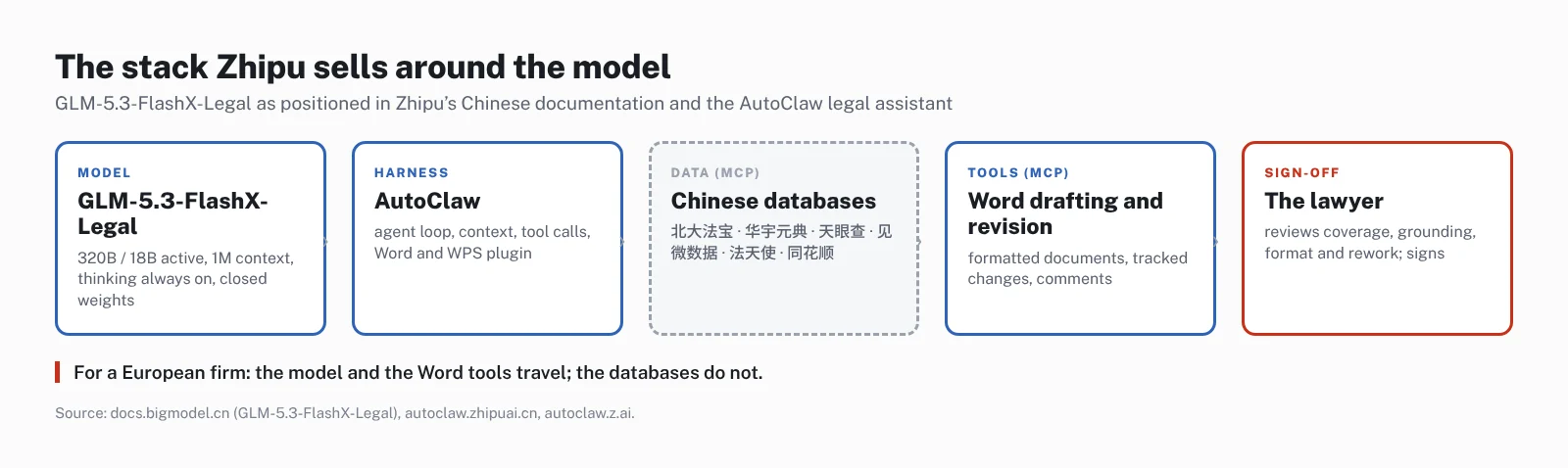
That stack is Chinese by construction. The databases cover PRC law and Chinese companies. PLawBench tests Chinese consultation, case analysis and drafting. The international benchmark results are in English and mostly US-flavoured. There is no published evidence yet on Dutch, French, German or EU law, and no EU legal database in the MCP list. For a European firm the model arrives without the part that makes it an agent in China.
The move also has history. In 2023 Zhipu and PowerLaw Intelligence (幂律智能) built PowerLawGLM, a hundred-billion-parameter legal model on ChatGLM-130B, and Zhipu later joined PowerLaw’s Pre-B round of nearly ¥80 million. China now has a crowded legal-AI field: Alibaba’s Tongyi Farui, Yuandian Wenda, Zhihe AI, iCourt’s AlphaGPT, Fadada’s Richee desktop agent and PowerLaw’s own Wulü agent. GLM-Legal is Zhipu’s bid to be the model underneath several of them rather than one more product. A Huatai Securities note on 13 October read it the same way: a light base plus domain reinforcement learning, it said, is likely to become an important development path for vertical professional agents.
How China received it
QbitAI ran the launch under the headline that Zhipu’s new model is now “world number one at knowing the law”, then spent half the article explaining why 19.2% is a hard number and that most tasks still fail under strict grading. Its “one more thing” was the comparison that matters: in August, Harvey built its Tenet model by post-training Kimi K3 with Fireworks and reported nearly twice as many completed LAB tasks as the base. Chinese open bases are now under Western legal products; GLM-Legal is a Chinese lab doing the post-training itself.
A widely shared piece on Shenmezhidemai (什么值得买) titled its analysis “three ledgers”. First: 19.2% is a pass rate, not an accuracy rate; single-skill scores of 86.2 and 77.3 show the parts work, but handing over a whole task succeeds about one time in five. Second: this was a beta with no self-serve keys, aimed at firms, legal-tech companies and in-house teams, with individual lawyers told to apply through a form. Third, and loudest in the comments: confidentiality. On 18 September a developer found that Zhipu’s coding tool ZCode had packaged his full workspace, Git history included, and tried 564 times to upload it to Alibaba Cloud storage without clear consent. Zhipu apologised the same day, shipped a fix, open-sourced ZCode on 21 September, had CAICT and NSFOCUS audit the deletion, announced a no-retention option for its model platform and paid compensation in tokens on 28 September. The piece advised lawyers to test GLM-Legal on synthetic matters first and wait for compliance documentation. Under Zhipu’s own launch video the top comment, with 149 likes, joked that the legal model was made for Zhipu itself, and several asked where GLM-5.5 was.
That is a fair summary of the mood: respect for the engineering, scepticism about handing a Chinese cloud model a client file four weeks after a data incident. European lawyers will recognise the question.
What a European legal team should check before a pilot
Zhipu’s international API is operated by a Singapore entity, Jingsheng Hengxing Technology Pte. Ltd. Its privacy policy and data processing addendum say customer content is processed in Singapore in real time and is not stored on its servers, and the API terms say it is not used to improve the service unless the customer agrees, but they allow transfers to group affiliates and offers no EU region. Singapore has no EU adequacy decision, so a transfer needs standard contractual clauses and a transfer impact assessment. Zhipu was added to the US Commerce Department’s Entity List in January 2025, which does not bind a European firm but will come up in any client-side vendor review. Under the AI Act a law firm is a deployer: Article 4 literacy duties have applied since February 2025 and Article 50 transparency since 2 August 2026. Annex III point 8 (administration of justice) targets systems used by judicial authorities, and after the AI Omnibus its obligations apply from 2 December 2027; a firm’s own contract-review tool is not high-risk by that point alone. Belgium’s bars (OVB and OBFG) said in January 2025 that the lawyer verifies every AI output including its sources, and the Antwerp Court of Appeal has since fined a lawyer €2,500, plus costs, for citing invented case law.
| Question | What we found | What to do |
|---|---|---|
| Can we run it ourselves? | No. Weights are closed; only the base GLM-5.3-Flash is MIT. | If self-hosting is a requirement, pilot the base (or Mistral Large 4 at 17.5% on LAB v1.1) and build the legal harness yourself. |
| Where does the file go? | Singapore processing, real-time, no storage per the DPA; affiliate transfers permitted; no EU region. | SCCs plus transfer impact assessment; anonymise or use synthetic matters first; no privileged documents until counsel signs the DPA. |
| Is the score real? | 19.2% was independently measured on LAB v1.0; the model is absent from v1.1, which reads tracked changes. | Ask Zhipu for a v1.1 run, or run 20 of your own matters through it and grade all-pass yourself. |
| What does a task cost? | About $0.75 at list price, 60 to 70 minutes per LAB task, mandatory thinking. | Budget per matter, not per token; it suits overnight batch review more than live meetings. |
| Does it know our law? | Evidence covers US-style English tasks and Chinese law; nothing published on EU or Belgian law. | Test on Belgian or EU precedents with your own database behind it; the Chinese MCP servers are of no use here. |
| Who is accountable? | Zhipu’s own Chinese FAQ: output is reference only, a practising lawyer must review it. | Keep the four-criteria review Zhipu used in training (coverage, grounding, format, rework) as your acceptance test. |
Frequently asked questions
Is GLM-5.3-FlashX-Legal the same model as GLM-Legal?
Yes. GLM-Legal is the product name from the 12 October launch; GLM-5.3-FlashX-Legal is the API model code Z.ai priced in late October and listed on OpenRouter on 2 November, signalling that it is the legal post-training of GLM-5.3-Flash served on the FlashX speed tier.
How much does it cost?
$0.37 per million input tokens, $1.25 per million output tokens and about $0.08 per million cached input tokens on OpenRouter and Vercel AI Gateway; ¥2, ¥7 and ¥0.57 on Zhipu’s Chinese platform. A full Harvey LAB task works out at roughly $0.75.
Can I download the weights?
No. Zhipu has not released them. The base model GLM-5.3-Flash is available under an MIT licence.
Is it better than Harvey or Legora?
Nobody knows. Harvey has not published its own product’s LAB score, and Harvey’s Tenet model is a research preview. GLM-Legal is a model, not a product; its Chinese product wrapper is AutoClaw with Chinese databases.
Does it work for Belgian or Dutch law?
There is no published evidence either way. The training corpus and the benchmarks are Chinese and English. Any European pilot has to supply its own legal sources through the harness.
The pattern, not the model
The interesting fact about GLM-5.3-FlashX-Legal is not that a Chinese model scored well on a US legal benchmark. It is that a small open base, two stages of domain training and a harness built alongside it moved a 6.7% model to 19.2% for less than a dollar a task, in the same quarter that Harvey did something similar on Kimi K3. The next legal model you evaluate will probably be built this way, and it may well sit on Chinese weights whether or not a Chinese company sells it. For European firms the practical lesson is in our sovereignty stack for open models: the capability is now cheap and portable, so the questions that remain are where the file goes, who grades the output and who signs. On the last one Zhipu agrees with the Belgian bar. It redlines. You sign.