Pika H3 Flex is the first video model Pika has published with open weights, and it is a good one: a post-trained MiniMax H3 that renders a clip with synchronised stereo sound in six sampling steps instead of fifty, takes up to twelve reference files and, through Pika’s API, finishes at 4K with separate audio stems. There is one line in the small print that most launch coverage skipped. The adapters inherit the MiniMax H3 Community License, and that licence does not cover the European Union, the United Kingdom, the United States or South Korea, for the weights or for what they generate. For a European team, “open from day one” means you can read the code and admire the weights, but the only route that is actually licensed is Pika’s hosted API. This article covers what Flex is, what it really costs and how fast it really is, what the licence says, and what to do about it.
What Pika H3 Flex is, and what it is not
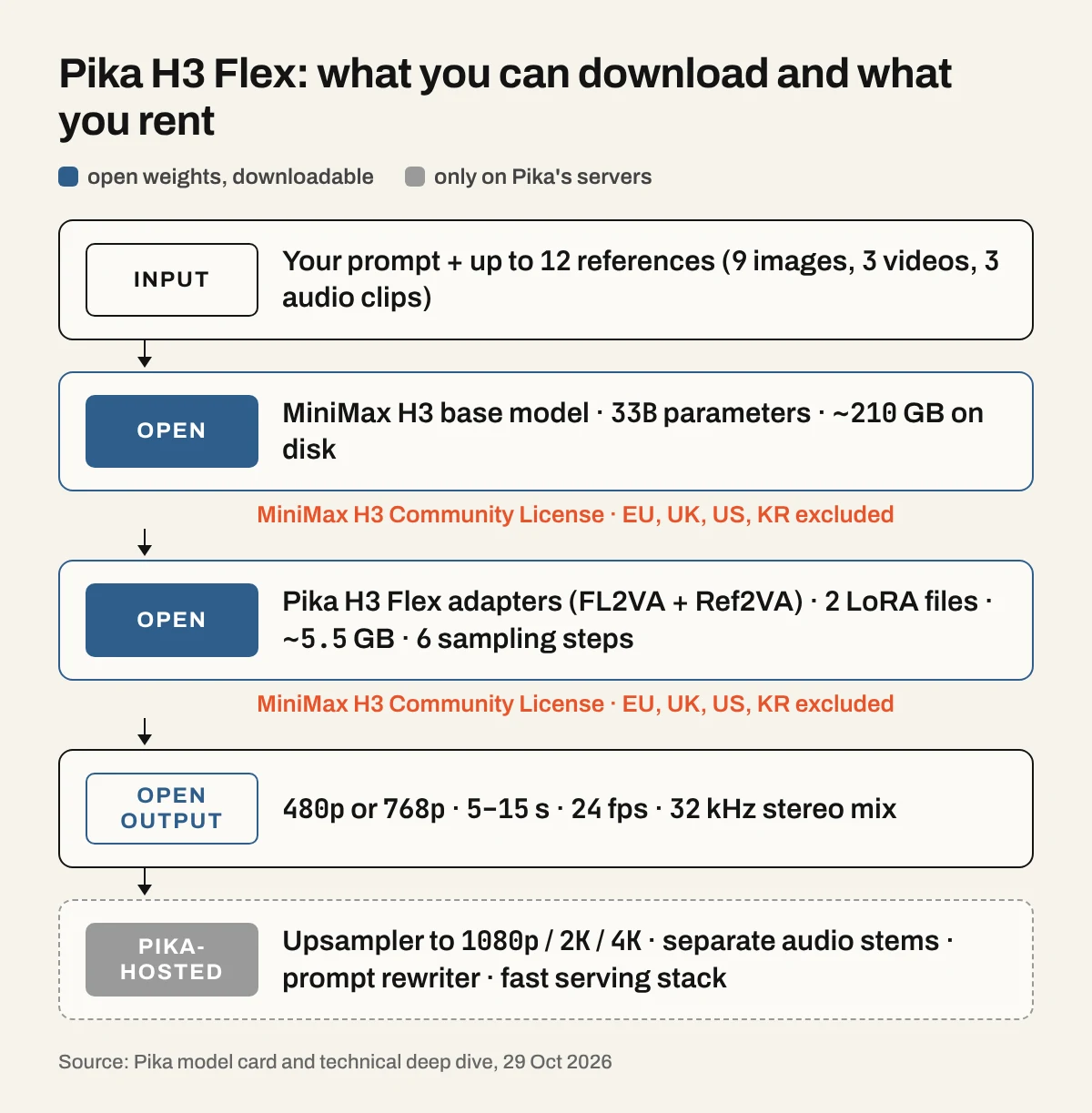
Flex is not a new architecture. It is MiniMax H3, the 33-billion-parameter video-and-audio model the Chinese lab MiniMax launched at the end of July 2026 and published as open weights in August, with two LoRA adapters from Pika on top. The model card lists FL2VA for text, first-frame and last-frame conditioning, and Ref2VA for multimodal references. Both run on the standard H3 base files, which means the download is the H3 base of about 210 GB plus about 5.5 GB of adapters.
What the open part gives you: clips of 5 to 15 seconds at 480p or 768p, 24 frames per second, 32 kHz stereo audio generated in the same pass, eleven aspect ratios from 21:9 to 9:21, and a reference mode that accepts up to nine images, three videos and three audio clips in one request. What stays on Pika’s servers: the upsampler to 1080p, 2K and 4K, the export of separate audio stems (the launch material promised five: dialogue, score, sound effects, foley and ambience; on 2 November Pika’s product page and API documentation list three, dialogue, music and effects, mono by default and stereo on request), the prompt rewriter and the accelerated serving stack that produces the headline speed numbers.
What Pika changed, and where H3 still wins
Pika’s technical write-up describes three stages. First a supervised fine-tune of H3 on an in-house audio-video set, keeping the original 50-step schedule. Then a distillation to six steps with a method Pika calls projected distribution matching distillation, after plain DMD proved unstable. Finally two reward passes, one for aesthetics and clarity and one for instruction following and realism, trained as separate LoRAs and merged into the adapters you download.
On Pika’s own automated metrics at 768p, Flex scores above MiniMax H3, Fal’s H3 Max and HeyGen’s quality model on the five visual and audio quality measures, with audio-video and text-video alignment roughly level. In its blind human study Flex wins on human anatomy, complex composition and audio synchronisation for text and image prompts, and on visual style, framing and camera motion for reference prompts. Pika also states where the others are still preferred: physics, multi-scene narrative, lighting and materials, and action-heavy reference tasks. On DesignArena’s text-to-video board Flex launched at seventh overall and first among open-weight models, above base H3, H3 Max and Seedance 2.5. Pika itself calls that a snapshot at launch, and arena positions move weekly.
In practice the ComfyUI documentation adds the limits you will feel first: camera instructions are advisory and can land 0.2 to 0.3 seconds off or in the wrong direction, a plain “wide shot” tends to come out as a medium shot, and fine contact constraints are unreliable, so a hand that should stop short of an object usually touches it. Short text on props stays legible through camera moves, which is unusual for video models.
The seven-second claim, and the clock on your desk
Pika’s headline is a 15-second 768p clip with soundtrack in as little as seven seconds. The footnote matters: that is transformer compute in a controlled benchmark, on Pika’s serving stack, not the time between pressing generate and getting a file. Pika’s own numbers for a 5-second 768p clip on eight B300 GPUs went from 3.4 seconds to 2.1 seconds of full inference after the serving optimisations, a 1.6 times gain, and Pika measures Flex at about 1.8 times faster than Fal’s H3 Max across text, image and reference modes.
On a workstation the story is different, and still good. Community tests in the first days show an RTX 5090 producing an 8-second 768×1344 clip in 1 minute 56 seconds, against 5 minutes 27 seconds for the full model at 20 steps, and a 10-second clip in just under five minutes against more than twenty. An RTX 3090 Ti ran the same prompt about a third faster than an 8-step turbo adapter. An RTX 4070 needed about seven minutes for five seconds. The ComfyUI tutorial puts a 5-second 1344×768 clip at about a minute on a single card. Six steps cut the sampling work by roughly eight times; the wall clock improves by three to four times, because encoding, decoding and audio do not shrink with the step count.
Two practical rules from the early guides: keep Pika’s published six-step sigma schedule with the lcm sampler and CFG 1.0, because more steps add no detail and a shorter schedule breaks the output, and do not stack other speed adapters on top. Style or character LoRAs trained on undistilled H3 may load, but need a fresh test.
What it costs through the API
Pika bills per second of output video, with a launch tariff at half the regular rate. The table shows the cost of one 15-second clip; the regular price is in brackets.
| Mode and output | Launch price per second | One 15-second clip |
|---|---|---|
| Text, image or keyframe, 480p | $0.01 ($0.02) | $0.15 ($0.30) |
| Text, image or keyframe, 768p | $0.02 ($0.04) | $0.30 ($0.60) |
| Text, image or keyframe, 1080p | $0.035 ($0.07) | $0.53 ($1.05) |
| Text, image or keyframe, 4K | $0.08 ($0.16) | $1.20 ($2.40) |
| Reference to video, 480p | $0.03 ($0.06) | $0.45 ($0.90) |
| Reference to video, 768p | $0.06 ($0.12) | $0.90 ($1.80) |
| Reference to video, 4K | $0.10 ($0.20) | $1.50 ($3.00) |
| Audio stems, add-on, per stem second | $0.001 | $0.045 for three stems |
Two details change the maths. Draft-to-video finishes an approved 480p or 768p take at a higher resolution and deducts the draft price, so the intended workflow is to iterate cheaply and pay for 4K once. Video references are billed on input seconds as well; image and audio references are not. The prompt rewriter is included on the hosted API; only self-hosters who call it as a separate endpoint pay $0.02 per request. For comparison, Pika’s own table lists MiniMax H3 at $0.08 per second, Fal’s H3 Max at $0.0325, Seedance 2.5 at $0.103 and Wan 3.0 at $0.03, all starting rates per output second. Pika is also giving API Club members fifteen free generations a day from 29 October to 5 November, and the launch post announced Flex for the Pika app itself from 2 November. Prices are those published on Pika’s product page on 2 November 2026.
Why Europe can only rent it
The GitHub repository splits the licensing in two. The inference code is Apache 2.0. The adapters are distributed under the MiniMax H3 Community License Agreement, because Pika describes them as Model Derivatives of MiniMax H3. That licence, dated 2 August 2026 and issued by MiniMax’s entity Nanonoble Pte. Ltd., grants its rights only within an “Applicable Territory” defined as the world minus four “Excluded Territories”: the European Union, the United Kingdom, the Republic of Korea and the United States. Section V.4 extends the restriction to the outputs, so a clip generated with the weights may not be used outside the permitted territory either.
Three further conditions apply everywhere the licence is valid. Commercial products that generate more than 20 million dollars a year need written permission from MiniMax. A commercial product or service must display “MiniMax H3” prominently in its interface. And neither the model nor its outputs may be used to improve another AI model, which rules out the common trick of generating synthetic training data. MiniMax claims no rights over the outputs themselves.
MiniMax does give reasons. The licence says the company will “continuously evaluate” the laws and compliance requirements of the excluded territories, and its licence Q&A is more specific: the EU AI Act has started to apply while the practical requirements for video and likeness generation are still evolving, the UK and South Korea carry similar uncertainty, and in the US MiniMax points to a fast-changing regulatory landscape and to the copyright lawsuit it faces over generative video. That suit, brought by Disney, Universal and Warner Bros. in September 2025, survived MiniMax’s motion to dismiss in May 2026 and is now in discovery; nothing has been decided on the merits. For Europe the practical result is the same as it was for LFM3’s revenue line or Mistral’s hosting clause: read the licence before the benchmark. The licence invites organisations in excluded regions to apply for a separate grant, and the Q&A links an application form for it. MiniMax’s own API is, in its words, globally available. Pika’s API runs under Pika’s own terms rather than the licence you accept when downloading; what Pika agreed with MiniMax is not public, so ask Pika to confirm in writing that European customers and their outputs are covered.
Pika’s own launch text says you can run the model on your own hardware “under the model’s license terms”. Nothing on its launch pages mentions the four regions. That is worth knowing if your creative agency, marketing team or research group downloads the adapters because the tweet said open source.
The AI Act angle: provider or deployer
The licence is not the only reason the hosted route is the cleaner one in Europe. Article 50 of the AI Act has applied since 2 August 2026. A provider of a generative AI system must mark its audio, image, video and text outputs in a machine-readable way so they can be detected as artificial, and a deployer who publishes a deepfake must disclose it. The Commission’s guidelines of 20 July 2026 and the Code of Practice on transparency of AI-generated content, finalised in June, describe how; systems already on the market before 2 August have until 2 December 2026 for the marking duty.
If your organisation downloads the weights and puts a video tool into service, you take on the provider’s marking obligation yourself, on top of the licence problem. If you call Pika’s API, Pika is the provider of that system and you are the deployer, responsible for the visible label when a clip shows a real person, place or event that did not happen. Either way, a marketing team that publishes an AI-generated video of its CEO is publishing a deepfake under Article 50(4) and has to say so. Before you commit, ask Pika in writing whether its outputs carry a machine-readable mark such as a watermark or content credentials; the public pages do not say.
What European teams can do now
| Your need | Route | What to check |
|---|---|---|
| Fast drafts with sound, finished takes at 4K, stems for the edit | Pika API, draft-to-video | Written confirmation that EU customers are covered, contract terms, data retention of prompts and references, machine-readable marking of outputs, launch pricing end date |
| Self-hosting for confidentiality or volume | Apply to MiniMax for a separate licence first | Territory and output clauses in writing, the 20 million dollar line, attribution in your interface, your own Article 50(2) marking |
| Open weights you may run in the EU today | Wan 2.2 (Apache 2.0), Kandinsky 6.0 Video (MIT), LTX-2.3 (community licence with a revenue line) | Native audio, VRAM floor, clip length, how quality compares to Flex on your own prompts |
| Internal R&D only, no deployment | Still not licensed in the EU under the Community License | The research exception you assume probably does not exist in this text; ask MiniMax |
Whatever the route, run the same test set through it: your product, your brand colours, a spoken line in your language, one scene with physics, one with two people. Score human anatomy and audio sync, where Flex is strong, and physics and multi-scene continuity, where Pika admits it is not. Keep the prompts, seeds and outputs; they are the start of the evidence file Article 50 and your legal team will want.
Frequently asked questions
Is Pika H3 Flex open source?
The inference code is Apache 2.0. The model adapters are open weights under the MiniMax H3 Community License, which restricts territory, revenue, attribution and downstream training. That is not an OSI open-source licence.
Can I legally run Pika H3 Flex on my own GPU in Belgium or elsewhere in the EU?
Not under the standard licence. The EU is an Excluded Territory for the weights and their outputs. The licence invites you to apply to MiniMax for a separate licence. The hosted Pika API runs under Pika’s own terms; ask Pika to confirm European coverage in writing.
How fast is it really?
Faster than real time on Pika’s servers, measured as transformer compute. On a single consumer GPU early tests show one to seven minutes per clip at six steps, three to four times faster than the full 20-step H3 run.
What do I get that MiniMax H3 does not offer?
Six-step sampling, Pika’s reward-tuned aesthetics, up to twelve references, and on the API separate audio stems and a draft-to-4K workflow. H3’s own API still offers native 2K generation, which Flex only reaches through Pika’s upsampler.
What hardware does the open release need?
Pika tested on one H100 80GB per request. Community users run quantised ComfyUI files on 24 GB cards such as an RTX 3090, with longer render times and, in some reports, weaker audio.
Open is a licence, not a download button
Flex is a smart release: Pika took the strongest open video base available, made it eight times cheaper to sample, and kept the parts that need a data centre as a paid service. For most of the world that is a free, capable video model and a cheap API. For Europe it is a cheap API. The difference is not in the weights, which are the same bytes everywhere, but in a paragraph MiniMax wrote in August. Until that paragraph changes, or until a European team gets its own grant, the honest description of Pika H3 Flex on this side of the Atlantic is “open weights, rental only”, and the honest question to ask every “open” video model from now on is the one you would ask about a film on a disc: which region is it coded for?