Anthropic is handing Agent Skills, the open format behind Claude Skills, to the Agentic AI Foundation (AAIF), the Linux Foundation body that already looks after MCP. The company announced the move on 22 October 2026. For organisations, the significance is less about the format, which does not change, and more about ownership. The procedures your teams write down as skills now sit on a standard that no single AI vendor controls. That makes them easier to carry from one agent to the next, and it makes them a supply chain that needs managing.
What Anthropic is handing over
The donation covers the specification, the Agent Skills name and logo, the GitHub organisation and the agentskills.io domain. Engineers from Anthropic, Google, OpenAI and other companies will maintain the standard in a personal capacity rather than on behalf of their employers, according to Anthropic. David Soria Parra, co-creator of MCP, and Mahesh Murag are the lead maintainers.
Nobody has to join the foundation to use the standard or contribute to it. Proposals are discussed on GitHub, and feedback on specification changes goes through the project’s Discord. Anthropic says the project will follow the MCP model, with community input and transparent decisions.
From one product feature to 70 platforms in a year
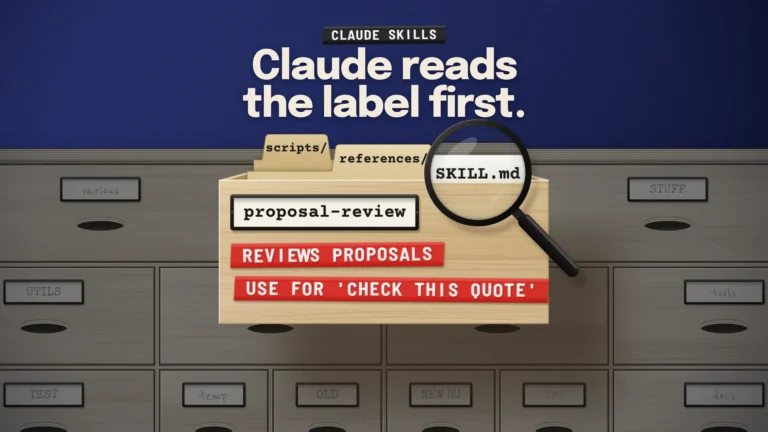
Anthropic built skills while working on Claude Code. The model handled general knowledge work well but lacked the procedural knowledge real business tasks need: how your team reviews a contract, which steps a month-end close has, what a client report must contain. A skill is a folder with a SKILL.md file that captures that knowledge, plus any scripts or reference files it needs. The agent reads only the name and description of each skill at the start, roughly 100 tokens, and loads the rest when a task calls for it.
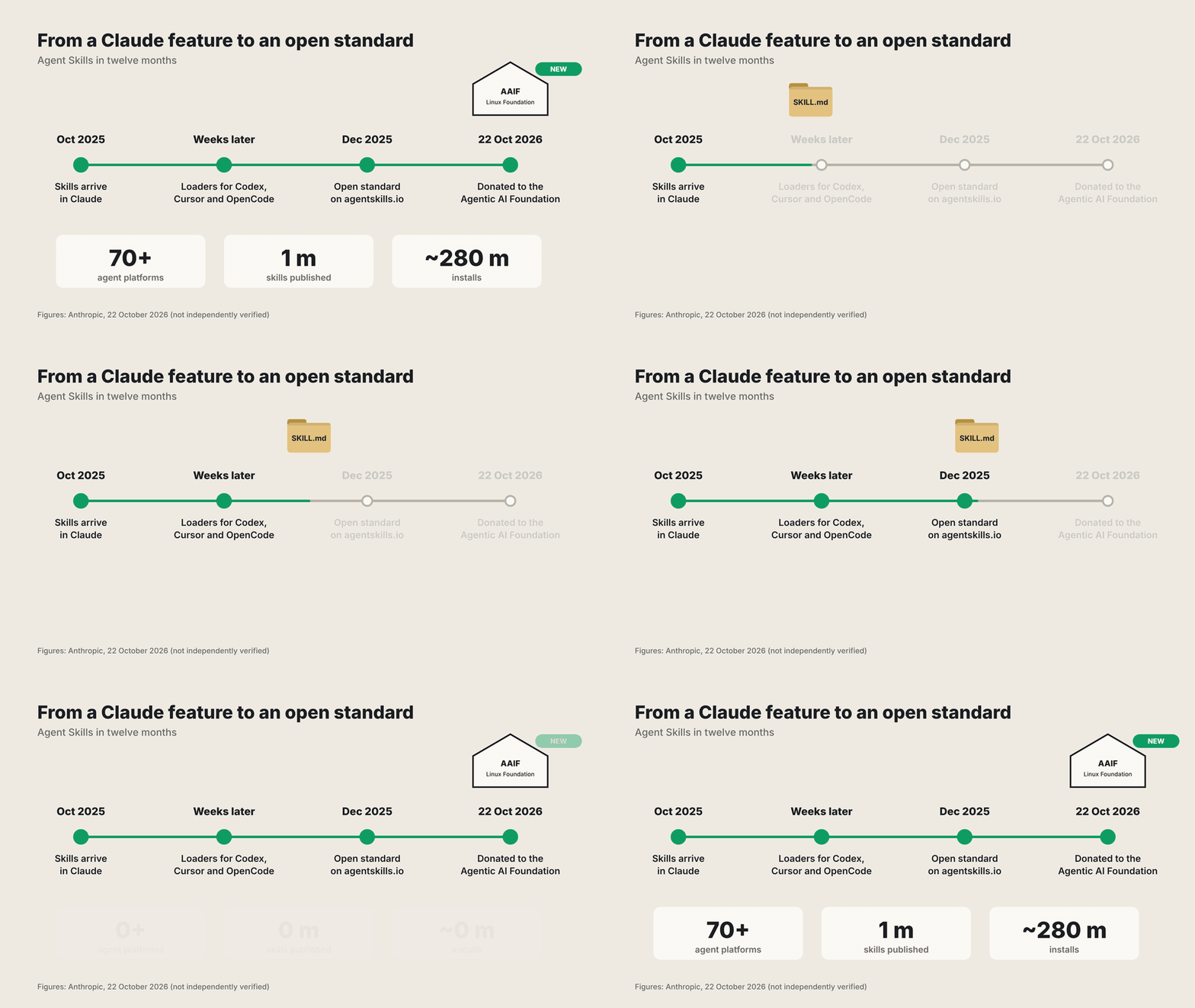
Skills reached Claude in October 2025. Within weeks, developers had published thousands on GitHub and written their own loaders for Codex, Cursor and OpenCode. In December 2025 Anthropic published the format as an open standard. By its own count, more than 70 agent platforms now support it, including ChatGPT, Cursor, GitHub Copilot and VS Code, with one million skills published and nearly 280 million installed. These figures come from Anthropic and have not been independently verified. The announcement does not explain how installs are counted.
Why a neutral home matters for European organisations
Most of the value in an AI deployment does not sit in the model. It sits in the context you build around it: your rules, examples, evaluations and procedures. We made that case in models are rented, context is owned. Skills are one of the most concrete forms that context takes. A skill that encodes how your claims department checks a file is company knowledge, written in plain Markdown.
As long as the format belonged to one vendor, that knowledge carried a quiet dependency. Under a Linux Foundation project with maintainers from competing companies, the same folder is far more likely to keep working when you add a second assistant, switch coding tools or move part of your work to an open-weight model hosted in Europe. For procurement teams, it gives a simple question to put to any agent vendor: do you read the Agent Skills format, and which version?
A word of caution. The maintainers named so far work for US companies, and both lead maintainers are Anthropic employees. Neutral governance is a promise until the first contested proposal tests it. MCP has passed that test so far.
In good company, ten projects and counting
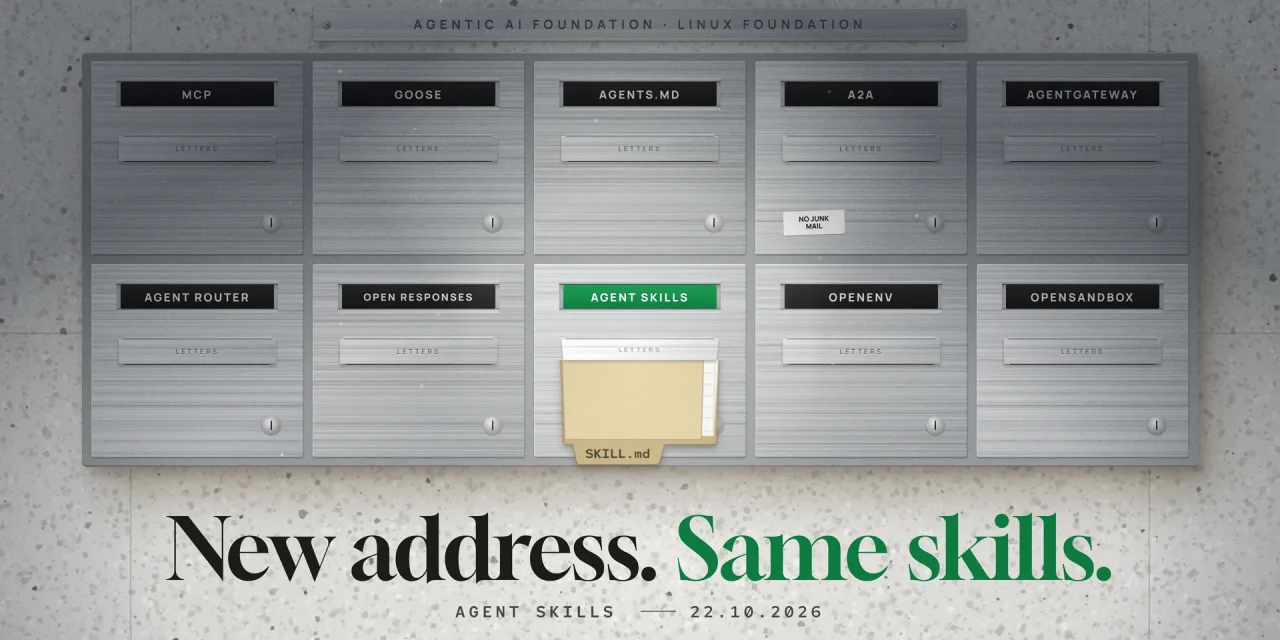
The AAIF launched in December 2025 with three projects: MCP from Anthropic, goose from Block and AGENTS.md from OpenAI. At AGNTCon + MCPCon in San Jose on 22 October it added four: Agent Skills, Open Responses from OpenAI, OpenEnv from Hugging Face and OpenSandbox from Alibaba. Together with A2A, agentgateway and Agent Router, the foundation now hosts ten. The pieces fit together. MCP connects agents to tools and data, Open Responses standardises how apps talk to models, AGENTS.md holds project instructions and Agent Skills carries the know-how. “Without the right context, even the most intelligent agents fall short,” Soria Parra said in the foundation’s announcement.
What changes and what stays the same
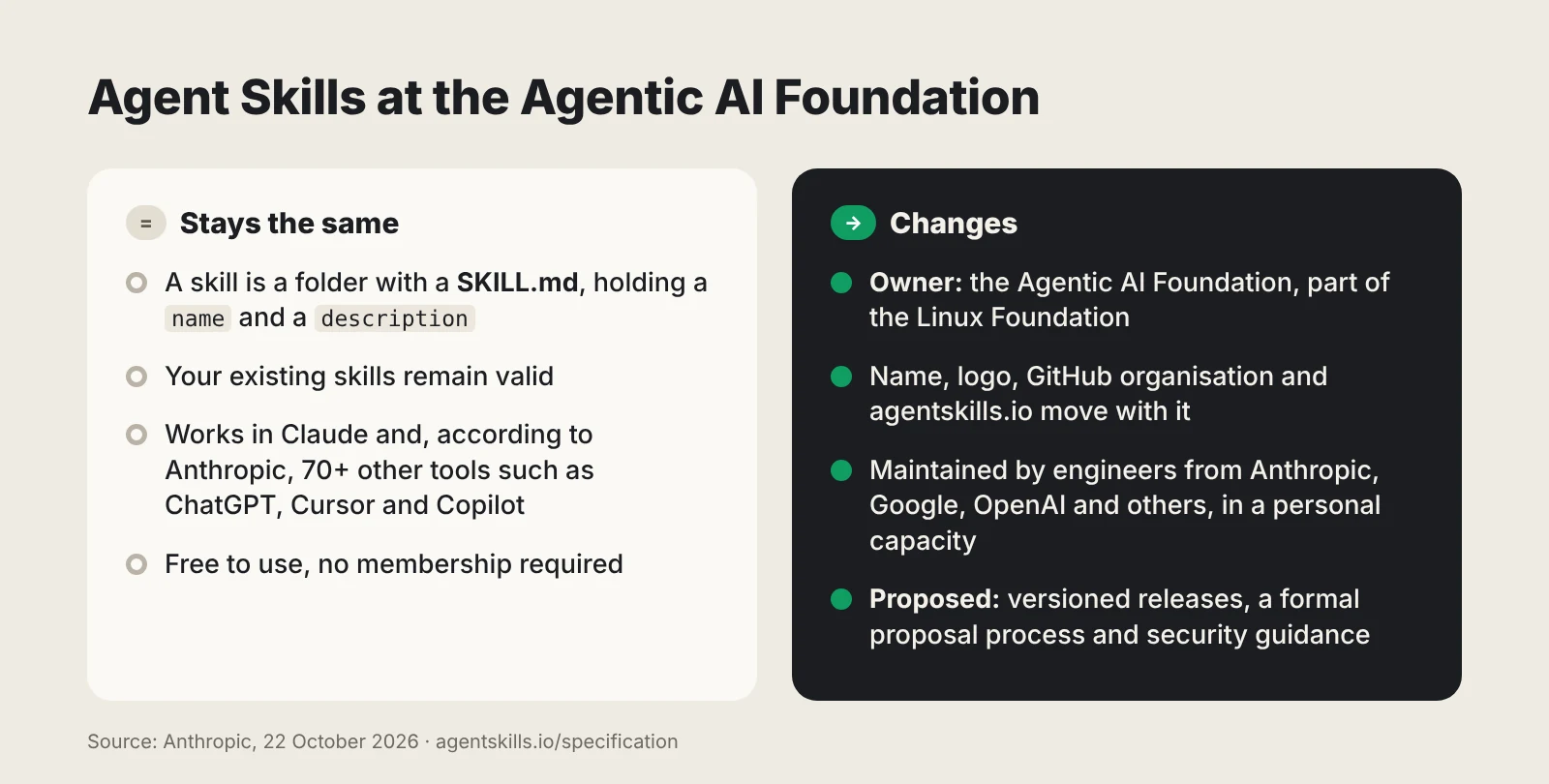
The format is unchanged. A skill still needs a SKILL.md with a name of up to 64 lowercase letters, digits and hyphens that matches its folder, and a description of up to 1,024 characters, as set out in the specification. Anthropic has proposed three additions:
- Versioned releases, so you can tell which version of the standard a tool or a skill targets.
- A formal proposal process for changes, discussed in public.
- Security guidance for people who write skills and for people who install them.
None of these exist yet, and the announcement gives no date.
Skills are now a software supply chain
A skill is a set of instructions an agent follows, often with scripts that run with the user’s permissions. Portability cuts both ways. A good skill now works across Claude, Copilot and Cursor, and so does a bad one. In February 2026 Snyk analysed 3,984 skills on the public registries ClawHub and skills.sh. It found critical issues in 13.4 per cent of them and confirmed malicious payloads in 76, designed among other things to steal credentials.
The Cloud Security Alliance advises bringing agent context files under existing supply chain policy: approved sources only, content checks before installation, an approval step for new skills, and over time an internal registry with signing, access control and audit logs. That fits the way European organisations already handle third-party code, and it is the kind of documented control that auditors and regulators increasingly expect around AI systems.
What to do this quarter
- Take stock. List the skills your teams use, where they came from and who maintains them. Include SKILL.md, AGENTS.md and CLAUDE.md files in shared repositories.
- Write skills to the open standard. Keep to the required fields, check them with the
skills-refvalidator in the GitHub repository, and treat fields that only Claude Code understands, or the still experimentalallowed-tools, as extras that may not travel. - Decide who may publish. On Claude Team and Enterprise, administrators can provision skills for the whole organisation. Our guide on how to build Claude Skills your organisation can rely on covers descriptions, evals and publishing rules.
- Review third-party skills like code. Read the scripts. A skill that formats reports has no business downloading and running code or reading an entire key folder.
- Add the standard to your vendor questions. Ask agent and copilot vendors whether they support Agent Skills and how they will track its versions.
Anthropic’s own overview of what skills do in its products is on the Claude Skills page. For a worked example of skills in a business setting, see our piece on agentic data analytics with Claude.
Frequently asked questions about Agent Skills and the AAIF
Do existing skills need to change?
No. The format has not changed. Skills that work in Claude or another tool today will keep working.
Are Agent Skills and Claude Skills the same thing?
Claude Skills is the common name for skills in Claude. Agent Skills is the open standard underneath. A skill built for Claude follows it and largely works in other tools that support the format.
Does it cost anything?
No. The specification is open and free to use, and contributing does not require AAIF membership.
How do Agent Skills relate to MCP?
MCP connects an agent to tools and data sources. A skill tells the agent how to carry out a task, and it can use MCP tools while doing so.
Your procedures just became portable
Anthropic is giving away the thing that made it the reference point for skills, and that is exactly why rivals can adopt it without hesitation. For organisations, the practical consequence is that the hours spent writing down how work gets done are no longer tied to one assistant. Write those skills well, govern them like code, and they will outlast whichever model you happen to rent this year.