42AI, a Tel Aviv startup that left stealth on 2 November 2026 with $62.5 million, sells what it calls a behavioral world model: an AI system that turns everything it observes about one person into a profile of psychological traits and then puts a probability on each choice that person might make next, including in situations they have never faced. Ten brokerages already use it to forecast what each client will trade in the next 24 hours. This article explains what 42AI is, how the model works, where its data comes from, what the accuracy figures do and do not mean, and why a European financial institution that buys something like it is already inside GDPR, MiFID II and the AI Act before the first prediction lands.
What 42AI is
42AI has three co-founders: CEO Amit Gal-Or, CTO Ehud Ezra and chairman Amir Gal-Or, Amit’s father and the founder of the Israeli investment group Infinity Group. The company spent three years on the approach and surfaced through an interview with TechCrunch. The $62.5 million “seed” is not a conventional venture round: the money came from the founders and from Infinity Group over those three years, Gal-Or said, and the company intends to raise external capital next.
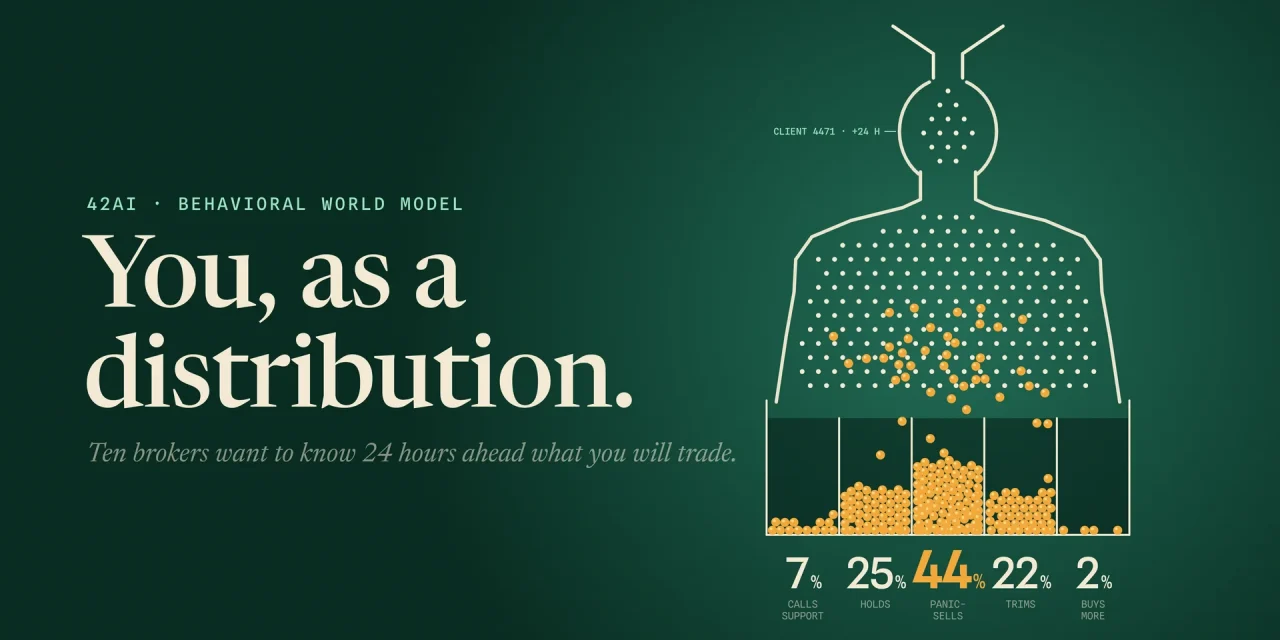
Its website describes the product as “behavioral risk intelligence” and lists exposure management, fraud detection, cybersecurity, investment research and personalised AI as applications. The first market is brokerages. For each client, the model forecasts which instrument they will trade, in which direction, when and in what volume, on 1-, 4- and 24-hour horizons. Brokers use that to manage liquidity, margin requirements and hedging. Gal-Or told TechCrunch one brokerage generated roughly $30 million in additional value through dynamic hedging, that revenue is in the “seven figures”, and that 42AI charges either a flat fee or a share of the value the platform helps create.
What a behavioral world model is, and what it is not
In AI research a world model is a system that predicts how an environment changes when something happens: given a scene and an action, it produces the next state. That is what Genie 4 does for interactive video and what SKY-001 does for machine designs. 42AI borrows the term and points it at a single human being. “In a world model, every individual is the world,” Ezra said.
Two ideas separate this from ordinary behavioural analytics. First, the model does not extrapolate from what a person did before. It tries to recover the underlying tendencies that drive their choices, such as risk aversion, impulsivity or tolerance for uncertainty, and assumes those tendencies persist when circumstances change. That is what lets it say something about a situation the person has never been in. Second, the output is never a single answer. “Behavior is not deterministic; it’s constantly probabilistic,” Gal-Or said. The model returns a distribution: this client sells with this probability, holds with that one, buys more with the rest.
It is also different from the most common way companies simulate people with AI today, which is to hand a large language model a persona and ask how “a 45-year-old retail investor in Lyon” would react. A July 2026 paper on mental world modeling shows why that approach fails: a model that tracks the visible scene but not what a person believes, wants or feels predicts the wrong action for a scene that otherwise looks right. 42AI’s bet is that the hidden part can be measured and fed into the model as numbers.
How it works, from support call to probability
The system runs on records a brokerage already holds: onboarding and KYC checks, support calls, money transfers and trades. In the early interactions it reads sentiment, tone of voice and how often someone calls. Later it adds trading behaviour, timing and the market conditions at the time. Those observations are converted into a mathematical representation of traits. The trait profile and the current situation go into a transformer-based world model that outputs the probability of each possible decision, and a separate language model writes an explanation of which traits and which context drove the forecast.
Training rewards the model for keeping a person’s stable tendencies intact inside a simulation. If a usually cautious client is suddenly modelled as a risk-taker, “the target is off”, Ezra said, and the model is penalised. On privacy, Gal-Or said the system needs no personally identifiable information and that “the model never knows who the person is”. TechCrunch added the obvious caveat: the system still builds an individual behavioural profile from activity linked to one customer account. For a European reader that caveat is the whole point, and we come back to it below.
Where the data comes from, and why genetics is in the mix
42AI says the three years of research combined psychology, neuroscience and genetics, with input from experts in psychology and PTSD. The team first studied thousands of people through psychological assessments and behavioural scenarios, then added government and biobank datasets covering more than 2 million people, and now holds customer datasets covering almost 30 million people.
The genetics is not a stray detail, and the back story is missing from this week’s coverage. 42AI appears to have grown out of OMGene.AI, a venture Amir Gal-Or presented to Globes in January 2025: a decision-support system that links a DNA sample to a database of health, psychological and social traits, with Amit Gal-Or in charge, Prof. Eyal Fruchter directing research, Nobel laureate Dan Shechtman advising, and a collaboration with the Israeli army on PTSD. The same names now appear around 42AI. The research paper 42AI links from its site, “Decoding the Human Factor” (February 2026), carries the affiliation “OMGene AI Lab” and lists Ehud Ezra as a co-author. Whether 42AI’s customers must supply genomic data is not stated. For the brokerage product the inputs described are transactions and conversations, not DNA, but a buyer should ask.
What the numbers actually say
42AI claims 98% accuracy on market trades. Pressed on it, Gal-Or clarified that the figure measures whether trading flows fall within a predicted range, not whether each individual trade was called correctly. For per-client direction and volume he cited an F1 score of 0.8 to 0.85. The evaluation method, the data and the baseline are not published.
The preprint is. Ben Yellin, Ehud Ezra and colleagues fine-tuned Llama 3.1 8B into a “Large Behavioral Model” on a proprietary dataset: a planned sample of 2,500 volunteers from the United States and Israel, a psychometric battery yielding 74 traits, and 55 scenarios with multiple-choice responses such as escalate, withdraw or compromise. On held-out scenarios, conditioned only on the Big Five, the fine-tuned model reaches 48.0% accuracy against 42.5% for the unmodified Llama and 46.3% for Claude 4.5 Sonnet with a prompt. Chance is about 20%.
The result that matters is the scaling. With 20 traits instead of five, the fine-tuned model climbs to 62.2%; with all 74, to 62.8%. Claude and Llama, given the same richer profiles, stay flat at roughly 46% and 43%. A general-purpose model cannot use a long description of a person; a model trained for it can. That is the scientific core of what 42AI sells, and it is a far more modest number than 98%: on a question with usually five options the model is wrong almost four times in ten. The authors list the limits themselves: a convenience sample of mostly American English speakers, hypothetical scenarios on paper, and the gap between stated and actual behaviour.
A crowded, well-funded race
42AI enters a market that has drawn large cheques over the past year. TechCrunch tallied them in October: Simile, founded by Stanford PhD graduate Joon Sung Park, which sells synthetic users for product and market research, raised $200 million at a $2 billion valuation in July; Aaru raised $88 million at $1 billion; Humans&, founded by researchers from Google, Anthropic, xAI and other labs, raised a $480 million seed round at $4.48 billion in January and launched Persimmon to model human behaviour. Mirror Particle is building a world model of consumer behaviour for brands.

The academic precedent is Centaur, published in Nature in July 2025: a Llama 3.1 70B fine-tuned on Psych-101, more than 10 million choices by 60,000 participants in 160 psychology experiments, which outperforms classic cognitive models in almost every task, including ones it never saw. The difference is scope. Centaur is open and models the average participant in an experiment; 42AI is closed and models one specific customer account in a live market.
Why Europe’s rules already apply
A behavioural profile built per customer account is personal data under the GDPR even if the vendor never sees a name: pseudonymised data is still personal data as long as the individual can be singled out. Three regimes then come into play, and none of them waits for the AI Act’s high-risk deadline.
| Rule | What it covers here | What to ask a vendor or your own team |
|---|---|---|
| GDPR, Articles 5, 6, 13-14 and 22; CJEU SCHUFA (C-634/21, December 2023) | Profiling with a legal basis, transparency to the client, and the right not to be subject to a solely automated decision with significant effects. SCHUFA held that an automated score already counts as such a decision when a third party draws strongly on it to enter into, perform or end a contract. | Which decisions does the forecast feed (margin calls, limits, offers)? Is a human materially involved? Can a client get a meaningful explanation and contest it? Is there a DPIA? |
| EU AI Act, Article 5 (applicable since 2 February 2025) | Prohibits AI that uses manipulative or deceptive techniques, or exploits vulnerabilities, to distort behaviour in a way that causes significant harm. | Is the forecast ever used to nudge the client, time an offer or exploit a known panic pattern? Document that it is not. |
| EU AI Act, Annex III point 5(b) (obligations from 2 December 2027 after Regulation (EU) 2026/1744) | AI that evaluates the creditworthiness of natural persons is high-risk. Whether a per-client margin or exposure forecast falls under it is not settled; an affordability-style use would pull it in. | Where does the output sit in the credit and margin chain? Classify it now, because conformity work takes quarters. |
| MiFID II and ESMA’s statement of 30 May 2024 | Firms using AI in retail investment services must meet organisational, conduct and best-interest obligations, keep records of AI use and complaints, and apply heightened diligence. Separately, ESMA runs a Common Supervisory Action in 2026 on conflicts of interest in the distribution of investment products to retail clients. | Who signs off on the model, how is it monitored, and does the business model (a share of hedging value) create a conflict with the client’s interest? |
The point of the table is not that 42AI is non-compliant; nothing public says it is, and the ten brokerages it says it works with are not named, let alone located in Europe. The point is that a European buyer inherits the obligations the moment the forecasts touch an identifiable client. 42AI’s own answer to the misuse question is thin. Ezra called the risk that brokers use predictions against their own customers “a valid concern” and pointed to regulation, monitoring and an internal ethics committee. That leaves the controls to the buyer, which is the same lesson we drew for AI agents in financial planning.
What it cannot do yet
The founders are candid about the ceiling. The model never sees everything a person experiences, Gal-Or said, and it loses accuracy when context is missing: a trader who changes strategy after advice from a friend is invisible to it until the trades reveal the shift, Ezra said. Every new domain, from gaming to fraud to cybersecurity, requires training on that domain’s rules. The long-term ambition is to help robots and AI agents understand people, which connects to the questions we raised about robots that read human intent and about physical AI more broadly.
Five questions before a pilot
- Inputs. Exactly which records feed the profile, and does any genomic or health data enter it? If so, Article 9 GDPR applies.
- Outputs. Which decisions does the forecast influence, automatically or through a dashboard someone acts on? Map them to Article 22 and to the AI Act classification.
- Evidence. Ask for the evaluation behind the 98% and the F1 figures on a held-out sample of your own clients, and for the base rate it beats.
- Location and processing. Where does client data go, under which contract, and can the model run inside the EU?
- Use limits. Write into the contract that forecasts are used for risk management only, not for pricing, product placement or client communication, and log how they are used.
Frequently asked questions
Is a behavioral world model the same thing as Genie or Sora?
No. Those predict how a physical scene evolves. A behavioral world model predicts how one person decides. Only the principle is shared: build an internal representation and simulate forward.
How accurate is 42AI?
The 98% refers to whether aggregate trading flows land within a predicted range. Per client the company cites an F1 score of 0.8 to 0.85 for direction and volume. The published preprint reaches 62.8% on five-way scenarios where chance is 20%. There is no independent validation yet.
Does the model know who I am?
42AI says it works without personally identifiable information. It still builds a profile per customer account, which in the EU remains personal data as long as you can be singled out.
Can my organisation buy it today?
42AI sells to organisations, for now mainly brokerages, and publishes no API or pricing. As far as is public, the research model from the preprint has not been released.
A probability with your name left off
42AI’s strongest argument is also its most uncomfortable one: people are more predictable than they believe, especially under stress, and whoever turns that into numbers gains an edge. The preprint shows the edge is real and grows as the model learns more about a person. For European organisations the question is therefore not whether this works, but on whose behalf it is allowed to work, and that answer is written into contracts, DPIAs and oversight long before the model makes its first forecast.