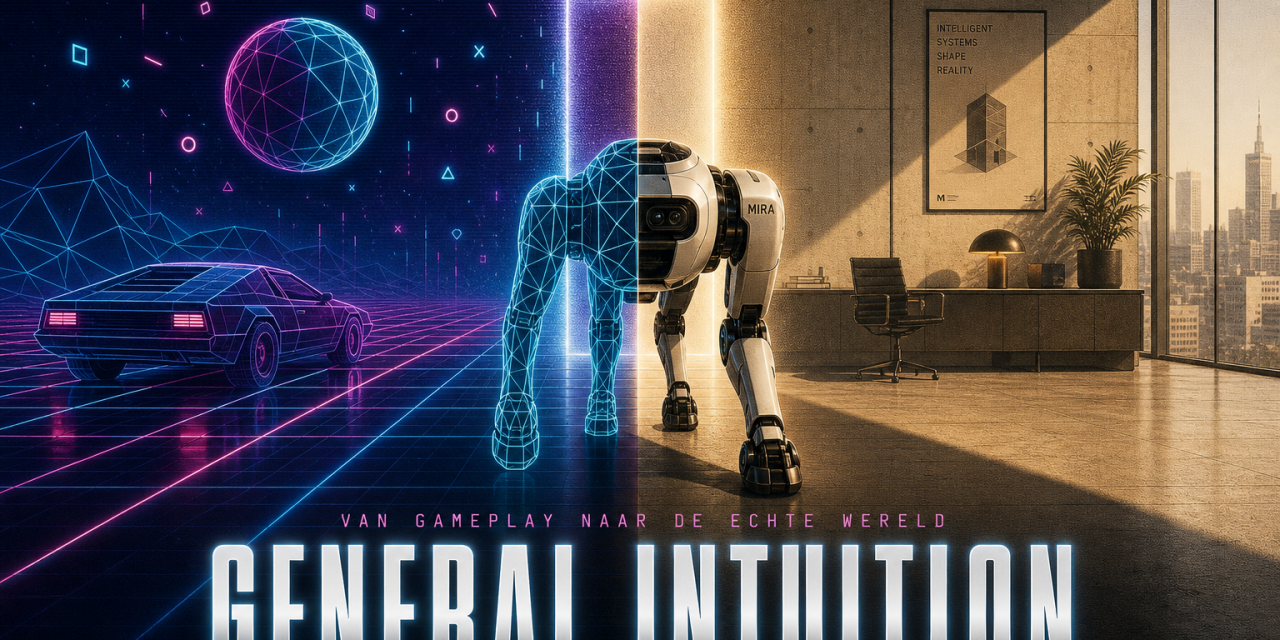
General Intuition confirmed a $320 million funding round in June 2026, at a $2.3 billion valuation, barely eight months after launching with $134 million. The New York startup, spun out of the gameplay platform Medal, is built on a single conviction. Today’s AI is book smart, and the next leap requires machines that are street smart. Rather than training only on text, images and video, General Intuition trains its models on millions of gameplay clips annotated with the exact inputs behind every move. The goal is an AI that can perceive, anticipate and improvise, or what the company calls a general intuition of reality.
From book smart to street smart
The most powerful foundation models are trained on written words. Yet human intelligence far exceeds language. It emerged over millennia of interaction and exploration, through an endless cycle of intent, action and consequences across diverse environments. Because language models absorb available text, images and videos, everything they know is secondhand. To move beyond that, AI needs realistic virtual playgrounds where it can make mistakes and learn from the outcomes.
Games provide exactly that. When you play a video game, you transfer your perception, usually through a first person camera, into a new environment and act on what you see. Games compress perception, decision and consequence into a tight loop, and they generate that loop at a scale no robotics lab can match. That is why General Intuition treats gameplay as the training ground for spatial and temporal reasoning, the ability to understand how things move through space and time.
Why action labels matter more than raw video
General Intuition builds on Medal, the platform co-founder and CEO Pim de Witte created for gamers to clip, edit and share gameplay moments. Medal users upload billions of clips every year, adding up to hundreds of millions of hours of footage. De Witte, a Dutch entrepreneur who earned his first $1.5 million as a teenager by hosting a private RuneScape server, argues that the footage itself is not the key ingredient. The value sits in the action labels embedded in the clips, precise records of which button a player pressed and when. Most competitors try to infer actions from video alone, which he calls insufficient. Action data lets a model separate the self from the environment and develop a richer understanding of causality.
That dataset explains why de Witte and his co-founders Eloi Alonso, Adam Jelley and Vincent Micheli refuse to sell. Medal reportedly attracted acquisition interest from OpenAI at around $500 million in early 2025, and at least one major lab has made an offer since. Vinod Khosla, whose firm Khosla Ventures led the latest round, says buying the company now would amount to a data acquisition, which he considers uninteresting.
MIRA shows what a world model can learn
The research splits into two model families. Action models decide which actions to take. World models predict the outcomes of actions. MIRA, built with the French AI lab Kyutai in collaboration with Epic Games, is the public showcase of the second family. It is a playable multiplayer world model trained on 10,000 hours of Rocket League data collected with publicly available bots, and it learned the dynamics of four player matches. MIRA runs in real time at 20 frames per second, responding to the keys you and the other players press.
A world model generates its environment frame by frame rather than relying on a traditional game engine. When a TechCrunch reporter tested General Intuition’s model by walking straight into walls, the agent refused to pass through. From millions of hours of gameplay it had learned that walls are walls, ladders are for climbing and shadows lengthen as the sun moves. The world model itself is not the product. The team calls it the gym, a training ground where agents fail cheaply. The product is the agentic model trained inside it.
One brain for games, robots and drones
General Intuition’s favorite demo pairs two machines. On a monitor, an agent plays a game like Fortnite and has been playing for 100 hours straight. Across the office, a large quadruped robot roams on a single camera feed, its default mode set to exploration, occasionally clipping a chair leg or a bin like a toddler still learning how its body relates to the world. The same brain powers both. Adapting the model for the quadruped took just eight minutes of real world robotics data, collected on the street rather than in the office where the robot was walking.
The team has also tested the model on drones and in driving games. “It works on anything that you can control using a game controller or a keyboard mouse,” de Witte says. Commercially, he wants General Intuition to be an ecosystem enabler in the mold of Anthropic or OpenAI, a model provider others build on. “We’re not gonna build a self-driving car company. We’re gonna make it 10 times easier for the next person to build a self-driving car company.” The first API customers span gaming, simulation and robotics, with use cases such as testing robots in a digital twin of a factory floor, powering humanlike bots inside games and sending quadrupeds into hazardous environments. A broader API release is planned for the end of summer.
Inside the $2.3 billion bet
Khosla Ventures led the $320 million round, joined by General Catalyst, Jeff Bezos, Eric Schmidt, Nico Rosberg and researchers at Google DeepMind and MIT. Total disclosed funding now stands at $454 million, and most of the new capital flows to compute through a deal with CoreWeave for pre-training the next model version.
If reasoning was the quantum leap for large language models, Koshla argues, the quantum leap for world models is the emergence of intuition, a humanlike capability that grows out of human action and reaction data in games. He describes General Intuition as a generational company rather than an acquisition target, precisely because its proprietary data position is difficult to replicate.
Ethical lines and a job market for gamers
General Intuition is a public benefit corporation and pledges to build technology that collaborates with game developers, designers and artists instead of replacing them. De Witte, who spent three years in humanitarian work including with Doctors Without Borders, draws a harder line. No agents will be employed to harm humans. Search and rescue missions are welcome. Lethal autonomy is not an option, partly because he believes it would trigger escalation in other countries. “We don’t want to be an escalatory part of the system,” he says. That stance cuts against a Silicon Valley mood that has grown comfortable with defense work, and de Witte, whose team is largely European, says there is a reason his company is not there. Chief of staff Brianna Martin joined in part because she publicly quit Palantir over its work with US immigration enforcement.
The second half of the values story is Nerve, a jobs marketplace where gamers earn money with their existing setups. Members start with data labeling and can progress toward robot teleoperation. De Witte notes that Medal’s user base is exactly the generation most exposed to displacement driven by AI, and he wants them to hold a stake in what comes next.
The open question that decides everything
None of this proves the central claim. Whether simulation to real transfer holds at scale remains unanswered across the entire field, and most competing approaches rely on real world data that is slow and expensive to collect. General Intuition’s bet is that gameplay is a scalable shortcut. To strengthen the case, the company selects API customers strategically, favoring partners that bring diverse embodiments, useful real world data and agile internal teams it can learn from. If those deployments feed back into training, the flywheel widens the data moat. If the transfer breaks down outside controlled demos, the valuation will look too high.
The intuition test
Large language models won by predicting the next word. General Intuition is wagering that the next generation of AI wins by predicting the next consequence. The $454 million buys compute, yet the real asset is a feedback loop rivals cannot easily copy, built from billions of human decisions recorded one button press at a time.