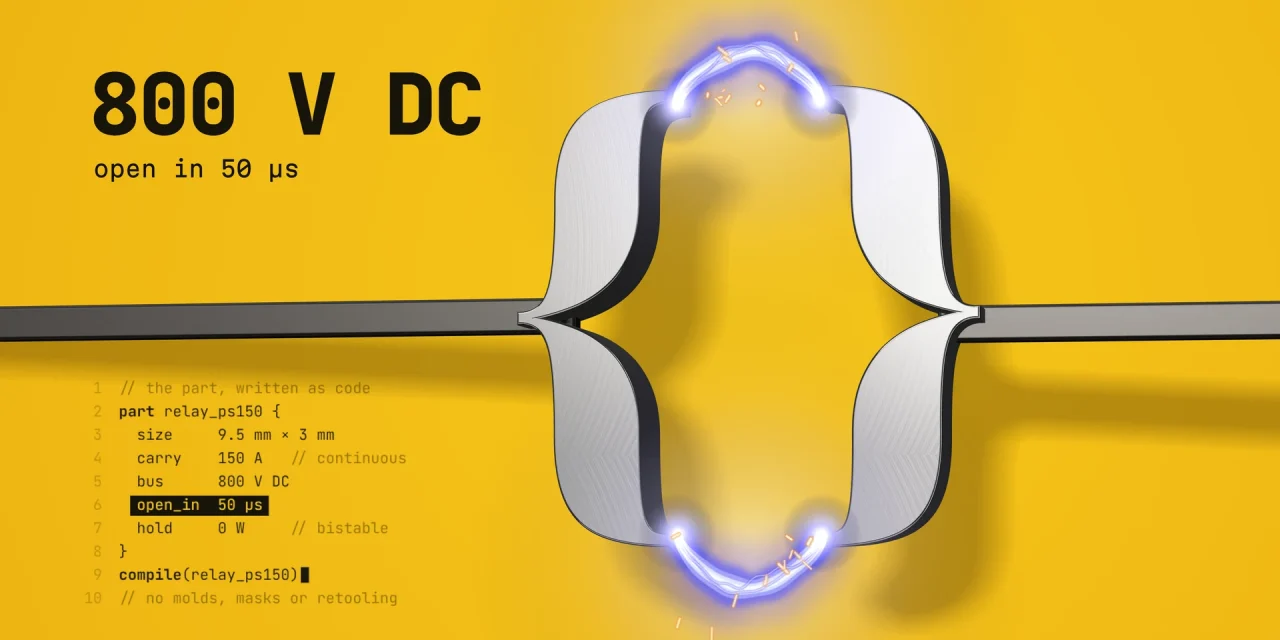
Atomic Machines is betting $250 million that hardware can be compiled like software. The Californian start-up came out of six years in stealth on 7 October 2026 with a manufacturing system it calls the Matter Compiler, which it says builds working micro-machines from code, with no hard tooling, masks or retooling. Its first product is not a robot or a medical device. It is a 9.5 mm relay that opens in 50 microseconds, aimed at the 800-volt power systems of the next AI data centers. Here is what the company claims, why it starts with a switch, how that switch compares with the alternatives and what to watch from a European point of view.
What Atomic Machines announced
Atomic Machines is based in Emeryville in the San Francisco Bay Area and has a second office in Santa Clara. Founder and CEO Jeff Holden was Amazon’s tenth engineer, helped build Amazon Prime, and later became Uber’s first chief product officer. According to the launch press release, the company has raised $250 million to date from investors including OneIM, Gigafund, XTX Ventures, KAS Venture Partners, Valor Equity Partners, Tru Arrow Partners, Construct Capital, Sozo Ventures and the Regents of the University of California. It did not disclose a valuation or how the money was split across rounds.
The leadership team mixes surgical robotics, national labs and the chip equipment industry. CTO Klaus Zietlow designed the system architecture of Verb Surgical’s robot and worked on Intuitive Surgical’s da Vinci. Other leaders come from Lawrence Livermore and Sandia National Laboratories, Applied Materials, Lam Research, Molex and Miso Robotics.
The problem it attacks, one product and one process
Atomic Machines’ core argument, laid out by Holden in The Micro-machine Universe, is that the most successful manufacturing system in history builds essentially one kind of machine. Semiconductor fabs have perfected the transistor, a device that encodes information, using flat, mostly single-material processes. MEMS (micro-electro-mechanical systems) reused those fab processes to make accelerometers, gyroscopes, microphones, inkjet nozzles and micromirrors. But every new MEMS device still needs years of process development of its own. The industry’s shorthand for that is “one product, one process”.
That model still supports a large industry. Yole Group’s Status of the MEMS Industry 2026 puts the MEMS market at $17.1 billion in 2025, with about 33 billion units shipped, and expects about $24 billion by 2031. Europe is strong here. Bosch is the largest MEMS player with $2.2 billion in revenue, STMicroelectronics is among the sensor leaders, and Infineon is expanding through its acquisition of ams OSRAM’s sensor business. Atomic Machines is not trying to make cheaper accelerometers. It wants to make the devices that this process model never reached: micro-pumps, micro-motors, heat pumps, grippers and power devices that need real 3D shapes, several materials and real current or force.
How the Matter Compiler is supposed to work
The company describes the Matter Compiler as an AI-native, all-digital factory that designs, builds, measures and learns in one loop. In the intended workflow you describe what a device must do. The system returns a design package with a validated CAD model, a validated process graph, an optimisation for time and cost and the performance targets the device must meet. After approval, the fab builds it.
Three claims carry the pitch:
- No hard tooling. There are no masks to make and no line to retool, so a new design is a change in software rather than in the factory.
- Measurement inside the loop. Every operation is measured and corrected in real time, and the AI runs its own experiments on the hardware to check what simulations predict.
- Machines, not shapes. Devices get moving parts, multiple materials and features down to single-digit microns. In the launch release, Holden frames it this way: “3D printing made shapes programmable,” and Atomic Machines is “making machines programmable”.
What the company does not disclose is the physical process itself. There is no public description of the deposition, machining or assembly steps. It is also not yet a lights-out factory. Interesting Engineering reports that engineers still move parts between the system’s 13 machines and help assemble the final device. The long-term goal the company describes, “prompt-to-product” manufacturing, is an ambition. Gigafund’s Luke Nosek calls it “the start of vibe manufacturing”, the hardware counterpart of vibe coding, the kind of AI-driven software work we covered in our piece on dark software factories.
Why the first product is a data center switch
The first device out of the Matter Compiler is the PrimeSwitch PS-150, a bistable electromechanical relay. These are the company’s figures from the PrimeSwitch page and the launch release:
| Specification | PrimeSwitch PS-150 |
|---|---|
| Continuous current | 150 A, AC or DC, no active cooling |
| Opening time | 50 µs |
| On-resistance | 200 µΩ |
| Galvanic isolation | 1,500 V |
| Size | 9.5 mm diameter, 3 mm high, hermetically sealed surface-mount package |
| Holding power | 0 W (bistable) |
| Status | sampling to early-access customers for evaluation |
The target market explains the choice. AI racks are heading towards a megawatt each. NVIDIA wants to power 1 MW racks with 800 V DC from 2027, in step with its Kyber rack systems, according to its technical blog. At today’s 54 V such a rack would need up to 200 kg of copper busbar, and NVIDIA expects up to 5% better end-to-end efficiency than current 54 V systems, and about 45% less copper than 415 V AC distribution. The same post notes that protection devices at the boundaries between power room, hall, row and rack still need further innovation.
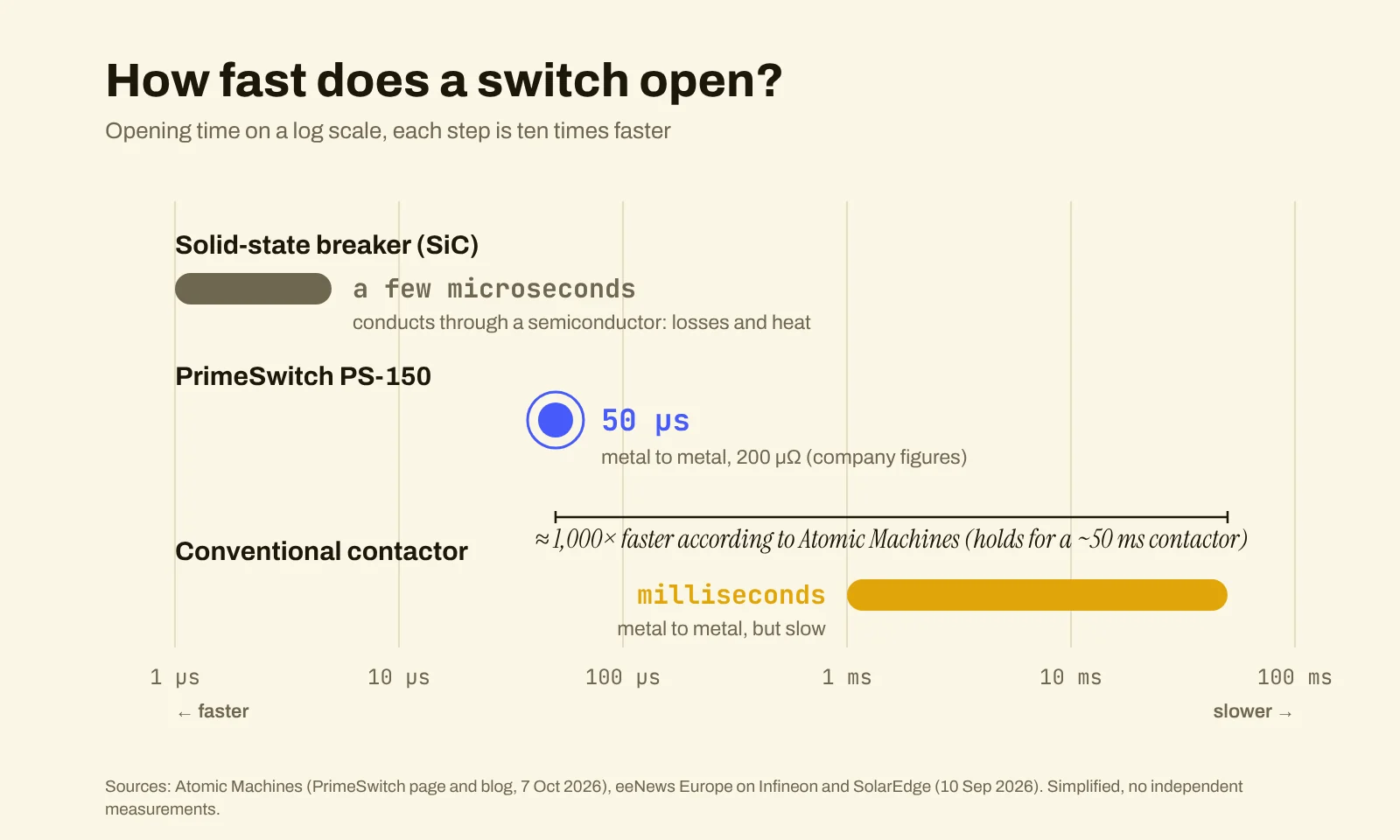
Protection is the hard part. A DC current never passes through zero, so a fault arc does not extinguish itself and the energy builds within microseconds. That leaves designers with a trade-off. Mechanical contactors conduct metal to metal with very low losses, but they open in milliseconds. Solid-state breakers open in microseconds but conduct through a semiconductor, which costs efficiency and produces heat. SolarEdge, for example, is developing a solid-state breaker for 800 V DC using Infineon’s silicon carbide JFETs, designed to interrupt faults within a few microseconds. Atomic Machines positions the PS-150 in a hybrid breaker, where a small solid-state bypass carries the current during the 50 µs in which the metal contact opens.
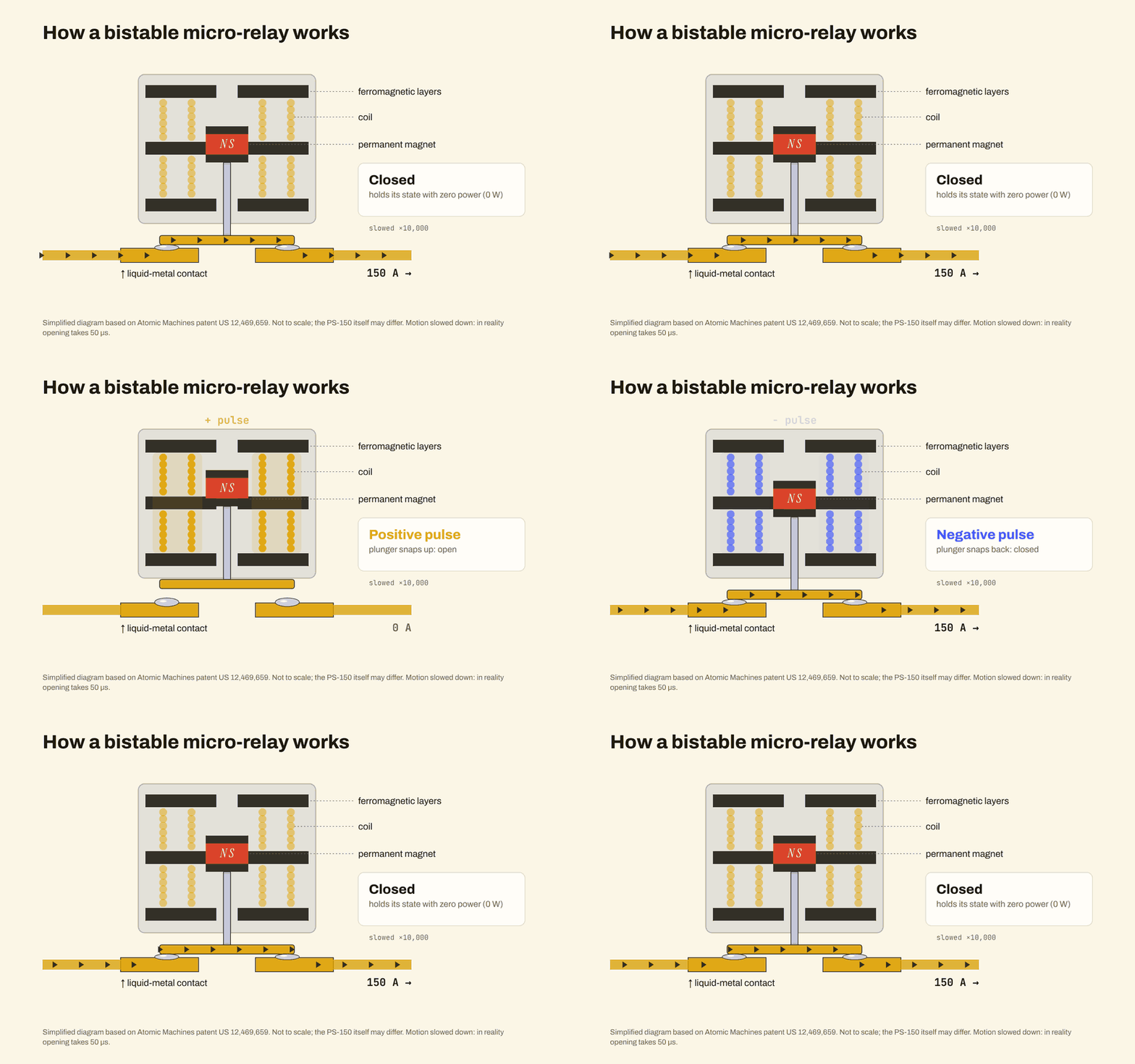
The company’s patents show how such a fast, zero-power relay can work. US patent 12,469,659, granted in November 2025, describes a MEMS power relay with a plunger that carries a permanent magnet between ferromagnetic layers. A short positive current pulse snaps it open, a negative pulse snaps it closed, and the magnet holds either position without power. The contacts use arrays of micromachined flexures or a thin layer of gallium-indium-tin liquid metal on tungsten in a sealed nitrogen atmosphere. The patent describes possible designs; the company has not said which one ships in the PS-150.
A switch is also a smart first product for a manufacturing platform. It is easy to test against a datasheet, it sells into a market with urgent demand and a known buyer base, and it shows what smaller and faster can deliver. For an industry already struggling with how AI data centers strain the power grid, efficient and fast protection is not a niche concern.
What it means for European industry
Three implications stand out for European companies and policymakers, with the caveat that everything rests on a single product for now.
- MEMS incumbents face a different kind of rival. Bosch, STMicroelectronics and Infineon compete on process mastery and volume. A platform that turns a new device into a software change would compete on time to a new product instead. If it works, the advantage moves from owning a process to owning the design and measurement loop.
- The 800 V DC supply chain is partly European. NVIDIA’s list of 800 V partners includes Infineon, STMicroelectronics and Schneider Electric, and ABB has published its own work on 800 V DC. European protection and power players will meet both solid-state and new electromechanical approaches in the same racks.
- AI is moving into the factory itself. Europe’s AI debate focuses on models, chips and sovereign AI. Atomic Machines is a reminder that the next layer is AI that runs experiments on physical equipment, an idea also behind Periodic Labs in materials science.
What to watch next
- Independent data on the PS-150. All specifications come from the company. Third-party tests of opening time, contact resistance and lifetime under fault conditions would be the first real check.
- The 1,000× claim in context. The company says the PS-150 opens about 1,000 times faster than a conventional contactor. The company does not say which device it compares against. 50 µs is 1,000 times faster than a 50 ms contactor, but only 20 times faster than a relay that opens in 1 ms.
- Price, volume and named customers. None are public yet. Early access means evaluation, not orders.
- A second device class. The platform claim stands or falls on whether a pump, motor or sensor follows without years of new process work.
- How much human work remains. The gap between 13 machines with engineers moving parts and “prompt-to-product” is where most of the remaining risk sits.
A compiler is judged by its second program
Atomic Machines has picked an expensive problem with a clear buyer and a product that can be measured against a datasheet. That makes the PS-150 a fair test of the switch, but not yet of the compiler. The platform thesis only becomes credible when a second, very different device comes out of the same machines in months rather than years. For European manufacturers the useful question is not whether this specific relay wins, but what happens to their own product roadmaps if new micro-devices start to cost a design file instead of a new process.
Frequently asked questions about Atomic Machines
What is the Matter Compiler?
An AI-native, all-digital manufacturing system that, according to Atomic Machines, builds working micro-machines with moving parts and multiple materials from a digital design, without product-specific hard tooling, masks or retooling.
What is the PrimeSwitch PS-150 used for?
It is a 150 A bistable relay that opens in 50 µs according to the company, designed for power distribution and protection, in particular 800 V DC systems in AI data centers, as part of a hybrid breaker.
How much funding has Atomic Machines raised?
$250 million to date, from investors including Gigafund, XTX Ventures, Valor Equity Partners and Construct Capital. The valuation has not been disclosed.
Is the Matter Compiler fully automated?
No. Engineers still move parts between the system’s 13 machines and help with final assembly. Fully automated prompt-to-product manufacturing is the company’s long-term aim.