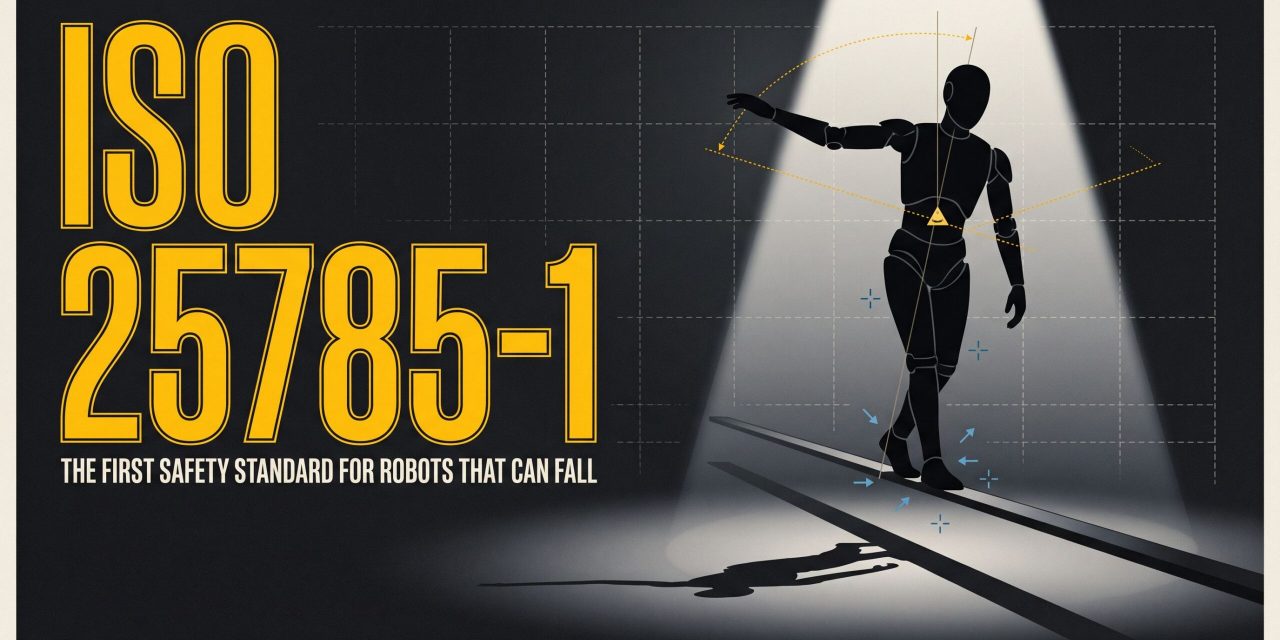
ISO 25785-1 is the first international safety standard written specifically for industrial mobile robots with actively controlled stability. That technical phrase covers the humanoid robots now entering warehouses, factories and logistics facilities, along with quadrupeds and balancing wheeled platforms. The working draft appeared in May 2025 and it closes a gap that existing robot safety standards never addressed. Machines that walk, balance continuously and can fall over need their own rules.
What is ISO 25785-1
The full designation of ISO 25785-1 describes safety requirements for industrial mobile robots with actively controlled stability, covering legged, wheeled or other forms of locomotion. Part 1 of the standard deals with the robots themselves. The working group behind it is led by a United States delegation that includes the Association for Advancing Automation, Agility Robotics and Boston Dynamics. That industry involvement keeps the standard close to the realities of actual deployments.
Actively controlled stability is the core concept. It means the robot needs continuous power and active control input to remain upright. Sensors detect tilt and actuators correct it hundreds of times per second. Remove power and the machine becomes unstable and falls. A conventional wheeled autonomous mobile robot stays exactly where it is when you switch it off. A humanoid does not. That single difference is why a separate standard exists.
The working group deliberately kept the word humanoid out of the title. The technical framing achieves three things at once. It covers every dynamically balanced robot rather than only bipedal humanoids, it includes quadrupedal machines such as Boston Dynamics Spot and wheeled balancing platforms, and it avoids endless debate about what qualifies as humanoid.
Scope and exclusions of the standard
ISO 25785-1 applies to robots with any number of legs, wheels or other mobility types that travel on ground surfaces with varying elevations in industrial environments and that could become unstable without power. The exclusions are just as informative as the scope. The standard does not address:
- severe environmental conditions such as extreme temperatures or freezer applications
- strong magnetic fields
- climbing vertical surfaces
- underground operations
- specific hygienic requirements
- corrosive or explosive atmospheres
- ionizing radiation and other hazardous radiation
- loads that inherently create dangerous situations
The gap ISO 25785-1 fills
The new work item proposal behind the standard states the problem plainly. No ISO safety standard, published or in development, existed for industrial mobile robots with actively controlled stability. ISO 3691-4 covers driverless industrial trucks and explicitly excludes these machines. ISO 10218 parts 1 and 2 cover industrial robots and their integration, and the 2025 revision shifted attention from hardware to the safety of the complete collaborative application. Even so, ISO 10218 assumes a robot that will not tip over. ISO 13482 covers personal care robots outside industrial settings. Stability itself, as a hazard, fell between all of them.
A parallel effort reinforces the point. The IEEE Robotics and Automation Society formed a Humanoid Study Group led by Aaron Prather of ASTM International, bringing together more than sixty experts from industry, academia and regulators. Their workstreams cover classification of humanoids by capability and application, quantifiable stability metrics with test methods, and guidance for safe human robot interaction. Both groups reached the same conclusion. Standards written for bolted down arms and statically stable wheeled robots do not fit machines that walk.
Core safety requirements in ISO 25785-1
Fall risk and stability
The central concern is tipping. A falling humanoid weighing 70 kilograms or more can seriously injure a worker, a hazard that simply does not exist with stationary arms or wheeled platforms. The draft therefore calls for defined safe operating parameters for stability, fall detection, controlled descent capability, test protocols under rated load, attention to how payloads affect balance and recovery procedures after instability events.
Fall zone planning becomes concrete here. A robot 1.7 meters tall walking at 1.5 meters per second can land anywhere within roughly two meters, depending on speed, load and floor angle. Facilities should calculate that zone from manufacturer specifications, mark it on the floor and keep workers out of it during operation. Floor conditions matter too. Oil residue, expansion joints and unexpected friction coefficients have already caused falls in real deployments.
Power loss behavior
The standard addresses what happens when a robot loses power. Requirements point toward controlled descent rather than collapse, audible and visual warnings before power loss where possible, clear space around the robot and defined stability behavior when an emergency stop is triggered. Many manufacturers already use a zero energy pose in which the robot drops to a kneeling position, sharply reducing fall height and impact force.
Contact forces and safety zones
For contact with people, the draft builds on the biomechanical force and pressure limits from ISO/TS 15066, now integrated into ISO 10218-2:2025. Expect maximum permissible impact forces, requirements for compliant joints and soft materials, and speed reduction near people. The zoning model distinguishes collaborative zones where humans and robots work together, restricted zones with extra safeguards, exclusion zones that people must never enter during operation, and dynamic zoning where parameters shift with robot activity.
Timeline and current status
As of early 2026, ISO 25785-1 remains a working draft. The working group held its most recent session in Barcelona in October 2025. Industry experts estimate 18 to 36 months from the May 2025 draft to a ratified standard, which points to a Draft International Standard during 2026 and final publication in late 2026 or 2027. Conformity assessment and certification pathways follow after that. The practical consequence is significant. Volume deployment of humanoids working collaboratively alongside people is unlikely before 2027. Note also that the final standard will assume level ground, so slopes above five degrees may require stability analysis specific to your site.
What ISO 25785-1 means for manufacturers and employers
For manufacturers, the draft creates visible design obligations around fall mitigation, force limitation and emergency stop integration, plus documentation covering risk assessment, operator training and maintenance protocols. Deploying before ratification means operating in a gray zone. If an injury occurs, the draft already serves as evidence of what the industry recognized as reasonable care.
For employers, the obligations exist today. OSHA’s General Duty Clause, Section 5(a)(1), requires a workplace “free from recognized hazards”, and a falling robot qualifies as a recognized hazard whether or not the standard is final. Inspectors reference ANSI/A3 R15.06-2025, the United States adoption of ISO 10218. One practical wrinkle deserves attention. Classic lockout and tagout means cutting power, yet a biped without power falls over, which makes maintenance more dangerous. OSHA accepts Control of Hazardous Energy procedures as an alternative, where the robot stays powered in a locked safe mode with frozen joints and active balance, provided you document this in your energy control program.
Preparing before the ink dries
Waiting for ratification is the most common mistake. The hazards exist now, so apply the draft’s principles alongside ISO 10218:2025. Calculate and mark fall zones, write energy control procedures, train operators on robot behavior and log every incident and near miss. One more pressure point is emerging from outside the standards world. Insurers already audit deployments against consensus standards, and the first insurance product designed exclusively for humanoid robots launched in China in 2025, combining property and third party liability cover. Documented alignment with ISO 25785-1 principles will translate into smoother certification, better premiums and a stronger legal position the moment the standard becomes binding.