Void is a new, free toolkit from Cloudflare that takes care of the hardest part of a web app: getting it online and keeping it running. You build your app, and Void works out which database and storage it needs, creates them and puts everything on Cloudflare’s global network. Since version 1.0, the same app can also run on your own server. That choice between Cloudflare’s cloud and your own hardware is at the heart of this article: what Void is, the idea behind it, and what you gain and give up on each side.
What is Void?
Cloudflare launched Void on October 15, 2026 in the blog post Deploy with Void. It comes from VoidZero, the team behind Vite, one of the most widely used build tools for websites. That team joined Cloudflare in June. Void is open source and free to use (code on GitHub) and has three parts:
- a toolkit for building the app, with the front end and back end in one project;
- a command-line tool that puts the app online and manages it;
- a platform a company installs in its own Cloudflare account, so colleagues can put their apps on it.
If you already work with a well-known framework such as Astro, Nuxt or SvelteKit, Void can also take care of just the deployment.
The idea behind Void: your code describes your infrastructure
With traditional hosting, building and hosting are two separate worlds. First you write the app. Then you set up a server, install a database, create storage and wire it all together. On top of that, every change to the database is something you have to roll out yourself.
Void flips that around. If your code uses a database, Void infers that a database needs to exist. The same goes for file storage, a queue or AI. When you put the app online, Void creates whatever is missing, applies the changes to the database and puts the new version live. All of that happens with one command, void deploy (Void’s deployment guide).
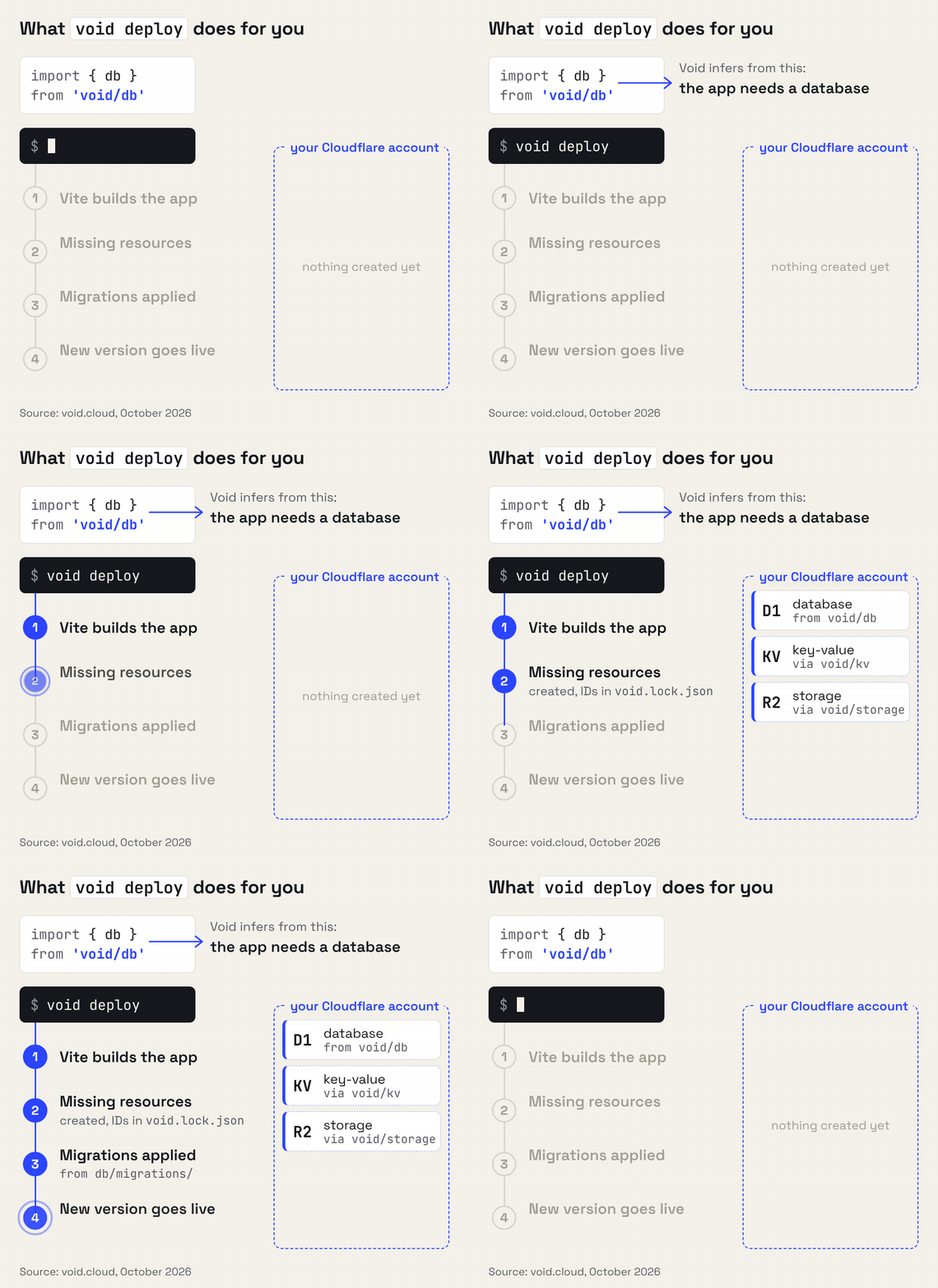
The benefit is that your infrastructure never falls out of step with your app: whatever the app needs, exists. One thing to keep in mind: going back to a previous version only rolls back the code, not the changes to the database. A new version therefore has to work with the old database too.
What it means for your app to run on Cloudflare’s network
By default, Void puts your app on Cloudflare Workers. That isn’t a server you rent. Your code runs in Cloudflare’s data centers around the world, close to the people using your app. There’s no machine to update, and everything scales automatically when traffic picks up. The database and storage are services Cloudflare manages for you.
| Who takes care of what? | Your own server | Void on Cloudflare |
|---|---|---|
| Updating and securing the server | You | Cloudflare |
| Setting up and maintaining a database | You | Void and Cloudflare |
| Handling traffic spikes | You, with a bigger server | Automatic |
| Cost to get started | Fixed monthly fee | Free up to 100,000 requests a day |
| Where your data lives | Wherever you choose | With Cloudflare |
The free plan is enough for an internal tool, a prototype or a small web app (Workers limits, October 2026). Bigger apps need a paid plan, and every service you use has its own pricing.
It’s a weaker fit if your app does heavy computation per request, or if your data has to stay on your own hardware for legal or contractual reasons. Flavio Copes, who tested Void extensively, would use it for a new internal app with a few features and a database. He wouldn’t move his own blog without a concrete reason (his complete guide).
The Void Platform, one place for all your internal apps
More and more people build small apps themselves with AI coding assistants and tools like Google AI Studio, including people without a developer background. The New Stack calls these homegrown tools the new shadow IT: useful, but invisible to IT. The Void Platform is Cloudflare’s answer. An admin installs it once, and from then on colleagues can put apps on it without getting access to the company’s cloud account.
The admin decides who can publish apps and who can open which app. They set usage limits and see logs and usage in one place. Colleagues sign in through GitHub, Google, Cloudflare Access or another login provider the company uses.
Two things to know. The platform is called self-hosted, but it runs in your own Cloudflare account, not on your own hardware (platform documentation). It requires a paid Cloudflare product, Workers for Platforms, starting at $25 a month plus usage, as well as your own PostgreSQL database. And access control isn’t a security review: an app can still read sensitive data and send it elsewhere. If you want a check before every release, you have to add it yourself.
The same app on your own server
New in Void 1.0 is that your app doesn’t have to run on Cloudflare. With one setting in the configuration, target: 'node', Void turns it into a regular web server you can run anywhere: in your own server room, with a hosting partner or on a rented server (guide for your own servers). That also works with the alternative runtimes Bun and Deno.
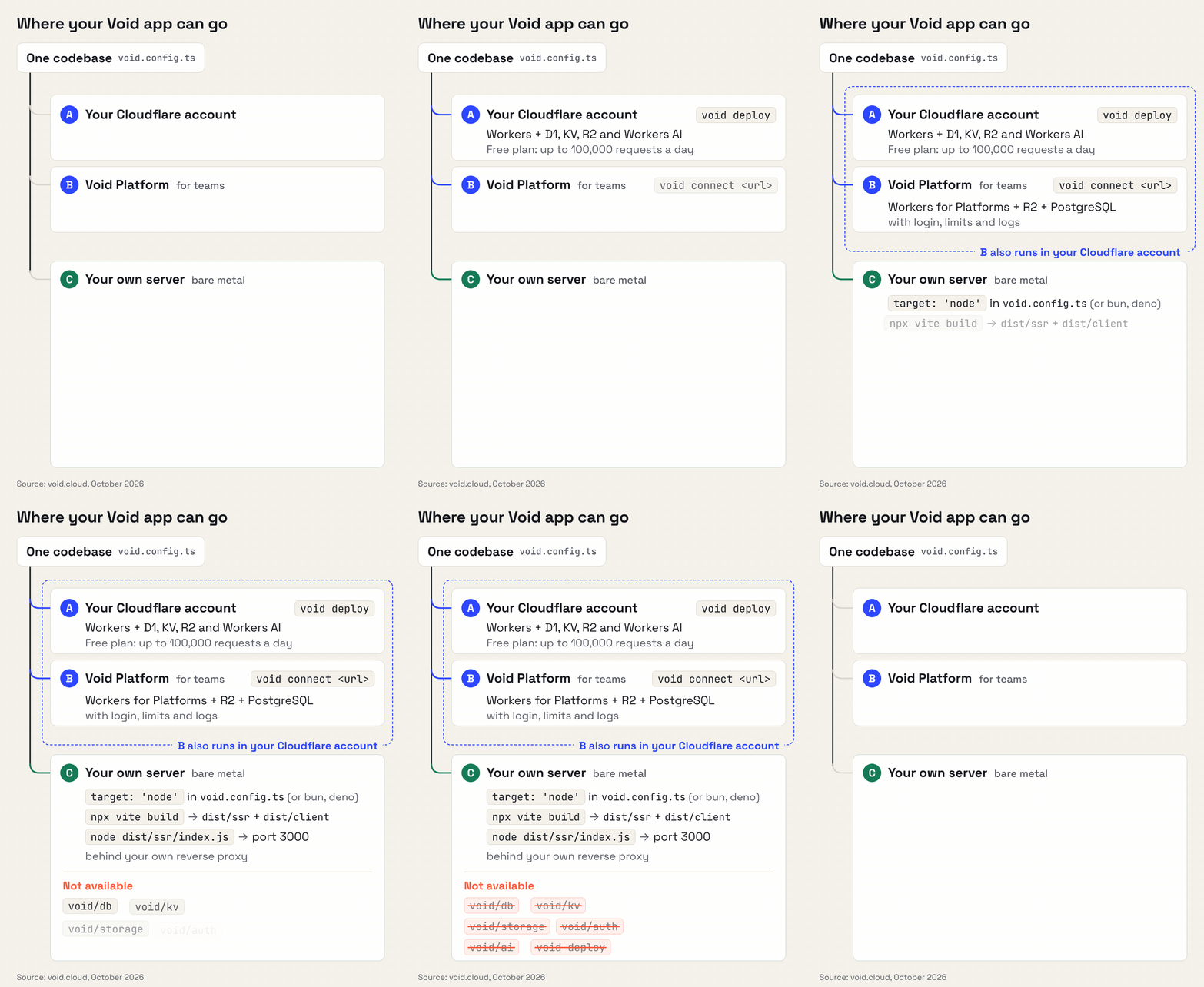
This gives you full control over where your app and your data live. The price is that everything Void handles automatically on Cloudflare lands back on your plate:
- Void’s database, storage and login don’t work outside Cloudflare, so you pick your own solution there, such as your own PostgreSQL database;
- Cloudflare’s AI features, email and real-time connections are no longer available;
- you have to schedule recurring jobs yourself;
- putting the app online and rolling back to a previous version happen through your own workflow, no longer with a single command.
The pages and logic of your app keep working as before. There’s also a middle ground: your app runs on your own server, with Cloudflare in front of it through a Cloudflare Tunnel. Your code and data stay with you, and you still get the speed and protection of Cloudflare’s network.
An app that already leans heavily on Cloudflare’s services won’t move with a single setting. Copes notes that moving his app to a regular server would require a different database. That’s why this choice is best made at the start of a project.
Which route fits you?
- One app or prototype online fast: straight to your own Cloudflare account, free to start.
- Many internal apps from different colleagues: the Void Platform, with login, limits and oversight in one place. Expect at least $25 a month plus usage.
- Data has to stay on your own hardware: your own server, optionally with Cloudflare in front.
- Just a website without a back end: Void generates every page in advance as plain HTML, which you can put on any web host (supported app types).
How future-proof is Void?
Void 1.0 has only been public since October 15, 2026, although according to Cloudflare more than 100 beta users had already built apps with it. This year Cloudflare also brought on the Astro team, then VoidZero, and on October 9 Deno. For Deno, that means among other things that the hosting service Deno Deploy shuts down within six months (The New Stack). If you go with your own server, Node.js is the safest choice.
Cloudflare promised that Vite will stay open source and vendor-neutral. For Void itself, Christoph Nakazawa, director of engineering at Cloudflare, said the automatic creation of infrastructure was designed around Cloudflare from the start. The team wants to explore support for other providers with the community, but made no firm commitment.
Frequently asked questions
Is Void free?
The software is free and open source. You pay for the hosting: going straight to Cloudflare is free to start, the Void Platform costs from $25 a month plus usage and a database, and your own server costs whatever that server costs.
Is Void a hosting plan?
No. Void is software that builds your app and puts it online. The hosting itself comes from Cloudflare or from your own server.
Do I need a Cloudflare account?
For the default route and the platform, yes. If you choose your own server, you don’t need Cloudflare.
Does Void work with my existing website?
If your site is built with Vite or a framework such as Astro, Nuxt, SvelteKit, TanStack Start, React Router or Analog, Void can take over the deployment. Plain static sites work too.
The real choice lives in your code
Whether your app can still leave Cloudflare later isn’t decided when you deploy, but every time you use a Cloudflare service in your code. Void’s database, storage and AI tie you to Cloudflare; your pages and app logic don’t. If you’re unsure, keep the use of those services in one clearly defined place in your code. Then Void stays the fastest route to a working app, and moving to your own server later becomes a manageable job instead of a rebuild.